
BuddhistCatholicContemplativeEvangelicalGeneral ChristianHinduJewishLatter-day SaintMuslimNew VisionsProgressive Christian
Beliefs
- Buddhist
- Catholic
- Contemplative
- Evangelical
- General Christian
- Hindu
- Jewish
- Latter-day Saint
- More Voices
- Muslim
- New Visions
- Pagan
- Progressive Christian
Topics
- Religion News
- Food and Religion
- Sports and Religion
- Religious Art
- Religious Music and Entertainment
- Religious Events
- History and Religion
- Style and Religion
- Politics and Religion
- Women in Religion
- Recreation Outdoors and Religion
- Business Finance and Religion
- Careers Workplace and Religion
- Education and Religion
- Family Parenting and Religion
- Health Fitness and Religion
- Home and Religion
- Relationships and Religion
- Technology and Religion
- Travel and Religion
Columnists
- Buddhist Columnists
- Business Finance and Religion Columnists
- Careers Workplace and Religion Columnists
- Catholic Columnists
- Contemplative Columnists
- Education and Religion Columnists
- Evangelists Columnists
- Family Parenting and Religion Columnists
- General Christian Columnists
- Health Fitness and Religion Columnists
- Hindu Columnists
- History and Religion Columnists
- Home and Religion Columnists
- Jewish Columnists
- More Voices Columnists
- Latter Day Columnists
- Muslim Columnists
- New Visions Columnists
- Nonreligious Columnists
- Pagan Columnists
- Politics and Religion Columnists
- Progressive Columnists
- Recreation Outdoors and Religion Columnists
- Relationships and Religion Columnists
- Religion News Columnists
- Religious Art Columnists
- Religious Events Columnists
- Religious Music and Entertainment Columnists
- Sports and Religion Columnists
- Style and Religion Columnists
- Technology and Religion Columnists
- Travel and Religion Columnists
- Women in Religion Columnists
Resource Library
- 2026 Calendar
- Library of World Religions
- The 100 Most Holy Places on Earth
- Patheos Answers
- Podcasts
- Videos
- Faith Leaders Database
- Anglican Episcopalian
- Bahai
- Baptist
- Buddhism
- Christianity
- Confucianism
- Eastern Orthodoxy
- Hinduism
- Holiness and Pentecostal
- ISKCON
- Islam
- Judaism
- Lutheran
- Methodist
- The Church of Jesus Christ of Latter-day Saints
- New Age
- Paganism
- Presbytarian and Reformed
- Protestantism
- Religion Behind the Scenes
- Roman Catholic
- Scientology
- Shia Islam
- Sikhism
- Sufism
- Sunni Islam
- Taoism
- Zen
- See all religions
Research Tools
 Ad-Free & Subscriber Log-In Subscription Support
Ad-Free & Subscriber Log-In Subscription Support
Follow Patheos 

- Trending:
- Forgiveness
- |
- Marriage
- |
- Consciousness
- |
- Death Penalty
- |
- Election
- |
- Halloween

- Home
- Buddhist
- History and Religion
- There’s a (W)Hole in the Soul
There’s a (W)Hole in the Soul
Last updated on: August 13, 2024 at 9:24 am by James Ford
There’s a (W)Hole in the Soul 2024-08-13T09:24:54-07:00 James Ford
Patheos Explore the world's faith through different perspectives on religion and spirituality! Patheos has the views of the prevalent religions and spiritualities of the world.
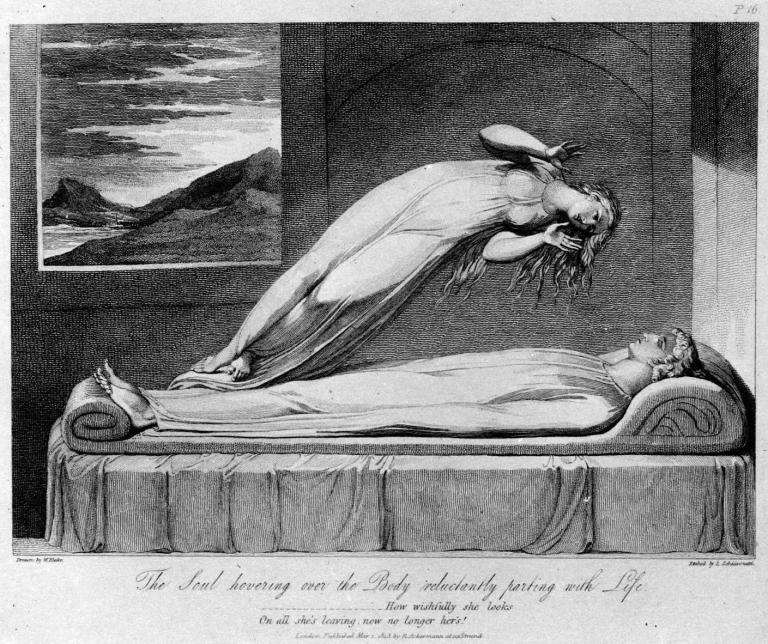
William Blake
Soul leaving the body
(My friend and colleague, the Reverend Silvio Nardoni recently shared an article he’d written with me. I was quite taken with it, and not just because he quotes me. It’s good. And I asked if I could reprint it at my Monkey Mind blog. He graciously agreed…)
Soul: It’s one of those little four-letter words that covers a lot of territory. Giants in the field of religion and psychology (Thomas Aquinas, Carl Jung, James Hillman, and others) have written with nuance and depth about the meaning(s) of soul. In popular discourse, it has branched out to music, food, and other endeavors in which a dimension of “depth” or “authenticity” brings a richness to the undertaking.
The Soul is Wholeness
I recently traded messages with a couple of colleagues in the Unitarian Universalist ministry in which we commonly affirmed our favorite name for a church: “All Souls” (followed or preceded by a place name). I find this term inclusive in the right way, even though I’m not sure what the word “soul” means. I consider that ambiguity as a virtue rather than a problem. “Spirit” has some of the same breadth of meaning and commonality of usage, and it, too, defies any single definition.
Some religions (Buddhism comes to mind) deny the existence of a soul, which they define as some eternal essence that transcends the existence of the physical body. Others (like the Roman Catholic tradition in which I was raised) make the soul almost a tangible object, endowed by God at the moment of conception, and which remains available for reward or punishment after death. Even though Buddhists may deny the soul as an article of belief, there’s no doubt there’s a “soulful” dimension to much of Buddhist writings and practice.
I recently watched a documentary about the Olympic gold medalist sprinter Noah Lyles in which Diana McNab, his “sports therapist,” spoke of how he needs to put his soul into his running. On the same day I read the story of a female French soccer player who called her love of the game “part of [her] soul.” This two-way dynamic exemplifies the flexibility of the soul: it’s something you pour into your activity, and at the same time something you pour activity into.
For this reason, I consider “soul” as summoning the image of our completeness. It embraces the many facets of our existence: our passions, our failings, our strengths, our work, our family and friendships, our solitude and our connectedness, and yes, even our politics (more about that below). Using soul this way recalls the way the ancient Greeks used the word “psyche” (soul) as containing both the raw urges of the Dionysian sect as well as the refined contemplation of the Apollonian tradition.
Bringing our complete selves to whatever confronts us offers a path through difficulty, a pace that allows awe and wonder a place in everyday life, and a healthy sense of humor. That’s soulful living. It’s not a prescription for happiness, but a perspective that sustains and guides even in times of uncertainty.
There’s a Hole in the Soul
Thus far I’ve discussed soul only in an individual context. But it has a place in wider contexts as well. Again, the lack of definition means that it yields an impression, not a data point.
Right now, I think our society is suffering “soul sickness.” We are at a turning point in our history and each day brings fresh news of the tectonic forces that are at work in our public life. As I began writing this, news of the attempted assassination of Donald Trump shocked anew our overtaxed psyches (the Greek word for “soul”).
Wiser minds than mine have attempted to explain the origin and nature of the illness. Sociologist Robert Putnam opines that the isolation born of declining membership in social groups of all types: faith groups, volunteer organizations, civic improvement alliances, even bowling leagues, has diminished the supply of connective tissue that sustains the fabric of social cohesion. The Surgeon General has declared an epidemic of loneliness, and the emptiness of lives played out on screens held in our hands has become a commonplace truth.
While these insights are valuable, my diagnosis of “soul sickness” (a term no respectable academic or public official would likely ever use) relies on a broader set of symptoms. I recently finished reading Homo Sapiens by Yuval Noah Harari. He provides a useful definition of “myth” as an “imagined world order.” In his reading of history, the developments born of the Cognitive Revolution (emergence of language), the Agricultural Revolution, and the Scientific Revolution have brought forth a world in which we adopt these imagined world orders in ever greater areas of our existence, both as individuals and as the larger societies we have gathered together.
While the task of the historian is to describe and perhaps diagnose the conditions of the historical era, my goal lies beyond that. I look for how we might transform these myths to make the world (and our place in it) more comprehensible and more welcoming to the future. From that standpoint, I see that our current crop of imagined world orders no longer has the power to reach across the ways in which we separate ourselves from others. Whether the chasm be race, class, religion, economic strata, political affiliation or …(fill in your own category that you see used to name the “other”), they no longer have sufficient power to explain the world and sustain a reasonable hope that human lives have meaning and purpose.
Without a renewed consortium of myths that are more adequate to our current predicament, we are in a state where, as Yeats put it, “the center will not hold.”
A Return to Wholeness?
I acknowledge that the process of new myths emerging is a long and unpredictable one. I don’t expect to see any perceptible movement on this during my lifetime. The sociologist
Putnam reports that he has spent more than twenty-five years in collaboration with other thinkers trying to find a solution. He pronounces his efforts a failure. Even so, I think there are things we can do now to prepare the soil, even if we don’t get to plant the seeds, see them sprout, much less reap the harvest.
What will preparation of the soil involve? As with any attempt to address illness, the first step is, “Physician, heal thyself.” The method employed by 12-step groups involves what they call a “fearless moral inventory.” This is the “inward” aspect of soul work. But the two-way dynamic applies here as well: not only do you pour your energy into your soul; the next step is turn that energy outward, to make that work part of your soul. That is why the 12-step model requires disclosing the content of that “inventory” to “God” (the higher power however one conceives it) as well as another person. By doing so, we put an end to the isolation born of fear that others will find our “soul” unattractive or even repellent.
How to do that? I offer this interpretation of Psalm #1, written by my friend James Ishmael Ford, Zen priest and author (at latest count) of seven books:
Blessed are they who have ceased to grasp,
And let go of hatred,
And are no longer swayed by siren songs of certainty. Who now find delight in the flowing currents of their lives, From dawn and through the night. They are like trees planted near deep springs, They bear fruit in season.
Their lives evergreen,
Their words and actions healing the world.
Beginning from that place, the words of Gordon Sumner (aka Sting) urge us to set out in this direction:
Let your pain be my sorrow
Let your tears be my tears, too
Let your courage be my model
That the north you find will be true
When there’s no information
And the compass turns to nowhere, to nowhere that you know well
Let your soul be your pilot Let your soul guide you
Let your soul guide you
Let your soul guide you upon yourway
Admittedly, that’s not much of a prescription for an illness of the scope I have described. But where else to start? The answer certainly cannot come from the force of arms, whether in the hands of a lone gunman or a cadre of organized militants. Even counting the votes in a fair and free election does not suffice, though that must be one element of an effective remedy.
As I wrote above, in my lifetime I don’t expect to see discernible progress on this re-casting of our imagined world order. But that makes the project no less urgent.
New Visions
History and Religion
Previous Post
August 10, 2024
The Eternal Now: Zen and the mysterious arts of meeting time
Next Post
August 14, 2024 A Zen Reflection on the Assumptions of Mary
Recent Comments
"Allowing anger to contaminate one's hard disk can be detrimental to one's holistic well being. ..."
Hot Anger: Meeting Anger in Zen ..."
"I love this koan. every which way you turn it bites you, Thirty years on ..."
Nanquan Cuts the Cat: A Jesuit ..."
"As a substitute for religion, Zen is probably better than taking drugs. However, it can ..."
The Selling of Zen at the ..."
"Craving and aversion are detrimental to one's peace and happiness. Easter is a wake up ..."
Easter: A Zen Buddhist Appreciation
Browse Our Archives
Select a Category A Christmas Carol Abolitionist African-American Ahmadiyya Alan Watts Aldous Huxley Allen Ginsberg Amedkar Jayanti American politics American Zen Anaheim Zen Sangha Anglican Annie Besant April Fool Armageddon Art and Religion artificial intellegence Atheist Awakening B R Ambedkar Barlaam & Josaphat Beatnik Between Bhagavad Gita Bible biography birthday bodhisattva Bodhisattva Precepts Book burning Book of Common Prayer Book of Mormon Brahmo Samaj Buddha Buddhism Buddhist Buddhist Lord's Prayer Butterflies Calendars cartoons cat ChatGPT Chicken Tortilla Soup choices Christian atheism Christian mysticism Christian origins Christian Science Christian Zen Christianity Christianity and Buddhism christmas Christmas Truce Christopher Isherwood Church of Later Day Saints Cinco de Mayo circus covenant critical thinking culture D. T. Suzuki Dalit Buddhism Daniel Defoe Desert Fathers and Mothers dharma talk Dogen Donald Trump Dongshan's Five Ranks Dorothy Day dream Duty Easter ecology Edwin Arnold emptiness Empty Moon Zen Network Episcopal Church Eternal Now Ethics evolution existentialism Faith fantasy Fathers Day film film review fire Five Ranks Folk music food Form and emptiness Four Seals Francis of Assisi Francis Xavier Free thinker friendship George MacDonald Gerald Heard Glenn Taylor Webb God Good Friday Gospel of Gospel of Mark Gospel of Thomas grace Graduate Theological Unioin Graduate Theological Union Guanyin H R Blyth Hakuin Ekaku Hanamatsuri Hanukkah Harada Yasutani Zen Heart Sutra Henry David Thoreau Hermann Hesse Hinduism History and Religion history of religion Holy Spirit home Hospitality Icon Ides of March Isaac Newton Islam Islamic mysticism Jack Kerouac James Luther Adams Jiddu Krishnamurti Joan of Arc Johannes Gutenberg John Donne joke Judaism justice karma kensho King James Bible koan Koun Yamada Kyoto School Lewis Carrol Liberal Christianity Liberal Religion Life Plan Community Liminal literature Literature and Religion Liturgy Lord's Prayer Love Mahatma Gandhi Mahayana Martin Luther King Jr Mary Baker Eddy Mary Magdelene Mary Oliver Mayflower Compact Meditation memories memory metaphor money money and religioin Mormons Mother's Day movie review mysticism mythic Neighborhood Unitarian Universalist Church New Thought Nichiren Buddhism Nonduality not knowing Omar Khayyam Pacific School of Religion pagan Palm Sunday Passover peace Pentecost perennialism Phantastes Philip Kapleau philosophy Pilgrimage poetry Poetry and Religion politics Prayer Precepts Printing Press prophecy prophetic spirituality psychology Pure Land Queer religion queering religion Quietism Ram Mohan Roy rebirth recipe Relationships and religion religion religion and history Religious syncretism Resistance Retirement Retreat review Rissho Kosei Kai Ritual Robert Aitken Roshi Robert Ingersoll Rohatsu Romani religion Rosie the Riveter saints samadhi SanboZen Sangha Satyagraha science science and reigion science and religion science fiction seminary sermon Sesshin Sex and Religion Shinran Sikh Sikh tradition silence Social Justice Socially Engaged Buddhism Society and religion Soto Zen soul spiritual community spiritual practice Spirituality Sufism Suicide superstition Taoism Television Teresa of Avila Thanksgiving theological schools Theosophy Thomas Merton Time Transcendentalism Transcendentalist Trinitarian Trinity Uncategorized unitarian Unitarian Christianity Unitarian Universalist Universalism Vajrayana Vedanta Walking war Willa Cather William Ellery Channing wisdom women and religion women in religion World Teacher Writing zazen Zen Zen Center Zen inspired retriement zen meditation Zen Precepts Zen women
Select a Month September 2026 August 2026 July 2026 June 2026 May 2026 April 2026 March 2026 February 2026 January 2026 December 2025 November 2025 October 2025 September 2025 August 2025 July 2025 June 2025 May 2025 April 2025 March 2025 February 2025 January 2025 December 2024 November 2024 October 2024 September 2024 August 2024 July 2024 June 2024 May 2024 April 2024 March 2024 February 2024 January 2024 December 2023 November 2023 October 2023 September 2023 August 2023 July 2023 June 2023 May 2023 April 2023 March 2023 February 2023 January 2023 December 2022 November 2022 October 2022 September 2022 August 2022 July 2022 June 2022 May 2022 April 2022 March 2022 February 2022 January 2022 December 2021 November 2021 October 2021 September 2021 August 2021 July 2021 June 2021 May 2021 April 2021 March 2021 February 2021 January 2021 December 2020 November 2020 October 2020 September 2020 August 2020 July 2020 June 2020 May 2020 April 2020 March 2020 February 2020 January 2020 December 2019 November 2019 October 2019 September 2019 August 2019 July 2019 June 2019 May 2019 April 2019 March 2019 February 2019 January 2019 December 2018 November 2018 October 2018 September 2018 August 2018 July 2018 June 2018 May 2018 April 2018 March 2018 February 2018 January 2018 December 2017 November 2017 October 2017 September 2017 August 2017 July 2017 June 2017 May 2017 April 2017 March 2017 February 2017 January 2017 December 2016 November 2016 October 2016 September 2016 August 2016 July 2016 June 2016 May 2016 April 2016 March 2016 February 2016 January 2016 December 2015 November 2015 October 2015 September 2015 August 2015 July 2015 June 2015 May 2015 April 2015 March 2015 February 2015 January 2015 December 2014 November 2014 October 2014 September 2014 August 2014 July 2014 June 2014 May 2014 April 2014 March 2014 February 2014 January 2014 December 2013 November 2013 October 2013 September 2013 August 2013 July 2013 June 2013 May 2013 April 2013 March 2013 February 2013 January 2013 December 2012 November 2012 October 2012 September 2012 August 2012 July 2012 June 2012 May 2012 April 2012 March 2012 February 2012 January 2012 December 2011 November 2011 October 2011 September 2011 August 2011 July 2011 June 2011 May 2011 April 2011 March 2011 February 2011 January 2011 December 2010 November 2010 October 2010 September 2010 August 2010 July 2010 June 2010 May 2010 April 2010 March 2010 February 2010 January 2010 December 2009 November 2009 October 2009 September 2009 August 2009 July 2009 June 2009 May 2009 April 2009 March 2009 February 2009 January 2009 December 2008 November 2008 October 2008 September 2008 August 2008 July 2008 June 2008 May 2008 April 2008 March 2008 February 2008 January 2008 December 2007 November 2007 October 2007 September 2007 August 2007 July 2007 June 2007 May 2007 April 2007 March 2007 February 2007 January 2007 December 2006 November 2006 October 2006 September 2006
Follow Us!
TAKE THE
Religious Wisdom Quiz
Which Christian group believes in "baptism of the Holy Spirit" with evidence of speaking in tongues?
Select your answer to see how you score.
Methodists Presbyterians Lutherans Pentecostals
Related posts from Monkey Mind


A Zen Buddhist Response to this Moment


Zen and the Dance of Not Knowing
TRENDING AT PATHEOS Buddhist

Swimfan: Forgotten Aughts Pleasures
This is a recovery effort. In 2002, My Big Fat Greek Wedding...

Top Three Anti-Catholic Lies About Catholicism
This is my initial transcript for the video, "THE 3 WORST...

Pope Leo Celebrates Mass for Nurses & Docs...
I don't have any idea how he did it, but Pope Leo...

The Sermon on the Mount, Part I: Matthew...
The Sermon on the Mount, Part I (Matthew 4:12-5:12) St. Matthew moves...

What's up from Crossway: Reviewing some of their latest A few weeks...

Janie Learns the Way of the Cross: A...
Teaching children about Jesus' Passion can be challenging. Many parents and educators...
view all Buddhist blogs
What Are Your Thoughts?leave a comment
Ad-Free & Subscriber Log-In Subscription Support
- About Us
- 2026 Calendar
- Videos
- Podcasts
- Library of World Religions
- Faith In Media Tracker
- Advertise With Us
- Write for Us
- Privacy Policy
- Terms of Service
- Do Not Sell My Data
- Contact Us
- Radiant Digital
- Manage Newsletter Subscriptions
- Unsubscribe From Notifications
- Sitemap
Copyright 2008-2026, Patheos. All rights reserved.
Subscription Support Ad-Free & Subscriber Log-In
Follow Patheos