
BuddhistCatholicContemplativeEvangelicalGeneral ChristianHinduJewishLatter-day SaintMuslimNew VisionsProgressive Christian
Beliefs
- Buddhist
- Catholic
- Contemplative
- Evangelical
- General Christian
- Hindu
- Jewish
- Latter-day Saint
- More Voices
- Muslim
- New Visions
- Pagan
- Progressive Christian
Topics
- Religion News
- Food and Religion
- Sports and Religion
- Religious Art
- Religious Music and Entertainment
- Religious Events
- History and Religion
- Style and Religion
- Politics and Religion
- Women in Religion
- Recreation Outdoors and Religion
- Business Finance and Religion
- Careers Workplace and Religion
- Education and Religion
- Family Parenting and Religion
- Health Fitness and Religion
- Home and Religion
- Relationships and Religion
- Technology and Religion
- Travel and Religion
Columnists
- Buddhist Columnists
- Business Finance and Religion Columnists
- Careers Workplace and Religion Columnists
- Catholic Columnists
- Contemplative Columnists
- Education and Religion Columnists
- Evangelists Columnists
- Family Parenting and Religion Columnists
- General Christian Columnists
- Health Fitness and Religion Columnists
- Hindu Columnists
- History and Religion Columnists
- Home and Religion Columnists
- Jewish Columnists
- More Voices Columnists
- Latter Day Columnists
- Muslim Columnists
- New Visions Columnists
- Nonreligious Columnists
- Pagan Columnists
- Politics and Religion Columnists
- Progressive Columnists
- Recreation Outdoors and Religion Columnists
- Relationships and Religion Columnists
- Religion News Columnists
- Religious Art Columnists
- Religious Events Columnists
- Religious Music and Entertainment Columnists
- Sports and Religion Columnists
- Style and Religion Columnists
- Technology and Religion Columnists
- Travel and Religion Columnists
- Women in Religion Columnists
Resource Library
- 2026 Calendar
- Library of World Religions
- The 100 Most Holy Places on Earth
- Patheos Answers
- Podcasts
- Videos
- Faith Leaders Database
- Anglican Episcopalian
- Bahai
- Baptist
- Buddhism
- Christianity
- Confucianism
- Eastern Orthodoxy
- Hinduism
- Holiness and Pentecostal
- ISKCON
- Islam
- Judaism
- Lutheran
- Methodist
- The Church of Jesus Christ of Latter-day Saints
- New Age
- Paganism
- Presbytarian and Reformed
- Protestantism
- Religion Behind the Scenes
- Roman Catholic
- Scientology
- Shia Islam
- Sikhism
- Sufism
- Sunni Islam
- Taoism
- Zen
- See all religions
Research Tools
 Ad-Free & Subscriber Log-In Subscription Support
Ad-Free & Subscriber Log-In Subscription Support
Follow Patheos 

- Trending:
- Forgiveness
- |
- Marriage
- |
- Consciousness
- |
- Death Penalty
- |
- Election
- |
- Halloween

- Home
- Buddhist
- History and Religion
- A Small Celebration of the Western Zen Master Philip Kapleau
A Small Celebration of the Western Zen Master Philip Kapleau
Last updated on: August 18, 2024 at 6:00 am by James Ford
A Small Celebration of the Western Zen Master Philip Kapleau 2024-08-14T09:42:59-07:00 James Ford
Patheos Explore the world's faith through different perspectives on religion and spirituality! Patheos has the views of the prevalent religions and spiritualities of the world.
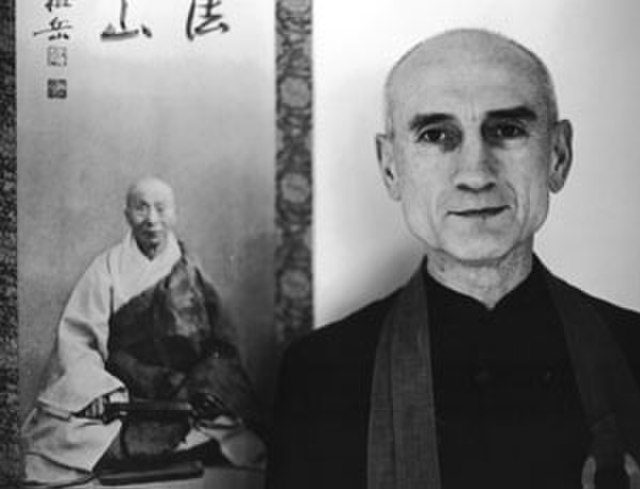
Philip Kapleau in front of an image of Daiun Harada
On August 20th in 1912, Philip Kapleau was born in New Haven, Connecticut. So, we’re now marking 112 years since that event.
Kapleau Roshi was one of the pioneers of Zen come west. His importance in this project is impossible to overestimate. At the same time there were complications that have followed him. As recently as a month or so ago someone posted a broadside linking him with a notorious fake teacher as people who made the whole thing up. For the other person that’s a simple if harsh fact. For Kapleau Roshi it lacks any nuance, and ignores the many facts on the ground. Facts and nuances I believe specifically are critical for us to understand as Zen begins the long task of rooting in the west.
I first wrote about Kapleau for my 2006 history of Zen comes west, Zen Master Who? In 2016 Lion’s Roar invited me to update that piece. What follows is that reflection…
James Ishmael Ford
In August 2003 the American Zen Teachers Association conference was hosted by Kapleau’s Rochester Zen Center in Chapin Mill, their country retreat, outside of Rochester. Those of us who were interested were invited to go into Rochester and meet Philip Kapleau Roshi. He was ninety years old and suffering from advanced Parkinson’s disease. Most of us understood this could be our last, and for some only, chance to meet this old Zen pioneer.
I actually hesitated. He had broken from his teacher Yasutani Roshi many years before. He took to calling himself Roshi and was known in subsequent years to make seemingly self-serving disparaging remarks about other teachers. He also, it seemed to me, gratuitously challenged the technical veracity of the transmission of the lineage from which he had broken — which was a lineage in which I also practiced. But he was also the editor of Three Pillars of Zen. I cannot fully express how important that single book was in my life; and this has been true for so many others who’ve taken up the Zen way. So, in the end I went to see him.
Philip Kapleau was living in a small two-room apartment at the center. His Parkinson’s was so advanced he could do little more than sit in his recliner and hold hands with each of us who’d made the trip. About ten teachers—dharma successors in the Soto, Rinzai, Harada-Yasutani, and Korean Chogye traditions — had made the pilgrimage. There was little option, if we wanted to shake Kapleau’s hand, but to kneel in front of him and take the initiative. It had clearly not been set up to require such a supplicative posture, but that was inevitably what was called for.
I found tears welling up from deep within me — not just for his physical condition, but for gratitude. This crusty old man was a true founder and absolutely one of the most important figures in bringing the Zen way West. For all his flaws, he was a great man and one of the most important people in my life. I happily knelt, took his hands in mine, and thanked him. I remain grateful for that opportunity.
Philip Kapleau was born in New Haven, Connecticut, in 1912. He served as chief court reporter for the International Military Tribunal at Nuremberg, and later he was also court reporter at the trials in Tokyo. While in Japan he met a number of prominent Zen teachers, including Soen Nakagawa, Sogaku Harada, and Haku’un Yasutani, the founders of the Harada-Yasutani line of koan-studying Soto Zen. After coming back to America he felt profoundly dissatisfied with his life and decided to return to Japan in 1953.
After spending three years at Hosshinji with Harada Roshi, Kapleau became the first Westerner to begin formal study with Haku’un Yasutani. After some twenty sesshins with Yasutani, the roshi confirmed Kapleau’s awakening. In 1966, after ten years studying with his teacher, he came home to America and, with Yasutani Roshi’s permission, founded the Rochester Zen Center in upstate New York.
There are several accounts of the reasons for his famous break with Yasutani Roshi. The most commonly reported version suggests deep disagreement about appropriate forms for the nascent North American center. Another story is that Kapleau objected to the close association of his teacher to another senior student who Kapleau felt was lax in his ethics.
Philip Kapleau was an aggressive personality who rubbed a number of people the wrong way, including several visiting Japanese teachers. More important, there were the growing tensions between Yasutani Roshi and Philip Kapleau. The specifics are debated but these tensions appear in significant part to have to do with Kapleau’s leadership of his center: his increasingly independent style, his departures in liturgical usage, and his relationships with visiting teachers.
The tensions all came to a head when Yasutani Roshi informed Kapleau that he, Kapleau, would no longer be considered Yasutani’s student. At this time Kapleau had completed about half of the Harada-Yasutani koan curriculum, the koans in The Gateless Gate and The Blue Cliff Record. Could he, in good faith, continue to teach considering his permissions were limited to introducing people to the practices of the Sanbo Kyodan—or “Three Treasures,” as the Harada-Yasutani school called itself—to which he no longer belonged? Regardless Kapleau decided to continue as a teacher.
The Three Pillars of Zen was the first book in English to describe authentic Zen training, and it justly became an international bestseller. Kapleau went on to write a number of other books, and his center grew to become one of the most influential Western Zen communities. While seen by many as a difficult personality inclined to unnecessary conflict, he was also a central figure in the establishment of a Western Zen. There should be little doubt the institution he founded will continue well into the future.
But the Rochester lineage, as it is sometimes called, opens all the questions regarding the nature of dharma transmission. What does this mean for us today and in the future? Andrew Rawlinson, who spent years studying Western teachers of Eastern religions, makes a pointed comparison of Philip Kapleau and Robert Aitken, as an aid to reflection on the nature of formal transmission—what it might mean, and what it probably doesn’t mean. Philip Kapleau spent thirteen years in Japan studying with several teachers. Eventually he received permission to teach but not dharma transmission, which is the approval to teach independently. Since his split with Yasutani Roshi, Rawlinson wrote before Kapleau’s death:
Kapleau has continued to teach, as he is entitled to do, but has also given dharma transmission to a number of his own students, which, according to the transmission criteria of the Zen tradition, he is not entitled to do. Or at least, these appointments need not be recognized by any other lineage or teacher.… In effect, then, Kapleau has created his own Zen lineage.
By contrast, Rawlinson holds up Robert Aitken (who would die in 2010):
Aitken received dharma transmission from [Ko’un] Yamada Roshi but he has been far more radical in his attitude to the traditional way of life than Kapleau. He has encouraged Zen (and Buddhist) feminism, for want of a better term, and has actively encouraged gay and lesbian participation in Zen (though he is not gay himself). He is also a committed social activist—he was a co-founder of the Buddhist Peace Fellowship — and sees such commitment as a necessary aspect of Buddhist ethics, which are themselves expressed in the precepts. At the same time he has given Dharma transmission to one of his students who is a Christian priest.
This last action is something for which Aitken has been openly criticized.
As Rawlinson sees it, the difference between these two teachers turns on their understanding of transmission: “In short, for Aitken transmission is a necessary condition (though not a sufficient one) for the tradition to continue; for Kapleau, spiritual qualities hold an equivalent place.”
Roshi Kapleau died on the sixth of May, 2004, in the garden of the Rochester Zen Center, surrounded by old and new students. He had suffered from the ravages of Parkinson’s disease for years and had long since retired from formal teaching. It is hard to assess yet what Roshi Kapleau’s career means for the development of Western Zen. But one thing is certain: despite having teaching authorizations, he ultimately lacked formal dharma transmission, yet he created a lineage that is largely recognized throughout the Western Zen community. (Among the most prominent of Kapleau Roshi’s heirs are the late Toni Packer, current RZC abbot Peter Bodhin Kjolhede, and Sunyana Graef, who guides the Vermont Zen Center near Burlington and Casa Zen in Costa Rica.) Thus his life and the institution he created forces Western Zen practitioners to carefully consider the nature of dharma transmission.
As an heir within a traditional lineage and as someone deeply involved in the transmission of Zen into our Western culture, Kapleau Roshi’s presence and legacy offered me a challenge and a pointer. The challenge was that to my mind he was completely and authentically a Zen teacher, but lacking the tactile authorization. The pointer was to go beyond the over blown rhetoric of the Zen way’s transmission, and to accept that it is in fact the transmission of a way, a style and and approach.
And specifically what we’re invited into is a more humble and I believe more authentic Zen. The transmission as something passed on from teacher to student is useful. And I’d be wary of anyone who lacks it. But, it also has something to do with the community. And I have learned to be wary of teachers who lack that. So, for me there need to be two other things to create an authentic Zen community of practice. One would be students who accept the teacher. And also other teachers who accept the teacher. You have that and you have Zen.
What we see in Kapleau Roshi’s gift of dharma successors are authentic Zen practitioners and teachers, pretty much any of whom I’d be completely comfortable entrusting the spiritual care of any of my students. For these gifts, I honor the memory of our founding Western master, Roshi Philip Kapleau.
New Visions
History and Religion

About James Ishmael Ford
James Ishmael Ford is an author, Zen teacher, and Unitarian minister. In addition to his Patheos blog Monkey Mind, he writes a spiritual newsletter Unanswered Question at Substack. His sixth book the Intimate Way of zen was released at the end of July, by Shambhala Publications. You can read more about the author here.
Previous Post
August 14, 2024
A Zen Reflection on the Assumptions of Mary
Next Post

August 21, 2024 A Buddhist Lord's Prayer
Recent Comments
"Allowing anger to contaminate one's hard disk can be detrimental to one's holistic well being. ..."
Hot Anger: Meeting Anger in Zen ..."
"I love this koan. every which way you turn it bites you, Thirty years on ..."
Nanquan Cuts the Cat: A Jesuit ..."
"As a substitute for religion, Zen is probably better than taking drugs. However, it can ..."
The Selling of Zen at the ..."
"Craving and aversion are detrimental to one's peace and happiness. Easter is a wake up ..."
Easter: A Zen Buddhist Appreciation
Browse Our Archives
Select a Category A Christmas Carol Abolitionist African-American Ahmadiyya Alan Watts Aldous Huxley Allen Ginsberg Amedkar Jayanti American politics American Zen Anaheim Zen Sangha Anglican Annie Besant April Fool Armageddon Art and Religion artificial intellegence Atheist Awakening B R Ambedkar Barlaam & Josaphat Beatnik Between Bhagavad Gita Bible biography birthday bodhisattva Bodhisattva Precepts Book burning Book of Common Prayer Book of Mormon Brahmo Samaj Buddha Buddhism Buddhist Buddhist Lord's Prayer Butterflies Calendars cartoons cat ChatGPT Chicken Tortilla Soup choices Christian atheism Christian mysticism Christian origins Christian Science Christian Zen Christianity Christianity and Buddhism christmas Christmas Truce Christopher Isherwood Church of Later Day Saints Cinco de Mayo circus covenant critical thinking culture D. T. Suzuki Dalit Buddhism Daniel Defoe Desert Fathers and Mothers dharma talk Dogen Donald Trump Dongshan's Five Ranks Dorothy Day dream Duty Easter ecology Edwin Arnold emptiness Empty Moon Zen Network Episcopal Church Eternal Now Ethics evolution existentialism Faith fantasy Fathers Day film film review fire Five Ranks Folk music food Form and emptiness Four Seals Francis of Assisi Francis Xavier Free thinker friendship George MacDonald Gerald Heard Glenn Taylor Webb God Good Friday Gospel of Gospel of Mark Gospel of Thomas grace Graduate Theological Unioin Graduate Theological Union Guanyin H R Blyth Hakuin Ekaku Hanamatsuri Hanukkah Harada Yasutani Zen Heart Sutra Henry David Thoreau Hermann Hesse Hinduism History and Religion history of religion Holy Spirit home Hospitality Icon Ides of March Isaac Newton Islam Islamic mysticism Jack Kerouac James Luther Adams Jiddu Krishnamurti Joan of Arc Johannes Gutenberg John Donne joke Judaism justice karma kensho King James Bible koan Koun Yamada Kyoto School Lewis Carrol Liberal Christianity Liberal Religion Life Plan Community Liminal literature Literature and Religion Liturgy Lord's Prayer Love Mahatma Gandhi Mahayana Martin Luther King Jr Mary Baker Eddy Mary Magdelene Mary Oliver Mayflower Compact Meditation memories memory metaphor money money and religioin Mormons Mother's Day movie review mysticism mythic Neighborhood Unitarian Universalist Church New Thought Nichiren Buddhism Nonduality not knowing Omar Khayyam Pacific School of Religion pagan Palm Sunday Passover peace Pentecost perennialism Phantastes Philip Kapleau philosophy Pilgrimage poetry Poetry and Religion politics Prayer Precepts Printing Press prophecy prophetic spirituality psychology Pure Land Queer religion queering religion Quietism Ram Mohan Roy rebirth recipe Relationships and religion religion religion and history Religious syncretism Resistance Retirement Retreat review Rissho Kosei Kai Ritual Robert Aitken Roshi Robert Ingersoll Rohatsu Romani religion Rosie the Riveter saints samadhi SanboZen Sangha Satyagraha science science and reigion science and religion science fiction seminary sermon Sesshin Sex and Religion Shinran Sikh Sikh tradition silence Social Justice Socially Engaged Buddhism Society and religion Soto Zen soul spiritual community spiritual practice Spirituality Sufism Suicide superstition Taoism Television Teresa of Avila Thanksgiving theological schools Theosophy Thomas Merton Time Transcendentalism Transcendentalist Trinitarian Trinity Uncategorized unitarian Unitarian Christianity Unitarian Universalist Universalism Vajrayana Vedanta Walking war Willa Cather William Ellery Channing wisdom women and religion women in religion World Teacher Writing zazen Zen Zen Center Zen inspired retriement zen meditation Zen Precepts Zen women
Select a Month September 2026 August 2026 July 2026 June 2026 May 2026 April 2026 March 2026 February 2026 January 2026 December 2025 November 2025 October 2025 September 2025 August 2025 July 2025 June 2025 May 2025 April 2025 March 2025 February 2025 January 2025 December 2024 November 2024 October 2024 September 2024 August 2024 July 2024 June 2024 May 2024 April 2024 March 2024 February 2024 January 2024 December 2023 November 2023 October 2023 September 2023 August 2023 July 2023 June 2023 May 2023 April 2023 March 2023 February 2023 January 2023 December 2022 November 2022 October 2022 September 2022 August 2022 July 2022 June 2022 May 2022 April 2022 March 2022 February 2022 January 2022 December 2021 November 2021 October 2021 September 2021 August 2021 July 2021 June 2021 May 2021 April 2021 March 2021 February 2021 January 2021 December 2020 November 2020 October 2020 September 2020 August 2020 July 2020 June 2020 May 2020 April 2020 March 2020 February 2020 January 2020 December 2019 November 2019 October 2019 September 2019 August 2019 July 2019 June 2019 May 2019 April 2019 March 2019 February 2019 January 2019 December 2018 November 2018 October 2018 September 2018 August 2018 July 2018 June 2018 May 2018 April 2018 March 2018 February 2018 January 2018 December 2017 November 2017 October 2017 September 2017 August 2017 July 2017 June 2017 May 2017 April 2017 March 2017 February 2017 January 2017 December 2016 November 2016 October 2016 September 2016 August 2016 July 2016 June 2016 May 2016 April 2016 March 2016 February 2016 January 2016 December 2015 November 2015 October 2015 September 2015 August 2015 July 2015 June 2015 May 2015 April 2015 March 2015 February 2015 January 2015 December 2014 November 2014 October 2014 September 2014 August 2014 July 2014 June 2014 May 2014 April 2014 March 2014 February 2014 January 2014 December 2013 November 2013 October 2013 September 2013 August 2013 July 2013 June 2013 May 2013 April 2013 March 2013 February 2013 January 2013 December 2012 November 2012 October 2012 September 2012 August 2012 July 2012 June 2012 May 2012 April 2012 March 2012 February 2012 January 2012 December 2011 November 2011 October 2011 September 2011 August 2011 July 2011 June 2011 May 2011 April 2011 March 2011 February 2011 January 2011 December 2010 November 2010 October 2010 September 2010 August 2010 July 2010 June 2010 May 2010 April 2010 March 2010 February 2010 January 2010 December 2009 November 2009 October 2009 September 2009 August 2009 July 2009 June 2009 May 2009 April 2009 March 2009 February 2009 January 2009 December 2008 November 2008 October 2008 September 2008 August 2008 July 2008 June 2008 May 2008 April 2008 March 2008 February 2008 January 2008 December 2007 November 2007 October 2007 September 2007 August 2007 July 2007 June 2007 May 2007 April 2007 March 2007 February 2007 January 2007 December 2006 November 2006 October 2006 September 2006
Follow Us!
TAKE THE
Religious Wisdom Quiz
What does "forgive us our trespasses as we forgive"" mean in the Lord's Prayer?
Select your answer to see how you score.
We should forgive others Pray for revenge Ask for wealth Hold grudges
Related posts from Monkey Mind

Keizan Jokin: The Zen Master Ancestor You Don't...

What Zen Practice Actually Does With Anger

Nanquan Cuts the Cat: A Jesuit commentary on...

On Taking Refuge in the Dharma
TRENDING AT PATHEOS Buddhist

A new article, written by Jeff Lindsay and Gale L. Pooley,...

Swimfan: Forgotten Aughts Pleasures
This is a recovery effort. In 2002, My Big Fat Greek Wedding...

Top Three Anti-Catholic Lies About Catholicism
This is my initial transcript for the video, "THE 3 WORST...

Pope Leo Celebrates Mass for Nurses & Docs...
I don't have any idea how he did it, but Pope Leo...

The Sermon on the Mount, Part I: Matthew...
The Sermon on the Mount, Part I (Matthew 4:12-5:12) St. Matthew moves...

What's up from Crossway: Reviewing some of their latest A few weeks...
view all Buddhist blogs
What Are Your Thoughts?leave a comment
Ad-Free & Subscriber Log-In Subscription Support
- About Us
- 2026 Calendar
- Videos
- Podcasts
- Library of World Religions
- Faith In Media Tracker
- Advertise With Us
- Write for Us
- Privacy Policy
- Terms of Service
- Do Not Sell My Data
- Contact Us
- Radiant Digital
- Manage Newsletter Subscriptions
- Unsubscribe From Notifications
- Sitemap
Copyright 2008-2026, Patheos. All rights reserved.
Subscription Support Ad-Free & Subscriber Log-In
Follow Patheos