
BuddhistCatholicContemplativeEvangelicalGeneral ChristianHinduJewishLatter-day SaintMuslimNew VisionsProgressive Christian
Beliefs
- Buddhist
- Catholic
- Contemplative
- Evangelical
- General Christian
- Hindu
- Jewish
- Latter-day Saint
- More Voices
- Muslim
- New Visions
- Pagan
- Progressive Christian
Topics
- Religion News
- Food and Religion
- Sports and Religion
- Religious Art
- Religious Music and Entertainment
- Religious Events
- History and Religion
- Style and Religion
- Politics and Religion
- Women in Religion
- Recreation Outdoors and Religion
- Business Finance and Religion
- Careers Workplace and Religion
- Education and Religion
- Family Parenting and Religion
- Health Fitness and Religion
- Home and Religion
- Relationships and Religion
- Technology and Religion
- Travel and Religion
Columnists
- Buddhist Columnists
- Business Finance and Religion Columnists
- Careers Workplace and Religion Columnists
- Catholic Columnists
- Contemplative Columnists
- Education and Religion Columnists
- Evangelists Columnists
- Family Parenting and Religion Columnists
- General Christian Columnists
- Health Fitness and Religion Columnists
- Hindu Columnists
- History and Religion Columnists
- Home and Religion Columnists
- Jewish Columnists
- More Voices Columnists
- Latter Day Columnists
- Muslim Columnists
- New Visions Columnists
- Nonreligious Columnists
- Pagan Columnists
- Politics and Religion Columnists
- Progressive Columnists
- Recreation Outdoors and Religion Columnists
- Relationships and Religion Columnists
- Religion News Columnists
- Religious Art Columnists
- Religious Events Columnists
- Religious Music and Entertainment Columnists
- Sports and Religion Columnists
- Style and Religion Columnists
- Technology and Religion Columnists
- Travel and Religion Columnists
- Women in Religion Columnists
Resource Library
- 2026 Calendar
- Library of World Religions
- The 100 Most Holy Places on Earth
- Patheos Answers
- Podcasts
- Videos
- Faith Leaders Database
- Anglican Episcopalian
- Bahai
- Baptist
- Buddhism
- Christianity
- Confucianism
- Eastern Orthodoxy
- Hinduism
- Holiness and Pentecostal
- ISKCON
- Islam
- Judaism
- Lutheran
- Methodist
- The Church of Jesus Christ of Latter-day Saints
- New Age
- Paganism
- Presbytarian and Reformed
- Protestantism
- Religion Behind the Scenes
- Roman Catholic
- Scientology
- Shia Islam
- Sikhism
- Sufism
- Sunni Islam
- Taoism
- Zen
- See all religions
Research Tools
 Ad-Free & Subscriber Log-In Subscription Support
Ad-Free & Subscriber Log-In Subscription Support
Follow Patheos 

- Trending:
- Forgiveness
- |
- Marriage
- |
- Consciousness
- |
- Death Penalty
- |
- Election
- |
- Halloween

- Home
- Buddhist
- History and Religion
- Our Fathers. A Continuing Meditation
Our Fathers. A Continuing Meditation
Last updated on: June 16, 2024 at 9:17 am by James Ford
Our Fathers. A Continuing Meditation 2024-06-16T09:17:03-07:00 James Ford
Patheos Explore the world's faith through different perspectives on religion and spirituality! Patheos has the views of the prevalent religions and spiritualities of the world.
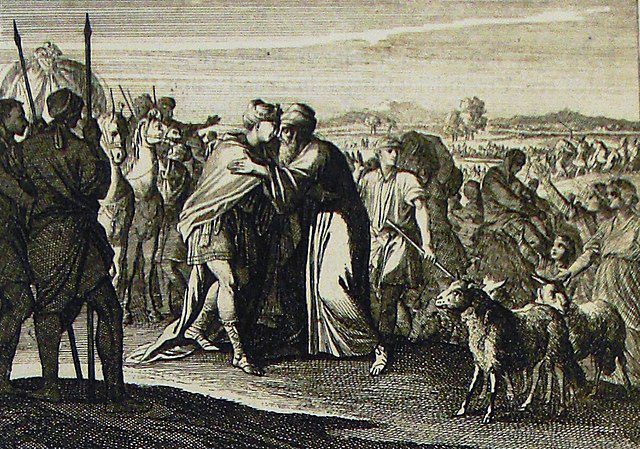
Joseph goes to meet his father
Caspar Luyken (17th century)
In digging through my files I notice every few years I share an ongoing thread of thoughts about Father’s Day. Some points I repeat. Others get dropped. While still others call for deeper consideration. I think of this project as a sort of spiritual discipline.
As far as the history of it goes, the idea of honoring fathers is pretty old and exists around the world one way or another. The Christian world has honored fathers at least nominally for a very long time. The Coptic church which today is centered in Egypt & Ethiopia have celebrated a Father’s Day connected to the Feast of St Joseph, Jesus’s, how shall we say, earthly father, possibly since as long ago as the early fifth century. In the Coptic church the feast is observed on July 20th. The Latin Church, meaning the church mainly of Europe, has done the same thing. Attaching Father’s Day to the festival for St Joseph since the Middle Ages, although on their own date for celebrating St Joseph, the 19th of March.
Looking around the world Father’s Day isn’t officially celebrated in China. Although I gather there are less formal observances here and there. Apparently, the same is true in India, with some local observances, but it’s not a national holiday. Roaming around the interwebs, the only reference I could find to Father’s Day celebrations in sub-Sahara Africa is South Africa. They also mark it as an official holiday. I think a deeper look will find others on the mother continent who also observe the day. You can consider it a small research assignment, if you want.
According to a source I found online, apparently in Germany many men take Father’s Day as a drinking event, while in Russia the holiday is enmeshed with martial celebrations of the “Fatherland.” Both of which open doors to the problematic and offer more reasons why it might feel attenuated in our own time and place.
Our American holiday seems to have been conceived as a complement to Mother’s Day. The earliest official celebration dates from 1910, when after years of lobbying Sonora Scott Dodd got Washington State to designate June 10th as a celebration for all things father. There was an attempt to create a Federal holiday in 1916. But it was met with resistance in congress who appear to have feared it becoming too commercial. I have to admit I don’t think of congress as being generally aware that such a thing could ever be problematic. In 1966 Lyndon Johnson issued a presidential proclamation stating Father’s Day should be observed on the 3rd Sunday in June. And, finally, in 1972 congress passed legislation making this official, and it was signed into law by Richard Nixon.
As to the designation Father’s with that apostrophe. For the grammarians among us, while the presence of that apostrophe has generated some controversy, it is the official designation. Please take notes. There could be a test, later.
Like for Mother’s Day this is a fraught holiday. Drunken fathers, abusive fathers, absent fathers crowd up in the heart along with loving and attentive and caring fathers. And. Fathers, like mothers, well, we all have one. Some are good, some are bad, many are indifferent. But, and this is really important: they loom so large in our consciousness and the stories we tell about ourselves that it can be overwhelming.
So, reflecting on this holiday is messy. Did I use the word fraught? We can see why a last-minute card or necktie can be the popular option for addressing it.
Me, I’m certainly not immune to the mess and the complicated feelings. My father had a rough life. Orphaned very young, passed around among relatives, until deemed incorrigible and institutionalized, ran away, as a young teen lived on New York’s streets, got into petty crime, maybe more serious crimes, as the second world war began ended up in prison, then in the last year of the war released into the Army, served as a medic, where he was badly, badly damaged.
The man I knew was disabled, he’d lost use of an arm to the war, an out of control alcoholic, in and out of jail, dreamer, wisher, wanter of better and bigger things. He wanted to be an Irish Frank Sinatra. Not the singer part, the cool man of the world part, the hip part. He wanted to be classy, but only understood it has having and spending money. Which was always just a little beyond him. Betrayed his family over and over again. And. And this is so important. Throughout my childhood he relentlessly told me how good I was, and how he loved me. Oh, and one more thing. While having maybe a third-grade education, he was an avid reader. And his encouragement, and probably more importantly his example illustrated by a pile of books at his bedside led me to a life of books. So. Complicated.
And there are more complexities. For me and for many here, I suspect, the mess of culture and everything that can be dropped into the term “patriarchy” poisons the water into which our celebration of fathers would be mixed. I’ve spent pretty much my entire ministerial career looking into my own heart, looking at the larger culture, and out of that acting from a desire to genuinely represent the truth that “women hold up half the sky.” And as we’ve been so immersed in a world where even our language is weighted with masculine terms as baseline, as normative, my work has been focused mostly on holding up women as whole, and as strong, and as leaders. And with that, as this is a spiritual project, casting light on all the many aspects of the feminine as divine.
Let’s be frank. That work is not done. Nowhere near done.
Although even at this moment we can see how we have all been enriched in this process. And we keep learning. All of us. Me, I’m really glad how this work has continued and has gone on to expose the deep problems with any binary reductionism of our sexuality. We not only all exist on a continuum rather than what our immediate physical attributes suggest, but how our basic identities can and usually do fit in more than one of two places. We not only slide along that continuum we encompass the whole glorious mess.
That acknowledged, I feel a need to pause here. And turn into and reflect just a little on fathers, on that particular spot on the continuum of human existence.
Today is Father’s Day.
What about fathers after God the father, after the man as the head of household? What about fathers as something more than a biological necessity to get the family thing going? (Well, with scientific advances, at least for the time being.)
So. My father. Your father. Our fathers. Those of us who are fathers. And that part of all of us which might be named father or fathering. What about it? Again, as this is a spiritual reflection, and we have such limited time, what I really want to dig into, if just a little (and, don’t worry about what I said earlier. There will be no test) is what can we find in the idea of the father, in that specific part of our human identity that is worthy of our deeper reflection?
Fathers. Both Freud and Jung had a field day with the idea of the father. We even have a term for it, “father complex.” And complex it is. With Freud there is a contention between a father and a son. Jung mixes it up a bit more and broadens the possibilities, for men and women, and for both good and ill. While I think Freud gets a bit of a bad rap that he only partially deserves, I find I’m nonetheless more attracted to the work of Carl Jung.
However, to be clear, I’m not a Jungian. I do not believe in the collective unconscious, nor any kind of Platonic or quasi or semi archetypal realm. Certainly not in a literal sense. And, as our ancestor Ralph Waldo Emerson warned about avoiding foolish consistencies, if we hold the idea of archetypes lightly, say as identifiable regularly occurring patterns of relationships both within our individual hearts and within our communal lives, I believe there is something to see. It might even reveal what we want to hold up. and what we might want to correct. So, there are things to explore.
From Freud and Jung people have spent a lot of time digging into the absence part of fathers and fathering. Certainly, absent was signal feature of my own upbringing. And with that there’s another term “father hunger.” It has been examined from the perspectives of both women and men. For all of us that father hunger speaks to another aspect of absence: longing. There seems a great longing for that aspect of parenting we call fathering.
And here I find something deeply compelling. James Hillman is particularly important to me. Hillman, who, as long as we’re talking about complex relationships with one’s father, is an interesting example of someone who has taken his spiritual father, Carl Jung, starting as his heir at the Jung Institute in Zurich, then proceeding to dismantle much of his mentor’s work. That is until the powers that be within the organization noticed and rather forcibly invited Mr Hillman to move on.
Hillman spent some serious time thinking about fathers, and absence. He reflected on this idea of the missing father, physically for some, metaphorically for others, that captures so many of our imaginations. Hillman observed how this missing father, “is not (simply) your or my personal father. He is the absent father of our culture, the (to use a Jungian term) the viable senex who provides not only daily bread but spirit through meaning and order.” The “senex” in archetypal language is the “wise old man,” our image, usually although not exclusively, our positive image of what a man can grow into. The sad thing is that this figure is increasingly experienced as something missing.
That observation makes me think a lot of things. One is that longing itself. I know everyone in this room doesn’t feel this way, but I believe I am not alone in that sense of longing for the father. Maybe, probably, not the actual father of the flesh, my father in the flesh, besides being dead, is as I briefly listed a complicated, and not particularly lovable figure. But, rather, with Hillman, I am interested in the father writ large. As well as the part of the father I don’t see in my own existence. And with that our collective desires, our communal lives, and what we need. And what we seek, either consciously or unconsciously.
I think there is legitimately a longing for that senex figure, that wise man, and the traits that are traditionally associated with him. Specifically, this father not only supports us physically, providing food and clothing and shelter, he embodies kindness. He offers sound judgments on events that are confronting us. He brings a unique wisdom to the matter at hand, whatever it might be. I like that this senex father image also carries with it hints of otherness.
So, the invitation is to look within and among us for those traits that our hearts long for. And what are they? That physical support symbolized by paying the rent and putting food on the table. That emotional support, which we find as perspective, and, to use a term not so common these days, grit. Of course, we also want to avoid the bad father things. And, oh, my, there are such a lot of them. Cruelty. Heavy judgment. Abandonment. In some myths the father actually devours us. In others he is a fool.
So, cutting through these things that are not helpful, noticing them, but not stopping there, and instead going for the heart, going for that other style of parenting, another angle on nurturing. And with that a question. Okay, maybe it turns out there is a test. But its take home. How do we own fathering as a part of our spiritual journey?
In short, as we genuinely ask when we hold up women, when we hold up LGBTQ people, when we hold up people of color, when we hold up immigrants, when we hold up anyone who might be considered other: how do we become whole people?
And the answer, well, this is my answer. But you might find it helpful. Kind of looking over the shoulder of your neighbor when taking a test. And this take home test is actually open book. My answer to the question of how to become whole is simply by seeing, simply by noticing what is, both as it arises around us, and as it arises within us. Just witness. Then, once we have noticed it, we never see it all, but we can see the big parts, and oh my, fathers, they are a big part – then, by wise discernment of what is useful and what is not, we can move toward integrating.
If this seems an awful lot for a take home exam, even open book, don’t worry we each of us have a whole lifetime to finish it.
So. All this explored. All this laid out. What’s a father’s love? So complex, so complicated. Me, I think of my father’s life and, well, his death, all that passed in between taken together, may well contain a hint at the whole of it, and with that at the whole of our lives. Failures large and small. Successes, maybe more small than large. Mistakes and foolishnesses. And, glued together with some sense of love.
Love. Open ended. Messy. Filled with mistakes and wrong turns. And something so beautiful, so beautiful. The mysteries of our humanity.
New Visions
History and Religion

About James Ishmael Ford
James Ishmael Ford is a writer, Zen teacher, and Unitarian minister. His sixth book, the Intimate Way of Zen is forthcoming from Shambhala Publications. In addition to his Patheos blog Monkey Mind he has a spiritual newsletter, Unanswered Question available at Substack, jamesiford.substack.com You can read more about the author here.
Previous Post
June 15, 2024
Henry Thoreau on Not Knowing
Next Post

June 19, 2024 Robert Aitken: An American Zen Original
Recent Comments
"Allowing anger to contaminate one's hard disk can be detrimental to one's holistic well being. ..."
Hot Anger: Meeting Anger in Zen ..."
"I love this koan. every which way you turn it bites you, Thirty years on ..."
Nanquan Cuts the Cat: A Jesuit ..."
"As a substitute for religion, Zen is probably better than taking drugs. However, it can ..."
The Selling of Zen at the ..."
"Craving and aversion are detrimental to one's peace and happiness. Easter is a wake up ..."
Easter: A Zen Buddhist Appreciation
Browse Our Archives
Select a Category A Christmas Carol Abolitionist African-American Ahmadiyya Alan Watts Aldous Huxley Allen Ginsberg Amedkar Jayanti American politics American Zen Anaheim Zen Sangha Anglican Annie Besant April Fool Armageddon Art and Religion artificial intellegence Atheist Awakening B R Ambedkar Barlaam & Josaphat Beatnik Between Bhagavad Gita Bible biography birthday bodhisattva Bodhisattva Precepts Book burning Book of Common Prayer Book of Mormon Brahmo Samaj Buddha Buddhism Buddhist Buddhist Lord's Prayer Butterflies Calendars cartoons cat ChatGPT Chicken Tortilla Soup choices Christian atheism Christian mysticism Christian origins Christian Science Christian Zen Christianity Christianity and Buddhism christmas Christmas Truce Christopher Isherwood Church of Later Day Saints Cinco de Mayo circus covenant critical thinking culture D. T. Suzuki Dalit Buddhism Daniel Defoe Desert Fathers and Mothers dharma talk Dogen Donald Trump Dongshan's Five Ranks Dorothy Day dream Duty Easter ecology Edwin Arnold emptiness Empty Moon Zen Network Episcopal Church Eternal Now Ethics evolution existentialism Faith fantasy Fathers Day film film review fire Five Ranks Folk music food Form and emptiness Four Seals Francis of Assisi Francis Xavier Free thinker friendship George MacDonald Gerald Heard Glenn Taylor Webb God Good Friday Gospel of Gospel of Mark Gospel of Thomas grace Graduate Theological Unioin Graduate Theological Union Guanyin H R Blyth Hakuin Ekaku Hanamatsuri Hanukkah Harada Yasutani Zen Heart Sutra Henry David Thoreau Hermann Hesse Hinduism History and Religion history of religion Holy Spirit home Hospitality Icon Ides of March Isaac Newton Islam Islamic mysticism Jack Kerouac James Luther Adams Jiddu Krishnamurti Joan of Arc Johannes Gutenberg John Donne joke Judaism justice karma kensho King James Bible koan Koun Yamada Kyoto School Lewis Carrol Liberal Christianity Liberal Religion Life Plan Community Liminal literature Literature and Religion Liturgy Lord's Prayer Love Mahatma Gandhi Mahayana Martin Luther King Jr Mary Baker Eddy Mary Magdelene Mary Oliver Mayflower Compact Meditation memories memory metaphor money money and religioin Mormons Mother's Day movie review mysticism mythic Neighborhood Unitarian Universalist Church New Thought Nichiren Buddhism Nonduality not knowing Omar Khayyam Pacific School of Religion pagan Palm Sunday Passover peace Pentecost perennialism Phantastes Philip Kapleau philosophy Pilgrimage poetry Poetry and Religion politics Prayer Precepts Printing Press prophecy prophetic spirituality psychology Pure Land Queer religion queering religion Quietism Ram Mohan Roy rebirth recipe Relationships and religion religion religion and history Religious syncretism Resistance Retirement Retreat review Rissho Kosei Kai Ritual Robert Aitken Roshi Robert Ingersoll Rohatsu Romani religion Rosie the Riveter saints samadhi SanboZen Sangha Satyagraha science science and reigion science and religion science fiction seminary sermon Sesshin Sex and Religion Shinran Sikh Sikh tradition silence Social Justice Socially Engaged Buddhism Society and religion Soto Zen soul spiritual community spiritual practice Spirituality Sufism Suicide superstition Taoism Television Teresa of Avila Thanksgiving theological schools Theosophy Thomas Merton Time Transcendentalism Transcendentalist Trinitarian Trinity Uncategorized unitarian Unitarian Christianity Unitarian Universalist Universalism Vajrayana Vedanta Walking war Willa Cather William Ellery Channing wisdom women and religion women in religion World Teacher Writing zazen Zen Zen Center Zen inspired retriement zen meditation Zen Precepts Zen women
Select a Month September 2026 August 2026 July 2026 June 2026 May 2026 April 2026 March 2026 February 2026 January 2026 December 2025 November 2025 October 2025 September 2025 August 2025 July 2025 June 2025 May 2025 April 2025 March 2025 February 2025 January 2025 December 2024 November 2024 October 2024 September 2024 August 2024 July 2024 June 2024 May 2024 April 2024 March 2024 February 2024 January 2024 December 2023 November 2023 October 2023 September 2023 August 2023 July 2023 June 2023 May 2023 April 2023 March 2023 February 2023 January 2023 December 2022 November 2022 October 2022 September 2022 August 2022 July 2022 June 2022 May 2022 April 2022 March 2022 February 2022 January 2022 December 2021 November 2021 October 2021 September 2021 August 2021 July 2021 June 2021 May 2021 April 2021 March 2021 February 2021 January 2021 December 2020 November 2020 October 2020 September 2020 August 2020 July 2020 June 2020 May 2020 April 2020 March 2020 February 2020 January 2020 December 2019 November 2019 October 2019 September 2019 August 2019 July 2019 June 2019 May 2019 April 2019 March 2019 February 2019 January 2019 December 2018 November 2018 October 2018 September 2018 August 2018 July 2018 June 2018 May 2018 April 2018 March 2018 February 2018 January 2018 December 2017 November 2017 October 2017 September 2017 August 2017 July 2017 June 2017 May 2017 April 2017 March 2017 February 2017 January 2017 December 2016 November 2016 October 2016 September 2016 August 2016 July 2016 June 2016 May 2016 April 2016 March 2016 February 2016 January 2016 December 2015 November 2015 October 2015 September 2015 August 2015 July 2015 June 2015 May 2015 April 2015 March 2015 February 2015 January 2015 December 2014 November 2014 October 2014 September 2014 August 2014 July 2014 June 2014 May 2014 April 2014 March 2014 February 2014 January 2014 December 2013 November 2013 October 2013 September 2013 August 2013 July 2013 June 2013 May 2013 April 2013 March 2013 February 2013 January 2013 December 2012 November 2012 October 2012 September 2012 August 2012 July 2012 June 2012 May 2012 April 2012 March 2012 February 2012 January 2012 December 2011 November 2011 October 2011 September 2011 August 2011 July 2011 June 2011 May 2011 April 2011 March 2011 February 2011 January 2011 December 2010 November 2010 October 2010 September 2010 August 2010 July 2010 June 2010 May 2010 April 2010 March 2010 February 2010 January 2010 December 2009 November 2009 October 2009 September 2009 August 2009 July 2009 June 2009 May 2009 April 2009 March 2009 February 2009 January 2009 December 2008 November 2008 October 2008 September 2008 August 2008 July 2008 June 2008 May 2008 April 2008 March 2008 February 2008 January 2008 December 2007 November 2007 October 2007 September 2007 August 2007 July 2007 June 2007 May 2007 April 2007 March 2007 February 2007 January 2007 December 2006 November 2006 October 2006 September 2006
Follow Us!
TAKE THE
Religious Wisdom Quiz
I saw the Lord seated on a throne, high and exalted, while six-winged beings called out 'Holy, holy, holy.' What were these creatures?
Select your answer to see how you score.
Seraphim Cherubim Leviathan Angels
Related posts from Monkey Mind


A Zen Buddhist Response to this Moment

Zen and the Dance of Not Knowing
TRENDING AT PATHEOS Buddhist

The Sermon on the Mount, Part I: Matthew...
The Sermon on the Mount, Part I (Matthew 4:12-5:12) St. Matthew moves...

What's up from Crossway: Reviewing some of their latest A few weeks...

Janie Learns the Way of the Cross: A...
Teaching children about Jesus' Passion can be challenging. Many parents and educators...

Looking For Good Catholic Writing - October 2026
He alone extends the heavens, and he walks upon the waves of...

In "Irreplaceable," our book on vocation and technology, Trevor Sutton and I...

I was strolling through the top floor of the brand new Parthenon...
view all Buddhist blogs
What Are Your Thoughts?leave a comment
Ad-Free & Subscriber Log-In Subscription Support
- About Us
- 2026 Calendar
- Videos
- Podcasts
- Library of World Religions
- Faith In Media Tracker
- Advertise With Us
- Write for Us
- Privacy Policy
- Terms of Service
- Do Not Sell My Data
- Contact Us
- Radiant Digital
- Manage Newsletter Subscriptions
- Unsubscribe From Notifications
- Sitemap
Copyright 2008-2026, Patheos. All rights reserved.
Subscription Support Ad-Free & Subscriber Log-In
Follow Patheos