
BuddhistCatholicContemplativeEvangelicalGeneral ChristianHinduJewishLatter-day SaintMuslimNew VisionsProgressive Christian
Beliefs
- Buddhist
- Catholic
- Contemplative
- Evangelical
- General Christian
- Hindu
- Jewish
- Latter-day Saint
- More Voices
- Muslim
- New Visions
- Pagan
- Progressive Christian
Topics
- Religion News
- Food and Religion
- Sports and Religion
- Religious Art
- Religious Music and Entertainment
- Religious Events
- History and Religion
- Style and Religion
- Politics and Religion
- Women in Religion
- Recreation Outdoors and Religion
- Business Finance and Religion
- Careers Workplace and Religion
- Education and Religion
- Family Parenting and Religion
- Health Fitness and Religion
- Home and Religion
- Relationships and Religion
- Technology and Religion
- Travel and Religion
Columnists
- Buddhist Columnists
- Business Finance and Religion Columnists
- Careers Workplace and Religion Columnists
- Catholic Columnists
- Contemplative Columnists
- Education and Religion Columnists
- Evangelists Columnists
- Family Parenting and Religion Columnists
- General Christian Columnists
- Health Fitness and Religion Columnists
- Hindu Columnists
- History and Religion Columnists
- Home and Religion Columnists
- Jewish Columnists
- More Voices Columnists
- Latter Day Columnists
- Muslim Columnists
- New Visions Columnists
- Nonreligious Columnists
- Pagan Columnists
- Politics and Religion Columnists
- Progressive Columnists
- Recreation Outdoors and Religion Columnists
- Relationships and Religion Columnists
- Religion News Columnists
- Religious Art Columnists
- Religious Events Columnists
- Religious Music and Entertainment Columnists
- Sports and Religion Columnists
- Style and Religion Columnists
- Technology and Religion Columnists
- Travel and Religion Columnists
- Women in Religion Columnists
Resource Library
- 2026 Calendar
- Library of World Religions
- The 100 Most Holy Places on Earth
- Patheos Answers
- Podcasts
- Videos
- Faith Leaders Database
- Anglican Episcopalian
- Bahai
- Baptist
- Buddhism
- Christianity
- Confucianism
- Eastern Orthodoxy
- Hinduism
- Holiness and Pentecostal
- ISKCON
- Islam
- Judaism
- Lutheran
- Methodist
- The Church of Jesus Christ of Latter-day Saints
- New Age
- Paganism
- Presbytarian and Reformed
- Protestantism
- Religion Behind the Scenes
- Roman Catholic
- Scientology
- Shia Islam
- Sikhism
- Sufism
- Sunni Islam
- Taoism
- Zen
- See all religions
Research Tools
 Ad-Free & Subscriber Log-In Subscription Support
Ad-Free & Subscriber Log-In Subscription Support
Follow Patheos 

- Trending:
- Forgiveness
- |
- Marriage
- |
- Consciousness
- |
- Death Penalty
- |
- Election
- |
- Halloween

- Home
- Buddhist
- History and Religion
- Saving Ghosts: A Zen Meditation
Saving Ghosts: A Zen Meditation
Last updated on: May 21, 2024 at 12:27 pm by James Ford
Saving Ghosts: A Zen Meditation 2024-05-21T12:27:20-07:00 James Ford
Patheos Explore the world's faith through different perspectives on religion and spirituality! Patheos has the views of the prevalent religions and spiritualities of the world.
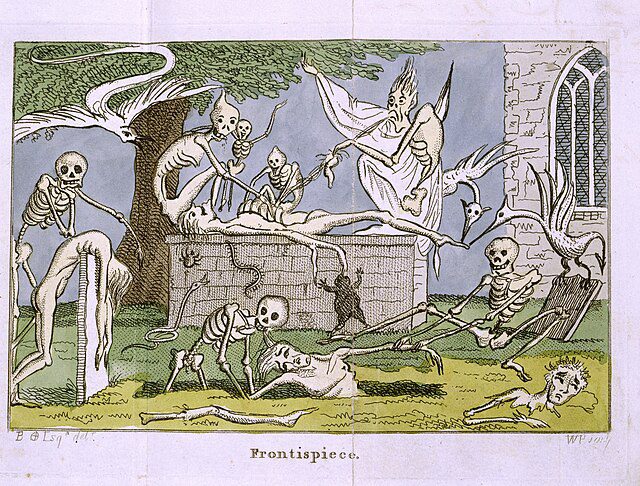
Skeletons from
Tales of Terror
1808
What follows is a Dharma talk by Dr Chris Hoff delivered at our 18th of May, 2024, Empty Moon Zen Saturday morning gathering. He is one of our Zen dharma teachers at Empty Moon Zen. Dr Hoff leads our Zen recovery sangha. He is also Executive Director of the nonprofit California Family Institute, which provides access to counseling services to underserved communities. He also has a podcast, the Radical Therapist, which is well worth a visit.
***
Last Saturday, during our monthly book study group that takes place on the 2nd Saturday of the
Month. I was reminded of one of the great shames of my life. Our group is studying
The Book of Householder Koans, by Eve Marko & Wendy Nakao. Last week were studying the chapter Titled Enju: The Black Abyss which explores ideas of loss, illness, old age, and death. In the conversations that ensued I was reminded of the time my favorite cat, Kitty, was to be put to sleep.
I had journeyed with Kitty for almost 20 years at the time. Kitty was my best friend
through thick and thin, Kitty was there for me when I was deep in my alcohol and drug
use, comforting me when I was experiencing a loneliness few know, and there for me when I
entered recovery and experienced a different sort of loneliness as my life was rearranging into something new. The great shame was that when it came time to put Kitty to sleep. I couldn’t do it. I couldn’t be in the room. My great shame was that I didn’t have the courage to meet death with my best friend. I didn’t show up for my friend. I asked my wife to stand in for me. I have never forgotten this shame.
Later that same day I read an article in the Guardian written by a therapist titled We All Want to Cut Out the Bad Parts of Ourselves. It Won’t Work and It Won’t Make Us Happier. In the article the author describes how as a therapist there is an expectation that she will help her clients to somehow cut out all the bad parts they wish to ignore and banish them forever. Her argument, and mine too, is that her clients have shown her time and time again that a better life is not one where we ignore or hide from all the things, we find objectionable about ourselves, but it’s found in forming a deeper relationship with ALL of ourselves and leaning in with genuine care for the good, the bad, and the ugly.
This article also had me thinking of spiritual bypassing. Spiritual bypassing, a term first coined by psychologist John Welwood in 1984, refers to the use of spiritual practices and beliefs to avoid dealing with emotional issues, psychological wounds, and unfinished business. From a Buddhist perspective, spiritual bypassing can manifest when individuals use Buddhism’s teachings and meditation practices to avoid facing personal issues, emotional pain, and unresolved problems. You see this play out in spiritual communities where folks have been harmed by teachers who, while quite skilled and wise in many ways, have avoided personal and emotional issues that always seem to find their way out and into their relationships. I’m always struck dumbfounded when this happens. But after I have had time to digest the judgement and critique that comes up for me, in my better moments, I understand that I am them too. Prone to all the mistakes this human life offers up. Making my equal share of harmful mistakes as well. Just not in the spotlight.
I suppose it’s hard to blame us for wanting to ignore or hide from all the things about ourselves we can’t stomach. We live in a culture that is increasingly encouraging us to not look clearly at ourselves. The last couple of decades has been ripe with leaders that promote a special brand of shamelessness. We are increasingly encouraged to point out the speck in our neighbor’s eye, while ignoring the plank in our own eye. Also, in this effort to not look at our shortcomings, in many cases we would rather take on some psychiatric diagnosis as our identity, than face the fact that we might just be an asshole. And in my work as a relational therapist, it’s getting darn near impossible to get anyone to take accountability, or make amends. Being right is the epidemic of our time.
So why is this important for practitioners for Zen. Why is this turning away from the shadows of ourselves an important matter for those on a spiritual path? Well, if we can’t get clear about our own suffering, how are we going to help others with their suffering?
I am a student of the Koan way. It wasn’t really by intentional choice. It’s because I’ve had the good fortune of establishing a teacher student relationship with James Ford. If you are going to practice with James, you are going to be doing Koans. I’m not the best Koan student. I know that. But I show up. While I often fumble with Koans there is one Koan that I have kept close since I first encountered it. This Koan is important to me for several reasons. It’s considered a “minor” Koan. It is included in a collection called “Miscellaneous Koans and it goes “Save a ghost.”
My teacher James said that in the Miscellaneous Koans we are learning how to deepen and widen our encounter with the most intimate things of our lives. And when I was first confronted with this question, I had an experience. An experience that can best be described as transformative. This seemingly “miscellaneous” Koan opened me up to a deep encounter with myself. I now carry it closely. It is a koan for my life, for the work I do as a therapist, and for our contemporary times. Why this Koan? I suppose because of where it points. My teacher has written that when we use the word Ghost in English we mean something specific. We mean something left over after a person has died. We are speaking of something lingering. Something that haunts.
Did you hear a Meow?
Dogen taught:
To study the Buddha Way is to study the self; to study the self is to forget the self; to forget the self is to be actualized by myriad things. When actualized by myriad things, your body and mind as well as the body and mind of others drop away. No trace of realization remains and this no trace continues endlessly.
If you’ve been around Zen a while, I’m sure you are familiar with this teaching, to study the self is to forget the self. When I first started practicing, I sort of always wondered how do we study the self? I thought we were supposed to forget the self. The self is an illusion, a dream, full of traps and snares. That moment with that “minor’ Koan Save A Ghost provided a realization for my question.
In 12 step recovery there is a process by which folks are asked to study the self. It is the 4th step. The 4th step asks people in recovery to make a searching and fearless moral inventory of themselves. This step involves a thorough and honest self-examination. The purpose is to identify and acknowledge personal challenges, resentments, fears, and harmful behaviors in relationships. It’s a process of self-reflection and self-awareness that requires courage and honesty. It is an act of growing up on a spiritual path.
When I first embarked on this task in my own recovery, before I ever was introduced to Dogen, I heard an older gentlemen say that the 4th step, this deep process of self-searching, wasn’t about finding out what bad people we are, but rather, finding out who we are not, removing it, and letting who we really are show up.
Or as Dogen taught, to study the Buddha Way is to study the self; to study the self is to forget the self; to forget the self is to be actualized by myriad things.
Bodhisattvas everywhere.
Back to shame. Or my shame.
The Buddha called shame the bright guardian of the world and a noble treasure, something of such value, that it could keep you from a life of regret and harm.
According to Buddhist monk Thanissaro Bhikkhu There are two kinds of shame — the unhealthy shame that’s the opposite of what gets described as self-esteem, and a healthy shame that’s the opposite of shamelessness. It is this second kind of shame that the Buddha calls a bright guardian and a treasure. Thanissaro Bhikkhu also argues that when all shame gets pathologized and is not approached mindfully, it goes underground in the mind, where people can’t think clearly about it, and then sends out tentacles that spread harm all around us.
The buddha believed with proper training healthy shame could be a useful antidote, helping to bring the topic into the open and to show that shame can be a great force for good and personal accountability. A very different conclusion than the many folks working to abolish shame. Many of them in my field.
In my time with him, my teacher has been very clear that this project, Zen, isn’t a psychological project but rather one of awakening. Because of my profession, I suppose I will always need to be careful of the risk of psychologizing Buddhism. To present something other than a path of awakening. However, my teacher also has been clear about another aspect of the path of awakening that I think psychology, or therapy, does have a role. That is in the project of growing up. I believe awakening is real. Awakening is possible. But in my case, the journey toward awakening had to start with growing up. Still does.
I lost both my parents over the last year. It has been difficult times. In these losses I have had quite a different experience from the turning away during the death of my favorite cat/friend Kitty. I didn’t turn away with my parents. I showed up. I don’t think that would have happened if I hadn’t examined the shames of my life. The hard parts. The regrets.
Save a Ghost
The 4th step
A bodhisattva cat who continues to teach.
All taught me not to turn away.
Look, look, look closely. Even at the scary stuff. Especially the scary stuff.
New Visions
History and Religion
Previous Post
May 18, 2024
Recalling the American Zen Founder Shunryu Suzuki
Next Post

May 24, 2024 Recalling the Romani Saint Sarah e Kali
Recent Comments
"Allowing anger to contaminate one's hard disk can be detrimental to one's holistic well being. ..."
Hot Anger: Meeting Anger in Zen ..."
"I love this koan. every which way you turn it bites you, Thirty years on ..."
Nanquan Cuts the Cat: A Jesuit ..."
"As a substitute for religion, Zen is probably better than taking drugs. However, it can ..."
The Selling of Zen at the ..."
"Craving and aversion are detrimental to one's peace and happiness. Easter is a wake up ..."
Easter: A Zen Buddhist Appreciation
Browse Our Archives
Select a Category A Christmas Carol Abolitionist African-American Ahmadiyya Alan Watts Aldous Huxley Allen Ginsberg Amedkar Jayanti American politics American Zen Anaheim Zen Sangha Anglican Annie Besant April Fool Armageddon Art and Religion artificial intellegence Atheist Awakening B R Ambedkar Barlaam & Josaphat Beatnik Between Bhagavad Gita Bible biography birthday bodhisattva Bodhisattva Precepts Book burning Book of Common Prayer Book of Mormon Brahmo Samaj Buddha Buddhism Buddhist Buddhist Lord's Prayer Butterflies Calendars cartoons cat ChatGPT Chicken Tortilla Soup choices Christian atheism Christian mysticism Christian origins Christian Science Christian Zen Christianity Christianity and Buddhism christmas Christmas Truce Christopher Isherwood Church of Later Day Saints Cinco de Mayo circus covenant critical thinking culture D. T. Suzuki Dalit Buddhism Daniel Defoe Desert Fathers and Mothers dharma talk Dogen Donald Trump Dongshan's Five Ranks Dorothy Day dream Duty Easter ecology Edwin Arnold emptiness Empty Moon Zen Network Episcopal Church Eternal Now Ethics evolution existentialism Faith fantasy Fathers Day film film review fire Five Ranks Folk music food Form and emptiness Four Seals Francis of Assisi Francis Xavier Free thinker friendship George MacDonald Gerald Heard Glenn Taylor Webb God Good Friday Gospel of Gospel of Mark Gospel of Thomas grace Graduate Theological Unioin Graduate Theological Union Guanyin H R Blyth Hakuin Ekaku Hanamatsuri Hanukkah Harada Yasutani Zen Heart Sutra Henry David Thoreau Hermann Hesse Hinduism History and Religion history of religion Holy Spirit home Hospitality Icon Ides of March Isaac Newton Islam Islamic mysticism Jack Kerouac James Luther Adams Jiddu Krishnamurti Joan of Arc Johannes Gutenberg John Donne joke Judaism justice karma kensho King James Bible koan Koun Yamada Kyoto School Lewis Carrol Liberal Christianity Liberal Religion Life Plan Community Liminal literature Literature and Religion Liturgy Lord's Prayer Love Mahatma Gandhi Mahayana Martin Luther King Jr Mary Baker Eddy Mary Magdelene Mary Oliver Mayflower Compact Meditation memories memory metaphor money money and religioin Mormons Mother's Day movie review mysticism mythic Neighborhood Unitarian Universalist Church New Thought Nichiren Buddhism Nonduality not knowing Omar Khayyam Pacific School of Religion pagan Palm Sunday Passover peace Pentecost perennialism Phantastes Philip Kapleau philosophy Pilgrimage poetry Poetry and Religion politics Prayer Precepts Printing Press prophecy prophetic spirituality psychology Pure Land Queer religion queering religion Quietism Ram Mohan Roy rebirth recipe Relationships and religion religion religion and history Religious syncretism Resistance Retirement Retreat review Rissho Kosei Kai Ritual Robert Aitken Roshi Robert Ingersoll Rohatsu Romani religion Rosie the Riveter saints samadhi SanboZen Sangha Satyagraha science science and reigion science and religion science fiction seminary sermon Sesshin Sex and Religion Shinran Sikh Sikh tradition silence Social Justice Socially Engaged Buddhism Society and religion Soto Zen soul spiritual community spiritual practice Spirituality Sufism Suicide superstition Taoism Television Teresa of Avila Thanksgiving theological schools Theosophy Thomas Merton Time Transcendentalism Transcendentalist Trinitarian Trinity Uncategorized unitarian Unitarian Christianity Unitarian Universalist Universalism Vajrayana Vedanta Walking war Willa Cather William Ellery Channing wisdom women and religion women in religion World Teacher Writing zazen Zen Zen Center Zen inspired retriement zen meditation Zen Precepts Zen women
Select a Month September 2026 August 2026 July 2026 June 2026 May 2026 April 2026 March 2026 February 2026 January 2026 December 2025 November 2025 October 2025 September 2025 August 2025 July 2025 June 2025 May 2025 April 2025 March 2025 February 2025 January 2025 December 2024 November 2024 October 2024 September 2024 August 2024 July 2024 June 2024 May 2024 April 2024 March 2024 February 2024 January 2024 December 2023 November 2023 October 2023 September 2023 August 2023 July 2023 June 2023 May 2023 April 2023 March 2023 February 2023 January 2023 December 2022 November 2022 October 2022 September 2022 August 2022 July 2022 June 2022 May 2022 April 2022 March 2022 February 2022 January 2022 December 2021 November 2021 October 2021 September 2021 August 2021 July 2021 June 2021 May 2021 April 2021 March 2021 February 2021 January 2021 December 2020 November 2020 October 2020 September 2020 August 2020 July 2020 June 2020 May 2020 April 2020 March 2020 February 2020 January 2020 December 2019 November 2019 October 2019 September 2019 August 2019 July 2019 June 2019 May 2019 April 2019 March 2019 February 2019 January 2019 December 2018 November 2018 October 2018 September 2018 August 2018 July 2018 June 2018 May 2018 April 2018 March 2018 February 2018 January 2018 December 2017 November 2017 October 2017 September 2017 August 2017 July 2017 June 2017 May 2017 April 2017 March 2017 February 2017 January 2017 December 2016 November 2016 October 2016 September 2016 August 2016 July 2016 June 2016 May 2016 April 2016 March 2016 February 2016 January 2016 December 2015 November 2015 October 2015 September 2015 August 2015 July 2015 June 2015 May 2015 April 2015 March 2015 February 2015 January 2015 December 2014 November 2014 October 2014 September 2014 August 2014 July 2014 June 2014 May 2014 April 2014 March 2014 February 2014 January 2014 December 2013 November 2013 October 2013 September 2013 August 2013 July 2013 June 2013 May 2013 April 2013 March 2013 February 2013 January 2013 December 2012 November 2012 October 2012 September 2012 August 2012 July 2012 June 2012 May 2012 April 2012 March 2012 February 2012 January 2012 December 2011 November 2011 October 2011 September 2011 August 2011 July 2011 June 2011 May 2011 April 2011 March 2011 February 2011 January 2011 December 2010 November 2010 October 2010 September 2010 August 2010 July 2010 June 2010 May 2010 April 2010 March 2010 February 2010 January 2010 December 2009 November 2009 October 2009 September 2009 August 2009 July 2009 June 2009 May 2009 April 2009 March 2009 February 2009 January 2009 December 2008 November 2008 October 2008 September 2008 August 2008 July 2008 June 2008 May 2008 April 2008 March 2008 February 2008 January 2008 December 2007 November 2007 October 2007 September 2007 August 2007 July 2007 June 2007 May 2007 April 2007 March 2007 February 2007 January 2007 December 2006 November 2006 October 2006 September 2006
Follow Us!
TAKE THE
Religious Wisdom Quiz
Which prophet was exiled to Babylon and saw a vision of four living creatures?
Select your answer to see how you score.
Hosea Joel Jeremiah Ezekiel
Related posts from Monkey Mind

Keizan Jokin: The Zen Master Ancestor You Don't...

What Zen Practice Actually Does With Anger

Nanquan Cuts the Cat: A Jesuit commentary on...

On Taking Refuge in the Dharma
TRENDING AT PATHEOS Buddhist

The Sermon on the Mount, Part I: Matthew...
The Sermon on the Mount, Part I (Matthew 4:12-5:12) St. Matthew moves...

What's up from Crossway: Reviewing some of their latest A few weeks...

Janie Learns the Way of the Cross: A...
Teaching children about Jesus' Passion can be challenging. Many parents and educators...

Looking For Good Catholic Writing - October 2026
He alone extends the heavens, and he walks upon the waves of...

In "Irreplaceable," our book on vocation and technology, Trevor Sutton and I...

I was strolling through the top floor of the brand new Parthenon...
view all Buddhist blogs
What Are Your Thoughts?leave a comment
Ad-Free & Subscriber Log-In Subscription Support
- About Us
- 2026 Calendar
- Videos
- Podcasts
- Library of World Religions
- Faith In Media Tracker
- Advertise With Us
- Write for Us
- Privacy Policy
- Terms of Service
- Do Not Sell My Data
- Contact Us
- Radiant Digital
- Manage Newsletter Subscriptions
- Unsubscribe From Notifications
- Sitemap
Copyright 2008-2026, Patheos. All rights reserved.
Subscription Support Ad-Free & Subscriber Log-In
Follow Patheos