
BuddhistCatholicContemplativeEvangelicalGeneral ChristianHinduJewishLatter-day SaintMuslimNew VisionsProgressive Christian
Beliefs
- Buddhist
- Catholic
- Contemplative
- Evangelical
- General Christian
- Hindu
- Jewish
- Latter-day Saint
- More Voices
- Muslim
- New Visions
- Pagan
- Progressive Christian
Topics
- Religion News
- Food and Religion
- Sports and Religion
- Religious Art
- Religious Music and Entertainment
- Religious Events
- History and Religion
- Style and Religion
- Politics and Religion
- Women in Religion
- Recreation Outdoors and Religion
- Business Finance and Religion
- Careers Workplace and Religion
- Education and Religion
- Family Parenting and Religion
- Health Fitness and Religion
- Home and Religion
- Relationships and Religion
- Technology and Religion
- Travel and Religion
Columnists
- Buddhist Columnists
- Business Finance and Religion Columnists
- Careers Workplace and Religion Columnists
- Catholic Columnists
- Contemplative Columnists
- Education and Religion Columnists
- Evangelists Columnists
- Family Parenting and Religion Columnists
- General Christian Columnists
- Health Fitness and Religion Columnists
- Hindu Columnists
- History and Religion Columnists
- Home and Religion Columnists
- Jewish Columnists
- More Voices Columnists
- Latter Day Columnists
- Muslim Columnists
- New Visions Columnists
- Nonreligious Columnists
- Pagan Columnists
- Politics and Religion Columnists
- Progressive Columnists
- Recreation Outdoors and Religion Columnists
- Relationships and Religion Columnists
- Religion News Columnists
- Religious Art Columnists
- Religious Events Columnists
- Religious Music and Entertainment Columnists
- Sports and Religion Columnists
- Style and Religion Columnists
- Technology and Religion Columnists
- Travel and Religion Columnists
- Women in Religion Columnists
Resource Library
- 2026 Calendar
- Library of World Religions
- The 100 Most Holy Places on Earth
- Patheos Answers
- Podcasts
- Videos
- Faith Leaders Database
- Anglican Episcopalian
- Bahai
- Baptist
- Buddhism
- Christianity
- Confucianism
- Eastern Orthodoxy
- Hinduism
- Holiness and Pentecostal
- ISKCON
- Islam
- Judaism
- Lutheran
- Methodist
- The Church of Jesus Christ of Latter-day Saints
- New Age
- Paganism
- Presbytarian and Reformed
- Protestantism
- Religion Behind the Scenes
- Roman Catholic
- Scientology
- Shia Islam
- Sikhism
- Sufism
- Sunni Islam
- Taoism
- Zen
- See all religions
Research Tools
 Ad-Free & Subscriber Log-In Subscription Support
Ad-Free & Subscriber Log-In Subscription Support
Follow Patheos 

- Trending:
- Forgiveness
- |
- Marriage
- |
- Consciousness
- |
- Death Penalty
- |
- Election
- |
- Halloween

- Home
- Buddhist
- History and Religion
- My Three body Problem: Zen, Jesus, and a Holy Communion
My Three body Problem: Zen, Jesus, and a Holy Communion
Last updated on: April 15, 2024 at 12:04 pm by James Ford
My Three body Problem: Zen, Jesus, and a Holy Communion 2024-04-15T12:04:03-07:00 James Ford
Patheos Explore the world's faith through different perspectives on religion and spirituality! Patheos has the views of the prevalent religions and spiritualities of the world.
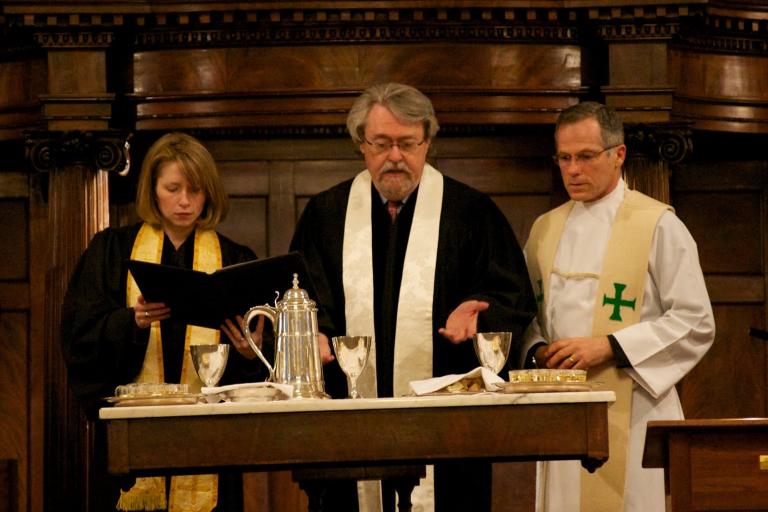
The Reverend James Ishmael Ford celebrating the Eucharist for Maundy Thursday at the First Unitarian Church of Providence.
Two things have been burrowing into my heart of late.
The first happened with a manuscript I’ve written for an introduction to Zen scheduled to be published next year. A number of my early readers commented on the Christian references in it. One noted straight out that it was “Christian Zen.” The confusion for me was that I never saw it that way. I thought I was simply enriching a pretty straight forward Mahayana Buddhist pespective. And if there were any departure from an orthodox Zen Buddhism, it was of a rationalist inclined sort. I was writing from what I’m coming to think of as my “spare Zen Buddhism.” But, it wasn’t one reader.
The second was from just a week. I was in conversation with a dear friend, a Soto Zen priest. I congratulated him on deciding to begin koan introspection work with a teacher I love and respect. He volunteered somewhat embarrassed, it seemed, that he didn’t ask me for two reasons. One was my apparent refrain that I’m getting old and more about ending things than starting things. The second, which he insisted wasn’t the big thing, but included, was your “Jesus thing.”
As I said, it’s all kind of digging into me.
I have an oft repeated summary of my faith stance. I claim a physiology of faith; a Buddhist brain, a Christian heart, and a rationalist naturalist stomach.
In my life this comes together as a song with several blending melodies.
Maybe a broken song, it certainly carries a sense of wound, and, miraculously, that has made a life.
As to the brain part.
Even this most prosaic aspect is for me a wonder and a miracle.
I unpack this as meaning my basic understanding of the world and the human condition is that “spare” Mahayana Buddhism. It’s a version of the three seals. My working hypothesis is that 1) everything made of parts will at some point come apart. 2) there are no essences to things, they are composed in a moment when causes and conditions gather, and cease when the conditions change. 3) human hurt arises as we misunderstand the nature of the world and our minds and hearts, and grasp too tightly at what is passing. And, 4) there is a way through this to a peace that passes all understanding. (Another of those Christian allusions…)
This is further enriched by my understanding of the two truths and the three bodies. The two truths as I understand it is the observation that this phenomenal world, where you and I live, the world of history and of consequences is exactly identical with that place usually called emptiness, boundlessness. The three bodies describes our encounters of the fundamental realities, including this historical world of pain and joy, and the empty world. But it notes a third place as well, a place of dream and wonder.
And that’s where the heart thing happens for me.
I have a simple anecdote to introduce this. I note how I learned to read from a large illustrated King James Bible resting on my grandmother’s lap. When I recently heard George Santayana’s “There is no God, and Mary is his mother,” I instantly understood that. If the world is made of stories, the stories I know from the core of my bones come from the Bible. I say that I dream Moses & Miriam, Jesus & the Marys. It’s often literally true.
And finally there’s that rationalist disposition. I am a child of the Western Enlightenment. I look at the natural world, and I see enough. I hear theistic friends who say they look at the majesty and grandeur of the cosmos and assume there must be a God. I witness the same things and feel awe. But I simply do not see a logical connection between what I witness and some assertion of a human-like mind behind it.
But I do love that there are those who are life committed to unpacking the mysteries of the mechanisms. Knowing the how is a wondrous thing.
And.
The world I live in is an unfolding mystery. It’s informed by the scientific investigation of things. In our corner of the universe if follows pretty straight forward laws. Although I’m told by smart people those laws may not apply everywhere and at all times. Still, if someone makes an assertion about the world or the human condition, for me a very good test as to whether that assertion is true, is what is the evidence for the assertion? And if there is no evidence, or if the evidence is strictly anecdotal, my response is extremely skeptical.
And. I’m not simply a materialist. I find those who embrace that term are too often reductionists. I also notice often the great scientists are kinds of mystics.
While I share a desire for the bare truth of a thing, I’ve noticed how elusive that sort of thing is. And, meaning (as well as meaninglessness) lives within a different place than a description of the how of it. The mysteries of the universe are not reducible to the described and tested. As I’ve noted the smart people tell us the fundamental rules are not at all certain. And, very much the truths of our hearts, our feeling lives, where we actually exist, are not reducible to the testable. Although they can help us sort some of the assertions and incline our engagement with other assertions.
My observation is that our minds are wonderful things. They have a quasi-independence. That is while it seems obvious to me our minds are rooted in our material existence and specifically located in our brains, they are not strictly epiphenomenal. The brain’s mind exists in some sort of biological feedback loop with the rest of the body. Hence both psychosomatic illness and the power of the placebo effect.
Our minds are somewhat independent but are also totally of the body. What we think of as normal or sane is largely informed by a complex and moving balance of chemicals. But that’s just a description.
Then there’s where and how we live.
As Emily Dickinson sang to us somewhere around 1862:
The Brain—is wider than the Sky—
For—put them side by side—
The one the other will contain
With ease—and you—beside—
The Brain is deeper than the sea—
For—hold them—Blue to Blue—
The one the other will absorb—
As sponges—Buckets—do—
The Brain is just the weight of God—
For—Heft them—Pound for Pound—
And they will differ—if they do—
As Syllable from Sound—
What I’ve come to find in this life is how we all build worlds out of stories vastly more than from facts as in those things that can be tested. A truth, I’ve found, universally applicable.
At this stage of my life, living in a world, this world, accepting the natural, embracing it with all my being, I allow it to teach me through those stories, to inform and direct my life.
The first of these stories is that guidance from those four seals.
A truth, the truth that lives within my being. It is how I see the world is, the unfolding of the mystery.
So. With that the next question. How to live this?
The next among those stories is the unfolding out of my culture’s ancient root wisdoms found in the narratives of Judaism and Christianity. With the odd adjustment from the stories of Islam, especially those Sufis. And, also, over the many years enriched and directed from the stories of the Zen tradition, most especially those enshrined in the koan literature, driven into my being, framing my being through the disciplines of the koan way.
The koan way, the question that contains its answer, the pointer and the invitation. The way of the deep.
It is learning to live with what is as it unfolds as it is.
And through the gift of my three body problem, I have a life.
From one angle I’m a rationalist, and a naturalist.
From another a pretty straight forward Zen Buddhist of a koan school.
And, from another a child of Jesus and those Marys.
I’m a kind of atheist. But, I don’t fear God language. I know to take off my shoes when I approach the mystery.
The mighty one for me is beyond all categories. My God is a pregnant emptiness. The nothing that is constantly birthing the worlds.
And that God calls with each in breath, with every out breath.
My longing and my home.
Out of that beautiful gift of a sense of a natural world, out of the deep wisdom of the Buddha and Nagarjuna and my Zen ancestors, I’m given a way to understand my dream worlds of Moses and Jesus and, especially of our mother Mary who is also Guanyin.
If I were to name the face of God, the door to God, the heart of God, it’s Mary.
Mary, sweet, terrifying Mary. Here I hear the dream of the dream, the manifestation of a life, of our lives. The playing out of all our hearts, an the call of the mystery into mystery.
My soul proclaims your greatness, O God! My heart rejoices in you, my Savior,
because you have showered your servant with blessing! From now to the end of time,
all generations will know the great things you have done for me.
Mighty One! Your name is holy! In every age, your compassion flows to those who reverence you! But all who seek to exalt themselves in arrogance will be leveled by your power.
You have deposed the mighty from their seats of power, and have raised the lowly to high places. Those who suffer hunger, you have filled with good things. Those who are privileged, you have turned away empty-handed.
You have come to the aid of your people, in fulfillment of the promise you made to our ancestors when you spoke blessing to Sarah and Hagar and all their descendants, to the utmost generation!
I notice the ecstatic gift.
And this is where I live with my rational heart, my great lens through which to engage with the invitation of the koan way, dreaming the world through those stories of scripture…
And I notice the call to serve. Symboled most of all by the poor and the left behind.
The call of this broken world. So full of pain. So full of love.
And a life to be lived.
Maybe this is my three body problem.
But problems, well, another interesting word. More like invitations, it seems.
Maybe there’s something for you in this, my little confession? Only you will know, of course.
But. My confession. The gift given me by this world and my heart.
A broken hallelujah.
A holy communion…
New Visions
History and Religion
Previous Post
April 14, 2024
B. R. Ambedkar's Socially Engaged Buddhism
Next Post
April 17, 2024 Swami Vivekananda on the Buddha's Message
Recent Comments
"Allowing anger to contaminate one's hard disk can be detrimental to one's holistic well being. ..."
Hot Anger: Meeting Anger in Zen ..."
"I love this koan. every which way you turn it bites you, Thirty years on ..."
Nanquan Cuts the Cat: A Jesuit ..."
"As a substitute for religion, Zen is probably better than taking drugs. However, it can ..."
The Selling of Zen at the ..."
"Craving and aversion are detrimental to one's peace and happiness. Easter is a wake up ..."
Easter: A Zen Buddhist Appreciation
Browse Our Archives
Select a Category A Christmas Carol Abolitionist African-American Ahmadiyya Alan Watts Aldous Huxley Allen Ginsberg Amedkar Jayanti American politics American Zen Anaheim Zen Sangha Anglican Annie Besant April Fool Armageddon Art and Religion artificial intellegence Atheist Awakening B R Ambedkar Barlaam & Josaphat Beatnik Between Bhagavad Gita Bible biography birthday bodhisattva Bodhisattva Precepts Book burning Book of Common Prayer Book of Mormon Brahmo Samaj Buddha Buddhism Buddhist Buddhist Lord's Prayer Butterflies Calendars cartoons cat ChatGPT Chicken Tortilla Soup choices Christian atheism Christian mysticism Christian origins Christian Science Christian Zen Christianity Christianity and Buddhism christmas Christmas Truce Christopher Isherwood Church of Later Day Saints Cinco de Mayo circus covenant critical thinking culture D. T. Suzuki Dalit Buddhism Daniel Defoe Desert Fathers and Mothers dharma talk Dogen Donald Trump Dongshan's Five Ranks Dorothy Day dream Duty Easter ecology Edwin Arnold emptiness Empty Moon Zen Network Episcopal Church Eternal Now Ethics evolution existentialism Faith fantasy Fathers Day film film review fire Five Ranks Folk music food Form and emptiness Four Seals Francis of Assisi Francis Xavier Free thinker friendship George MacDonald Gerald Heard Glenn Taylor Webb God Good Friday Gospel of Gospel of Mark Gospel of Thomas grace Graduate Theological Unioin Graduate Theological Union Guanyin H R Blyth Hakuin Ekaku Hanamatsuri Hanukkah Harada Yasutani Zen Heart Sutra Henry David Thoreau Hermann Hesse Hinduism History and Religion history of religion Holy Spirit home Hospitality Icon Ides of March Isaac Newton Islam Islamic mysticism Jack Kerouac James Luther Adams Jiddu Krishnamurti Joan of Arc Johannes Gutenberg John Donne joke Judaism justice karma kensho King James Bible koan Koun Yamada Kyoto School Lewis Carrol Liberal Christianity Liberal Religion Life Plan Community Liminal literature Literature and Religion Liturgy Lord's Prayer Love Mahatma Gandhi Mahayana Martin Luther King Jr Mary Baker Eddy Mary Magdelene Mary Oliver Mayflower Compact Meditation memories memory metaphor money money and religioin Mormons Mother's Day movie review mysticism mythic Neighborhood Unitarian Universalist Church New Thought Nichiren Buddhism Nonduality not knowing Omar Khayyam Pacific School of Religion pagan Palm Sunday Passover peace Pentecost perennialism Phantastes Philip Kapleau philosophy Pilgrimage poetry Poetry and Religion politics Prayer Precepts Printing Press prophecy prophetic spirituality psychology Pure Land Queer religion queering religion Quietism Ram Mohan Roy rebirth recipe Relationships and religion religion religion and history Religious syncretism Resistance Retirement Retreat review Rissho Kosei Kai Ritual Robert Aitken Roshi Robert Ingersoll Rohatsu Romani religion Rosie the Riveter saints samadhi SanboZen Sangha Satyagraha science science and reigion science and religion science fiction seminary sermon Sesshin Sex and Religion Shinran Sikh Sikh tradition silence Social Justice Socially Engaged Buddhism Society and religion Soto Zen soul spiritual community spiritual practice Spirituality Sufism Suicide superstition Taoism Television Teresa of Avila Thanksgiving theological schools Theosophy Thomas Merton Time Transcendentalism Transcendentalist Trinitarian Trinity Uncategorized unitarian Unitarian Christianity Unitarian Universalist Universalism Vajrayana Vedanta Walking war Willa Cather William Ellery Channing wisdom women and religion women in religion World Teacher Writing zazen Zen Zen Center Zen inspired retriement zen meditation Zen Precepts Zen women
Select a Month September 2026 August 2026 July 2026 June 2026 May 2026 April 2026 March 2026 February 2026 January 2026 December 2025 November 2025 October 2025 September 2025 August 2025 July 2025 June 2025 May 2025 April 2025 March 2025 February 2025 January 2025 December 2024 November 2024 October 2024 September 2024 August 2024 July 2024 June 2024 May 2024 April 2024 March 2024 February 2024 January 2024 December 2023 November 2023 October 2023 September 2023 August 2023 July 2023 June 2023 May 2023 April 2023 March 2023 February 2023 January 2023 December 2022 November 2022 October 2022 September 2022 August 2022 July 2022 June 2022 May 2022 April 2022 March 2022 February 2022 January 2022 December 2021 November 2021 October 2021 September 2021 August 2021 July 2021 June 2021 May 2021 April 2021 March 2021 February 2021 January 2021 December 2020 November 2020 October 2020 September 2020 August 2020 July 2020 June 2020 May 2020 April 2020 March 2020 February 2020 January 2020 December 2019 November 2019 October 2019 September 2019 August 2019 July 2019 June 2019 May 2019 April 2019 March 2019 February 2019 January 2019 December 2018 November 2018 October 2018 September 2018 August 2018 July 2018 June 2018 May 2018 April 2018 March 2018 February 2018 January 2018 December 2017 November 2017 October 2017 September 2017 August 2017 July 2017 June 2017 May 2017 April 2017 March 2017 February 2017 January 2017 December 2016 November 2016 October 2016 September 2016 August 2016 July 2016 June 2016 May 2016 April 2016 March 2016 February 2016 January 2016 December 2015 November 2015 October 2015 September 2015 August 2015 July 2015 June 2015 May 2015 April 2015 March 2015 February 2015 January 2015 December 2014 November 2014 October 2014 September 2014 August 2014 July 2014 June 2014 May 2014 April 2014 March 2014 February 2014 January 2014 December 2013 November 2013 October 2013 September 2013 August 2013 July 2013 June 2013 May 2013 April 2013 March 2013 February 2013 January 2013 December 2012 November 2012 October 2012 September 2012 August 2012 July 2012 June 2012 May 2012 April 2012 March 2012 February 2012 January 2012 December 2011 November 2011 October 2011 September 2011 August 2011 July 2011 June 2011 May 2011 April 2011 March 2011 February 2011 January 2011 December 2010 November 2010 October 2010 September 2010 August 2010 July 2010 June 2010 May 2010 April 2010 March 2010 February 2010 January 2010 December 2009 November 2009 October 2009 September 2009 August 2009 July 2009 June 2009 May 2009 April 2009 March 2009 February 2009 January 2009 December 2008 November 2008 October 2008 September 2008 August 2008 July 2008 June 2008 May 2008 April 2008 March 2008 February 2008 January 2008 December 2007 November 2007 October 2007 September 2007 August 2007 July 2007 June 2007 May 2007 April 2007 March 2007 February 2007 January 2007 December 2006 November 2006 October 2006 September 2006
Follow Us!
TAKE THE
Religious Wisdom Quiz
What does Siloam mean?
Select your answer to see how you score.
Love Received Gift Sent
Related posts from Monkey Mind


Keizan Jokin: The Zen Master Ancestor You Don't...

What Zen Practice Actually Does With Anger

Nanquan Cuts the Cat: A Jesuit commentary on...
TRENDING AT PATHEOS Buddhist

The First Eucharistic Controversy: Christ’s Real Presence
For Catholics, the Eucharist is the source and summit of the Christian...

What a Stop Sign Can Teach Us About...
How to Make a Decision When You Can't Hear God Main point:...

Archdiocese Hosts Military Marriage Retreat in Germany
RASTATT, Germany — The transient military lifestyle, with its frequent deployments and...

Nearly every morning, I make the drive to Detroit with my high-school-age...

The Real AI Story Is Adoption Without Trust
Artificial intelligence has crossed a political threshold. It is no longer a...

A new article, written by Jeff Lindsay and Gale L. Pooley,...
view all Buddhist blogs
What Are Your Thoughts?leave a comment
Ad-Free & Subscriber Log-In Subscription Support
- About Us
- 2026 Calendar
- Videos
- Podcasts
- Library of World Religions
- Faith In Media Tracker
- Advertise With Us
- Write for Us
- Privacy Policy
- Terms of Service
- Do Not Sell My Data
- Contact Us
- Radiant Digital
- Manage Newsletter Subscriptions
- Unsubscribe From Notifications
- Sitemap
Copyright 2008-2026, Patheos. All rights reserved.
Subscription Support Ad-Free & Subscriber Log-In
Follow Patheos