
BuddhistCatholicContemplativeEvangelicalGeneral ChristianHinduJewishLatter-day SaintMuslimNew VisionsProgressive Christian
Beliefs
- Buddhist
- Catholic
- Contemplative
- Evangelical
- General Christian
- Hindu
- Jewish
- Latter-day Saint
- More Voices
- Muslim
- New Visions
- Pagan
- Progressive Christian
Topics
- Religion News
- Food and Religion
- Sports and Religion
- Religious Art
- Religious Music and Entertainment
- Religious Events
- History and Religion
- Style and Religion
- Politics and Religion
- Women in Religion
- Recreation Outdoors and Religion
- Business Finance and Religion
- Careers Workplace and Religion
- Education and Religion
- Family Parenting and Religion
- Health Fitness and Religion
- Home and Religion
- Relationships and Religion
- Technology and Religion
- Travel and Religion
Columnists
- Buddhist Columnists
- Business Finance and Religion Columnists
- Careers Workplace and Religion Columnists
- Catholic Columnists
- Contemplative Columnists
- Education and Religion Columnists
- Evangelists Columnists
- Family Parenting and Religion Columnists
- General Christian Columnists
- Health Fitness and Religion Columnists
- Hindu Columnists
- History and Religion Columnists
- Home and Religion Columnists
- Jewish Columnists
- More Voices Columnists
- Latter Day Columnists
- Muslim Columnists
- New Visions Columnists
- Nonreligious Columnists
- Pagan Columnists
- Politics and Religion Columnists
- Progressive Columnists
- Recreation Outdoors and Religion Columnists
- Relationships and Religion Columnists
- Religion News Columnists
- Religious Art Columnists
- Religious Events Columnists
- Religious Music and Entertainment Columnists
- Sports and Religion Columnists
- Style and Religion Columnists
- Technology and Religion Columnists
- Travel and Religion Columnists
- Women in Religion Columnists
Resource Library
- 2026 Calendar
- Library of World Religions
- The 100 Most Holy Places on Earth
- Patheos Answers
- Podcasts
- Videos
- Faith Leaders Database
- Anglican Episcopalian
- Bahai
- Baptist
- Buddhism
- Christianity
- Confucianism
- Eastern Orthodoxy
- Hinduism
- Holiness and Pentecostal
- ISKCON
- Islam
- Judaism
- Lutheran
- Methodist
- The Church of Jesus Christ of Latter-day Saints
- New Age
- Paganism
- Presbytarian and Reformed
- Protestantism
- Religion Behind the Scenes
- Roman Catholic
- Scientology
- Shia Islam
- Sikhism
- Sufism
- Sunni Islam
- Taoism
- Zen
- See all religions
Research Tools
 Ad-Free & Subscriber Log-In Subscription Support
Ad-Free & Subscriber Log-In Subscription Support
Follow Patheos 

- Trending:
- Forgiveness
- |
- Marriage
- |
- Consciousness
- |
- Death Penalty
- |
- Election
- |
- Halloween

- Home
- Buddhist
- Politics and Religion
- A Word of Advice for a Unitarian Universalist Congregation
A Word of Advice for a Unitarian Universalist Congregation
Last updated on: September 17, 2023 at 12:00 pm by James Ford
A Word of Advice for a Unitarian Universalist Congregation 2023-09-17T07:35:00-07:00 James Ford
Patheos Explore the world's faith through different perspectives on religion and spirituality! Patheos has the views of the prevalent religions and spiritualities of the world.
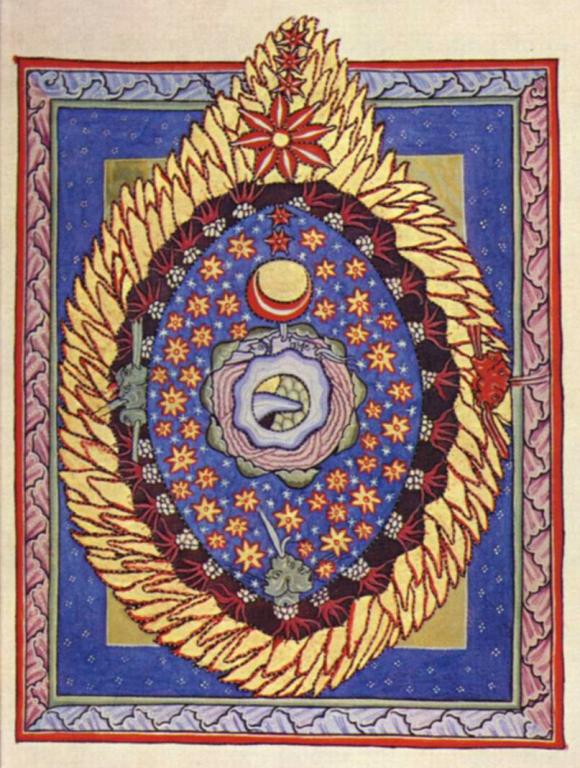
Hildegard
Cosmic Egg
Scivias
I saw a huge form, rounded and shadowy, and shaped like an egg… Its outer layer consisted of an atmosphere of bright fire with a kind of dark membrane beneath it… From the outer atmosphere of fire, a wind blew storms. And from the dark membrane beneath, another membrane raged with further storms which moved out in all directions of the globe.
Hildegard of Bingen, Scivias, Book One, Vision Three
It’s been such an honor, and a genuine pleasure to serve as one of your consulting ministers here at the First Unitarian Church of Los Angeles for these past three years. And, well, everything ends. As the wise remind us, change is the only constant.
For Jan and me, for all practical purposes we’ve moved to Tujunga to be with Jan’s mom. For now, it’s pretty light lifting. But we do need to be around. In reframing our lives for this next bit, I see a broad outline.
Family first.
But also, I’ll continue to write. I now have contracts for two books, what will be my sixth and my seventh. Maybe there’ll be more after these, but I wouldn’t bet a great deal of money on it. The first has been a deal in the works for a while now. It’s a reflection on the arc of the spiritual life which is due from Shambhala Publications in July of 2024. The second, a reflection on the core of Zen teachings against the backdrop of the chaos of religion in the Global North, will be published by Monkfish in the Fall of 2025. Of course, my Monkey Mind blog continues. As of this month I’m beginning my seventeenth year with it. And while nowadays it’s a couple of times a week rather than near daily, I very much continue to enjoy it.
Our online Zen community continues. If you are looking for a meditation group, check us out. Just google Empty Moon Zen, or my name and Zen. As to Unitarian Universalism, the closest congregations to us in our new lives are the two in Pasadena. Next week, I’ve been asked to cover the Sunday services for the minister at Neighborhood Unitarian Church, who has an unexpected obligation. I’m open to being of use. I like being of use. But any future obligations will be light.
I’m feeling my seventy-five years. And this feels enough.
All that said, what about today? What can I say beyond letting you know what my near future plans are, and my expressions of love and gratitude. I am so impressed with this vibrant little band gathered and thriving in the crumbling edifice of an historic church at the heart of one of the great global cities.
I love what I see. And basically, what I see is a manifestation of the spiritual but not religious. Or, in your case, perhaps the spiritual but barely religious. Kind of the hallmark of our contemporary Unitarian Universalism at our best.
I see in your band lots of concern for the world. Care and social engagement beating a strong heart that motivates a lot of what you are about. Although maybe as a group a bit less clear about what that spiritual part might be. This is the First Unitarian Church, after all. And maybe something to attend to. It, some spiritual intuition, is, I suggest, what informs your reaching out to the world. Or can. And understanding it can sustain you for the long haul.
So, this intuition is what I feel is important to talk about today.
As it happens today is celebrated within the Christian world as the feast of Hildegard of Bingen. She was born at the tail end of the eleventh century into the “lower nobility” of the Holy Roman Empire, which you may recall from some history class was not holy, nor Roman, nor an Empire. Rather it was a confederation spanning much of central Europe for quite a while. Hildegard lived in what today is Germany.
She spent her life as a Benedictine nun. She was also a visionary. Which truthfully barely describes the abbess, one of the singular people not only of her age, but right down to today. Her interests and the subjects of her visions were wide, ranging from medicine, to music, to the natural sciences, especially ecology. Hildegard wrote what is generally considered the oldest surviving morality play. Throughout her life she continued to break past the conventions of gender and became a popular preacher, taking three major tours to lecture on her teachings. She became counselor to bishops and kings. She even had the pope’s ear.
Speaking of teachings, through extensive commentaries on her visions Hildegard became a major theologian. I’ll return to her and that in a moment.
A major question for our time and place where the supernatural aspects of religions are increasingly hard to support. Where God has been reduced to the cracks of science, and any idea of human beings standing in any way outside the flow of natural events seeming absurd on the face of it, well, what does this mean for any kind of spirituality? Especially considering that intuition of care and our sense of some call to justice? What about meaning? What about purpose? What can these words mean for us today?
We live in a secular world. That is a nonreligious world. This is a hallmark of our times and extends well beyond the Global North. And one thing for sure, our secular age isn’t big on meaning and purpose. Spiritual practices are reduced to physical and mental hygiene. And somehow the secular has slid rapidly into a bare consumerism.
There’s a lot of analysis of neo-liberalism. When you look at it, some of it is actually coopted by market assumptions. Lots of ironies in our lives. But this ubiquity of markets also points to the sea in which we now live. We are customers and product. And in service to that our lives are distracted from any considerations beyond the market. I’m taken by the Christian term for this distracted world: Empire. It fits. The empire’s tendrils of grasping and endlessly arising fixes to that which ills that are all available for the right price. And, rage at those who dare say otherwise.
Empire also reminds us that this consumer age is simply the most current iteration of something poisonous in our human hearts. And. This is the world we live in. One would be foolish not to understand economics and business at some nitty gritty levels. It is where we live. And pretending otherwise is probably a mistake. But even if this is the world, there is also something profoundly wrong in a consumer driven life. Living in the empire is not a good thing.
It often seems to be a path to despair. I looked and it seems about one in twenty among us are regularly using prescription medications for anxiety. And, for most of us who are, I think its important people have that help. A lot more of us are self-medicating in all sorts of different ways. Again, I’m not really against that. These are practical responses to something deeply wrong.
Yes, with a lot of “buts” and “ands.” But. And. And a turning, or at least an invitation.
What is our spirituality? What might be a current that runs through all our different approaches within this community?
I suggest a great deal of this project turns on engaging nonduality. The term means not dual. It is a view of the world that encompasses two truths that appear on the surface of things to be mutually contradictory. We are as we are in this world you and I and all the other things. Discrete, individual. Rising and falling. Subject to the currents and tides of events.
And. In our Unitarian Universalist sense each of us precious. I suggest because at the very same time of all this rising and falling, the nondual assertion is that we are all bound up together. In some very, very real sense is the assertion we are one. It’s actually within that intuition we can speak of precious, valuable, unique and wondrous.
I suggest to you out of my years, that the spiritual project is about understanding this nonduality as our intimate personal truth. We find it, and we understand ourselves. We find it and we understand our impulse to be of use in this world. This sense realized is a cornucopia of care and love, and, through those things, justice.
It’s good to notice most of religion is about culture. Framed generously religion is about cultural cohesion. Framed more harshly, it’s about crowd control. Religions is mainly about serving the Empire. But is there more to this? Especially as we take the teachings of religions as hard-earned metaphors for deep matters. The literal often is for the Empire. The images and metaphors held not as history but as the currents of our inner lives belong to the nondual.
As I see it most all religions have this nondual aspect. For some it is very much in the background, and on occasion bald assertions of nonduality is suppressed and even violently persecuted. After all, nonduality challenges all sorts of cultural norms, is anathema to the Empire. That said in some religions the nondual gets a more central place. Zen Buddhism is an example. Especially as Zen offers some practical spiritual disciplines to help people find this nondual truth as a personal thing. Although there is a warning in how in Japan the Zen churches were successfully coopted by Empire, in this case the literal one, leading into the second world war. We always have to be careful when engaging the deeper matters of our spiritual lives.
But the important thing I want to share here is that nondual impulse, and its practices. That it exists many places, each with different twists, is also important. To cite two examples. Zen’s nonduality is also nontheistic. Advita Vedanta the nondual in Hinduism is theistic. My take away is how we humans encounter this great nondual mystery in all sorts of ways. I would add our Unitarian Universalist stream of nonduality arises within Transcendentalism, which itself is ultimately nature-centered, and Universalism, the intuition that no one is left behind.
Which brings us, at least briefly, back to the wondrous Hildegard of Bingin. One writer, Marco Vannini, tells us how “Hildegard found the meaning of the unity and divinity of the cosmos with which the human being is profoundly and wonderfully united, to the point of constituting itself a cosmos, and a whole.” There is something potentially powerful for us here as we consider the whole of which we are a part, and in that find an invitation to discover how we, you and I, as we are, recapitulate the whole of the cosmos. As we are. As who we are. Secrets of the nondual.
For Hildegard we humans are each of us the manifestation of the divine. It wasn’t hierarchical as so much of Christianity is, but rather, in her imagery, like a cosmic egg, where all the nested layers are interconnected. And, I find critical for our time and place, centered in the earth. Hers was a mystical ecology, where everyone, and in a very real sense everything is connected, and holy.
There’s a lot in what she says that is directly applicable to a contemporary nature-centered Unitarian Universalism.
Kind of a bottom line: As UUs we are invited to see for ourselves. We start with the individual. But be careful. The seductions of markets, the seductions of consumerisms of all sorts arise from an unbalanced sense of the individual. The Empire rests selling the belief that what makes me feel good for a moment is the measure of all things. And that everything is disposable.
The good in this is that we get to choose. But what we choose matters. Instead of cheap goods and quick fixes, what about the possibilities of looking to the ancestors and guided by them, into the depths of our own hearts? What happens when we allow the mystery to unfold as our living truth?
What I find most important for us, for you, if you hope to find peace for yourselves, and to be active participants in the healing of the many wounds, you need to know for yourself, in your own way, what this nondual is.
It cannot be found in a denial of our individuality. The individual, you, me, we need to see how much we are bound up together. For us, while there are wonderful spiritual disciplines, like meditation, and I commend them, but for UUs specifically the main way we find this by engaging communally.
I suggest we need to reframe what that looks like. This is our sacred work. And maybe yours? We need to move away from the bare inheritance of our Puritan ancestors, or from a knee-jerk reaction by rejecting their myths because they don’t map history. The stories of the ancestors do map our hearts, if always in part, and properly engaged, can be enormously helpful.
Here, I think of Mordecai Kaplan the founder of Jewish Reconstruction. In my years as a UU parish minister, two of the four churches I served housed Reconstructionist congregations. I loved them. On the one hand they were enthusiastic, whole-hearted observers of the tradition. When I think of theologians I tend to think of logicians, theoretical, and frankly, often bloodless. Reconstruction shows something different.
Their services ran on, sometimes for hours, filled with singing and procession and dancing. To the casual observer they looked remarkably like Orthodox or Hasids. But. Women counted for minyan. And I knew for a fact many were agnostics or atheists. Originally Orthodox, Rabbi Kaplan’s approach to the tradition was pragmatic. As he would say of the traditions, they have a vote, but not a veto.
Another line for this is engaging one’s religious tradition seriously but not literally.
Here I see a possible pattern for you all. For Unitarian Universalist’s writ large. But specifically for this congregation in Korea Town.
I think about why it makes sense to embrace the holy rather than simply slipping into secularism. And with that, what might it look like? Where is the orthopraxy of natural religion? I suggest an embrace, specifically, of Transcendentalism and Universalism. In its several strands, the Hindu-like Transcendentalism of Ralph Waldo Emerson, the Taoist-like Transcendentalism of Henry Thoreau, and the feminist Transcendentalism of Margaret Fuller. There are Buddhist Transcendentalist strands. There are Christian Transcendentalist strands.
And equally important discovering the intimations of the nondual that run a rich current through our Universalist history. Our Unitarian strand is rich with stories of standing up to authority. Our Universalist strand is awash with miracle and intimations of joy.
Taken together the invitation for us here today is a New Universalism.
We’ve inherited something rich. Pay a little attention to it.
Here we find endless possibilities.
And this, dear ones, is my last word. I hope it’s useful.
Amen.
New Visions
More Voices
Politics and Religion

Next Post

September 24, 2023 The Dance of Welcoming in Spiritual Communities
Recent Comments
"Allowing anger to contaminate one's hard disk can be detrimental to one's holistic well being. ..."
Hot Anger: Meeting Anger in Zen ..."
"I love this koan. every which way you turn it bites you, Thirty years on ..."
Nanquan Cuts the Cat: A Jesuit ..."
"As a substitute for religion, Zen is probably better than taking drugs. However, it can ..."
The Selling of Zen at the ..."
"Craving and aversion are detrimental to one's peace and happiness. Easter is a wake up ..."
Easter: A Zen Buddhist Appreciation
Browse Our Archives
Select a Category A Christmas Carol Abolitionist African-American Ahmadiyya Alan Watts Aldous Huxley Allen Ginsberg Amedkar Jayanti American politics American Zen Anaheim Zen Sangha Anglican Annie Besant April Fool Armageddon Art and Religion artificial intellegence Atheist Awakening B R Ambedkar Barlaam & Josaphat Beatnik Between Bhagavad Gita Bible biography birthday bodhisattva Bodhisattva Precepts Book burning Book of Common Prayer Book of Mormon Brahmo Samaj Buddha Buddhism Buddhist Buddhist Lord's Prayer Butterflies Calendars cartoons cat ChatGPT Chicken Tortilla Soup choices Christian atheism Christian mysticism Christian origins Christian Science Christian Zen Christianity Christianity and Buddhism christmas Christmas Truce Christopher Isherwood Church of Later Day Saints Cinco de Mayo circus covenant critical thinking culture D. T. Suzuki Dalit Buddhism Daniel Defoe Desert Fathers and Mothers dharma talk Dogen Donald Trump Dongshan's Five Ranks Dorothy Day dream Duty Easter ecology Edwin Arnold emptiness Empty Moon Zen Network Episcopal Church Eternal Now Ethics evolution existentialism Faith fantasy Fathers Day film film review fire Five Ranks Folk music food Form and emptiness Four Seals Francis of Assisi Francis Xavier Free thinker friendship George MacDonald Gerald Heard Glenn Taylor Webb God Good Friday Gospel of Gospel of Mark Gospel of Thomas grace Graduate Theological Unioin Graduate Theological Union Guanyin H R Blyth Hakuin Ekaku Hanamatsuri Hanukkah Harada Yasutani Zen Heart Sutra Henry David Thoreau Hermann Hesse Hinduism History and Religion history of religion Holy Spirit home Hospitality Icon Ides of March Isaac Newton Islam Islamic mysticism Jack Kerouac James Luther Adams Jiddu Krishnamurti Joan of Arc Johannes Gutenberg John Donne joke Judaism justice karma kensho King James Bible koan Koun Yamada Kyoto School Lewis Carrol Liberal Christianity Liberal Religion Life Plan Community Liminal literature Literature and Religion Liturgy Lord's Prayer Love Mahatma Gandhi Mahayana Martin Luther King Jr Mary Baker Eddy Mary Magdelene Mary Oliver Mayflower Compact Meditation memories memory metaphor money money and religioin Mormons Mother's Day movie review mysticism mythic Neighborhood Unitarian Universalist Church New Thought Nichiren Buddhism Nonduality not knowing Omar Khayyam Pacific School of Religion pagan Palm Sunday Passover peace Pentecost perennialism Phantastes Philip Kapleau philosophy Pilgrimage poetry Poetry and Religion politics Prayer Precepts Printing Press prophecy prophetic spirituality psychology Pure Land Queer religion queering religion Quietism Ram Mohan Roy rebirth recipe Relationships and religion religion religion and history Religious syncretism Resistance Retirement Retreat review Rissho Kosei Kai Ritual Robert Aitken Roshi Robert Ingersoll Rohatsu Romani religion Rosie the Riveter saints samadhi SanboZen Sangha Satyagraha science science and reigion science and religion science fiction seminary sermon Sesshin Sex and Religion Shinran Sikh Sikh tradition silence Social Justice Socially Engaged Buddhism Society and religion Soto Zen soul spiritual community spiritual practice Spirituality Sufism Suicide superstition Taoism Television Teresa of Avila Thanksgiving theological schools Theosophy Thomas Merton Time Transcendentalism Transcendentalist Trinitarian Trinity Uncategorized unitarian Unitarian Christianity Unitarian Universalist Universalism Vajrayana Vedanta Walking war Willa Cather William Ellery Channing wisdom women and religion women in religion World Teacher Writing zazen Zen Zen Center Zen inspired retriement zen meditation Zen Precepts Zen women
Select a Month September 2026 August 2026 July 2026 June 2026 May 2026 April 2026 March 2026 February 2026 January 2026 December 2025 November 2025 October 2025 September 2025 August 2025 July 2025 June 2025 May 2025 April 2025 March 2025 February 2025 January 2025 December 2024 November 2024 October 2024 September 2024 August 2024 July 2024 June 2024 May 2024 April 2024 March 2024 February 2024 January 2024 December 2023 November 2023 October 2023 September 2023 August 2023 July 2023 June 2023 May 2023 April 2023 March 2023 February 2023 January 2023 December 2022 November 2022 October 2022 September 2022 August 2022 July 2022 June 2022 May 2022 April 2022 March 2022 February 2022 January 2022 December 2021 November 2021 October 2021 September 2021 August 2021 July 2021 June 2021 May 2021 April 2021 March 2021 February 2021 January 2021 December 2020 November 2020 October 2020 September 2020 August 2020 July 2020 June 2020 May 2020 April 2020 March 2020 February 2020 January 2020 December 2019 November 2019 October 2019 September 2019 August 2019 July 2019 June 2019 May 2019 April 2019 March 2019 February 2019 January 2019 December 2018 November 2018 October 2018 September 2018 August 2018 July 2018 June 2018 May 2018 April 2018 March 2018 February 2018 January 2018 December 2017 November 2017 October 2017 September 2017 August 2017 July 2017 June 2017 May 2017 April 2017 March 2017 February 2017 January 2017 December 2016 November 2016 October 2016 September 2016 August 2016 July 2016 June 2016 May 2016 April 2016 March 2016 February 2016 January 2016 December 2015 November 2015 October 2015 September 2015 August 2015 July 2015 June 2015 May 2015 April 2015 March 2015 February 2015 January 2015 December 2014 November 2014 October 2014 September 2014 August 2014 July 2014 June 2014 May 2014 April 2014 March 2014 February 2014 January 2014 December 2013 November 2013 October 2013 September 2013 August 2013 July 2013 June 2013 May 2013 April 2013 March 2013 February 2013 January 2013 December 2012 November 2012 October 2012 September 2012 August 2012 July 2012 June 2012 May 2012 April 2012 March 2012 February 2012 January 2012 December 2011 November 2011 October 2011 September 2011 August 2011 July 2011 June 2011 May 2011 April 2011 March 2011 February 2011 January 2011 December 2010 November 2010 October 2010 September 2010 August 2010 July 2010 June 2010 May 2010 April 2010 March 2010 February 2010 January 2010 December 2009 November 2009 October 2009 September 2009 August 2009 July 2009 June 2009 May 2009 April 2009 March 2009 February 2009 January 2009 December 2008 November 2008 October 2008 September 2008 August 2008 July 2008 June 2008 May 2008 April 2008 March 2008 February 2008 January 2008 December 2007 November 2007 October 2007 September 2007 August 2007 July 2007 June 2007 May 2007 April 2007 March 2007 February 2007 January 2007 December 2006 November 2006 October 2006 September 2006
Follow Us!
TAKE THE
Religious Wisdom Quiz
A virgin will conceive and bear a son whose name means 'God with us.' What is this prophetic name?
Select your answer to see how you score.
Messiah Jesus Immanuel Rabboni
Related posts from Monkey Mind
Zen and the Dance of Not Knowing
No One is an Island: A small Zen...

Evelyn Underhill's Practical Guide to Prayer
Recalling Thomas Starr King, the Apostle of Liberty
TRENDING AT PATHEOS Buddhist

Nearly every morning, I make the drive to Detroit with my high-school-age...

The Real AI Story Is Adoption Without Trust
Artificial intelligence has crossed a political threshold. It is no longer a...

A new article, written by Jeff Lindsay and Gale L. Pooley,...

Swimfan: Forgotten Aughts Pleasures
This is a recovery effort. In 2002, My Big Fat Greek Wedding...

Top Three Anti-Catholic Lies About Catholicism
This is my initial transcript for the video, "THE 3 WORST...

Pope Leo Celebrates Mass for Nurses & Docs...
I don't have any idea how he did it, but Pope Leo...
view all Buddhist blogs
What Are Your Thoughts?leave a comment
Ad-Free & Subscriber Log-In Subscription Support
- About Us
- 2026 Calendar
- Videos
- Podcasts
- Library of World Religions
- Faith In Media Tracker
- Advertise With Us
- Write for Us
- Privacy Policy
- Terms of Service
- Do Not Sell My Data
- Contact Us
- Radiant Digital
- Manage Newsletter Subscriptions
- Unsubscribe From Notifications
- Sitemap
Copyright 2008-2026, Patheos. All rights reserved.
Subscription Support Ad-Free & Subscriber Log-In
Follow Patheos