
BuddhistCatholicContemplativeEvangelicalGeneral ChristianHinduJewishLatter-day SaintMuslimNew VisionsProgressive Christian
Beliefs
- Buddhist
- Catholic
- Contemplative
- Evangelical
- General Christian
- Hindu
- Jewish
- Latter-day Saint
- More Voices
- Muslim
- New Visions
- Pagan
- Progressive Christian
Topics
- Religion News
- Food and Religion
- Sports and Religion
- Religious Art
- Religious Music and Entertainment
- Religious Events
- History and Religion
- Style and Religion
- Politics and Religion
- Women in Religion
- Recreation Outdoors and Religion
- Business Finance and Religion
- Careers Workplace and Religion
- Education and Religion
- Family Parenting and Religion
- Health Fitness and Religion
- Home and Religion
- Relationships and Religion
- Technology and Religion
- Travel and Religion
Columnists
- Buddhist Columnists
- Business Finance and Religion Columnists
- Careers Workplace and Religion Columnists
- Catholic Columnists
- Contemplative Columnists
- Education and Religion Columnists
- Evangelists Columnists
- Family Parenting and Religion Columnists
- General Christian Columnists
- Health Fitness and Religion Columnists
- Hindu Columnists
- History and Religion Columnists
- Home and Religion Columnists
- Jewish Columnists
- More Voices Columnists
- Latter Day Columnists
- Muslim Columnists
- New Visions Columnists
- Nonreligious Columnists
- Pagan Columnists
- Politics and Religion Columnists
- Progressive Columnists
- Recreation Outdoors and Religion Columnists
- Relationships and Religion Columnists
- Religion News Columnists
- Religious Art Columnists
- Religious Events Columnists
- Religious Music and Entertainment Columnists
- Sports and Religion Columnists
- Style and Religion Columnists
- Technology and Religion Columnists
- Travel and Religion Columnists
- Women in Religion Columnists
Resource Library
- 2026 Calendar
- Library of World Religions
- The 100 Most Holy Places on Earth
- Patheos Answers
- Podcasts
- Videos
- Faith Leaders Database
- Anglican Episcopalian
- Bahai
- Baptist
- Buddhism
- Christianity
- Confucianism
- Eastern Orthodoxy
- Hinduism
- Holiness and Pentecostal
- ISKCON
- Islam
- Judaism
- Lutheran
- Methodist
- The Church of Jesus Christ of Latter-day Saints
- New Age
- Paganism
- Presbytarian and Reformed
- Protestantism
- Religion Behind the Scenes
- Roman Catholic
- Scientology
- Shia Islam
- Sikhism
- Sufism
- Sunni Islam
- Taoism
- Zen
- See all religions
Research Tools
 Ad-Free & Subscriber Log-In Subscription Support
Ad-Free & Subscriber Log-In Subscription Support
Follow Patheos 

- Trending:
- Forgiveness
- |
- Marriage
- |
- Consciousness
- |
- Death Penalty
- |
- Election
- |
- Halloween

- Home
- Buddhist
- Women’s Equality Day & That Image of Rosie the Riveter
Women’s Equality Day & That Image of Rosie the Riveter
Last updated on: August 27, 2023 at 12:00 pm by James Ford
Women’s Equality Day & That Image of Rosie the Riveter 2023-08-27T07:41:10-07:00 James Ford
Patheos Explore the world's faith through different perspectives on religion and spirituality! Patheos has the views of the prevalent religions and spiritualities of the world.
Yesterday, the 26th of August marks a momentous day in US history. Not that you would necessarily know, given the scant attention he received in the press.
It was on that day, yesterday, in 1920, that Bainbridge Colby, the then American Secretary of State signed the proclamation enacting the 19th amendment, securing American women the constitutional right to vote. He did so in the privacy of his home, we can say behind closed doors, at 8am. The press was not invited. Nor were the leading feminists of the day, especially or maybe specifically Alice Paul and Carrie Chapman Catt. I suggest we can see a lot in those facts. All of them.
The run up to that moment was long, very long, and hard, extremely hard. And, of course, of course, the struggle did not end there. Nor, I hope it’s obvious, although apparently it isn’t to everyone, that struggle for full gender equality isn’t anywhere near over. Not if we’re talking about the place of women in our culture. I would add, nor within the world’s various cultures.
This day has been observed in various ways since 1920. And under several names, among them, Suffrage Day, Woman Suffrage Ratification Day, and Women’s Emancipation Day. But it always carried a shadow as it really was mostly, although not exclusively, white women’s suffrage day. And this was noticed.
Being aware of the nuances and incompleteness of it, the 26th of August is still an enormously important marker. Despite the unfinished character of the moment, something truly important and significant happened.
For me it’s joined with another event on a 26th of August. In 1970, for the fiftieth anniversary of that signing, feminist leader Betty Friedan plotted a major demonstration. She managed to attract and if barely kept it together, did keep together what one article called both the “bourgeoise” and “radical crazies.” By the former term middle-class women who formed the core of second wave feminism and by the later term mostly younger people and people of color. Friedan’s demonstration included groups like the National Organization for Women and the Third World Women’s Alliance. It was called the Women’s Strike for Equality. The strike was set for 5pm so working women could attend. Speakers included radical lesbians as well as middle class liberals. No one can say precisely how many people arrived, although one number is 50,000. What we know is that it was very large.
It captured a moment as one article noticed where long simmering discontent among women “that had been brewing since pioneering Rosie the Riveters were fired from their jobs and told to go home to make way for the boys returning after World War II” finally boiled over.
That date is also considered the foundation moment for organized reaction to women’s rights. So, a powerful moment. And like all powerful moments, dangerous. Responding to this and wanting to secure the forward motion of this struggle, Bella Abzug a firebrand representative from New York authored a proclamation for the 26th to be observed as Women’s Equality Day. In 1973 Congress passed the resolution. And every year since then the sitting president has annually renewed the proclamation. To this day. Just read President Biden’s.
This year it is a bit more obscured by the 60th anniversary of the 1970 March on Washington for Jobs and Freedom, led by Dr Martin Luther King Jr, which occurred on the 28th, tomorrow. Speaking of Dr King, it has been observed making his birthday a national holiday was at least in part an attempt to tame him, reel the dangerous thing in, to corral the energy.
And with this day, the 26th, well actually the 28th, as well; we’ve seen some of that. I think there’s a similar danger anytime something as wild and revolutionary as, well, saying all human beings are equal, is turned into a holiday.
At the same time, I’m very much aware of the power of civic religion. Enshrining holidays also enshrines ideas. And as we revisit them over years these ideas begin to weave into who we see we are. From my perspective, one of the most important things we can embrace right now are the unique contributions to both our country and the world that come from women. The minority who are a majority.
Like with the achievements of African Americans, Native Americans, and other minorities, I believe those ubiquitous reminders of women’s contributions to science and culture we can see popping up constantly on social media are really, really important. As are images as metaphors of the heart, of what we can really be.
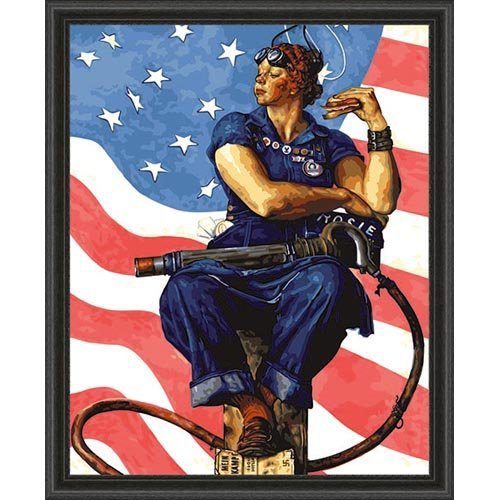
Like that article which spoke of all those Rosie the Riveters. I believe as an image that captures the feminist spirit rising, few are as important as Rosie. There are a number of versions, I bet you can dredge up at least two right off. But, me, and here today, I’m thinking most of all of Norman Rockwell’s painting.
Throughout my younger years I thought Rockwell wasn’t really an artist, or at least not a great one. I held this view for a couple of reasons. His thematic choices mostly of smalltown Americana together with his use of an often-humorous realism just ran against the grain of mid and late twentieth centuries intellectual aesthetics. Basically my circles. More challenging, I think, and perhaps a more authentic critique, was his free use of sentimentality. He could pile it on. And when I think of sentimentality I also think of cheap.
But then there were his paintings exploring racism. Years ago Jan & I were in his hometown in Western Massachusetts at the museum where his painting “the Problem We All Live With” hangs. My response standing in front of that painting, like the response of so many confronted with it, was simply to weep. The pure artistry of his work cannot be challenged. And in it, the cutting to the heart of what racism actually means, well. No one has captured it quite so directly and vividly.
So, while Rockwell could be and often was sentimental, he also touched much deeper currents of the human heart. At his best he was one of the great artists. Clearly, he understood the mysteries of love as something vastly more than sentiment. His images often unpacked what love meant in action.
And of his work the one that most captures me, that most puts love into action, is his “Rosie the Riveter.”
It is a great picture, and great art. After years in private hands Rosie now hangs in the Crystal Bridges museum in Bentonville, Arkansas. It’s an icon of the war effort, in this case the 2nd World War. It is quite literally an icon, drawing upon themes used for images of Mary in both the Eastern and Western churches. Not to mention how for me it evokes even older goddess images. Hard not to find at least distant echoes of Ishtar, of Inanna, of Athena. Of Kali. Of what the divine of women means when turned to flesh. With those muscles, but also that delightful upturned nose. And wearing makeup, but with that rivet gun in her lap. And her foot resting, not on the snake of traditional western images of Mary, but on a copy of Mein Kampf.
Thinking of it and his masterful use of classic religious themes just thrills me.
The painting is in fact directly based upon one by Michelangelo; the older artist’s portrayal of the prophet Isaiah on the Sistine Chapel ceiling. Right down to the arc of the arm, although in Michelangelo’s original it’s without the ham sandwich.
We also get a buried subtext in that use. Isaiah said sin will bring down the nation. But through turning to the redeeming power of love, by turning toward justice, we can be saved. And the embodied promise showing who is being sinned against, and where our saving can happen. Well. Rosie the Riveter. All those Rosie the Riveters who were used and then abandoned. And who are sitting here today.
Icons are images into heaven. Icons tell us who we really are.
I suggest as we contemplate Rosie, we think not only of how people pulled together in the second world war or the echoes of Mary and other goddesses throughout time, but also there’s something prophetic here. Rosie is a prescient image, a foreshadowing of something amazing that is going on in our times.
For individuals. For communities. For culture. For all of us.
This is the important thing. Rosie is, or certainly can be, the image of the promise of the 26th of August. It is a call to a holy project, something we are caught up in, and to which we need to constantly recall, for and about ourselves. And, I believe, in that recollection to recommit ourselves, in a more conscious way. It has to do with the saving of our republic, and more importantly it is about the saving of humanity, and most importantly about the saving of our planet.
Everything is tied up in this.
And with that, a suggestion of the particular shape that this saving must take.
Women’s place in our culture is different than it was a single generation ago, and with few exceptions, mostly moments, substantially different than throughout history. There has been a continuous progression towards genuine equal rights between women and men at least within the Global North for generations now. I believe we have crossed some tipping point, and we need to notice. There can be no going back. Although there are those who want it so. And are working hard to turn it all back.
Just some examples of the good, as regards what is being called “traditional marriage,” setting aside what it means in the scriptures, which would horrify most of us should we actually look, in English common law, which was our law for most of our history, when a woman and a man married, they became a single person, the man.
And that’s the way it was until 1981, that’s 1981, not very long ago when the Supreme Court finally struck down all state laws designating men as “head and master” with control over the property owned jointly by the couple. This older perspective is unthinkable for most of us, even most of those calling for something they imagine as traditional marriage.
Some great revolution is birthing. And This is what it means to side with Love. To be part of a revolution.
Today in Afghanistan, where in the spirit of one step forward and then a step back has become a fall down a flight of stairs into a basement, in villages where women are kept in bondage and ignorance, they whisper to their daughters the secret message: they are equal to the men. In Saudi Arabia, women gather in secret and talk of driving and voting and how that is their divine right. In America young women demand to be paid the same as men, and they know the day one of their number will be president is not far off.
There are those around the globe who do not want this to happen, who want that backward and downward fall. Here in this country a rigged up supreme court has overturned women’s right to choose. There are now laws on the books in numerous states that rival the worst of pre-Roe. In the same spirit, the Southern Baptist Convention is expelling congregations where women dare to preach.
And we need to note the backlash against LGBTQ rights are completely tied up with this. The great hubbub in conservative circles around homosexuality and in the moment specifically trans rights turn on the same issues as restricting the rights of women. Strict prescriptions about sexual roles have assured the old paradigm. They’ve been used for much of forever to subject women and sexual minorities in exactly the same way.
This is why those of us concerned with the firm establishment of women’s rights are almost always equally concerned with the rights of lesbians, and gay men, of bisexuals and transgender people. Let me throw in race here, as well. It is one thing. I repeat, as passionately as forcefully as I can: it is all about one thing. Maintaining a strict hierarchy of control. The very paradigm of totalitarianism, where everyone has a place in a relentlessly narrowing of power.
But the power of the heart will prevail. There is another way. And it turns on that passing strange thing we call love. The eyes of love that see connections. And in seeing connections calling us into new lives. Lives where we all count equally.
The real revolution. What is central to this revolution is simple enough. We need to move from fixed views about ourselves and about each other, including our ideas of sexual relationships; shifting to a dynamic sense of inclusion. This is the call to love as a generous spirit, already expressed in many ways.
This is a fierce love, a fire burning away the false. So, I find myself returning to that amazing icon, Rosie the Riveter. And I think of Isaiah, the pattern for Rosie, whose prophetic voice called us back to our best nature, to a path of equity and justice.
I think of Women’s Equality Day. And I think of revolutions.
It is a call of and to the heart. And here’s the heart’s promise. Here is what love looks like.
Think of Rosie. Think of her muscles and that dab of makeup. Think of her foot on the bible of evil. There we find an archetype for all of us, an icon of a world that can be. Icon. A window into heaven. A window into what can be in this time and in this place. A transformed world.
Here’s some good news. If you can find this openness, love’s heaven is at hand. At that moment when your heart opens, justice will fall like waters, and righteousness like an ever-flowing stream.
Everything we do from that place of openness will be graceful. Our lives will become a glorious and sacred dance, now leading, now following, each step a glory for the world.
All of us together.
The Day of Equality.
Amen.
New Visions
More Voices

About James Ishmael Ford
James Ishmael Ford is both a Unitarian minister and a Zen teacher. His sixth book, The Intimate Way of Zen is forthcoming from Shambhala Publications. You can read more about the author here.
Previous Post

August 24, 2023
Thinking of Prayer Books and Liturgies and the Spiritual Life

Recent Comments
"Allowing anger to contaminate one's hard disk can be detrimental to one's holistic well being. ..."
Hot Anger: Meeting Anger in Zen ..."
"I love this koan. every which way you turn it bites you, Thirty years on ..."
Nanquan Cuts the Cat: A Jesuit ..."
"As a substitute for religion, Zen is probably better than taking drugs. However, it can ..."
The Selling of Zen at the ..."
"Craving and aversion are detrimental to one's peace and happiness. Easter is a wake up ..."
Easter: A Zen Buddhist Appreciation
Browse Our Archives
Select a Category A Christmas Carol Abolitionist African-American Ahmadiyya Alan Watts Aldous Huxley Allen Ginsberg Amedkar Jayanti American politics American Zen Anaheim Zen Sangha Anglican Annie Besant April Fool Armageddon Art and Religion artificial intellegence Atheist Awakening B R Ambedkar Barlaam & Josaphat Beatnik Between Bhagavad Gita Bible biography birthday bodhisattva Bodhisattva Precepts Book burning Book of Common Prayer Book of Mormon Brahmo Samaj Buddha Buddhism Buddhist Buddhist Lord's Prayer Butterflies Calendars cartoons cat ChatGPT Chicken Tortilla Soup choices Christian atheism Christian mysticism Christian origins Christian Science Christian Zen Christianity Christianity and Buddhism christmas Christmas Truce Christopher Isherwood Church of Later Day Saints Cinco de Mayo circus covenant critical thinking culture D. T. Suzuki Dalit Buddhism Daniel Defoe Desert Fathers and Mothers dharma talk Dogen Donald Trump Dongshan's Five Ranks Dorothy Day dream Duty Easter ecology Edwin Arnold emptiness Empty Moon Zen Network Episcopal Church Eternal Now Ethics evolution existentialism Faith fantasy Fathers Day film film review fire Five Ranks Folk music food Form and emptiness Four Seals Francis of Assisi Francis Xavier Free thinker friendship George MacDonald Gerald Heard Glenn Taylor Webb God Good Friday Gospel of Gospel of Mark Gospel of Thomas grace Graduate Theological Unioin Graduate Theological Union Guanyin H R Blyth Hakuin Ekaku Hanamatsuri Hanukkah Harada Yasutani Zen Heart Sutra Henry David Thoreau Hermann Hesse Hinduism History and Religion history of religion Holy Spirit home Hospitality Icon Ides of March Isaac Newton Islam Islamic mysticism Jack Kerouac James Luther Adams Jiddu Krishnamurti Joan of Arc Johannes Gutenberg John Donne joke Judaism justice karma kensho King James Bible koan Koun Yamada Kyoto School Lewis Carrol Liberal Christianity Liberal Religion Life Plan Community Liminal literature Literature and Religion Liturgy Lord's Prayer Love Mahatma Gandhi Mahayana Martin Luther King Jr Mary Baker Eddy Mary Magdelene Mary Oliver Mayflower Compact Meditation memories memory metaphor money money and religioin Mormons Mother's Day movie review mysticism mythic Neighborhood Unitarian Universalist Church New Thought Nichiren Buddhism Nonduality not knowing Omar Khayyam Pacific School of Religion pagan Palm Sunday Passover peace Pentecost perennialism Phantastes Philip Kapleau philosophy Pilgrimage poetry Poetry and Religion politics Prayer Precepts Printing Press prophecy prophetic spirituality psychology Pure Land Queer religion queering religion Quietism Ram Mohan Roy rebirth recipe Relationships and religion religion religion and history Religious syncretism Resistance Retirement Retreat review Rissho Kosei Kai Ritual Robert Aitken Roshi Robert Ingersoll Rohatsu Romani religion Rosie the Riveter saints samadhi SanboZen Sangha Satyagraha science science and reigion science and religion science fiction seminary sermon Sesshin Sex and Religion Shinran Sikh Sikh tradition silence Social Justice Socially Engaged Buddhism Society and religion Soto Zen soul spiritual community spiritual practice Spirituality Sufism Suicide superstition Taoism Television Teresa of Avila Thanksgiving theological schools Theosophy Thomas Merton Time Transcendentalism Transcendentalist Trinitarian Trinity Uncategorized unitarian Unitarian Christianity Unitarian Universalist Universalism Vajrayana Vedanta Walking war Willa Cather William Ellery Channing wisdom women and religion women in religion World Teacher Writing zazen Zen Zen Center Zen inspired retriement zen meditation Zen Precepts Zen women
Select a Month September 2026 August 2026 July 2026 June 2026 May 2026 April 2026 March 2026 February 2026 January 2026 December 2025 November 2025 October 2025 September 2025 August 2025 July 2025 June 2025 May 2025 April 2025 March 2025 February 2025 January 2025 December 2024 November 2024 October 2024 September 2024 August 2024 July 2024 June 2024 May 2024 April 2024 March 2024 February 2024 January 2024 December 2023 November 2023 October 2023 September 2023 August 2023 July 2023 June 2023 May 2023 April 2023 March 2023 February 2023 January 2023 December 2022 November 2022 October 2022 September 2022 August 2022 July 2022 June 2022 May 2022 April 2022 March 2022 February 2022 January 2022 December 2021 November 2021 October 2021 September 2021 August 2021 July 2021 June 2021 May 2021 April 2021 March 2021 February 2021 January 2021 December 2020 November 2020 October 2020 September 2020 August 2020 July 2020 June 2020 May 2020 April 2020 March 2020 February 2020 January 2020 December 2019 November 2019 October 2019 September 2019 August 2019 July 2019 June 2019 May 2019 April 2019 March 2019 February 2019 January 2019 December 2018 November 2018 October 2018 September 2018 August 2018 July 2018 June 2018 May 2018 April 2018 March 2018 February 2018 January 2018 December 2017 November 2017 October 2017 September 2017 August 2017 July 2017 June 2017 May 2017 April 2017 March 2017 February 2017 January 2017 December 2016 November 2016 October 2016 September 2016 August 2016 July 2016 June 2016 May 2016 April 2016 March 2016 February 2016 January 2016 December 2015 November 2015 October 2015 September 2015 August 2015 July 2015 June 2015 May 2015 April 2015 March 2015 February 2015 January 2015 December 2014 November 2014 October 2014 September 2014 August 2014 July 2014 June 2014 May 2014 April 2014 March 2014 February 2014 January 2014 December 2013 November 2013 October 2013 September 2013 August 2013 July 2013 June 2013 May 2013 April 2013 March 2013 February 2013 January 2013 December 2012 November 2012 October 2012 September 2012 August 2012 July 2012 June 2012 May 2012 April 2012 March 2012 February 2012 January 2012 December 2011 November 2011 October 2011 September 2011 August 2011 July 2011 June 2011 May 2011 April 2011 March 2011 February 2011 January 2011 December 2010 November 2010 October 2010 September 2010 August 2010 July 2010 June 2010 May 2010 April 2010 March 2010 February 2010 January 2010 December 2009 November 2009 October 2009 September 2009 August 2009 July 2009 June 2009 May 2009 April 2009 March 2009 February 2009 January 2009 December 2008 November 2008 October 2008 September 2008 August 2008 July 2008 June 2008 May 2008 April 2008 March 2008 February 2008 January 2008 December 2007 November 2007 October 2007 September 2007 August 2007 July 2007 June 2007 May 2007 April 2007 March 2007 February 2007 January 2007 December 2006 November 2006 October 2006 September 2006
Follow Us!
TAKE THE
Religious Wisdom Quiz
What church leader is called "the Bishop of Rome"?
Select your answer to see how you score.
The Archbishop of Canterbury The Pope The Patriarch The General Superintendent
Related posts from Monkey Mind

A Zen Buddhist Response to this Moment

The American Unitarian Association Marks Two Hundred Years
Last Call: The Joy of Fat Tuesday
Who Saves Us? A Meditation about Joan of...
TRENDING AT PATHEOS Buddhist

The First Eucharistic Controversy: Christ’s Real Presence
For Catholics, the Eucharist is the source and summit of the Christian...

How to Make a Decision When You Can't...
Main point: It’s much more valuable to stay close to God so...

Archdiocese Hosts Military Marriage Retreat in Germany
RASTATT, Germany — The transient military lifestyle, with its frequent deployments and...

Nearly every morning, I make the drive to Detroit with my high-school-age...

The Real AI Story Is Adoption Without Trust
Artificial intelligence has crossed a political threshold. It is no longer a...

A new article, written by Jeff Lindsay and Gale L. Pooley,...
view all Buddhist blogs
What Are Your Thoughts?leave a comment
Ad-Free & Subscriber Log-In Subscription Support
- About Us
- 2026 Calendar
- Videos
- Podcasts
- Library of World Religions
- Faith In Media Tracker
- Advertise With Us
- Write for Us
- Privacy Policy
- Terms of Service
- Do Not Sell My Data
- Contact Us
- Radiant Digital
- Manage Newsletter Subscriptions
- Unsubscribe From Notifications
- Sitemap
Copyright 2008-2026, Patheos. All rights reserved.
Subscription Support Ad-Free & Subscriber Log-In
Follow Patheos