
BuddhistCatholicContemplativeEvangelicalGeneral ChristianHinduJewishLatter-day SaintMuslimNew VisionsProgressive Christian
Beliefs
- Buddhist
- Catholic
- Contemplative
- Evangelical
- General Christian
- Hindu
- Jewish
- Latter-day Saint
- More Voices
- Muslim
- New Visions
- Pagan
- Progressive Christian
Topics
- Religion News
- Food and Religion
- Sports and Religion
- Religious Art
- Religious Music and Entertainment
- Religious Events
- History and Religion
- Style and Religion
- Politics and Religion
- Women in Religion
- Recreation Outdoors and Religion
- Business Finance and Religion
- Careers Workplace and Religion
- Education and Religion
- Family Parenting and Religion
- Health Fitness and Religion
- Home and Religion
- Relationships and Religion
- Technology and Religion
- Travel and Religion
Columnists
- Buddhist Columnists
- Business Finance and Religion Columnists
- Careers Workplace and Religion Columnists
- Catholic Columnists
- Contemplative Columnists
- Education and Religion Columnists
- Evangelists Columnists
- Family Parenting and Religion Columnists
- General Christian Columnists
- Health Fitness and Religion Columnists
- Hindu Columnists
- History and Religion Columnists
- Home and Religion Columnists
- Jewish Columnists
- More Voices Columnists
- Latter Day Columnists
- Muslim Columnists
- New Visions Columnists
- Nonreligious Columnists
- Pagan Columnists
- Politics and Religion Columnists
- Progressive Columnists
- Recreation Outdoors and Religion Columnists
- Relationships and Religion Columnists
- Religion News Columnists
- Religious Art Columnists
- Religious Events Columnists
- Religious Music and Entertainment Columnists
- Sports and Religion Columnists
- Style and Religion Columnists
- Technology and Religion Columnists
- Travel and Religion Columnists
- Women in Religion Columnists
Resource Library
- 2026 Calendar
- Library of World Religions
- The 100 Most Holy Places on Earth
- Patheos Answers
- Podcasts
- Videos
- Faith Leaders Database
- Anglican Episcopalian
- Bahai
- Baptist
- Buddhism
- Christianity
- Confucianism
- Eastern Orthodoxy
- Hinduism
- Holiness and Pentecostal
- ISKCON
- Islam
- Judaism
- Lutheran
- Methodist
- The Church of Jesus Christ of Latter-day Saints
- New Age
- Paganism
- Presbytarian and Reformed
- Protestantism
- Religion Behind the Scenes
- Roman Catholic
- Scientology
- Shia Islam
- Sikhism
- Sufism
- Sunni Islam
- Taoism
- Zen
- See all religions
Research Tools
 Ad-Free & Subscriber Log-In Subscription Support
Ad-Free & Subscriber Log-In Subscription Support
Follow Patheos 

- Trending:
- Forgiveness
- |
- Marriage
- |
- Consciousness
- |
- Death Penalty
- |
- Election
- |
- Halloween

- Home
- Buddhist
- The Great Invitation: A Meditation on Queering Religion
The Great Invitation: A Meditation on Queering Religion
Last updated on: June 6, 2023 at 6:17 am by James Ford
The Great Invitation: A Meditation on Queering Religion 2023-06-06T06:17:32-07:00 James Ford
Patheos Explore the world's faith through different perspectives on religion and spirituality! Patheos has the views of the prevalent religions and spiritualities of the world.
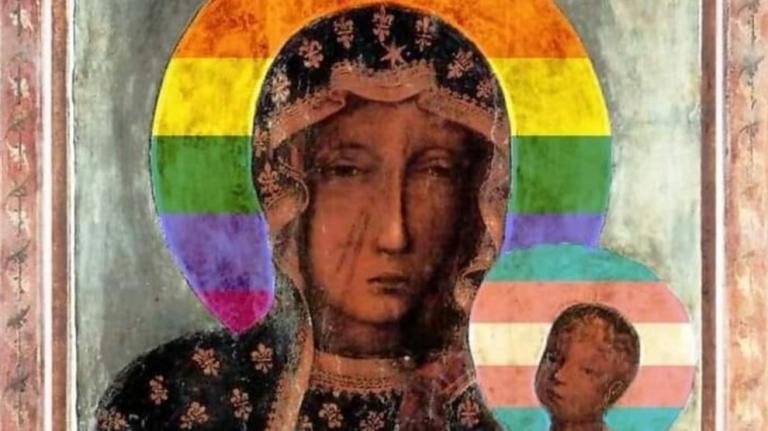
In April 2019, Elżbieta Podleśna, Anna Prus, and Joanna Gzyra – put up images of the Virgin Mary with a rainbow halo in protest at what they called the “exclusion of LGBT+ people from society” by Poland’s Catholic church.
Back in April, Jan and I made our first visit to my seminary, the Pacific School of Religion since I graduated with my Master of Divinity degree in 1991. PSR nestles on Holy Hill above the UC Berkeley campus as a part of the Graduate Theological Union, itself composed of Catholic, Protestant, and Buddhist seminaries, as well as Jewish and Muslim centers. It is an amazing collaborative. I don’t believe there’s anything quite like it anywhere else.
And. It’s been thirty-two years. I didn’t even return to the campus the following year to be formally awarded my MA in the Philosophy of Religion. I’d been pulled into the whirlwind of parish life and didn’t have time. And circumstances since just haven’t led me back. So, this visit was a big deal. And not just because PSR had named me a distinguished alumnx, and that there was going to be a ceremony.
Among the many things that happened, some quite moving, two stand out as appropriate to share here today. First, was our visceral experience of what is happening within our North American religious scene. The second something I think directly important to us, here, today.
As you probably know American Christianity is shrinking as part of the larger American demographic. Pew suggests it is genuinely possible for professing Christians to count for less than half the country’s population by 2070. Evangelicals and Fundamentalists claim they’re growing. And that’s true. But actually, what’s hidden in the demographics, is that they’re capturing a larger percentage of that declining number.
Where these people are going is also important. There is some growth among other religions. But mostly the growth is among the disaffiliated. Almost one in three American adults are what we’ve come to call “nones.” As in none of the above.
Of course, for us within the Unitarian Universalist world, we occupy a strange and liminal space between the farthest edge of radical Christianity, cultural Protestantism, and secularity. We are, as they say, the barely organized religion. So, with no credal test, its why as a Zen Buddhist, I can be a UU. Or, as I think about our crowd, how we can come from pretty much any spiritual perspective, or, importantly, none. And have a place. Rather than having credal statements we are bound by covenants of presence. I’ll return to that.
Walking around the campus of the GTU what this steep decline for organized religions actually means was on full display. I knew that our UU seminary Starr King had left the GTU, principally because they could no longer afford the dues. They sold their building and are now housed in Oakland at Mills College. The old campus, which we walked by, has been joined with the also now defunct First Christian Church to form the heart of a small Muslim liberal arts college. Zaytuna College. The grounds are beautifully kept, and I absolutely wish them every good. But I also felt a wound from the loss. Starr King wasn’t my seminary, but it was an important school to me, and I took some critical classes there.
They’re not the only one. Another school I took a class at, the Franciscan seminary is completely gone, now consolidated into the University of San Diego.
In the years following the Second World War, some visionaries at my school PSR, started buying up real estate on Holy Hill. When Jan & I were there, they provided the larger part of student housing not only for PSR but for many of the students at the GTU.
One of the things I continue to love about the school was their married housing policy in the late 1980s. They were pretty conservative, in that if you wanted to cohabitate and live in their housing, you had to be married. But also, they were a fair bit ahead of some curves. If you could not legally be married, but wanted to, all you had to do was assert this and you could get the housing. Some heterosexual couples expressed annoyance that this meant they didn’t qualify, but gay and lesbian couples did. It tickled me at the time. A very long time ago.
Those buildings are all gone. PSR itself has shrunk to its core campus. And actually, it rents out some of that space. For instance, the chapel is rented by a preschool.
So, all that. Religion, certainly organized religions are in turmoil. Larger congregations are mostly doing okay. For now. While smaller congregations are mostly in deep trouble. It feels like those small congregations may well be those proverbial canaries in the coal mine. The whole idea of organized religions is being challenged.
That’s the second big thing. During the day at PSR, there were several presentations aimed at alumns. Jan’s and my favorite by far, was the panel presentation of the school’s junior faculty. Presiding over the panel was the dean Dr Susan Abraham, an Indian national wearing for the occasion a dramatic sari. She’s also professor of theology and post-colonial cultures. It felt like she was pushing along her brood of chicks as she introduced, occasionally teased, and constantly encouraged her, and it felt like “her,” brood. I had the distinct feeling no one dare hurt any of them with her around. Korean born Eunhye So teaches New Testament, Filipina American Lisa Asedillo teaches worship and ethics, and African American Leonard McMahon teaches spirituality and political theology.
They are all so brilliant it hurt. PSR has always been about academic rigor. And. In my student days there, the ethos of the school felt to me basically like a nineteenth century Unitarian Christianity. If not precisely that, certainly relentlessly honest about text and tradition. This new faculty represents something even more daring. They all are committed to something they called a radically inclusive gospel. Not the Christianity of my childhood. And not the theology of the fundamentalist majority. The term they all embraced from different angles as the distillation of that radical and inclusive, they called Queer Theology.
As they made their presentation, a colleague whispered to her companion behind Jan and me, “I wish I could go to seminary now.” I thought, well, no. I don’t. But I got the enthusiasm. Really. I listened to these young professors and felt their brilliance and passion, and my body shivered. Something absolutely wonderful is happening. In the ruin of religions, as Christianity is seriously considering whether it is dying in the global north, as churches, temples, and synagogues are emptying, something quite wonderful is happening.
“Queer theology.” It sings into our hearts of great mysteries. I mentioned at the beginning how Unitarian Universalists exist within covenants of presence. Sometimes this is interpreted as being allowed to believe anything you want. You can. But the invitation is into the heart of presence, and what we can discover by being nakedly, unguardedly, passionately present.
Queer theology points to how this actively engaged presence can work. It arises from something called Queer theory. First, queer theory challenges heterosexuality as necessarily normative. It looks at the backside of the tapestry of the world we all assume. And shows how the threads come together to create who and what we think of as ourselves. Queer theology brings that challenge to religion and religious identity.
As a discipline it seems to have three aspects. First it means theology done by, with, and for the LGBTQIA community. Second, it challenges millennia old assumptions starting with boundaries defining gender and then noting the oppressions that have followed for those deemed outside those norms. And third, and maybe most importantly, it means theology opposed to any sense of a fixed position. Especially as regards sexuality and gender identity, but critically for all of us, as a liberating of human imagination from all our assumptions of what is.
It starts with an embrace of not knowing. Which I’m lucky to recognize from my Buddhist practice and study. But with Queer Theology that not knowing starts with our human bodies. And from there leads us into the brilliant and liberating darkness of endless curiosity. With this our human sexuality ceases to be a problem, and instead is the very place in which we find our deepest truths. In Western religious language, our bodies are where we find our salvation.
Heady stuff.
Now, please indulge me with one more statistic. With that we can unpack why I’m standing here more excited about the possibilities for spiritual growth and what that can mean in this world here and now, than I’ve been able to feel for a long while. This all speaks directly to who you all are in this gathering as the First Unitarian Church of Los Angeles.
So, that statistic. As of right now, according to the ACLU, there are 491anti-LGBTQ bills being pursued across the country. According to the Human Rights Campaign over 220 of these target transgender and nonbinary people. So far this year 45 laws have been passed including 13 banning gender affirming care for youth, 3 that require misgendering students, 2 that target drag performances, and 2 that censor school curriculum including books.
The best of times. The worst of times. Forward motion and backlash. How we can elect Barack Obama president and then immediately after through the vagaries of the electoral college system, end up with Donald Trump. These are dangerous, dangerous times. There are no guarantees. We can go in any number of ways. We can be opening the doors of perception and throwing open the gates to our liberation. Or, we can be living in a reprise of the Weimar Republic, a wildly creative moment soon to be crushed by totalitarian reaction.
Maybe a bit of both. Life is always dangerous. And we all will die. Something to remember. The question is how will we live within these tensions. In this place. At this time.
In our time and place there are three areas that we can find will open our hearts. They turn on our presence to and with the poor. As the good rabbi once said, “the poor will always be with us.” As we ask why, as we do not turn away, hearts open. Next in my list, is our presence to and with marginalized peoples. In our time and place the African American experience is most obvious. But that list is long. And it includes the minority that is a majority, women. Lots of marginalization. As we ask why, as we do not turn away, our hearts open.
And third are the queer. Lesbian, gay, bisexual, transgender, nonbinary, intersex, gender nonconforming, anyone, anyone who doesn’t fit our received idea of normative sexuality. In fact, women fit in here, as well. Because culture, certainly our culture puts male heterosexuality at the center, and makes everything else not quite right, if not fully wrong. As we ask why, as we do not turn away, our hearts open.
Each of these noticings is a gate. In fact we cannot afford to ignore any of them. Not if we’re seeking the great healing of our human hearts. If we want a religious community worth belonging to, I suggest it needs to be those three things. It needs to be a church of the poor. It needs to be a church of minorities. And it needs to be a queer church.
People have always had a boot on the necks of the poor. People are always using minorities as scapegoats for societal problems. And, well there are those near five hundred anti-LGBTQ bills winding their way through various legislatures. Right now. And speaking of right now, the reactionary wave of attacks on women’s rights that are going on right now are bone chilling and relentless.
Did I say dangerous times?
Which way are we going? As a people? As spiritual communities? As individuals?
We can’t control how things turn out. But we can choose how we will engage. What is true is the stakes are high. They’ve rarely been higher. And in the face of all that, a question. With whom do we stand? With whom do we throw in our lot? With whom will we live? And with whom will we die?
My hope for us today is that we be a church for the poor. My hope for today is that we be a church for women, for black, and for brown people.
My hope today is we become a Queer church.
This can open hearts. It can bring the edges into the center and show us new worlds of hope and possibility. It can show the world what love looks like. And it can show each of us what rests at the heart of our being. It can reveal mysterious truths about who we all really are.
So, how do we do that? How do we move from aspiration to action?
When I was in seminary at PSR all those years ago, my ethics professor was Karen Lebacqz. During a discussion in a class led by her, I stated I was a feminist. It was a moment when some women felt no man could be a feminist. Professor Lebacqz looked at me and looked at the class. Then she said, “James, you can be a feminist. All you have to do, is become a sister.”
Become a sister. Therein rests everything. The problem for our normative view is that being a woman is less than being a man. Being black. Being Asian. Being Latinx. Being poor. Who are we willing to stand with? And. And. More intimately, who are we willing to be?
Who can we be?
Each of us faces our own unique way in. If we belong to one of the traditionally marginalized if not outright oppressed groups, how do we include, deeply, profoundly include those others? And, of course, can we also include those identifiable as part of the majorities? Recall the project of seeing how the threads come together. And living from that deeper place.
This is an invitation into the sublime not knowing. Into deep curiosity.
What hope might arise for this poor, hurting world, if we surrender into the family of things? Into that deeper intimacy? What happens when we don’t know, but are endlessly curious?
Perhaps the churches and temples and synagogues we once knew are fading away. Time will tell.
But in the ruin of those institutions people are engaging the great questions. And out of that several pedagogies of the oppressed are emerging. Each with windows. Each with doors. Promising our liberation, our saving.
The most exciting of which, well may be Queer theology.
No guarantees. Of course. Still. Whispering to our hearts, the question.
Who will we be? You. And me.
Who will we be?
The great invitation.
Amen.
And, amen.
A sermon delivered
by James Ishmael Ford
at the First Unitarian Church of Los Angeles
June 4th, 2023
New Visions
More Voices
First Unitarian Church of Los Angeles
Previous Post

May 31, 2023
Unity and Diversity in Religion
Next Post

June 9, 2023 Quietism as a Spiritual Method & Quietism as a Spiritual Mistake
Recent Comments
"Allowing anger to contaminate one's hard disk can be detrimental to one's holistic well being. ..."
Hot Anger: Meeting Anger in Zen ..."
"I love this koan. every which way you turn it bites you, Thirty years on ..."
Nanquan Cuts the Cat: A Jesuit ..."
"As a substitute for religion, Zen is probably better than taking drugs. However, it can ..."
The Selling of Zen at the ..."
"Craving and aversion are detrimental to one's peace and happiness. Easter is a wake up ..."
Easter: A Zen Buddhist Appreciation
Browse Our Archives
Select a Category A Christmas Carol Abolitionist African-American Ahmadiyya Alan Watts Aldous Huxley Allen Ginsberg Amedkar Jayanti American politics American Zen Anaheim Zen Sangha Anglican Annie Besant April Fool Armageddon Art and Religion artificial intellegence Atheist Awakening B R Ambedkar Barlaam & Josaphat Beatnik Between Bhagavad Gita Bible biography birthday bodhisattva Bodhisattva Precepts Book burning Book of Common Prayer Book of Mormon Brahmo Samaj Buddha Buddhism Buddhist Buddhist Lord's Prayer Butterflies Calendars cartoons cat ChatGPT Chicken Tortilla Soup choices Christian atheism Christian mysticism Christian origins Christian Science Christian Zen Christianity Christianity and Buddhism christmas Christmas Truce Christopher Isherwood Church of Later Day Saints Cinco de Mayo circus covenant critical thinking culture D. T. Suzuki Dalit Buddhism Daniel Defoe Desert Fathers and Mothers dharma talk Dogen Donald Trump Dongshan's Five Ranks Dorothy Day dream Duty Easter ecology Edwin Arnold emptiness Empty Moon Zen Network Episcopal Church Eternal Now Ethics evolution existentialism Faith fantasy Fathers Day film film review fire Five Ranks Folk music food Form and emptiness Four Seals Francis of Assisi Francis Xavier Free thinker friendship George MacDonald Gerald Heard Glenn Taylor Webb God Good Friday Gospel of Gospel of Mark Gospel of Thomas grace Graduate Theological Unioin Graduate Theological Union Guanyin H R Blyth Hakuin Ekaku Hanamatsuri Hanukkah Harada Yasutani Zen Heart Sutra Henry David Thoreau Hermann Hesse Hinduism History and Religion history of religion Holy Spirit home Hospitality Icon Ides of March Isaac Newton Islam Islamic mysticism Jack Kerouac James Luther Adams Jiddu Krishnamurti Joan of Arc Johannes Gutenberg John Donne joke Judaism justice karma kensho King James Bible koan Koun Yamada Kyoto School Lewis Carrol Liberal Christianity Liberal Religion Life Plan Community Liminal literature Literature and Religion Liturgy Lord's Prayer Love Mahatma Gandhi Mahayana Martin Luther King Jr Mary Baker Eddy Mary Magdelene Mary Oliver Mayflower Compact Meditation memories memory metaphor money money and religioin Mormons Mother's Day movie review mysticism mythic Neighborhood Unitarian Universalist Church New Thought Nichiren Buddhism Nonduality not knowing Omar Khayyam Pacific School of Religion pagan Palm Sunday Passover peace Pentecost perennialism Phantastes Philip Kapleau philosophy Pilgrimage poetry Poetry and Religion politics Prayer Precepts Printing Press prophecy prophetic spirituality psychology Pure Land Queer religion queering religion Quietism Ram Mohan Roy rebirth recipe Relationships and religion religion religion and history Religious syncretism Resistance Retirement Retreat review Rissho Kosei Kai Ritual Robert Aitken Roshi Robert Ingersoll Rohatsu Romani religion Rosie the Riveter saints samadhi SanboZen Sangha Satyagraha science science and reigion science and religion science fiction seminary sermon Sesshin Sex and Religion Shinran Sikh Sikh tradition silence Social Justice Socially Engaged Buddhism Society and religion Soto Zen soul spiritual community spiritual practice Spirituality Sufism Suicide superstition Taoism Television Teresa of Avila Thanksgiving theological schools Theosophy Thomas Merton Time Transcendentalism Transcendentalist Trinitarian Trinity Uncategorized unitarian Unitarian Christianity Unitarian Universalist Universalism Vajrayana Vedanta Walking war Willa Cather William Ellery Channing wisdom women and religion women in religion World Teacher Writing zazen Zen Zen Center Zen inspired retriement zen meditation Zen Precepts Zen women
Select a Month September 2026 August 2026 July 2026 June 2026 May 2026 April 2026 March 2026 February 2026 January 2026 December 2025 November 2025 October 2025 September 2025 August 2025 July 2025 June 2025 May 2025 April 2025 March 2025 February 2025 January 2025 December 2024 November 2024 October 2024 September 2024 August 2024 July 2024 June 2024 May 2024 April 2024 March 2024 February 2024 January 2024 December 2023 November 2023 October 2023 September 2023 August 2023 July 2023 June 2023 May 2023 April 2023 March 2023 February 2023 January 2023 December 2022 November 2022 October 2022 September 2022 August 2022 July 2022 June 2022 May 2022 April 2022 March 2022 February 2022 January 2022 December 2021 November 2021 October 2021 September 2021 August 2021 July 2021 June 2021 May 2021 April 2021 March 2021 February 2021 January 2021 December 2020 November 2020 October 2020 September 2020 August 2020 July 2020 June 2020 May 2020 April 2020 March 2020 February 2020 January 2020 December 2019 November 2019 October 2019 September 2019 August 2019 July 2019 June 2019 May 2019 April 2019 March 2019 February 2019 January 2019 December 2018 November 2018 October 2018 September 2018 August 2018 July 2018 June 2018 May 2018 April 2018 March 2018 February 2018 January 2018 December 2017 November 2017 October 2017 September 2017 August 2017 July 2017 June 2017 May 2017 April 2017 March 2017 February 2017 January 2017 December 2016 November 2016 October 2016 September 2016 August 2016 July 2016 June 2016 May 2016 April 2016 March 2016 February 2016 January 2016 December 2015 November 2015 October 2015 September 2015 August 2015 July 2015 June 2015 May 2015 April 2015 March 2015 February 2015 January 2015 December 2014 November 2014 October 2014 September 2014 August 2014 July 2014 June 2014 May 2014 April 2014 March 2014 February 2014 January 2014 December 2013 November 2013 October 2013 September 2013 August 2013 July 2013 June 2013 May 2013 April 2013 March 2013 February 2013 January 2013 December 2012 November 2012 October 2012 September 2012 August 2012 July 2012 June 2012 May 2012 April 2012 March 2012 February 2012 January 2012 December 2011 November 2011 October 2011 September 2011 August 2011 July 2011 June 2011 May 2011 April 2011 March 2011 February 2011 January 2011 December 2010 November 2010 October 2010 September 2010 August 2010 July 2010 June 2010 May 2010 April 2010 March 2010 February 2010 January 2010 December 2009 November 2009 October 2009 September 2009 August 2009 July 2009 June 2009 May 2009 April 2009 March 2009 February 2009 January 2009 December 2008 November 2008 October 2008 September 2008 August 2008 July 2008 June 2008 May 2008 April 2008 March 2008 February 2008 January 2008 December 2007 November 2007 October 2007 September 2007 August 2007 July 2007 June 2007 May 2007 April 2007 March 2007 February 2007 January 2007 December 2006 November 2006 October 2006 September 2006
Follow Us!
TAKE THE
Religious Wisdom Quiz
Who was cast out with her son Ishmael?
Select your answer to see how you score.
Dinah Lot's wife Hagar Rebekah
Related posts from Monkey Mind


A Zen Buddhist Response to this Moment


The Suchness of Crows: The Zen teachings of...
TRENDING AT PATHEOS Buddhist

Nearly every morning, I make the drive to Detroit with my high-school-age...

The Real AI Story Is Adoption Without Trust
Artificial intelligence has crossed a political threshold. It is no longer a...

A new article, written by Jeff Lindsay and Gale L. Pooley,...

Swimfan: Forgotten Aughts Pleasures
This is a recovery effort. In 2002, My Big Fat Greek Wedding...

Top Three Anti-Catholic Lies About Catholicism
This is my initial transcript for the video, "THE 3 WORST...

Pope Leo Celebrates Mass for Nurses & Docs...
I don't have any idea how he did it, but Pope Leo...
view all Buddhist blogs
What Are Your Thoughts?leave a comment
Ad-Free & Subscriber Log-In Subscription Support
- About Us
- 2026 Calendar
- Videos
- Podcasts
- Library of World Religions
- Faith In Media Tracker
- Advertise With Us
- Write for Us
- Privacy Policy
- Terms of Service
- Do Not Sell My Data
- Contact Us
- Radiant Digital
- Manage Newsletter Subscriptions
- Unsubscribe From Notifications
- Sitemap
Copyright 2008-2026, Patheos. All rights reserved.
Subscription Support Ad-Free & Subscriber Log-In
Follow Patheos