
BuddhistCatholicContemplativeEvangelicalGeneral ChristianHinduJewishLatter-day SaintMuslimNew VisionsProgressive Christian
Beliefs
- Buddhist
- Catholic
- Contemplative
- Evangelical
- General Christian
- Hindu
- Jewish
- Latter-day Saint
- More Voices
- Muslim
- New Visions
- Pagan
- Progressive Christian
Topics
- Religion News
- Food and Religion
- Sports and Religion
- Religious Art
- Religious Music and Entertainment
- Religious Events
- History and Religion
- Style and Religion
- Politics and Religion
- Women in Religion
- Recreation Outdoors and Religion
- Business Finance and Religion
- Careers Workplace and Religion
- Education and Religion
- Family Parenting and Religion
- Health Fitness and Religion
- Home and Religion
- Relationships and Religion
- Technology and Religion
- Travel and Religion
Columnists
- Buddhist Columnists
- Business Finance and Religion Columnists
- Careers Workplace and Religion Columnists
- Catholic Columnists
- Contemplative Columnists
- Education and Religion Columnists
- Evangelists Columnists
- Family Parenting and Religion Columnists
- General Christian Columnists
- Health Fitness and Religion Columnists
- Hindu Columnists
- History and Religion Columnists
- Home and Religion Columnists
- Jewish Columnists
- More Voices Columnists
- Latter Day Columnists
- Muslim Columnists
- New Visions Columnists
- Nonreligious Columnists
- Pagan Columnists
- Politics and Religion Columnists
- Progressive Columnists
- Recreation Outdoors and Religion Columnists
- Relationships and Religion Columnists
- Religion News Columnists
- Religious Art Columnists
- Religious Events Columnists
- Religious Music and Entertainment Columnists
- Sports and Religion Columnists
- Style and Religion Columnists
- Technology and Religion Columnists
- Travel and Religion Columnists
- Women in Religion Columnists
Resource Library
- 2026 Calendar
- Library of World Religions
- The 100 Most Holy Places on Earth
- Patheos Answers
- Podcasts
- Videos
- Faith Leaders Database
- Anglican Episcopalian
- Bahai
- Baptist
- Buddhism
- Christianity
- Confucianism
- Eastern Orthodoxy
- Hinduism
- Holiness and Pentecostal
- ISKCON
- Islam
- Judaism
- Lutheran
- Methodist
- The Church of Jesus Christ of Latter-day Saints
- New Age
- Paganism
- Presbytarian and Reformed
- Protestantism
- Religion Behind the Scenes
- Roman Catholic
- Scientology
- Shia Islam
- Sikhism
- Sufism
- Sunni Islam
- Taoism
- Zen
- See all religions
Research Tools
 Ad-Free & Subscriber Log-In Subscription Support
Ad-Free & Subscriber Log-In Subscription Support
Follow Patheos 

- Trending:
- Forgiveness
- |
- Marriage
- |
- Consciousness
- |
- Death Penalty
- |
- Election
- |
- Halloween

- Home
- Buddhist
- DYING & RISING: A Zen Reflection on Easter
DYING & RISING: A Zen Reflection on Easter
Last updated on: April 9, 2023 at 2:17 pm by James Ford
DYING & RISING: A Zen Reflection on Easter 2023-04-09T14:17:09-07:00 James Ford
Patheos Explore the world's faith through different perspectives on religion and spirituality! Patheos has the views of the prevalent religions and spiritualities of the world.
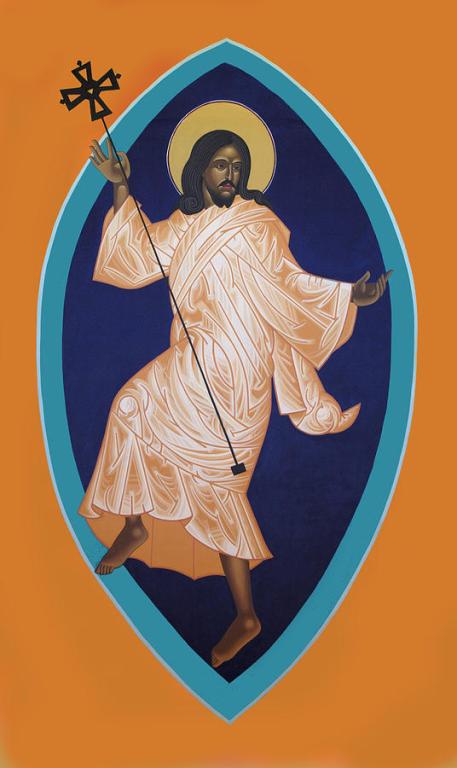
Dancing Christ
Icon by Mark Dukes
DYING & RISING A Zen Reflection on Easter
For the last half of my professional ministerial life, I served in some venerable New England parishes. Spiritually we were pretty much generic contemporary Unitarian Universalists. That is, we shared a naturalist and humanist bent. And issues of social justice were very important to us. But at the same time, there was always a bit of a Protestant Congregational Christian sense to the whole thing. This sense was something more in the air than anything else. But it was there. You could find it in the architecture. Some churches had touches in the background such as ancient wall plaques offering the Lord’s Prayer. And it’s there in the way worship services were put together.
Among the consequences of this, shall we say homeopathic Christian sense to our New England churches, was how our Sunday services swelled enormously during Christmas and Easter. People in the larger community wanted some touch of the Christian stories of the normative tradition. But also something that wouldn’t offend secular sensibilities. And we fit the bill. Christmas was easy as pie: the birth of a child as a miracle.
Easter was a horse of another color.
Me, I have a visceral and deeply negative reaction to any emphasis on bunny rabbits and chocolate eggs and vague appeals to spring as the meaning of the season. So, the congregation, by which I mean the real congregation, not the many folk who showed up just for the holidays, but rather the people who gathered in the good and the ill, and made the church alive, would usually look forward to witnessing how I would twist and turn at my wrestle with the Easter story. And with that, something of the Christian church, writ large.
Sadly, too much of Christianity, as contemporary firebrand Protestant pastor John Pavlovitz says, is “a toxic cocktail of power, control, fear, nationalism, and white privilege…” The Easter story can be about the crowd control thing. Believe this is a historical event, and that if you do believe and do what we tell you, you go to heaven. Along with a threat. And if you don’t, there’s eternal conscious torment awaiting.
That’s there. No doubt. Although there is more going on, as well. Always. It’s not, after all, all about crowd control. No real religion is. With that, here, I want to offer an alternative view of the Easter story.
Bottom line, as best I can make it out. The actual of Jesus of history was an apocalyptic prophet who inherited the mantel of his teacher John, after John’s brutal murder. Jesus’ message was that the world was about to end, the rich and powerful would be overthrown, and the poor and endlessly left behind, would be raised up. The kingdom of God, as he called it, as best I can discern from his sayings, was a strange and strangely compelling thing, partially in some other place, and partially here and now.
Jesus’ ministry captured many hearts. For years people shared collections of his sayings and of miracles he was said to have performed. Mainly about healing the sick. Over time communities grew around his teachings and with variations of his personal story.
That “toxic cocktail of power, control, fear, nationalism, and white privilege…” is one version. But, always, always, there was and is more going on. I think of what sustained the American black community through four hundred years of oppression and suffering. I think of the faith of poor people and the oppressed and the stories of God’s love for them. I think of that most mysterious thing the Christian communion and the hints of connection if offers in sharing bread and wine. I think of my own encounters with hurt and healing.
And. And, I think of reality, and how messy and mysterious it really is.
Now, my natural disposition is rationalist. I believe the world described by modern science is more accurate than any other. Although, of course, that view is subject to change as science continues its relentless pursuit of the truths of nature. But this part I’m sure of. We are biological creatures evolved on a tiny planet circling a middling star at the edge of one of a million, million, galaxies in a very strange universe.
So, what is being pointed to in the Resurrection story that calls people even when they know it’s more myth than history? There certainly are a lot of such people. And with that questions come. How can we engage Easter in a healthy and honest manner? Myth, after all, doesn’t have to mean lies. Myths can be our ancestors telling us about who we are and what we might be.
Over the many years I’ve come to a personal faith that expresses the spiritual crossroads of our times. I am at base a Mahayana Buddhist of a modernist sort. Perhaps with some Taoist sensibilities, as well. Now, this isn’t a sermon about Mahayana Buddhism, or Taoism. But it informs my perspectives, so in a nutshell: I believe the world, writ large, is composed of interactions, moments is a good word. These moments mysterious things. And mystery is a right word. These moments arise and, importantly, fall within a play of mutual causality. Practically this means you and I are temporary things, woven out of a mysterious play of causes and conditions. Which are constantly in motion.
For us as humans, we mostly experience this temporariness as some deep anxiety. There are other words that can express these latent and sometimes not so latent feelings. Mostly they’re negative. Off balance, out of kilter. But we also have a latent insight that perceives the whole. Everything is connected, after all. And in encountering that whole as another truth alongside our separation and temporality, brings with it an abiding sense of possibility and even joy.
And this saving insight, wisdom or gnosis are not bad words for it, either; can be found in our ordinary and natural lives. Actually, it can only be found in this life as it is. That sense of one and two, of our unity and our separation as not actually different, manifests in each culture in a multitude of ways. This is the real work of religions, not crowd control.
Like pretty much anyone raised in a religious tradition, my dream life is informed by my childhood religion and the Jesus I started with and who continues to be a part of my life. That influence from my childhood Christianity and the pointers for what is, that I’ve found within that rich tradition are a deep well. Our religions are our dreams. And they tell us about who and what we really are.
For me Zen and Christianity came together as a visceral thing, some thirty years ago during a Zen meditation retreat. Deep in retreat with enforced silence and relentless presence, hallucinations of various sorts are not unexpected. Mostly they’re visual or aural disruptions. Sometimes, however, they take shapes.
In Zen they’re called makyo. Hallucination isn’t a bad translation. When they happen, we’re encouraged to be present, dreams are real too, but not to think they’re offering anything other than our inner lives expressing. In this vision I had, in this makyo, Jesus was walking toward me. Picture whatever Jesus looks like for you. We each get our own, which is kind of cool. His hands, palm to palm together like the Christian prayer mudra, Hindu namaste, or Zen’s gassho. Then he said to me, “I have a great gift for you.”
Within the revery of that moment, not exactly a dream, and not exactly, not a dream; my immediate thought was of my childhood Jesus. The one with all the little children. I felt waves of love washing over me. Then. He spread his hands to reveal those infamous bleeding wounds. A terrible visceral fear leapt into my throat, as he grasped my hands with his bleeding hands.
With that, the pain of worlds birthing and dying ran from his wounds into what are now mine. Then, as fast as it happened, it was over. I was back in the meditation hall, and the simple, relentless rhythms of a Zen retreat.
My hands hurt for weeks. Actually, to this day I can still touch an echo of that hurt if I pay attention. Now blending with the arthritis of old age. Still, on occasion, when I feel a tang of the ongoing hurt in my thumbs, I also touch that makyo, that hallucination, that truth from somewhere deep in my mind, in my heart.
So, what is the Jesus that continues to live within me? And what might it mean for people who self-select to come to a Unitarian Universalist church, of a rationalist, and politically activist bent, on an Easter Sunday?
Easter. When the stories of Jesus sayings and miracles were captured by Greek imagination and wedded to the religious style of their mystery religions. Not as an intellectual enterprise, but as our ancestors whispering truths, if we’re willing to hear them. Truths about living, dying, and rising. Not bunny rabbits and chocolates. Not even spring, although that’s a living current, and it is connected. As is Passover and that other ancient story of pilgrimage, of passing from slavery to freedom.
Easter, I suggest, is taking all that, all of the things of our lives. Rising and falling as they are. And then filled to overflowing with the sorrow and the joy of it, letting it go. And then stepping forward into new worlds.
Easter as a linchpin in our lives. An invitation into a way of life.
To put it another way. My dear friend John Jeffrey, one-time Methodist minister with a long time Buddhist meditation practice, a chaplain and spiritual director, talks about the complexities of our lives. He says, we are “Either-or people, living in a both-and world. We generate suffering for ourselves and each other when we live out that either-or in this both-and world.”
Easter is about correcting our cognitive error, of how we can move from either or, to both and. Along with hints of what that will bring. Can bring.
This is the nub of it all. There’s too much either-or in our thinking. It has roots in logic, “a” in most cases cannot be “b.” But, it turns out our lives are messy things, and not so easily restricted. As we look into our being, as we track our minds, our hearts, we discover that reality is a lot messier. Much richer.
This calls for a shift in perspective. And here I think of the Easter story.
When I consider Easter, I think of us, you and me living in this moment. This bubble of time and space, of energy and longing. We are connected to the past, and we are connected to the future. What happens in this moment shaped by the past, determines much of what will play out going forward.
However. And this is so important. While we are constrained by the events of the past, we have some miraculous ability to adjust in the moment, to shift the course of things. Imagine a small tugboat and great seagoing tanker. It can change who we are going forward as individuals. And we can see it when we engage in the works of justice. One is personal, the other communal. but both are doing the same thing.
So, what does this kind of Easter look like as a lynchpin of our worlds, where the past does not fully determine the future? I think of the story of Jesus and his suffering. I find it our story, all of us. Internally, and communally. We are fractured and separate. We are wounded and isolated. Then, there comes a letting go. Let’s call it death. It can be surrender of our ideas of control, our thoughts determined by the past. Let go. Fall away. Die.
It can be a terrible painful thing. Like death. Like going to the grave.
The poet and teacher Clark Strand tells us “Christianity is a mystery religion. The story it tells is an ecological story, not a theological one—a redemptive story of circular time, rather than a punitive story of linear time, or “end time.” The church doesn’t interpret the Christian story that way because it has spent two thousand years denying its roots in pagan mystery religion. But it’s all there—a secret hidden in plain view…”
And, as the mystery religions told us, as the ancient Hebrew prophets sang, mystery follows upon mystery. A raising from the dead. And with that a new world. New worlds. Our own personal worlds, our communal world. The story of Jesus as our story. The Easter story as our destiny.
So, what does the other side look like? What does an Easter world look like?
The American Buddhist teacher Jack Kornfeld tells of a meeting with his teacher the Thai meditation master, Ajahn Chah. “One day Ajahn Chah held up a beautiful Chinese teacup and said, ‘To me this cup is already broken. Because I know its fate, I can enjoy it fully here and now. And when it’s gone, it’s gone.’ When we understand the truth of uncertainty and relax, we become free.”
We attend to this, and we find an Easter moment, living and dying and living anew.
If, that is, we let go of our certainties. If we allow what was to fall away. And if we open our hearts to what can be. All of that mixed up together. This moment is the linchpin. Here. Now. Accept what was, let it go, and turn toward to the new.
Easter.
The kingdom of God.
The realm of peace and justice.
And what does that look like? You know, when rubber and road meet?
There’s an old term, the “wounded healer.” Here’s a secret. There are no other types of healers. The hope of the world is in your hands. Those hands that hurt. Those hands that exist because of a hundred, thousand, million things. The hands that can in turn, well, bring blessings.
That’s the Easter message I find.
And I offer it as a suggestion for your consideration.
With that, I wish you all a blessed Easter. I wish you a rebirth into new worlds of possibility and hope.
Amen.
Dancing Christ Icon by Mark Dukes
New Visions
More Voices
Previous Post
April 7, 2023
Every Day is the Good Day: A Zen Meditation on Good Friday

Recent Comments
Browse Our Archives
Select a Category A Christmas Carol Abolitionist African-American Ahmadiyya Alan Watts Aldous Huxley Allen Ginsberg Amedkar Jayanti American politics American Zen Anaheim Zen Sangha Anglican Annie Besant April Fool Armageddon Art and Religion artificial intellegence Atheist Awakening B R Ambedkar Barlaam & Josaphat Beatnik Between Bhagavad Gita Bible biography birthday bodhisattva Bodhisattva Precepts Book burning Book of Common Prayer Book of Mormon Brahmo Samaj Buddha Buddhism Buddhist Buddhist Lord's Prayer Butterflies Calendars cartoons cat ChatGPT Chicken Tortilla Soup choices Christian atheism Christian mysticism Christian origins Christian Science Christian Zen Christianity Christianity and Buddhism christmas Christmas Truce Christopher Isherwood Church of Later Day Saints Cinco de Mayo circus covenant critical thinking culture D. T. Suzuki Dalit Buddhism Daniel Defoe Desert Fathers and Mothers dharma talk Dogen Donald Trump Dongshan's Five Ranks Dorothy Day dream Duty Easter ecology Edwin Arnold emptiness Empty Moon Zen Network Episcopal Church Eternal Now Ethics evolution existentialism Faith fantasy Fathers Day film film review fire Five Ranks Folk music food Form and emptiness Four Seals Francis of Assisi Francis Xavier Free thinker friendship George MacDonald Gerald Heard Glenn Taylor Webb God Good Friday Gospel of Gospel of Mark Gospel of Thomas grace Graduate Theological Unioin Graduate Theological Union Guanyin H R Blyth Hakuin Ekaku Hanamatsuri Hanukkah Harada Yasutani Zen Heart Sutra Henry David Thoreau Hermann Hesse Hinduism History and Religion history of religion Holy Spirit home Hospitality Icon Ides of March Isaac Newton Islam Islamic mysticism Jack Kerouac James Luther Adams Jiddu Krishnamurti Joan of Arc Johannes Gutenberg John Donne joke Judaism justice karma kensho King James Bible koan Koun Yamada Kyoto School Lewis Carrol Liberal Christianity Liberal Religion Life Plan Community Liminal literature Literature and Religion Liturgy Lord's Prayer Love Mahatma Gandhi Mahayana Martin Luther King Jr Mary Baker Eddy Mary Magdelene Mary Oliver Mayflower Compact Meditation memories memory metaphor money money and religioin Mormons Mother's Day movie review mysticism mythic Neighborhood Unitarian Universalist Church New Thought Nichiren Buddhism Nonduality not knowing Omar Khayyam Pacific School of Religion pagan Palm Sunday Passover peace Pentecost perennialism Phantastes Philip Kapleau philosophy Pilgrimage poetry Poetry and Religion politics Prayer Precepts Printing Press prophecy prophetic spirituality psychology Pure Land Queer religion queering religion Quietism Ram Mohan Roy rebirth recipe Relationships and religion religion religion and history Religious syncretism Resistance Retirement Retreat review Rissho Kosei Kai Ritual Robert Aitken Roshi Robert Ingersoll Rohatsu Romani religion Rosie the Riveter saints samadhi SanboZen Sangha Satyagraha science science and reigion science and religion science fiction seminary sermon Sesshin Sex and Religion Shinran Sikh Sikh tradition silence Social Justice Socially Engaged Buddhism Society and religion Soto Zen soul spiritual community spiritual practice Spirituality Sufism Suicide superstition Taoism Television Teresa of Avila Thanksgiving theological schools Theosophy Thomas Merton Time Transcendentalism Transcendentalist Trinitarian Trinity Uncategorized unitarian Unitarian Christianity Unitarian Universalist Universalism Vajrayana Vedanta Walking war Willa Cather William Ellery Channing wisdom women and religion women in religion World Teacher Writing zazen Zen Zen Center Zen inspired retriement zen meditation Zen Precepts Zen women
Select a Month September 2026 August 2026 July 2026 June 2026 May 2026 April 2026 March 2026 February 2026 January 2026 December 2025 November 2025 October 2025 September 2025 August 2025 July 2025 June 2025 May 2025 April 2025 March 2025 February 2025 January 2025 December 2024 November 2024 October 2024 September 2024 August 2024 July 2024 June 2024 May 2024 April 2024 March 2024 February 2024 January 2024 December 2023 November 2023 October 2023 September 2023 August 2023 July 2023 June 2023 May 2023 April 2023 March 2023 February 2023 January 2023 December 2022 November 2022 October 2022 September 2022 August 2022 July 2022 June 2022 May 2022 April 2022 March 2022 February 2022 January 2022 December 2021 November 2021 October 2021 September 2021 August 2021 July 2021 June 2021 May 2021 April 2021 March 2021 February 2021 January 2021 December 2020 November 2020 October 2020 September 2020 August 2020 July 2020 June 2020 May 2020 April 2020 March 2020 February 2020 January 2020 December 2019 November 2019 October 2019 September 2019 August 2019 July 2019 June 2019 May 2019 April 2019 March 2019 February 2019 January 2019 December 2018 November 2018 October 2018 September 2018 August 2018 July 2018 June 2018 May 2018 April 2018 March 2018 February 2018 January 2018 December 2017 November 2017 October 2017 September 2017 August 2017 July 2017 June 2017 May 2017 April 2017 March 2017 February 2017 January 2017 December 2016 November 2016 October 2016 September 2016 August 2016 July 2016 June 2016 May 2016 April 2016 March 2016 February 2016 January 2016 December 2015 November 2015 October 2015 September 2015 August 2015 July 2015 June 2015 May 2015 April 2015 March 2015 February 2015 January 2015 December 2014 November 2014 October 2014 September 2014 August 2014 July 2014 June 2014 May 2014 April 2014 March 2014 February 2014 January 2014 December 2013 November 2013 October 2013 September 2013 August 2013 July 2013 June 2013 May 2013 April 2013 March 2013 February 2013 January 2013 December 2012 November 2012 October 2012 September 2012 August 2012 July 2012 June 2012 May 2012 April 2012 March 2012 February 2012 January 2012 December 2011 November 2011 October 2011 September 2011 August 2011 July 2011 June 2011 May 2011 April 2011 March 2011 February 2011 January 2011 December 2010 November 2010 October 2010 September 2010 August 2010 July 2010 June 2010 May 2010 April 2010 March 2010 February 2010 January 2010 December 2009 November 2009 October 2009 September 2009 August 2009 July 2009 June 2009 May 2009 April 2009 March 2009 February 2009 January 2009 December 2008 November 2008 October 2008 September 2008 August 2008 July 2008 June 2008 May 2008 April 2008 March 2008 February 2008 January 2008 December 2007 November 2007 October 2007 September 2007 August 2007 July 2007 June 2007 May 2007 April 2007 March 2007 February 2007 January 2007 December 2006 November 2006 October 2006 September 2006
Follow Us!
TAKE THE
Religious Wisdom Quiz
What does the Bible say about rest?
Select your answer to see how you score.
Avoid rest God rested on the seventh day Only rest when you're old Rest is evil
Related posts from Monkey Mind

Keizan Jokin: The Zen Master Ancestor You Don't...

What Zen Practice Actually Does With Anger

Nanquan Cuts the Cat: A Jesuit commentary on...

On Taking Refuge in the Dharma
TRENDING AT PATHEOS Buddhist

Pope Leo Celebrates Mass for Nurses & Docs...
I don't have any idea how he did it, but Pope Leo...

The Sermon on the Mount, Part I: Matthew...
The Sermon on the Mount, Part I (Matthew 4:12-5:12) St. Matthew moves...

What's up from Crossway: Reviewing some of their latest A few weeks...

Janie Learns the Way of the Cross: A...
Teaching children about Jesus' Passion can be challenging. Many parents and educators...

Looking For Good Catholic Writing - October 2026
He alone extends the heavens, and he walks upon the waves of...

In "Irreplaceable," our book on vocation and technology, Trevor Sutton and I...
view all Buddhist blogs
What Are Your Thoughts?leave a comment
Ad-Free & Subscriber Log-In Subscription Support
- About Us
- 2026 Calendar
- Videos
- Podcasts
- Library of World Religions
- Faith In Media Tracker
- Advertise With Us
- Write for Us
- Privacy Policy
- Terms of Service
- Do Not Sell My Data
- Contact Us
- Radiant Digital
- Manage Newsletter Subscriptions
- Unsubscribe From Notifications
- Sitemap
Copyright 2008-2026, Patheos. All rights reserved.
Subscription Support Ad-Free & Subscriber Log-In
Follow Patheos