
BuddhistCatholicContemplativeEvangelicalGeneral ChristianHinduJewishLatter-day SaintMuslimNew VisionsProgressive Christian
Beliefs
- Buddhist
- Catholic
- Contemplative
- Evangelical
- General Christian
- Hindu
- Jewish
- Latter-day Saint
- More Voices
- Muslim
- New Visions
- Pagan
- Progressive Christian
Topics
- Religion News
- Food and Religion
- Sports and Religion
- Religious Art
- Religious Music and Entertainment
- Religious Events
- History and Religion
- Style and Religion
- Politics and Religion
- Women in Religion
- Recreation Outdoors and Religion
- Business Finance and Religion
- Careers Workplace and Religion
- Education and Religion
- Family Parenting and Religion
- Health Fitness and Religion
- Home and Religion
- Relationships and Religion
- Technology and Religion
- Travel and Religion
Columnists
- Buddhist Columnists
- Business Finance and Religion Columnists
- Careers Workplace and Religion Columnists
- Catholic Columnists
- Contemplative Columnists
- Education and Religion Columnists
- Evangelists Columnists
- Family Parenting and Religion Columnists
- General Christian Columnists
- Health Fitness and Religion Columnists
- Hindu Columnists
- History and Religion Columnists
- Home and Religion Columnists
- Jewish Columnists
- More Voices Columnists
- Latter Day Columnists
- Muslim Columnists
- New Visions Columnists
- Nonreligious Columnists
- Pagan Columnists
- Politics and Religion Columnists
- Progressive Columnists
- Recreation Outdoors and Religion Columnists
- Relationships and Religion Columnists
- Religion News Columnists
- Religious Art Columnists
- Religious Events Columnists
- Religious Music and Entertainment Columnists
- Sports and Religion Columnists
- Style and Religion Columnists
- Technology and Religion Columnists
- Travel and Religion Columnists
- Women in Religion Columnists
Resource Library
- 2026 Calendar
- Library of World Religions
- The 100 Most Holy Places on Earth
- Patheos Answers
- Podcasts
- Videos
- Faith Leaders Database
- Anglican Episcopalian
- Bahai
- Baptist
- Buddhism
- Christianity
- Confucianism
- Eastern Orthodoxy
- Hinduism
- Holiness and Pentecostal
- ISKCON
- Islam
- Judaism
- Lutheran
- Methodist
- The Church of Jesus Christ of Latter-day Saints
- New Age
- Paganism
- Presbytarian and Reformed
- Protestantism
- Religion Behind the Scenes
- Roman Catholic
- Scientology
- Shia Islam
- Sikhism
- Sufism
- Sunni Islam
- Taoism
- Zen
- See all religions
Research Tools
 Ad-Free & Subscriber Log-In Subscription Support
Ad-Free & Subscriber Log-In Subscription Support
Follow Patheos 

- Trending:
- Forgiveness
- |
- Marriage
- |
- Consciousness
- |
- Death Penalty
- |
- Election
- |
- Halloween

- Home
- Buddhist
- THE UNITARIAN WHO WOULD BE PRESIDENT: A Meditation on the Politics of Unitarian Universalism
THE UNITARIAN WHO WOULD BE PRESIDENT: A Meditation on the Politics of Unitarian Universalism
Last updated on: February 5, 2023 at 11:58 am by James Ford
THE UNITARIAN WHO WOULD BE PRESIDENT: A Meditation on the Politics of Unitarian Universalism 2023-02-05T11:58:56-08:00 James Ford
Patheos Explore the world's faith through different perspectives on religion and spirituality! Patheos has the views of the prevalent religions and spiritualities of the world.
THE UNITARIAN WHO WOULD BE PRESIDENT
A Meditation on the Politics of Unitarian Universalism
A sermon delivered at
the First Unitarian Church of Los Angeles
5 February 2023
Back in the day, most people with an axe they were looking to grind regarding candidate and then President Barack Obama, wanted people to know he really was a Muslim. You know. Some kind of other. But there were a few people who wanted to keep a little closer to the facts. And those people made sure we all knew Obama was in fact a Unitarian Universalist. Which they said, in case it wasn’t totally obvious, meant he was a communist.
As they say, close enough.
At least for President Obama there’s an argument to be made. I mean about the UU thing. His maternal grandparents were Unitarian Universalists, and he spent a goodly part of his childhood in their care. There are plenty of people who can recall young Barack in the children’s program at the First Unitarian Church of Honolulu. As most of us know his adult faith journey eventually took him to more normative forms of Christianity. Of course, that path he followed didn’t hurt his political prospects. You know, the UU means communist thing.
There were in fact four Unitarians to hold the office of the presidency. Two most of us like. John Adams and later his son John Quincy. But also, Millard Fillmore, whom most of us would just as soon forget. And William Howard Taft. He is not generally ranked high on the list of American presidents. But he did enjoy the distinction of later becoming the tenth Chief Justice of the Supreme Court. Having served as both president and chief justice is a unique distinction.
Some people like to add in Thomas Jefferson. And in his later life he wrote nice things about the Unitarians. But he never belonged to a Unitarian church and is by most reckonings counted as a Deist. As a footnote there has never been a Universalist president. Although I read an interesting article that argues that the needs of the office tends to create a “presidential universalism.” Very much lower case “u,” however.
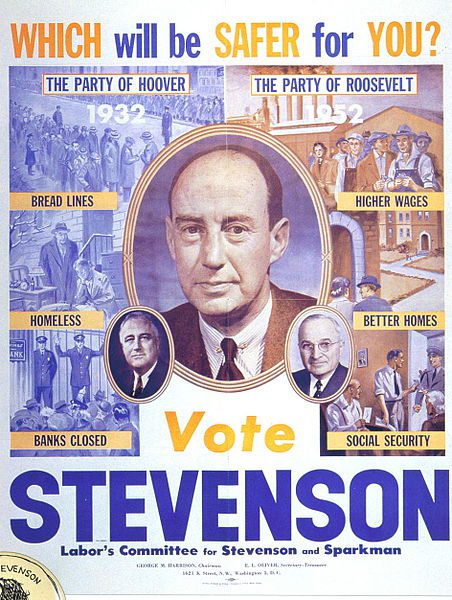
The last Unitarian to mount a credible campaign for the presidency was Adlai Stevenson. He was born on this day, the 5th of February, in 1900, in Los Angeles.
The grandson of the 23rd vice president of the United States, and eventually governor of Illinois, Stevenson carried the Democratic banner twice in presidential elections. First in 1952 and then in 1956. Both times he was defeated by Dwight David Eisenhower. In 1961, the year the American Unitarian Association and the Universalist Church in America consolidated to form the UUA, John Kennedy appointed him ambassador to the United Nations. Four years later he was serving in that capacity when he died of a massive heart attack while walking in London, England.
Stevenson was a fascinating figure. His mother was a Unitarian and a Republican. His Father a Presbyterian and Democrat. He would later say “I wound up in his party and her church.” Which he added, “seemed an expedient solution to the problem.” He occasionally attended the Presbyterian church, and even briefly was a member of one of their congregations. When asked about this he said only because there was no Unitarian option at the time. He never was not a Unitarian and for those last four years of his life, interestingly for the duration of his tenure as the American ambassador to the United Nations, he was a Unitarian Universalist.
Stevenson was brilliant and quick with a quip. When the Unitarian Universalist Association was formed in 1961, he sent a letter to Dana McLean Greeley, the UUAs first president, saying “Congratulations on your election as president. I know from hearsay how satisfying that can be.”
As an intellectual in an era not particularly cherishing such, there’s a famous story where a reporter told him, “Governor, you have the vote of all the thinking people.” To which he replied, “That’s not enough. I need a majority.” While the term “egghead” for an intellectual is not so common anymore, in my childhood and youth it was a common disparagement. In fact, the term was coined by the newspaper columnist Stewart Alsop to describe Stevenson, who in addition to his prodigious intellect was also balding and had a pronounced high forehead. Kind of like an egg.
In some ways I see Adlai Stevenson as a turning figure, representing the shifting from Unitarianism as a part, if a bit nearer the edge, of the American mainstream. Unitarian Universalism is in some fundamental ways counter-cultural, and fundamentally at odds with the political status quo.
But not disengaged. The current congress counts three Unitarian Universalists in the House. Two from California, Ami Bera and Judy Chu, and one from North Carolina, Deborah Ross. However, it’s unlikely there’ll be a UU president anytime soon. I think.
Questions of religion and spirituality are my great passion. You may have noticed. I’m especially interested in the modern divide of spiritual but not religious. With squishy terms like religion and spiritual let’s set up some definitions for this reflection. The word religion is a big subject. Starting mostly in the nineteenth century, the word has come to describe that part of a culture concerned with meaning and purpose. It has two principal expressions.
One is about defining and reinforcing the boundaries of a culture. A great deal of energy is put to the issue of who is in, and who is out. The second expression is usually more personal if not private. Spirituality is about, if you will, the deeper issues of meaning and purpose. Spiritual untangled from religion occurs as that social purpose of a religion begins to weakens, where a particular religion is less obviously about reinforcing a specific culture.
Today we’re in the midst of some terrible upheavals. While many countries can be defined by their majority religions, I think of Buddhist Sri Lanka and Hindu India as examples. Russian Orthodox shows a lot of cracks. And American Evangelical Christianity is capturing a larger part of the Christian identified, but Christianity itself is shrinking and rapidly. Over large swaths of the globe the close identification of a specific culture and a specific religion no longer can be assumed.
Boundaries are loosening. And people are responding sometimes out of fear and sometimes out of some larger vision. American Evangelical religion driving reactionary politics is a good example of fear-based responses. I suggest Unitarian Universalism is an example of responding from some larger vision. Of course, we’re not the only ones. But this reflection is about us.
What’s intriguing is that Unitarian Universalism as it both consolidated the older traditions of the American Unitarian Association and the Universalist Church of America, has been mutating over the past sixty-odd years in some very, very interesting ways. Ways that might mean we do not produce a president any time soon. But ways that might be of vastly more use for people on that individual quest, and socially and politically in the larger sense of helping people to understand who we are beyond the confines of our specific cultures.
The history is complex and trying to unravel it all is beyond the scope of a single sermon. But there is a bit of a paper trail. For many years our Seven Principles have proven a pretty good snapshot of what we commonly hold as important among us. It is interesting in a lot of ways, but not least of which is that while we can find our Jewish and specifically Christian origins in the supplementary documents, the principles themselves lay out something new. It is profoundly ethical, and it calls us to engagement in the world. While the spiritual of it is pretty private, and not spelled out very clearly.
And now we’re in the midst of a conversation at the denominational level about new language which might replace the principles. This language attempts to capture who we are and what we’re about now. I’m fascinated by how it is coming together. All the call to ethics and justice are there. In fact, they’re more explicitly spelled out. Especially regarding racial justice. But and I find this the most interesting thing, this call for justice is seen as the result of something. Our call to engaging the world as UUs is because of a radical intuition that the writers of the draft document call “love.”
It’s been a while coming. Our most successful public witness has involved yellow shirts and, first the slogan “Standing on the Side of Love,” and now “Siding with Love.” I’ve been to several major political demonstrations where non UUs refer to us collectively as the “Love people.” Among our most intriguing theologians Thandeka’s call to “Love Beyond Belief,” a reframing of the old Universalist slogan “Love over creed,” has had enormous resonances among us. I personally am intrigued by just how evocative that word “love” is, while at the same time being resistant to hard definitions.
It speaks to a grand intuition. And the part where the brain engages, where we look to consequences and definitions of this intuition, is how we manifest it all. Those calls to ethics and to the work of justice, specifically. But, perhaps for the first time since Transcendentalism, clearly and unambiguously calling us into some form of spirituality. Opening doors that we may not have even thought existed. Much less that were closed and should be opened.
The Unitarian Universalist songwriter Peter Mayer captures something about this in his hymn “Holy Now.”
When I was a boy, each week
On Sunday, we would go to church
And pay attention to the priest
He would read the holy word
And consecrate the holy bread
And everyone would kneel and bow
Today the only difference is
Everything is holy now
Everything, everything
Everything is holy now.
I should note that a dear friend of mine, a Christian Zen master, when she heard a clip of this song was offended. I’m not sure which part of her found the offense, the Zen or the Christian. Although I think it was within both.
The immediate issue can be that the first part of the song might be heard as a rebuke of silly literalists going to church and thinking that there’s a holy word and a holy bread. And, of course, a priest. An intermediary. The hymn could be heard as if all that were worthless.
To be fair, I bet a lot of people read or hear the lines exactly that way. Foolish them. But me, well, everything holy now. I offer that quickly, and as a caution. A caution because that’s actually not what the hymn calls us to.
Rather it is a call to the deep intuition. When we’ve turned away from the idea of our religion as a safeguard to some culture, specifically guarding our culture, telling us who is in and who is out. When we actually notice the feeling of love rising for and within this world, when we see that everything is holy now. Think of that word love. Think of the intuition of a profound connection among us, that web of interdependence. Well. What then?
When the rubber and the road meet. When our intimations of love, both as a private matter, and with social consequence, are not bound by our specific place, by our culture, or our country, what then?
I suspect that song speaks in part to the mystery. It in fact does not tell people to not go to church. It doesn’t say there is no holy book. It doesn’t tell us there is no holy bread. It doesn’t even disdain the work of priests, or shamans, or witches, holy witches. People who make the sacred their work.
It tells us of a small shift. One thing. A turning of the heart. A realization. An awakening. The new vision, really it’s as ancient as human hearts, but stated unequivocally: is that everything is holy. Larded through all of existence. It is a song of the good and the ill, in the heaven experiences, and in those hell realms. It sings of some holiness that unites everything.
Another wonderful word. Holy. Our English word holy comes from Old English and is related to a German word. It means blessed. Holy is also connected with whole. It hints at our seeing the connections. It is about what we experience when we find those connections beyond the parochial. It doesn’t deny the parochial, the intimate, but it does call us to something larger.
In practical terms it means Unitarian Universalist political engagement is informed by something that no one culture can claim as its own. There is nothing that can be excluded from it. In a final and in a terrible sense, what love tells us, is that there is no other to be excluded.
Love, lover, and beloved, are all facets of the divine. In love everything is holy.
It makes for messy politics. One obvious example. It challenges any idea of a border. It doesn’t say they don’t exist. It doesn’t say they shouldn’t exist. But it does say they’re permeable in ways that challenge all ideas of ultimate separation. And, more. It calls us into caring deeply and doing what we can for those on both sides of any border.
With that all things, intimate. As they are, you and me. The only difference. Well, a new perspective. A wild and open thing. Songs of intimacy. Songs of love.
So today UUs, well, we’re about something powerful and compelling. And, you know. In an era of fear, compounded by those who want to direct the fear at others, any others; all of a sudden our faith tradition throws our lot in with those others.
Doesn’t make us super electable. Not when a lot of money and attention are thrown at a candidate, say at the presidential level. Well. It might be a while before we see a UU president.
But. And. You know. The rubber and the road.
Religion today should, (should is such an interesting word, always invites a caution or two, doesn’t it?). Religion should, can, might, be about our personal quests, the healing of our hurt and longing. And. Religion now should, can, might, be about the great family, the web of relationships, the intimacy of all things.
Some love beyond belief.
Perhaps in this new age, this crossing of boundaries will be the politics of Unitarian Universalism.
I hope so.
Amen.
Previous Post

February 4, 2023
THIRD PURE PRECEPT: Zen’s Shorthand for the Bodhisattva Vow
Next Post
February 5, 2023 Recalling William S. Burroughs
Recent Comments
"Allowing anger to contaminate one's hard disk can be detrimental to one's holistic well being. ..."
Hot Anger: Meeting Anger in Zen ..."
"I love this koan. every which way you turn it bites you, Thirty years on ..."
Nanquan Cuts the Cat: A Jesuit ..."
"As a substitute for religion, Zen is probably better than taking drugs. However, it can ..."
The Selling of Zen at the ..."
"Craving and aversion are detrimental to one's peace and happiness. Easter is a wake up ..."
Easter: A Zen Buddhist Appreciation
Browse Our Archives
Select a Category A Christmas Carol Abolitionist African-American Ahmadiyya Alan Watts Aldous Huxley Allen Ginsberg Amedkar Jayanti American politics American Zen Anaheim Zen Sangha Anglican Annie Besant April Fool Armageddon Art and Religion artificial intellegence Atheist Awakening B R Ambedkar Barlaam & Josaphat Beatnik Between Bhagavad Gita Bible biography birthday bodhisattva Bodhisattva Precepts Book burning Book of Common Prayer Book of Mormon Brahmo Samaj Buddha Buddhism Buddhist Buddhist Lord's Prayer Butterflies Calendars cartoons cat ChatGPT Chicken Tortilla Soup choices Christian atheism Christian mysticism Christian origins Christian Science Christian Zen Christianity Christianity and Buddhism christmas Christmas Truce Christopher Isherwood Church of Later Day Saints Cinco de Mayo circus covenant critical thinking culture D. T. Suzuki Dalit Buddhism Daniel Defoe Desert Fathers and Mothers dharma talk Dogen Donald Trump Dongshan's Five Ranks Dorothy Day dream Duty Easter ecology Edwin Arnold emptiness Empty Moon Zen Network Episcopal Church Eternal Now Ethics evolution existentialism Faith fantasy Fathers Day film film review fire Five Ranks Folk music food Form and emptiness Four Seals Francis of Assisi Francis Xavier Free thinker friendship George MacDonald Gerald Heard Glenn Taylor Webb God Good Friday Gospel of Gospel of Mark Gospel of Thomas grace Graduate Theological Unioin Graduate Theological Union Guanyin H R Blyth Hakuin Ekaku Hanamatsuri Hanukkah Harada Yasutani Zen Heart Sutra Henry David Thoreau Hermann Hesse Hinduism History and Religion history of religion Holy Spirit home Hospitality Icon Ides of March Isaac Newton Islam Islamic mysticism Jack Kerouac James Luther Adams Jiddu Krishnamurti Joan of Arc Johannes Gutenberg John Donne joke Judaism justice karma kensho King James Bible koan Koun Yamada Kyoto School Lewis Carrol Liberal Christianity Liberal Religion Life Plan Community Liminal literature Literature and Religion Liturgy Lord's Prayer Love Mahatma Gandhi Mahayana Martin Luther King Jr Mary Baker Eddy Mary Magdelene Mary Oliver Mayflower Compact Meditation memories memory metaphor money money and religioin Mormons Mother's Day movie review mysticism mythic Neighborhood Unitarian Universalist Church New Thought Nichiren Buddhism Nonduality not knowing Omar Khayyam Pacific School of Religion pagan Palm Sunday Passover peace Pentecost perennialism Phantastes Philip Kapleau philosophy Pilgrimage poetry Poetry and Religion politics Prayer Precepts Printing Press prophecy prophetic spirituality psychology Pure Land Queer religion queering religion Quietism Ram Mohan Roy rebirth recipe Relationships and religion religion religion and history Religious syncretism Resistance Retirement Retreat review Rissho Kosei Kai Ritual Robert Aitken Roshi Robert Ingersoll Rohatsu Romani religion Rosie the Riveter saints samadhi SanboZen Sangha Satyagraha science science and reigion science and religion science fiction seminary sermon Sesshin Sex and Religion Shinran Sikh Sikh tradition silence Social Justice Socially Engaged Buddhism Society and religion Soto Zen soul spiritual community spiritual practice Spirituality Sufism Suicide superstition Taoism Television Teresa of Avila Thanksgiving theological schools Theosophy Thomas Merton Time Transcendentalism Transcendentalist Trinitarian Trinity Uncategorized unitarian Unitarian Christianity Unitarian Universalist Universalism Vajrayana Vedanta Walking war Willa Cather William Ellery Channing wisdom women and religion women in religion World Teacher Writing zazen Zen Zen Center Zen inspired retriement zen meditation Zen Precepts Zen women
Select a Month September 2026 August 2026 July 2026 June 2026 May 2026 April 2026 March 2026 February 2026 January 2026 December 2025 November 2025 October 2025 September 2025 August 2025 July 2025 June 2025 May 2025 April 2025 March 2025 February 2025 January 2025 December 2024 November 2024 October 2024 September 2024 August 2024 July 2024 June 2024 May 2024 April 2024 March 2024 February 2024 January 2024 December 2023 November 2023 October 2023 September 2023 August 2023 July 2023 June 2023 May 2023 April 2023 March 2023 February 2023 January 2023 December 2022 November 2022 October 2022 September 2022 August 2022 July 2022 June 2022 May 2022 April 2022 March 2022 February 2022 January 2022 December 2021 November 2021 October 2021 September 2021 August 2021 July 2021 June 2021 May 2021 April 2021 March 2021 February 2021 January 2021 December 2020 November 2020 October 2020 September 2020 August 2020 July 2020 June 2020 May 2020 April 2020 March 2020 February 2020 January 2020 December 2019 November 2019 October 2019 September 2019 August 2019 July 2019 June 2019 May 2019 April 2019 March 2019 February 2019 January 2019 December 2018 November 2018 October 2018 September 2018 August 2018 July 2018 June 2018 May 2018 April 2018 March 2018 February 2018 January 2018 December 2017 November 2017 October 2017 September 2017 August 2017 July 2017 June 2017 May 2017 April 2017 March 2017 February 2017 January 2017 December 2016 November 2016 October 2016 September 2016 August 2016 July 2016 June 2016 May 2016 April 2016 March 2016 February 2016 January 2016 December 2015 November 2015 October 2015 September 2015 August 2015 July 2015 June 2015 May 2015 April 2015 March 2015 February 2015 January 2015 December 2014 November 2014 October 2014 September 2014 August 2014 July 2014 June 2014 May 2014 April 2014 March 2014 February 2014 January 2014 December 2013 November 2013 October 2013 September 2013 August 2013 July 2013 June 2013 May 2013 April 2013 March 2013 February 2013 January 2013 December 2012 November 2012 October 2012 September 2012 August 2012 July 2012 June 2012 May 2012 April 2012 March 2012 February 2012 January 2012 December 2011 November 2011 October 2011 September 2011 August 2011 July 2011 June 2011 May 2011 April 2011 March 2011 February 2011 January 2011 December 2010 November 2010 October 2010 September 2010 August 2010 July 2010 June 2010 May 2010 April 2010 March 2010 February 2010 January 2010 December 2009 November 2009 October 2009 September 2009 August 2009 July 2009 June 2009 May 2009 April 2009 March 2009 February 2009 January 2009 December 2008 November 2008 October 2008 September 2008 August 2008 July 2008 June 2008 May 2008 April 2008 March 2008 February 2008 January 2008 December 2007 November 2007 October 2007 September 2007 August 2007 July 2007 June 2007 May 2007 April 2007 March 2007 February 2007 January 2007 December 2006 November 2006 October 2006 September 2006
Follow Us!
TAKE THE
Religious Wisdom Quiz
What empire destroyed the Second Temple in Jerusalem?
Select your answer to see how you score.
Assyrian Roman Greek Babylonian
Related posts from Monkey Mind


Which Is the True Qian? A Koan About...


TRENDING AT PATHEOS Buddhist

The Problem with False Prophets
Miller’s Station UMC| 10/18/26| Anchor Verse: Jeremiah 23: 1, 9-23 I...

Emotion in Early Christianity by Andrew Crislip
Andrew Crislip’s Emotion in Early Christianity examines an often overlooked dimension of...

16 Spiritual Touchstones for a More Grounded Life
After decades of spiritual study, here are 16 principles I try...

Catholic Evangelization: Sharing Your Faith Every Day
Welcome back to the Graceful Awakening mini-series called, “From Faith to Mission.” ...

The Pillar of the Boatmen: the Ancient Monument...
The Pillar of the Boatmen is a Romano-Gaulish sculpture that dates from...

In one sense walking into Westminster Abbey is like walking down the...
view all Buddhist blogs
What Are Your Thoughts?leave a comment
Ad-Free & Subscriber Log-In Subscription Support
- About Us
- 2026 Calendar
- Videos
- Podcasts
- Library of World Religions
- Faith In Media Tracker
- Advertise With Us
- Write for Us
- Privacy Policy
- Terms of Service
- Do Not Sell My Data
- Contact Us
- Radiant Digital
- Manage Newsletter Subscriptions
- Unsubscribe From Notifications
- Sitemap
Copyright 2008-2026, Patheos. All rights reserved.
Subscription Support Ad-Free & Subscriber Log-In
Follow Patheos