
BuddhistCatholicContemplativeEvangelicalGeneral ChristianHinduJewishLatter-day SaintMuslimNew VisionsProgressive Christian
Beliefs
- Buddhist
- Catholic
- Contemplative
- Evangelical
- General Christian
- Hindu
- Jewish
- Latter-day Saint
- More Voices
- Muslim
- New Visions
- Pagan
- Progressive Christian
Topics
- Religion News
- Food and Religion
- Sports and Religion
- Religious Art
- Religious Music and Entertainment
- Religious Events
- History and Religion
- Style and Religion
- Politics and Religion
- Women in Religion
- Recreation Outdoors and Religion
- Business Finance and Religion
- Careers Workplace and Religion
- Education and Religion
- Family Parenting and Religion
- Health Fitness and Religion
- Home and Religion
- Relationships and Religion
- Technology and Religion
- Travel and Religion
Columnists
- Buddhist Columnists
- Business Finance and Religion Columnists
- Careers Workplace and Religion Columnists
- Catholic Columnists
- Contemplative Columnists
- Education and Religion Columnists
- Evangelists Columnists
- Family Parenting and Religion Columnists
- General Christian Columnists
- Health Fitness and Religion Columnists
- Hindu Columnists
- History and Religion Columnists
- Home and Religion Columnists
- Jewish Columnists
- More Voices Columnists
- Latter Day Columnists
- Muslim Columnists
- New Visions Columnists
- Nonreligious Columnists
- Pagan Columnists
- Politics and Religion Columnists
- Progressive Columnists
- Recreation Outdoors and Religion Columnists
- Relationships and Religion Columnists
- Religion News Columnists
- Religious Art Columnists
- Religious Events Columnists
- Religious Music and Entertainment Columnists
- Sports and Religion Columnists
- Style and Religion Columnists
- Technology and Religion Columnists
- Travel and Religion Columnists
- Women in Religion Columnists
Resource Library
- 2026 Calendar
- Library of World Religions
- The 100 Most Holy Places on Earth
- Patheos Answers
- Podcasts
- Videos
- Faith Leaders Database
- Anglican Episcopalian
- Bahai
- Baptist
- Buddhism
- Christianity
- Confucianism
- Eastern Orthodoxy
- Hinduism
- Holiness and Pentecostal
- ISKCON
- Islam
- Judaism
- Lutheran
- Methodist
- The Church of Jesus Christ of Latter-day Saints
- New Age
- Paganism
- Presbytarian and Reformed
- Protestantism
- Religion Behind the Scenes
- Roman Catholic
- Scientology
- Shia Islam
- Sikhism
- Sufism
- Sunni Islam
- Taoism
- Zen
- See all religions
Research Tools
 Ad-Free & Subscriber Log-In Subscription Support
Follow Patheos 

- Trending:
- Advent
- |
- Forgiveness
- |
- Thanksgiving
- |
- Election
- |
- Seasonal Holidays
- |
- Marriage

- Home
- Buddhist
- King’s Chapel and Its Prayer Book
King’s Chapel and Its Prayer Book
Last updated on: December 2, 2022 at 11:35 am by James Ford
King’s Chapel and Its Prayer Book 2022-12-02T11:35:26-08:00 James Ford
Patheos Explore the world's faith through different perspectives on religion and spirituality! Patheos has the views of the prevalent religions and spiritualities of the world.
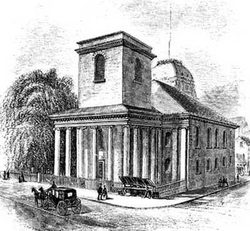
King’s Chapel and its Prayer Book
John Harcourt
Members of Saint John’s visiting Boston may have discovered King’s Chapel on Tremont Street at the foot of Beacon Hill. Those who have ventured inside for a service may have been vaguely disconcerted. The text in their hands was entitled The Book of Common Prayer; its format and much of the language would have seemed familiar enough. But something seemed odd about it all. And indeed it might King’s Chapel uses a revision of the traditional Prayer Book—a revision that reflects its status as a Unitarian congregation. “High Church Unitarian,” we might be tempted to say.
Anglican worship was forbidden during much of the seventeenth century, when Puritans dominated the Massachusetts Bay Colony. But in the confusion of the early 1680s when James II, the last of the Stuart monarchs, occupied the throne and issued new royal charters, the Calvinist hegemony began to crumble. The new royal governor may have preferred to commandeer part of the Old South Church for his Anglican services to the annoyance of those who had founded King’s Chapel in 1688, the first church of our communion in Boston, under the jurisdiction of the bishop of London.
Much later, after the American Revolution, more changes occurred. The American Episcopal Church came into existence, drew up its own polity, and issued the first American Prayer Book. But things were a bit more complicated at King’s Chapel, where the gentle winds of Unitarianism were beginning to stir. James Freeman was officiating there as lay reader, and it was hoped that he could be ordained by the new bishops of the Episcopal Church. But in 1785, King’s Chapel had already revised the 1662 Book of Common Prayer into a mildly Unitarian document, and this revision proved unacceptable to the new American bishops. King’s Chapel countered by itself ordaining Freeman as “Rector, Minister, public Teacher, Priest, Pastor, and teaching Elder.” This purely local “lay ordination” established the essential character of King’s Chapel to this day. It is not officially a member of any other grouping not even of the Unitarians. It defines itself in its Prayer Book as “Unitarian Christian in theology, anglican in worship, and congregational in government” (p. 120).
The King’s Chapel Book of Common Prayer is now in its ninth edition (1986); its development has paralleled in many ways the evolution of our own Prayer Book—and those of other mainline Protestant denominations. Its language is mostly (though not entirely) traditional; its contents have expanded to include Midday Prayer, three orders of Holy Communion, special services for Christmas, for tenebrae, for Easter Vigil, a two year daily lectionary, a three year lectionary for Sundays and Holy Days. A detailed Kalendar (in the back end pages) will seem familiar enough to us, although a close scrutiny will disclose the omission of Trinity Sunday (the long stretch of Sundays between Pentecost and advent are numbered as Sundays “after Whitsunday”).
The careful reader will also note the absence of creeds; the authors of our own American Prayer book at first rejected even the Apostles’ and the Nicene creeds. The festivals of saints, even New Testament saints, are not explicitly mentioned. Within the liturgies, the Gloria Patri is replaced by a scriptural doxology:
Now unto the King eternal, immortal, invisible, the only Wise God; Be honor and glory, through Jesus Christ, for ever and ever. Amen (cf. I Timothy 10:17)
What to make of all this? We Episcopalians know very little about Unitarianism, especially in its earlier Christian forms. We are surprised to earn how vigorous it was during the period of the Reformation, especially in Poland and Hungary. The Arian impulse has never been wholly absent from Christian thought, despite the efforts of Athanasius and his followers. Many, perhaps most, of the New Testament writers were, to some degree. Adoptionists in their Christologies (that is, for them the many Jesus was adopted by God as His Son at some point in His early life at His Baptism or perhaps at the Transfiguration. Most New Testament passages are susceptible of an Adoptionist reading: 2 Corinthians 13:14 is typical:
The grace of the Lord Jesus Christ and the love of God and the fellowship of the Holy spirit be with you all.
The word Trinity does not occur in the New Testament nor for several centuries after its completion. Trinity Sunday was a late and unmemorable addition to the church year—think back on the sermons you have heard on that date! The most explicit formulation of Trinitarian doctrine, the so called Athanasian Creed (composed centuries after the death of its namesake) has never appeared in any American Prayer Book before 1979, where it is relegated to an appendix discreetly called Historical Documents of the Church pp. 864–865). In the past hundred years or so, we have come to accept more and more the fact that Jesus was an observant Jew throughout His life. However He may have conceptualized His relationship to God, it was not in the theological terminology of the early Middle Ages.
Or consider church polity. Episcopalians sometimes seem to think that the orders of bishops, priests, and deacons
(like gothic church buildings) stretch back to their institution by Jesus. Yet today’s Biblical scholars are hardly in agreement to what New Testament terms such as bishop (overseer, teacher, presiding officer?) or deacon (servant) may have meant originally. Few main line interpreters would maintain today that Jesus intended to found a church: did the very word exist in His first century Jewish vocabulary? Even Matthew presents “Go reach ye all nations” (28:19 20) as a post Resurrection utterance.
Congregational organization, in a wide variety of shapes rather than that of a modem diocese and its “monarchical” bishop? Secret rather than public services, held in homes before sun up, with great variety in what was said and done? Something like this would appear to have been the norm in the first Christian centuries.
King’s Chapel is thus no late eighteenth century aberration. It draws largely through an Anglican filter upon ancient traditions that go back to the time when Christianity was an underground movement. It bears living witness to a troubled past, complex and multiform, that we are only beginning to recover.
“In an age of liturgical change and experiment, we at King’s Chapel are sometimes asked why we keep the prayer book In fact, it is the prayer book that has kept us.” (xii)
Can not as much be said of Saint John’s, Ithaca?
**
A note to the reader from Professor Harcourt: I am not a “closet Unitarian,” a crypto Arian, or a “behind barred doors first century Palestinian Adoptionist.” My own views on the subject have been set forth in “Experiencing the Trinity” (which I regard as the central Christian metaphor) in The Eagle of June, 1993.
Dr John Bertram Harcourt was the Charles A. Dana Professor of English at Ithaca College. He was a member of St John’s Episcopal Church in Ithaca, and served in several positions including on the Vestry, until his death in 2005. This article was first published in the church’s newsletter, St John’s Eagle, in May, 2002.
Progressive Christian
Contemplative
Previous Post

November 30, 2022
Recalling the Catholic Nun & Zen Master Sister Elaine MacInnis
Browse Our Archives
Select a Category A Christmas Carol Abolitionist African-American Ahmadiyya Alan Watts Aldous Huxley Allen Ginsberg Amedkar Jayanti American politics American Zen Anaheim Zen Sangha Anglican Annie Besant April Fool Armageddon Art and Religion artificial intellegence Atheist Awakening B R Ambedkar Barlaam & Josaphat Beatnik Between Bhagavad Gita Bible biography birthday bodhisattva Bodhisattva Precepts Book burning Book of Common Prayer Book of Mormon Brahmo Samaj Buddha Buddhism Buddhist Buddhist Lord's Prayer Butterflies Calendars cartoons cat ChatGPT Chicken Tortilla Soup choices Christian atheism Christian mysticism Christian origins Christian Science Christian Zen Christianity Christianity and Buddhism christmas Christmas Truce Christopher Isherwood Church of Later Day Saints Cinco de Mayo circus covenant critical thinking culture D. T. Suzuki Dalit Buddhism Daniel Defoe Desert Fathers and Mothers dharma talk Dogen Donald Trump Dongshan's Five Ranks Dorothy Day dream Duty Easter ecology Edwin Arnold emptiness Empty Moon Zen Network Episcopal Church Eternal Now Ethics evolution existentialism Faith fantasy Fathers Day film film review fire Five Ranks Folk music food Form and emptiness Four Seals Francis of Assisi Francis Xavier Free thinker friendship George MacDonald Gerald Heard Glenn Taylor Webb God Good Friday Gospel of Gospel of Mark Gospel of Thomas grace Graduate Theological Unioin Graduate Theological Union Guanyin H R Blyth Hakuin Ekaku Hanamatsuri Hanukkah Harada Yasutani Zen Heart Sutra Henry David Thoreau Hermann Hesse Hinduism History and Religion history of religion Holy Spirit home Hospitality Icon Ides of March Isaac Newton Islam Islamic mysticism Jack Kerouac James Luther Adams Jiddu Krishnamurti Joan of Arc Johannes Gutenberg John Donne joke Judaism justice karma kensho King James Bible koan Koun Yamada Kyoto School Lewis Carrol Liberal Christianity Liberal Religion Life Plan Community Liminal literature Literature and Religion Liturgy Lord's Prayer Love Mahatma Gandhi Mahayana Martin Luther King Jr Mary Baker Eddy Mary Magdelene Mary Oliver Mayflower Compact Meditation memories memory metaphor money money and religioin Mormons Mother's Day movie review mysticism mythic Neighborhood Unitarian Universalist Church New Thought Nichiren Buddhism Nonduality not knowing Omar Khayyam Pacific School of Religion pagan Palm Sunday Passover peace Pentecost perennialism Phantastes Philip Kapleau philosophy Pilgrimage poetry Poetry and Religion politics Prayer Precepts Printing Press prophecy prophetic spirituality psychology Pure Land Queer religion queering religion Quietism Ram Mohan Roy rebirth recipe Relationships and religion religion religion and history Religious syncretism Resistance Retirement Retreat review Rissho Kosei Kai Ritual Robert Aitken Roshi Robert Ingersoll Rohatsu Romani religion Rosie the Riveter saints samadhi SanboZen Sangha Satyagraha science science and reigion science and religion science fiction seminary sermon Sesshin Sex and Religion Shinran Sikh Sikh tradition silence Social Justice Socially Engaged Buddhism Society and religion Soto Zen soul spiritual community spiritual practice Spirituality Sufism Suicide superstition Taoism Television Teresa of Avila Thanksgiving theological schools Theosophy Thomas Merton Time Transcendentalism Transcendentalist Trinitarian Trinity Uncategorized unitarian Unitarian Christianity Unitarian Universalist Universalism Vajrayana Vedanta Walking war Willa Cather William Ellery Channing wisdom women and religion women in religion World Teacher Writing zazen Zen Zen Center Zen inspired retriement zen meditation Zen Precepts Zen women
Select a Month October 2026 September 2026 August 2026 July 2026 June 2026 May 2026 April 2026 March 2026 February 2026 January 2026 December 2025 November 2025 October 2025 September 2025 August 2025 July 2025 June 2025 May 2025 April 2025 March 2025 February 2025 January 2025 December 2024 November 2024 October 2024 September 2024 August 2024 July 2024 June 2024 May 2024 April 2024 March 2024 February 2024 January 2024 December 2023 November 2023 October 2023 September 2023 August 2023 July 2023 June 2023 May 2023 April 2023 March 2023 February 2023 January 2023 December 2022 November 2022 October 2022 September 2022 August 2022 July 2022 June 2022 May 2022 April 2022 March 2022 February 2022 January 2022 December 2021 November 2021 October 2021 September 2021 August 2021 July 2021 June 2021 May 2021 April 2021 March 2021 February 2021 January 2021 December 2020 November 2020 October 2020 September 2020 August 2020 July 2020 June 2020 May 2020 April 2020 March 2020 February 2020 January 2020 December 2019 November 2019 October 2019 September 2019 August 2019 July 2019 June 2019 May 2019 April 2019 March 2019 February 2019 January 2019 December 2018 November 2018 October 2018 September 2018 August 2018 July 2018 June 2018 May 2018 April 2018 March 2018 February 2018 January 2018 December 2017 November 2017 October 2017 September 2017 August 2017 July 2017 June 2017 May 2017 April 2017 March 2017 February 2017 January 2017 December 2016 November 2016 October 2016 September 2016 August 2016 July 2016 June 2016 May 2016 April 2016 March 2016 February 2016 January 2016 December 2015 November 2015 October 2015 September 2015 August 2015 July 2015 June 2015 May 2015 April 2015 March 2015 February 2015 January 2015 December 2014 November 2014 October 2014 September 2014 August 2014 July 2014 June 2014 May 2014 April 2014 March 2014 February 2014 January 2014 December 2013 November 2013 October 2013 September 2013 August 2013 July 2013 June 2013 May 2013 April 2013 March 2013 February 2013 January 2013 December 2012 November 2012 October 2012 September 2012 August 2012 July 2012 June 2012 May 2012 April 2012 March 2012 February 2012 January 2012 December 2011 November 2011 October 2011 September 2011 August 2011 July 2011 June 2011 May 2011 April 2011 March 2011 February 2011 January 2011 December 2010 November 2010 October 2010 September 2010 August 2010 July 2010 June 2010 May 2010 April 2010 March 2010 February 2010 January 2010 December 2009 November 2009 October 2009 September 2009 August 2009 July 2009 June 2009 May 2009 April 2009 March 2009 February 2009 January 2009 December 2008 November 2008 October 2008 September 2008 August 2008 July 2008 June 2008 May 2008 April 2008 March 2008 February 2008 January 2008 December 2007 November 2007 October 2007 September 2007 August 2007 July 2007 June 2007 May 2007 April 2007 March 2007 February 2007 January 2007 December 2006 November 2006 October 2006 September 2006
Follow Us!
TAKE THE
Religious Wisdom Quiz
Who was the first high priest of Israel?
Select your answer to see how you score.
Aaron Joshua Caleb Moses
Related posts from Monkey Mind
Taking Refuge in the (Zen) Sangha
Recalling the Amazing Alexandra David-Neel
The Great Matter: Walking the Zen Way
TRENDING AT PATHEOS Buddhist

'Statements of Faith' never get shorter
Nothing demonstrates a conservative commitment to faith and faithfulness like a "statement...

Michele's Reviews - Future Grace by John Piper
In God's Place, at God's Pace, by Future Grace Impatience is...

Bama Gramma's Blackout Christmas: the Power of Light...
Another Christmas Skit: I have an alter ego: Bama Gramma. She shows...

Thanksgiving as a Way of Life: A Christian...
Each year, Thanksgiving brings families and friends together to share meals, stories,...

Two Women Doctors Who Went Against the Current
Women physicians who transformed healthcare for "Indians" “I shall have an advantage...

Reading Culture Through Scripture, Not the Other Way...
A Radix Teleology and Faith Before Seeing: Essentialism “For we also have...
view all Buddhist blogs
Ad-Free & Subscriber Log-In Subscription Support
- About Us
- 2026 Calendar
- Videos
- Podcasts
- Library of World Religions
- Faith In Media Tracker
- Advertise With Us
- Write for Us
- Privacy Policy
- Terms of Service
- Do Not Sell My Data
- Contact Us
- Radiant Digital
- Manage Newsletter Subscriptions
- Unsubscribe From Notifications
- Sitemap
Copyright 2008-2026, Patheos, part of the Radiant Digital network of media brands. All rights reserved.
Subscription Support Ad-Free & Subscriber Log-In
Follow Patheos