
BuddhistCatholicContemplativeEvangelicalGeneral ChristianHinduJewishLatter-day SaintMuslimNew VisionsProgressive Christian
Beliefs
- Buddhist
- Catholic
- Contemplative
- Evangelical
- General Christian
- Hindu
- Jewish
- Latter-day Saint
- More Voices
- Muslim
- New Visions
- Pagan
- Progressive Christian
Topics
- Religion News
- Food and Religion
- Sports and Religion
- Religious Art
- Religious Music and Entertainment
- Religious Events
- History and Religion
- Style and Religion
- Politics and Religion
- Women in Religion
- Recreation Outdoors and Religion
- Business Finance and Religion
- Careers Workplace and Religion
- Education and Religion
- Family Parenting and Religion
- Health Fitness and Religion
- Home and Religion
- Relationships and Religion
- Technology and Religion
- Travel and Religion
Columnists
- Buddhist Columnists
- Business Finance and Religion Columnists
- Careers Workplace and Religion Columnists
- Catholic Columnists
- Contemplative Columnists
- Education and Religion Columnists
- Evangelists Columnists
- Family Parenting and Religion Columnists
- General Christian Columnists
- Health Fitness and Religion Columnists
- Hindu Columnists
- History and Religion Columnists
- Home and Religion Columnists
- Jewish Columnists
- More Voices Columnists
- Latter Day Columnists
- Muslim Columnists
- New Visions Columnists
- Nonreligious Columnists
- Pagan Columnists
- Politics and Religion Columnists
- Progressive Columnists
- Recreation Outdoors and Religion Columnists
- Relationships and Religion Columnists
- Religion News Columnists
- Religious Art Columnists
- Religious Events Columnists
- Religious Music and Entertainment Columnists
- Sports and Religion Columnists
- Style and Religion Columnists
- Technology and Religion Columnists
- Travel and Religion Columnists
- Women in Religion Columnists
Resource Library
- 2026 Calendar
- Library of World Religions
- The 100 Most Holy Places on Earth
- Patheos Answers
- Podcasts
- Videos
- Faith Leaders Database
- Anglican Episcopalian
- Bahai
- Baptist
- Buddhism
- Christianity
- Confucianism
- Eastern Orthodoxy
- Hinduism
- Holiness and Pentecostal
- ISKCON
- Islam
- Judaism
- Lutheran
- Methodist
- The Church of Jesus Christ of Latter-day Saints
- New Age
- Paganism
- Presbytarian and Reformed
- Protestantism
- Religion Behind the Scenes
- Roman Catholic
- Scientology
- Shia Islam
- Sikhism
- Sufism
- Sunni Islam
- Taoism
- Zen
- See all religions
Research Tools
 Ad-Free & Subscriber Log-In Subscription Support
Ad-Free & Subscriber Log-In Subscription Support
Follow Patheos 

- Trending:
- Forgiveness
- |
- Marriage
- |
- Consciousness
- |
- Death Penalty
- |
- Election
- |
- Halloween

- Home
- Buddhist
- A Festival for Bodhidharma and the Oldest of Zen Texts
A Festival for Bodhidharma and the Oldest of Zen Texts
Last updated on: October 5, 2022 at 1:00 am by James Ford
A Festival for Bodhidharma and the Oldest of Zen Texts 2022-10-04T08:42:06-07:00 James Ford
Patheos Explore the world's faith through different perspectives on religion and spirituality! Patheos has the views of the prevalent religions and spiritualities of the world.
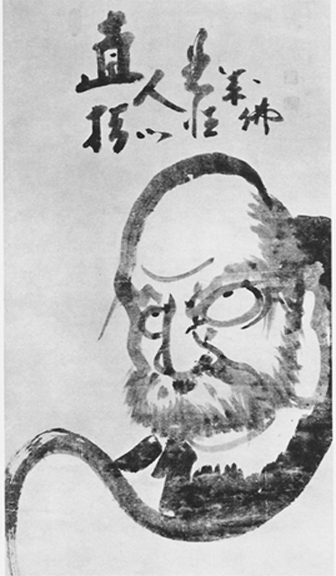
In Japanese Zen today, the 5th of October is reserved as a holiday in remembrance of Bodhidharma, the mostly mythical founder of Chinese Zen.
As Issho Fujita writes, “The accounts of his life are largely legendary (see Comics “Bodhidharma” 1-12 at Sotozen-net International website) but according to Denkoroku (The Record of Transmitting the Light) written by Keizan Zenji, he was born as the third son of the king of Koshi in southern India. He became a monk and practiced under the guidance of Venerable Hannyatara(Prajnatara). He is considered to be the 28th Indian Buddhist teacher in a direct line from Gautama Buddha…”
According to the stories he then carried the Zen dharma to China. There he found a Chinese disciple Huike, and with that the lineage of the Zen way began in East Asia.
Along with other things Bodhidharma is the putative author of the oldest text attributed specifically to the Zen schools. The Long Scroll of the Treatise on the Two Entrances and Four Practices. Sometimes it is shortened to the Treatise on the Two Entrances and Four Practices. And, sometimes simply to The Two Entrances.
Some argue Bodhidharma’s disciple Huike compiled his teacher’s message as an early version the treatise. And then it was edited more or less into the document we have by the monk Tanlin. The earliest strata seems to date from about the sixth century. Possibly there are even earlier elements.
The consensus view seems to be that all other texts attributed to Bodhidharma date long after the old barbarian. But in this text there is at least some possible connection to him. Among other things we get critical Zen themes as “wall gazing,” “skillful means,” and “putting the mind at rest.” These are central to the ongoing themes of the Zen way.
The Dharma as we receive it in the Pali Sutras is highly didactic. The teachings are laid out in order, and each stage is spelled out. Within that received tradition the anecdotes of awakening turn on the Buddha explaining things clearly and people realizing the truth of his teaching.
Zen mostly plays out differently. Instead of lists and stages, we hear stories. We are invited to take a journey. As we trek all along the way surprises, shocks, offense and joy erupt, pretty much unbidden, often at the strangest moments. And from those moments where we’re thrown into the mystery, we pick ourselves up, dust ourselves off, and find strangely, wondrously, that our lives take new courses.
Two Entrances is a hybrid document, representing the old and the new pretty jumbled up. In the treatise we start with an invitation to the leap from the hundred-foot pole. But, most of it is presented within that older more formal didactic expression of our way.
If you don’t push it too hard, the treatise is sort of a platypus, part mammal, part reptile, part classical Buddhist explanation, part Zen presentation. You get to choose which is mammal, which is reptile.
All of it, however, I suggest, is alive.
There are a number of translations available. Here are three. May you enjoy them on this festival of the old sage…
***
Bodhidharma on the Twofold Entrance to the Tao
Translated by D T Suzuki
From the Manual of Zen Buddhism
There are many ways to enter the Path, but briefly speaking they are of two sorts only. The one is “Entrance by Reason” and the other “Entrance by Conduct”.
By “Entrance by Reason” we mean the realization of the spirit of Buddhism by the aid of the scriptural teaching. We then come to have a deep faith in the True Nature which is the same in all sentient beings . The reason why it does not manifest itself is due to the overwrapping of external objects and false thoughts. When a man,abandoning the false and embracing the true, in singleness of thought practises the Pi-kuan [“Wall-gazing”] he finds that there is neither self nor other,that the masses and the worthies are of one essence, and he firmly holds on to this belief and never moves away therefrom. He will not then be a slave to words, for he is in silent communion with the Reason itself, free from conceptual discrimination; he is serene and not-acting. This is called “Entrance by Reason”.
By “Entrance by Conduct” is meant the four acts in which all other acts are included. What are the four?
1. To know how to requite hatred;
2. To be obedient to karma;
3. Not to crave anything; and
4. To be in accord with the Dharma.
1. What is meant by “How to requite hatred”? He who disciplines himself in the Path should think thus when he has to struggle with adverse conditions: “During the innumerable past ages I have wandered through a multiplicity of existences, all the while giving myself to unimportant details of life at the expense of essentials, and thus creating infinite occasions for hate, ill-will, and wrongdoing. While no violations have been committed in this life, the fruits of evil deeds in the past are to be gathered now. Neither gods nor men can foretell what is coming upon me. I will submit myself willingly and patiently to all the ills that befall me, and I will never bemoan or complain. The Sutra teaches me not to worry over ills that may happen tome. Why? Because when things are surveyed by a higher intelligence, the foundation of causation is reached.” When this thought is awakened in a man, he will be in accord with the Reason because he makes the best use of hatred and turns it into the service in his advance towards the Path. This is called the “way to requite hatred”.
2. By “being obedient to karma” is meant this: There is no self (atman) in whatever beings are produced by the interplay of karmic conditions; the pleasure and pain I suffer are also the results of my previous action. If I am rewarded with fortune, honour, etc., this is the outcome of my past deeds which by reason of causation affect my present life. When the force of karma is exhausted, the result I am enjoying now will disappear; what is then the use of being joyful over it? Gain or loss, let me accept the karma as it brings to me the one or the other; the Mind itself knows neither increase nor decrease. The wind of pleasure [and pain] will not stir me, for I am silently in harmony with the Path. Therefore this is called “being obedient to karma”.
3. By “not craving (ch’iu) anything” is meant this: Men of the world, in eternal confusion, are attached everywhere to one thing or another, which is called craving. The wise however understand the truth and are not like the ignorant. Their minds abide serenely in the uncreated while the body moves about in accordance with the laws of causation. All things are empty and there is nothing desirable to seek after. Where there is the merit of brightness there surely lurks the demerit of darkness. This triple world where we stay altogether too long is like a house on fire; all that has a body suffers, and nobody really knows what peace is. Because the wise are thoroughly acquainted with this truth, they are never attached to things that change; their thoughts are quieted, they never crave anything. Says the Sutra:”Wherever there is a craving, there is pain; cease from craving and you are blessed.” Thus we know that not to crave anything is indeed the way to the Truth. Therefore, it is taught not “to crave anything”.
4. By “being in accord with the Dharma” is meant that the Reason which we call the Dharma in its essence is pure, and that this Reason is the principle of emptiness (sunyata) in all that is manifested; it is above defilements and attachments, and there is no “self”, no “other” in it. Says the Sutra: “In the Dharma there are no sentient beings, because it is free from the stain of being; in the Dharma there is no ‘self because it is free from the stain of selfhood.” When the wise understand this truth and believe in it, their lives will be “in accordance with the Dharma”.
As there is in the essence of the Dharma no desire to possess, the wise are ever ready to practice charity with their body, life, and property, and they never begrudge, they never know what an ill grace means. As they have a perfect understanding of the threefold nature of emptiness, they are above partiality and attachment. Only because of their will to cleanse all beings of their stains, they come among them as of them, but they are not attached to form. This is the self-benefiting phase of their lives. They,however, know also how to benefit others, and again how to glorify the truth of enlightenment. As with the virtue of charity, so with the other five virtues [of the Prajnaparamita], The wise practice the six virtues of perfection to get rid of confused thoughts, and yet there is no specific consciousness on their part that they are engaged in any meritorious deeds. This is called “being in accord with the Dharma”.
***
Treatise on the Two Entrances and Four Practices
attributed to Bodhidharma
translated by John R. McRae
from The Northern School and the Formation of Early Ch’an Buddhism
There are many ways of entering into enlightenment, but all of them may effectively be subsumed under two categories: the “entrance of principle” and the “entrance of practice”.
The entrance of principle is to become enlightened to the Truth on the basis of the teaching. One must have a profound faith in the fact that one and the same True Nature is possessed of all sentient beings, both ordinary and enlightened, and that this True Nature is only covered up and made imperceptible by false sense impressions.
If one discards the false and takes refuge in the True, one resides frozen in “wall contemplation”, in which self and other, ordinary person and sage, are one and the same; one resides fixedly without wavering, never again to be swayed by written teachings. To be thus mysteriously identified with the True Principle, to be without discrimination, serene and inactive: This is called the entrance of principle.
The entrance of practice refers to the “four practices” which encompass all other practices. They are the “practice of retribution of enmity,” the “practice of acceptance of circumstances,” the “practice of the absence of craving,” and the “practice of accordance with the Dharma.”
What is the practice of the retribution of enmity? When the practitioner of Buddhist spiritual training experiences suffering, he should think to himself:
“For innumerable eons I have wandered through the various states of existence, forsaking the fundamental for the derivative, generating a great deal of enmity and distaste and bringing an unlimited amount of injury and discord upon others.
My present suffering constitutes the fruition of my past crimes and karma, rather than anything bequeathed to me from any heavenly or human being. I shall accept it patiently and contentedly, without complaint.”
When you react to events in this fashion, you can be in accord with Principle, therefore this is called practice of the retribution of enmity.
The second is the practice of the acceptance of circumstances. Sentient beings have no unchanging self and are entirely subject to the impact of their circumstances. Whether one experiences suffering or pleasure, both are generated from one’s circumstances. If one experiences fame, fortune, and other forms of superior karmic retribution, this is the result of past causes.
Although one may experience good fortune now, when the circumstances responsible for its present manifestation are exhausted, it will disappear. How could one take joy in good fortune? Since success and failure depend on circumstances, the mind should remain unchanged. It should be unmoved even by the winds of good fortune, but mysteriously in accordance with the Tao. Therefore, this is called the practice of acceptance of circumstances.
The third is the practice of the absence of craving. The various kinds of covetousness and attachment that people experience in their never-ending ignorance are referred to as craving. The wise person is enlightened to the Truth, the essential principle which is contrary to human convention. He pacifies his mind in inactivity and accepts whatever happens to him. Understanding that all existence is nonsubstantial, he is without desire. The sutra says: “To have craving entails suffering; to be without craving means joy.” Understand clearly that to be without craving is equivalent to the true practice of the Path.
The fourth is the practice of accordance with the Dharma. The absolute principle of essential purity is called Dharma. According to this principle, all characteristics are nonsubstantial and there is no defilement and no attachment, no “this” and “that.” Since this Dharma is without parsimony, one should practice the perfection of dana (selfless giving), giving of one’s body, life, and possessions without any regret. In this way one benefits self as well as others ornamenting the path of enlightenment.
***
Outline of Practice
Translated by Red Pine
From The Zen Teachings of Bodhidharma
MANY roads lead to the Path, but basically there are only two: reason and practice. To enter by reason means to realize the essence through instruction and to believe that all living things share the same true nature, which isn’t apparent because it’s shrouded by sensation and delusion. Those who turn from delusion back to reality, who meditate on walls,’ the absence of self and other, the oneness of mortal and sage, and who remain unmoved even by scriptures are in complete and unspoken agreement with reason. Without moving, without effort, they enter, we say, by reason.
To enter by practice refers to four all-inclusive practices: Suffering injustice, adapting to conditions, seeking nothing, and practicing the Dharma.
First, suffering injustice. When those who search for the Path encounter adversity, they should think to themselves, “In Countless ages gone by, I’ve turned from the essential to the trivial and wandered through all manner of existence, often angry without cause and guilty of numberless transgressions. Now, though I do no wrong, I’m punished by my past. Neither gods nor men can foresee when an evil deed will bear its fruit. I accept it with an open heart and without complaint of injustice. The sutras say “when you meet with adversity don’t be upset because it makes sense.” With such understanding you’re in harmony with reason. And by suffering injustice you enter the Path.
Second, adapting to conditions. As mortals, we’re ruled by conditions, not by ourselves. All the suffering and joy we experience depend on conditions. If we should be blessed by some great reward, such as fame or fortune, it’s the fruit of a seed planted by us in the past. When conditions change, it ends. Why delight In Its existence? But while success and failure depend on conditions, the mind neither waxes nor wanes. Those who remain unmoved by the wind of joy silently follow the Path.
Third, seeking nothing. People of this world are deluded. They’re always longing for something-always, in a word, seeking. But the wise wake up. They choose reason over custom. They fix their minds on the sublime and let their bodies change with the seasons. All phenomena are empty. They contain nothing worth desiring. Calamity forever alternates with Prosperity. To dwell in the three realms is to dwell in a burning house. To have a body is to suffer. Does anyone with a body know peace? Those who understand this detach themselves from all that exists and stop imagining or seeking anything. The sutras say, “To seek is to suffer. To seek nothing is bliss.” When you seek nothing, you’re on the Path.
Fourth, practicing the Dharma. The Dharma is the truth that all natures are pure. By this truth, all appearances are empty. Defilement and attachment, subject and object don’t exist. The sutras say, “The Dharma includes no being because it’s free from the impurity of being, and the Dharma includes no self because it’s free from the impurity of self.” Those wise enough to believe and understand these truths are bound to practice according to the Dharma. And since that which is real includes nothing worth begrudging, they give their body, life, and property in charity, without regret, without the vanity of giver, gift, or recipient, and without bias or attachment. And to eliminate impurity they teach others, but without becoming attached to form. Thus, through their own practice they’re able to help others and glorify the Way of Enlightenment. And as with charity, they also practice the other virtues. But while practicing the six virtues to eliminate delusion, they practice nothing at all. This is what’s meant by practicing the Dharma.
Previous Post

October 4, 2022
Bodhisattva Francis
Next Post
October 6, 2022 Evelyn Underhill: A Meditation on Prayer
Browse Our Archives
Select a Category A Christmas Carol Abolitionist African-American Ahmadiyya Alan Watts Aldous Huxley Allen Ginsberg Amedkar Jayanti American politics American Zen Anaheim Zen Sangha Anglican Annie Besant April Fool Armageddon Art and Religion artificial intellegence Atheist Awakening B R Ambedkar Barlaam & Josaphat Beatnik Between Bhagavad Gita Bible biography birthday bodhisattva Bodhisattva Precepts Book burning Book of Common Prayer Book of Mormon Brahmo Samaj Buddha Buddhism Buddhist Buddhist Lord's Prayer Butterflies Calendars cartoons cat ChatGPT Chicken Tortilla Soup choices Christian atheism Christian mysticism Christian origins Christian Science Christian Zen Christianity Christianity and Buddhism christmas Christmas Truce Christopher Isherwood Church of Later Day Saints Cinco de Mayo circus covenant critical thinking culture D. T. Suzuki Dalit Buddhism Daniel Defoe Desert Fathers and Mothers dharma talk Dogen Donald Trump Dongshan's Five Ranks Dorothy Day dream Duty Easter ecology Edwin Arnold emptiness Empty Moon Zen Network Episcopal Church Eternal Now Ethics evolution existentialism Faith fantasy Fathers Day film film review fire Five Ranks Folk music food Form and emptiness Four Seals Francis of Assisi Francis Xavier Free thinker friendship George MacDonald Gerald Heard Glenn Taylor Webb God Good Friday Gospel of Gospel of Mark Gospel of Thomas grace Graduate Theological Unioin Graduate Theological Union Guanyin H R Blyth Hakuin Ekaku Hanamatsuri Hanukkah Harada Yasutani Zen Heart Sutra Henry David Thoreau Hermann Hesse Hinduism History and Religion history of religion Holy Spirit home Hospitality Icon Ides of March Isaac Newton Islam Islamic mysticism Jack Kerouac James Luther Adams Jiddu Krishnamurti Joan of Arc Johannes Gutenberg John Donne joke Judaism justice karma kensho King James Bible koan Koun Yamada Kyoto School Lewis Carrol Liberal Christianity Liberal Religion Life Plan Community Liminal literature Literature and Religion Liturgy Lord's Prayer Love Mahatma Gandhi Mahayana Martin Luther King Jr Mary Baker Eddy Mary Magdelene Mary Oliver Mayflower Compact Meditation memories memory metaphor money money and religioin Mormons Mother's Day movie review mysticism mythic Neighborhood Unitarian Universalist Church New Thought Nichiren Buddhism Nonduality not knowing Omar Khayyam Pacific School of Religion pagan Palm Sunday Passover peace Pentecost perennialism Phantastes Philip Kapleau philosophy Pilgrimage poetry Poetry and Religion politics Prayer Precepts Printing Press prophecy prophetic spirituality psychology Pure Land Queer religion queering religion Quietism Ram Mohan Roy rebirth recipe Relationships and religion religion religion and history Religious syncretism Resistance Retirement Retreat review Rissho Kosei Kai Ritual Robert Aitken Roshi Robert Ingersoll Rohatsu Romani religion Rosie the Riveter saints samadhi SanboZen Sangha Satyagraha science science and reigion science and religion science fiction seminary sermon Sesshin Sex and Religion Shinran Sikh Sikh tradition silence Social Justice Socially Engaged Buddhism Society and religion Soto Zen soul spiritual community spiritual practice Spirituality Sufism Suicide superstition Taoism Television Teresa of Avila Thanksgiving theological schools Theosophy Thomas Merton Time Transcendentalism Transcendentalist Trinitarian Trinity Uncategorized unitarian Unitarian Christianity Unitarian Universalist Universalism Vajrayana Vedanta Walking war Willa Cather William Ellery Channing wisdom women and religion women in religion World Teacher Writing zazen Zen Zen Center Zen inspired retriement zen meditation Zen Precepts Zen women
Select a Month September 2026 August 2026 July 2026 June 2026 May 2026 April 2026 March 2026 February 2026 January 2026 December 2025 November 2025 October 2025 September 2025 August 2025 July 2025 June 2025 May 2025 April 2025 March 2025 February 2025 January 2025 December 2024 November 2024 October 2024 September 2024 August 2024 July 2024 June 2024 May 2024 April 2024 March 2024 February 2024 January 2024 December 2023 November 2023 October 2023 September 2023 August 2023 July 2023 June 2023 May 2023 April 2023 March 2023 February 2023 January 2023 December 2022 November 2022 October 2022 September 2022 August 2022 July 2022 June 2022 May 2022 April 2022 March 2022 February 2022 January 2022 December 2021 November 2021 October 2021 September 2021 August 2021 July 2021 June 2021 May 2021 April 2021 March 2021 February 2021 January 2021 December 2020 November 2020 October 2020 September 2020 August 2020 July 2020 June 2020 May 2020 April 2020 March 2020 February 2020 January 2020 December 2019 November 2019 October 2019 September 2019 August 2019 July 2019 June 2019 May 2019 April 2019 March 2019 February 2019 January 2019 December 2018 November 2018 October 2018 September 2018 August 2018 July 2018 June 2018 May 2018 April 2018 March 2018 February 2018 January 2018 December 2017 November 2017 October 2017 September 2017 August 2017 July 2017 June 2017 May 2017 April 2017 March 2017 February 2017 January 2017 December 2016 November 2016 October 2016 September 2016 August 2016 July 2016 June 2016 May 2016 April 2016 March 2016 February 2016 January 2016 December 2015 November 2015 October 2015 September 2015 August 2015 July 2015 June 2015 May 2015 April 2015 March 2015 February 2015 January 2015 December 2014 November 2014 October 2014 September 2014 August 2014 July 2014 June 2014 May 2014 April 2014 March 2014 February 2014 January 2014 December 2013 November 2013 October 2013 September 2013 August 2013 July 2013 June 2013 May 2013 April 2013 March 2013 February 2013 January 2013 December 2012 November 2012 October 2012 September 2012 August 2012 July 2012 June 2012 May 2012 April 2012 March 2012 February 2012 January 2012 December 2011 November 2011 October 2011 September 2011 August 2011 July 2011 June 2011 May 2011 April 2011 March 2011 February 2011 January 2011 December 2010 November 2010 October 2010 September 2010 August 2010 July 2010 June 2010 May 2010 April 2010 March 2010 February 2010 January 2010 December 2009 November 2009 October 2009 September 2009 August 2009 July 2009 June 2009 May 2009 April 2009 March 2009 February 2009 January 2009 December 2008 November 2008 October 2008 September 2008 August 2008 July 2008 June 2008 May 2008 April 2008 March 2008 February 2008 January 2008 December 2007 November 2007 October 2007 September 2007 August 2007 July 2007 June 2007 May 2007 April 2007 March 2007 February 2007 January 2007 December 2006 November 2006 October 2006 September 2006
Follow Us!
TAKE THE
Religious Wisdom Quiz
What does "Levi" mean in Hebrew?
Select your answer to see how you score.
God is my strength Set apart Joined Chosen
Related posts from Monkey Mind


Which Is the True Qian? A Koan About...


TRENDING AT PATHEOS Buddhist

In one sense walking into Westminster Abbey is like walking down the...

'Super Scam Me' Exposes AI Jon Bon Jovi...
Leslie Pickett believed she was in a relationship with Jon Bon Jovi....

The Brazilian Remake of Kendricks' 'Flywheel' Opens in...
“Flywheel,” the story that launched the Kendrick Brothers’ filmmaking career is getting...

The Dangers of Gradual Accommodation (Winking at Sin)
Recently, the “law of gradualness” resurfaced during the opening of a weeklong,...

The Iron Gates and the Lion of the...
Yesterday, I didn't finish my report about, well, yesterday. So I'll...

The Image: On the Horror of Capitalism and...
The Image Then went the Pharisees, and took counsel how they might...
view all Buddhist blogs
Ad-Free & Subscriber Log-In Subscription Support
- About Us
- 2026 Calendar
- Videos
- Podcasts
- Library of World Religions
- Faith In Media Tracker
- Advertise With Us
- Write for Us
- Privacy Policy
- Terms of Service
- Do Not Sell My Data
- Contact Us
- Radiant Digital
- Manage Newsletter Subscriptions
- Unsubscribe From Notifications
- Sitemap
Copyright 2008-2026, Patheos. All rights reserved.
Subscription Support Ad-Free & Subscriber Log-In
Follow Patheos