
BuddhistCatholicContemplativeEvangelicalGeneral ChristianHinduJewishLatter-day SaintMuslimNew VisionsProgressive Christian
Beliefs
- Buddhist
- Catholic
- Contemplative
- Evangelical
- General Christian
- Hindu
- Jewish
- Latter-day Saint
- More Voices
- Muslim
- New Visions
- Pagan
- Progressive Christian
Topics
- Religion News
- Food and Religion
- Sports and Religion
- Religious Art
- Religious Music and Entertainment
- Religious Events
- History and Religion
- Style and Religion
- Politics and Religion
- Women in Religion
- Recreation Outdoors and Religion
- Business Finance and Religion
- Careers Workplace and Religion
- Education and Religion
- Family Parenting and Religion
- Health Fitness and Religion
- Home and Religion
- Relationships and Religion
- Technology and Religion
- Travel and Religion
Columnists
- Buddhist Columnists
- Business Finance and Religion Columnists
- Careers Workplace and Religion Columnists
- Catholic Columnists
- Contemplative Columnists
- Education and Religion Columnists
- Evangelists Columnists
- Family Parenting and Religion Columnists
- General Christian Columnists
- Health Fitness and Religion Columnists
- Hindu Columnists
- History and Religion Columnists
- Home and Religion Columnists
- Jewish Columnists
- More Voices Columnists
- Latter Day Columnists
- Muslim Columnists
- New Visions Columnists
- Nonreligious Columnists
- Pagan Columnists
- Politics and Religion Columnists
- Progressive Columnists
- Recreation Outdoors and Religion Columnists
- Relationships and Religion Columnists
- Religion News Columnists
- Religious Art Columnists
- Religious Events Columnists
- Religious Music and Entertainment Columnists
- Sports and Religion Columnists
- Style and Religion Columnists
- Technology and Religion Columnists
- Travel and Religion Columnists
- Women in Religion Columnists
Resource Library
- 2026 Calendar
- Library of World Religions
- The 100 Most Holy Places on Earth
- Patheos Answers
- Podcasts
- Videos
- Faith Leaders Database
- Anglican Episcopalian
- Bahai
- Baptist
- Buddhism
- Christianity
- Confucianism
- Eastern Orthodoxy
- Hinduism
- Holiness and Pentecostal
- ISKCON
- Islam
- Judaism
- Lutheran
- Methodist
- The Church of Jesus Christ of Latter-day Saints
- New Age
- Paganism
- Presbytarian and Reformed
- Protestantism
- Religion Behind the Scenes
- Roman Catholic
- Scientology
- Shia Islam
- Sikhism
- Sufism
- Sunni Islam
- Taoism
- Zen
- See all religions
Research Tools
 Ad-Free & Subscriber Log-In Subscription Support
Ad-Free & Subscriber Log-In Subscription Support
Follow Patheos 

- Trending:
- Forgiveness
- |
- Marriage
- |
- Consciousness
- |
- Death Penalty
- |
- Election
- |
- Halloween

- Home
- Buddhist
- THE GOD OF DIRT A Reflection on the Spirituality of Mary Oliver
THE GOD OF DIRT A Reflection on the Spirituality of Mary Oliver
Last updated on: August 14, 2022 at 12:00 pm by James Ford
THE GOD OF DIRT A Reflection on the Spirituality of Mary Oliver 2022-08-14T08:13:43-07:00 James Ford
Patheos Explore the world's faith through different perspectives on religion and spirituality! Patheos has the views of the prevalent religions and spiritualities of the world.
THE GOD OF DIRT
A Reflection on the Spirituality of Mary Oliver
I.
Something came up
out of the dark.
It wasn’t anything I had ever seen before.
It wasn’t an animal
or a flower,
unless it was both.
Something came up out of the water,
a head the size of a cat
but muddy and without ears.
I don’t know what God is.
I don’t know what death is.
But I believe they have between them
some fervent and necessary arrangement.
II.
Sometimes
melancholy leaves me breathless…
III.
Water from the heavens! Electricity from the source!
Both of them mad to create something!
The lighting brighter than any flower.
The thunder without a drowsy bone in its body.
IV.
Instructions for living a life:
Pay attention.
Be astonished.
Tell about it.
V.
Two or three times in my life I discovered love.
Each time it seemed to solve everything.
Each time it solved a great many things
but not everything.
Yet left me as grateful as if it had indeed, and
thoroughly, solved everything.
VI.
God, rest in my heart
and fortify me,
take away my hunger for answers,
let the hours play upon my body
like the hands of my beloved.
Let the cathead appear again—
the smallest of your mysteries,
some wild cousin of my own blood probably—
some cousin of my own wild blood probably,
in the black dinner-bowl of the pond.
VII.
Death waits for me, I know it, around
one corner or another.
This doesn’t amuse me.
Neither does it frighten me.
After the rain, I went back into the field of sunflowers.
It was cool, and I was anything but drowsy.
I walked slowly, and listened
to the crazy roots, in the drenched earth, laughing and growing.
Mary Oliver
In 2006 Mary Oliver gave the Ware Lecture at the Unitarian Universalist General Assembly. To be invited to give the Ware Lecture is one of the highest honors in the Unitarian Universalist world. Among those who’ve presented are Cornel West, Kurt Vonnegut, Reinhold Niebuhr, Jane Addams, and Martin Luther King, Jr.
Additionally, three of Oliver’s poems are enshrined in the current UU Hymnal. And, her principal publisher was UU owned Beacon Press, the last of the religiously owned major publishing houses. She is cited so frequently in UU sermons, that most present at the Ware assumed she was a UU. So, when she passingly referenced attending mass with her wife, there was an audible collective inhalation.
People were shocked that she was Roman Catholic. Of course, she wasn’t. The mass she referred to was Episcopal. She and her life-long partner Molly Malone Cook were members of St Mary of the Harbor Episcopal church in Provincetown. Actually, “member” is a bit complicated. I gather she never actually joined due to scruples around the doctrine of the resurrection, and didn’t want to make the credal assertion, even though many if not most Episcopalians seem to take it poetically, themselves. She did, I’ve read, serve on the altar guild for a time. And she once famously referred to the Episcopal church as “that strange, difficult, and beautiful church.” So, Episcopal, more than not.
And there are more reasons than I could count that UUs would find her ours, as well. We are, after all, another strange, difficult, and beautiful church. Maybe not as beautiful as the Episcopals, but not doubt every bit as strange and difficult. Mary Oliver is a much beloved poet among religious liberals, whatever our denominational affiliation or not. I would call her a poet of mystical specificity. She sings to the mystery of things. She draws our hearts to astonishment in small things. She invites us, if you will, to the God of dirt.
The god of dirt
came up to me many times and said
so many wise and delectable things,
I lay
on the grass listening
to his dog voice,
frog voice; now,
he said, and now,
and never once mentioned forever
Scruples about the resurrection. Hers is a type of naturalistic spirituality. Dead is dead. As life is life. As is some fervent and necessary arrangement between them. In addition to Unitarians and Episcopalians, Mary Oliver is much beloved in Western Zen Buddhist circles.
In some ways she really is the patron saint of the spiritual but not religious. And, in some ways, not. Unitarians, Episcopalians, Zen Buddhists. And the spiritually liberal of maybe all religions. And, not restrained by any one of them. What she is, is a wonder and a joy, inviting us all into the intimate way.
Mary Jane Oliver was born on the 10th of September 1935, in a suburb of Cleveland, Ohio. She is said to have started writing poetry at fourteen. Oliver went on to study at Ohio State and Vassar. But left her college years without a degree.
Her endless passion was writing. She was twenty-eight when her first collection of poems, No Voyage and Other Poems was published to critical acclaim. Her fifth collection American Primative was awarded the Pulitzer Prize. Later her New and Selected Poems won the National Book Award.
Oliver and her partner the photographer Molly Malone Cook lived largely in Provincetown, Massachusetts for some forty years, continuing there until Cook’s death in 2005. After which Oliver relocated to Florida. She died there on the 17th of January 2019. She was eighty-three.
Oliver is often compared to Emily Dickinson. Another poet UUs claim when it’s not exactly so. Reading her we can see why Oliver and Dickinson can be seen keeping company. And of course, there’s much more to her than that similarity of sparse spirit in their writing. The article about Oliver in Wikipedia summarizes how “Her poetry combines dark introspection with joyous release. Although she has been criticized for writing poetry that assumes a dangerously close relationship of women with nature, she finds the self is only strengthened through an immersion with nature. Oliver is also known for her unadorned language and accessible themes. While the Harvard Review describes her work as an antidote to ‘inattention and the baroque conventions of our social and professional lives. She was a poet of wisdom and generosity whose vision allows us to look intimately at a world not of our making.’”
A liberal spiritual spirit runs deeply through her writings. I love how Episcopal canon, Reverend George Maxwell opined “If it were up to me, her poem “The Summer Day” would be read in every confirmation service, and “Wild Geese” at every wedding.”
As I suggested Oliver has been particularly fashionable within Unitarian Universalist circles. I do agree that perhaps too many of our preachers seem to think she and maybe Rumi are the only poets we are allowed to quote. There are reasons so many of us just assumed she was UU. And so, of course, in good time there have been those among us who have criticized her work. Several of these criticisms describe her focus as too small and inoffensive. While others criticized her close identification of women and nature as, well, too close.
That said, me, I’ve found her a deeply important voice pointing to many truths that mark the best of our contemporary Western spiritualities. As Canon Maxwell says, her poetry is “earthy, sacramental, and prayerful; responsive to mystery; and inclined to gratitude…” I think of her, like Dickinson, if not directly, nonetheless, as a true heir to the Transcendentalists. Carrying forward the best of that mixed bag, offering a subtle yet compelling nature mysticism.
You read something like her Summer Day, and you can see why she is so important to anyone seeking the mystery within the ordinary.
Who made the world?
Who made the swan, and the black bear?
Who made the grasshopper?
this grasshopper, I mean—
the one who has flung herself out of the grass,
the one who is eating sugar out of my hand,
who is moving her jaws back and forth instead of up and down—
who is gazing around with her enormous and complicated eyes.
Now she lifts her pale forearms and thoroughly washes her face.
Now she snaps her wings open, and floats away.
I don’t know exactly what a prayer is.
I do know how to pay attention, how to fall down
into the grass, how to kneel down in the grass,
how to be idle and blessed, how to stroll through the fields,
which is what I have been doing all day.
Tell me, what else should I have done?
Doesn’t everything die at last, and too soon?
Tell me, what is it you plan to do
with your one wild and precious life?
At her death the writer and musician Josh Jones summed up a lot when he wrote of Oliver:
“The word ‘earnest’ comes up often as faint praise in reviews of Oliver’s poetry (Garner tidily sums up her work as ‘earnest poems about nature’). The implication is that her poems are slight, simple, unrefined. This perhaps inevitably happens to accessible poets who become famous in life, but it is also a serious misreading. Oliver’s work is full of paradoxes, ambiguities, and the hard wisdom of a mature moral vision. She is ‘among the few American poets,’ critic Alicia Ostriker writes, ‘who can describe and transmit ecstasy, while retaining a practical awareness of the world as one of predators and prey.’ In her work, she faces suffering with ‘cold, sharp eyes,’ confronting ‘steadily,’ Ostriker goes on, ‘what she cannot change.’”
I think there’s a truth in some of the criticisms. Her work is inward. And there’s a next step. There’s always a call to reach out. As well. We are beings. And we are doers. But we cannot do in any healthful way without rooting our being. We need to know who we are. And few sing the truth of who we are is powerfully as Mary Oliver.
With that I gift you all with this, the tag end of Mary Oliver’s In Blackwater Woods.
It is not too much to say it is close to the sum total of my spiritual life. Unitarian minister. Zen teacher. A person who has given a lifetime to the intimate way. Just about all of it. Nearly the whole thing. As we say in Zen, a full eighty percent.
Look, the trees are turning
their own bodies into pillars
of light,
are giving off the rich fragrance of cinnamon and fulfillment,
the long tapers
of cattails
are bursting and floating away over the blue shoulders
of the ponds,
and every pond,
no matter what its
name is, is
nameless now.
Every year
everything
I have ever learned
in my lifetime
leads back to this: the fires and the black river of loss whose other side
is salvation,
whose meaning
none of us will ever know. To live in this world
you must be able
to do three things:
to love what is mortal;
to hold it
against your bones knowing
your own life depends on it;
and, when the time comes to let it go,
to let it go.
Let me repeat that last part.
“To live in this world, you must be able to do three things: to love what is mortal; to hold it against your bones knowing your own life depends on it; and, when the time comes to let it go, to let it go.”
You can unpack that teaching, that pointer, that koan for a lifetime. It is the song of the real. It calls us to the God of dirt. She, Mary Oliver calls us to our lives. Nothing less.
Do I hear an amen?
Amen.
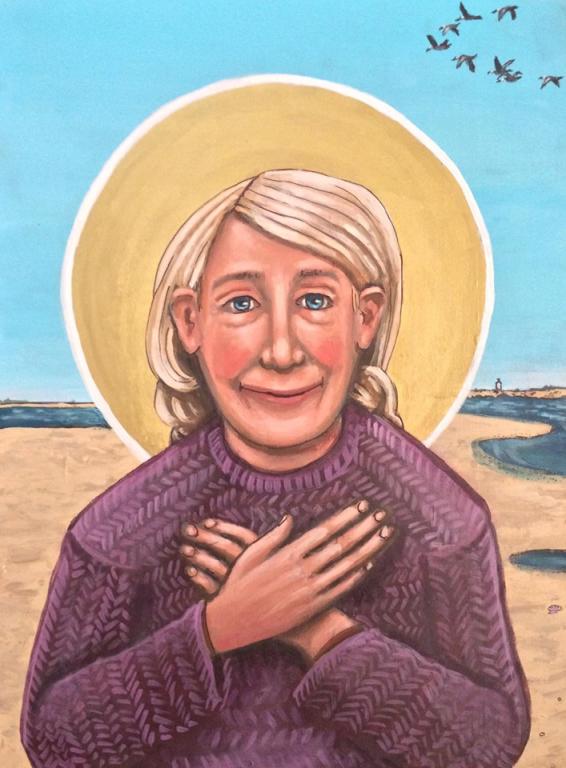
The image “Mary Oliver” is by Kelly Latimore. Prints are available at Fine Art America.
Previous Post

August 13, 2022
A feast for the Universalist Mystic Florence Nightingale
Next Post
August 15, 2022 The Zen Minister Considers the Assumptions of Mary
Browse Our Archives
Select a Category A Christmas Carol Abolitionist African-American Ahmadiyya Alan Watts Aldous Huxley Allen Ginsberg Amedkar Jayanti American politics American Zen Anaheim Zen Sangha Anglican Annie Besant April Fool Armageddon Art and Religion artificial intellegence Atheist Awakening B R Ambedkar Barlaam & Josaphat Beatnik Between Bhagavad Gita Bible biography birthday bodhisattva Bodhisattva Precepts Book burning Book of Common Prayer Book of Mormon Brahmo Samaj Buddha Buddhism Buddhist Buddhist Lord's Prayer Butterflies Calendars cartoons cat ChatGPT Chicken Tortilla Soup choices Christian atheism Christian mysticism Christian origins Christian Science Christian Zen Christianity Christianity and Buddhism christmas Christmas Truce Christopher Isherwood Church of Later Day Saints Cinco de Mayo circus covenant critical thinking culture D. T. Suzuki Dalit Buddhism Daniel Defoe Desert Fathers and Mothers dharma talk Dogen Donald Trump Dongshan's Five Ranks Dorothy Day dream Duty Easter ecology Edwin Arnold emptiness Empty Moon Zen Network Episcopal Church Eternal Now Ethics evolution existentialism Faith fantasy Fathers Day film film review fire Five Ranks Folk music food Form and emptiness Four Seals Francis of Assisi Francis Xavier Free thinker friendship George MacDonald Gerald Heard Glenn Taylor Webb God Good Friday Gospel of Gospel of Mark Gospel of Thomas grace Graduate Theological Unioin Graduate Theological Union Guanyin H R Blyth Hakuin Ekaku Hanamatsuri Hanukkah Harada Yasutani Zen Heart Sutra Henry David Thoreau Hermann Hesse Hinduism History and Religion history of religion Holy Spirit home Hospitality Icon Ides of March Isaac Newton Islam Islamic mysticism Jack Kerouac James Luther Adams Jiddu Krishnamurti Joan of Arc Johannes Gutenberg John Donne joke Judaism justice karma kensho King James Bible koan Koun Yamada Kyoto School Lewis Carrol Liberal Christianity Liberal Religion Life Plan Community Liminal literature Literature and Religion Liturgy Lord's Prayer Love Mahatma Gandhi Mahayana Martin Luther King Jr Mary Baker Eddy Mary Magdelene Mary Oliver Mayflower Compact Meditation memories memory metaphor money money and religioin Mormons Mother's Day movie review mysticism mythic Neighborhood Unitarian Universalist Church New Thought Nichiren Buddhism Nonduality not knowing Omar Khayyam Pacific School of Religion pagan Palm Sunday Passover peace Pentecost perennialism Phantastes Philip Kapleau philosophy Pilgrimage poetry Poetry and Religion politics Prayer Precepts Printing Press prophecy prophetic spirituality psychology Pure Land Queer religion queering religion Quietism Ram Mohan Roy rebirth recipe Relationships and religion religion religion and history Religious syncretism Resistance Retirement Retreat review Rissho Kosei Kai Ritual Robert Aitken Roshi Robert Ingersoll Rohatsu Romani religion Rosie the Riveter saints samadhi SanboZen Sangha Satyagraha science science and reigion science and religion science fiction seminary sermon Sesshin Sex and Religion Shinran Sikh Sikh tradition silence Social Justice Socially Engaged Buddhism Society and religion Soto Zen soul spiritual community spiritual practice Spirituality Sufism Suicide superstition Taoism Television Teresa of Avila Thanksgiving theological schools Theosophy Thomas Merton Time Transcendentalism Transcendentalist Trinitarian Trinity Uncategorized unitarian Unitarian Christianity Unitarian Universalist Universalism Vajrayana Vedanta Walking war Willa Cather William Ellery Channing wisdom women and religion women in religion World Teacher Writing zazen Zen Zen Center Zen inspired retriement zen meditation Zen Precepts Zen women
Select a Month September 2026 August 2026 July 2026 June 2026 May 2026 April 2026 March 2026 February 2026 January 2026 December 2025 November 2025 October 2025 September 2025 August 2025 July 2025 June 2025 May 2025 April 2025 March 2025 February 2025 January 2025 December 2024 November 2024 October 2024 September 2024 August 2024 July 2024 June 2024 May 2024 April 2024 March 2024 February 2024 January 2024 December 2023 November 2023 October 2023 September 2023 August 2023 July 2023 June 2023 May 2023 April 2023 March 2023 February 2023 January 2023 December 2022 November 2022 October 2022 September 2022 August 2022 July 2022 June 2022 May 2022 April 2022 March 2022 February 2022 January 2022 December 2021 November 2021 October 2021 September 2021 August 2021 July 2021 June 2021 May 2021 April 2021 March 2021 February 2021 January 2021 December 2020 November 2020 October 2020 September 2020 August 2020 July 2020 June 2020 May 2020 April 2020 March 2020 February 2020 January 2020 December 2019 November 2019 October 2019 September 2019 August 2019 July 2019 June 2019 May 2019 April 2019 March 2019 February 2019 January 2019 December 2018 November 2018 October 2018 September 2018 August 2018 July 2018 June 2018 May 2018 April 2018 March 2018 February 2018 January 2018 December 2017 November 2017 October 2017 September 2017 August 2017 July 2017 June 2017 May 2017 April 2017 March 2017 February 2017 January 2017 December 2016 November 2016 October 2016 September 2016 August 2016 July 2016 June 2016 May 2016 April 2016 March 2016 February 2016 January 2016 December 2015 November 2015 October 2015 September 2015 August 2015 July 2015 June 2015 May 2015 April 2015 March 2015 February 2015 January 2015 December 2014 November 2014 October 2014 September 2014 August 2014 July 2014 June 2014 May 2014 April 2014 March 2014 February 2014 January 2014 December 2013 November 2013 October 2013 September 2013 August 2013 July 2013 June 2013 May 2013 April 2013 March 2013 February 2013 January 2013 December 2012 November 2012 October 2012 September 2012 August 2012 July 2012 June 2012 May 2012 April 2012 March 2012 February 2012 January 2012 December 2011 November 2011 October 2011 September 2011 August 2011 July 2011 June 2011 May 2011 April 2011 March 2011 February 2011 January 2011 December 2010 November 2010 October 2010 September 2010 August 2010 July 2010 June 2010 May 2010 April 2010 March 2010 February 2010 January 2010 December 2009 November 2009 October 2009 September 2009 August 2009 July 2009 June 2009 May 2009 April 2009 March 2009 February 2009 January 2009 December 2008 November 2008 October 2008 September 2008 August 2008 July 2008 June 2008 May 2008 April 2008 March 2008 February 2008 January 2008 December 2007 November 2007 October 2007 September 2007 August 2007 July 2007 June 2007 May 2007 April 2007 March 2007 February 2007 January 2007 December 2006 November 2006 October 2006 September 2006
Follow Us!
TAKE THE
Religious Wisdom Quiz
True or False: Paul taught the Galatians that circumcision is necessary for salvation.
Select your answer to see how you score.
TRUE FALSE
Related posts from Monkey Mind


Which Is the True Qian? A Koan About...


TRENDING AT PATHEOS Buddhist

The Problem with False Prophets
Miller’s Station UMC| 10/18/26| Anchor Verse: Jeremiah 23: 1, 9-23 I...

Emotion in Early Christianity by Andrew Crislip
Andrew Crislip’s Emotion in Early Christianity examines an often overlooked dimension of...

16 Spiritual Touchstones for a More Grounded Life
After decades of spiritual study, here are 16 principles I try...

Catholic Evangelization: Sharing Your Faith Every Day
Welcome back to the Graceful Awakening mini-series called, “From Faith to Mission.” ...

The Pillar of the Boatmen: the Ancient Monument...
The Pillar of the Boatmen is a Romano-Gaulish sculpture that dates from...

In one sense walking into Westminster Abbey is like walking down the...
view all Buddhist blogs
Ad-Free & Subscriber Log-In Subscription Support
- About Us
- 2026 Calendar
- Videos
- Podcasts
- Library of World Religions
- Faith In Media Tracker
- Advertise With Us
- Write for Us
- Privacy Policy
- Terms of Service
- Do Not Sell My Data
- Contact Us
- Radiant Digital
- Manage Newsletter Subscriptions
- Unsubscribe From Notifications
- Sitemap
Copyright 2008-2026, Patheos. All rights reserved.
Subscription Support Ad-Free & Subscriber Log-In
Follow Patheos