
BuddhistCatholicContemplativeEvangelicalGeneral ChristianHinduJewishLatter-day SaintMuslimNew VisionsProgressive Christian
Beliefs
- Buddhist
- Catholic
- Contemplative
- Evangelical
- General Christian
- Hindu
- Jewish
- Latter-day Saint
- More Voices
- Muslim
- New Visions
- Pagan
- Progressive Christian
Topics
- Religion News
- Food and Religion
- Sports and Religion
- Religious Art
- Religious Music and Entertainment
- Religious Events
- History and Religion
- Style and Religion
- Politics and Religion
- Women in Religion
- Recreation Outdoors and Religion
- Business Finance and Religion
- Careers Workplace and Religion
- Education and Religion
- Family Parenting and Religion
- Health Fitness and Religion
- Home and Religion
- Relationships and Religion
- Technology and Religion
- Travel and Religion
Columnists
- Buddhist Columnists
- Business Finance and Religion Columnists
- Careers Workplace and Religion Columnists
- Catholic Columnists
- Contemplative Columnists
- Education and Religion Columnists
- Evangelists Columnists
- Family Parenting and Religion Columnists
- General Christian Columnists
- Health Fitness and Religion Columnists
- Hindu Columnists
- History and Religion Columnists
- Home and Religion Columnists
- Jewish Columnists
- More Voices Columnists
- Latter Day Columnists
- Muslim Columnists
- New Visions Columnists
- Nonreligious Columnists
- Pagan Columnists
- Politics and Religion Columnists
- Progressive Columnists
- Recreation Outdoors and Religion Columnists
- Relationships and Religion Columnists
- Religion News Columnists
- Religious Art Columnists
- Religious Events Columnists
- Religious Music and Entertainment Columnists
- Sports and Religion Columnists
- Style and Religion Columnists
- Technology and Religion Columnists
- Travel and Religion Columnists
- Women in Religion Columnists
Resource Library
- 2026 Calendar
- Library of World Religions
- The 100 Most Holy Places on Earth
- Patheos Answers
- Podcasts
- Videos
- Faith Leaders Database
- Anglican Episcopalian
- Bahai
- Baptist
- Buddhism
- Christianity
- Confucianism
- Eastern Orthodoxy
- Hinduism
- Holiness and Pentecostal
- ISKCON
- Islam
- Judaism
- Lutheran
- Methodist
- The Church of Jesus Christ of Latter-day Saints
- New Age
- Paganism
- Presbytarian and Reformed
- Protestantism
- Religion Behind the Scenes
- Roman Catholic
- Scientology
- Shia Islam
- Sikhism
- Sufism
- Sunni Islam
- Taoism
- Zen
- See all religions
Research Tools
 Ad-Free & Subscriber Log-In Subscription Support
Ad-Free & Subscriber Log-In Subscription Support
Follow Patheos 

- Trending:
- Forgiveness
- |
- Marriage
- |
- Consciousness
- |
- Death Penalty
- |
- Election
- |
- Halloween

- Home
- Buddhist
- HONEST TO JESUS: The Zen minister considers the religion of Jesus & A Christianity that can be
HONEST TO JESUS: The Zen minister considers the religion of Jesus & A Christianity that can be
Last updated on: November 15, 2022 at 8:50 am by James Ford
HONEST TO JESUS: The Zen minister considers the religion of Jesus & A Christianity that can be 2022-11-15T08:50:14-08:00 James Ford
Patheos Explore the world's faith through different perspectives on religion and spirituality! Patheos has the views of the prevalent religions and spiritualities of the world.
HONEST TO JESUS
The Zen minister considers the religion of Jesus & A Christianity that can be
James Ishmael Ford
“I love the pure, peaceable, and impartial Christianity of Christ; I therefore hate the corrupt, slaveholding, women-whipping, cradle-plundering, partial, and hypocritical Christianity of this land. Indeed, I can see no reason, but the most deceitful one, for calling the religion of this land Christianity. I look upon it as the climax of all misnomers, the boldest of all frauds, and the grossest of all libels.”
Frederick Douglass
Normative Christianity is Pauline Christianity. In my view, while it has some compelling and beautiful parts, it is not the religion of Jesus, nor does it call to my heart.
The religion we call Christianity is really for the most part the religion about Jesus as interpreted by Paul. Some versions on offer today, I believe Frederick Douglass would recognize and continue to condemn. Too much of it, as contemporary firebrand Protestant pastor John Pavlovitz says, is “a toxic cocktail of power, control, fear, nationalism, and white privilege…” Other versions of Paul’s Christianity call for a more nuanced judgement. And while in the United States we are awash in the public witness of that toxic cocktail, and there are similar strains around the world fixated on purity codes and often some form or another of ultra-nationalisms; this kind of Christianity absolutely is not the last word.
While that is the complexity of normative Christianity or perhaps better normative Christianities, there is more on offer. A thread. An alternative. For this small reflection I want to briefly consider what we might know about what Jesus believed. And, from there, to consider briefly what that might mean for me and for others who feel touched by that ancient teacher partially hidden and partially revealed in the traditional texts and in the communities that gather in his name.
So, first. What do we actually know about Jesus? Well. There is very little that can be known with anything approaching certainty. One scholar said the consensus of what we can know with that approaching certainty is that in all likelihood Jesus was a real person, he was born, he was a disciple of a prophet named John, and that he died, in all likelihood under horrific circumstances.
We can infer more than that. It would appear in the wake of his death stories of his teachings and stories of miracles he performed continued to be circulated. Perhaps as much as a lifetime after he died the first of the canonical gospels, generally believed to be Mark was composed. Later Matthew and Luke, Luke being composed by a disciple of Paul, each in varying degree in dialogue with the others were written. And then, maybe as much as a hundred years after the events of Jesus life, the gospel of John. Outside of the canon another book that claimed to capture Jesus teachings, the Gospel of Thomas dates from about the same time as John. There are non-canonical attestations to his life, but they only confirm that there was such a person. And that’s about it.
So, bottom line, as best I can make it out. The actual Jesus was an apocalyptic prophet who inherited the mantel of his teacher John. His message was that the world was about to end, the rich and powerful would be overthrown, and the poor and left behind would be raised up. The kingdom, as best I can discern from his sayings, was a strange and strangely compelling thing, partially in some other place, and partially here and now. Frederick Douglass’ “…pure, peaceable, and impartial Christianity of Christ.”
So, what would a religion that tried to follow what we know of Jesus actual ministry look like?
In Paul’s various letters where he references his raising money for the “poor” in Jerusalem, he is actually raising money for the central organization, which appears to have called itself the Poor, as in Ebionites. The Wikipedia article on this lost sect summarized them as a “Jewish Christian movement that existed during the early centuries of the Christian Era. They regarded Jesus of Nazareth as the Messiah while rejecting his divinity and insisted on the necessity of following Jewish law and rites. The Ebionites used only one of the Jewish Gospels (a version of the book we call Matthew), revered James the Just, and rejected Paul the Apostle as an apostate from the Law. Their name suggests that they placed a special value on voluntary poverty.”
The article goes on to observe “Since historical records by the Ebionites are scarce, fragmentary, and disputed, much of what is known or conjectured about the Ebionites derives from the Church Fathers, who wrote polemics against the Ebionites, whom they deemed heretical Judaizers.”
And so as the article states any opinions about them are ultimately conjecture, there can, however, be educated conjecture. What we do know is there is a person named James, who is called Jesus’ brother, who is the head of the organization in Jerusalem until he is killed. If one does not assume Paul’s religion that he built up among converts away from Jerusalem and environs, was anything more than one of a number of teachings and organization, then the hints are tantalizing.
I have to admit how I also like that James is the putative author of the Epistle given his name, much hated by Luther and others for stating that without actually doing something, one’s faith is worthless. To the degree the epistle reflects James’ actual teachings it must have been a royal annoyance to Paul who put all his eggs in the faith only basket. That it survives in a document dominated by followers of Paul suggests its importance as maybe representing the original teachings of the original organization and perhaps its inspiration, Jesus.
My belief is pretty strong that James, the natural brother of Jesus, inherited the organization when Jesus was murdered by the rich and the powerful. And that while he consulted with Jesus’ other leading disciples, he was the final arbiter until his own death. Then, after his death, the organization passed to another blood relative, a cousin.
However, not long after James’ death Jerusalem was destroyed and those not killed were dispersed, and in the chaos that followed, the Jewish Christian Ebionites fell apart and the gentile communities founded by Paul filled the void and became normative Christianity.
My faith has followed a long and winding road. I was raised a fundamentalist Christian. I learned to read from a large illustrated King James Bible resting on my grandmother’s lap. I know the stories, and more importantly I know the sayings attributed to Jesus.
Over the many years I’ve come to a religion that expresses the spiritual cross roads of our times. I am at base a Mahayana Buddhist of a modernist sort. I believe in the four seals, the two truths, and the three bodies as as true analysis of the way things are as has been articulated by any religion.
In addition my natural disposition is rationalist. I believe the world described by modern science is more accurate than any other. Of course that view is subject to change as science continues its relentless pursuit of the truths of nature. But this part I’m sure of, we are biological creatures evolved on a tiny planet circling a middling star at the edge of one of a million million galaxies in a very strange universe.
However, my dream life is dominated by my childhood religion and the Jesus I started with and who continues to be a part of my life. That influence and the pointers for what is that I’ve found are endless. Most notably for me in my life today, thirty years ago during a Zen meditation retreat I had a vision of Jesus walking toward me, his hands, palm to palm together like the Christian prayer mudra, Hindu namaste, or Zen’s gassho, and saying, “I have a great gift for you.”
My immediate thought was of my childhood Jesus, the one with all the little children. And I felt waves of love washing over me. Then. He spreads his hands to reveal those infamous bleeding wounds. A terrible visceral fear leapt into my throat, as he then grasped my own hands with those bleeding hands. And, with that the pain of worlds birthing and dying ran from his wounds into what are now mine. And it was over. I was back in the meditation hall. My hands hurt for weeks.
Actually, to this day I can still touch an echo of that hurt.
So, what is the Jesus that continues to live within me?
For a start the Jesus I understand and believe distilled the collective wisdom of the Jewish people and offered something powerful. He certainly wasn’t the only one. Hillel, for instance, is a rough contemporary of Jesus who also presented a healing distillation of the Jewish traditions.
That acknowledged Jesus does something particularly magical with his approach to God. The stories of of the Jewish God coalesced over millennia becoming in his time the great creator and parent of humanity. I do think the early versions from storm god, to the particular god of a particular people, to something vast and universal are all there at the same confusing and contradictory time. Somehow I find that important. There is when we use the word God, of necessity, an aspect of human projection. But, it can, and sometimes does include something else. An attempt to name an experience.
A smiling Jesus with bleeding hands. And a joining of heaven and earth.
In fact the version of this deity that I find most useful in my life is the one that can be found buried within the heart of the Book of Job. Not in the set pieces that frame that story where Job is rewarded, but rather in the midst of the terrible storm that over takes Job, and in that confrontation with what is. That’s the god I’m interested in. God as the great Is-ness of life.
I don’t resonate with the central story of the main currents of the Christian tradition. While I can read almost any story that tries to point to our human condition of hurt and separation with some sympathy, I do not see a soul separate from the universe that embodies that hurt, nor the fix in anything even vaguely like substitutionary atonement.
As a birthright Christian I am fascinated by the rise of a nondual Christianity. There appear to be corollaries in Judaism, as well. But my heart goes this my natal tradition. Looking at those old stories and traditions without assuming dualism, an ultimate gap between the holy, God, and this world, and specifically, us; is something powerful and inviting. It is a two-way street, actually it is a tangle of highways, byways, and trails all crossing each other. There is no absolute truth, we all get a little angle on it, it is always, always through a glass darkly.
I can squint and massage the story and make something comparable with the universe I experience. And, indeed it is that lovely nondual Christianity (for instance or from a more Zen Christian perspective) that is popping up here and there that I find resonates. And. All I have to do is go to any Christian church for a Sunday service to recall this nondual approach, while perhaps the true heart of the tradition, is also not normative.
Then there my dream Jesus. He names the energy that connects a very specific if temporal, if passing me to that great Is that Is. And, and this seems so important, at the very same time he brings it to my neighbor, which as I read it, seems obviously to mean the whole blessed world.
And Jesus named it Love.
With that a minority report.
My Christianity, poor thing that it is, is based on the teaching of this wandering sage, a wonder worker and a teller of stories of oppression and freedom. Maybe half mad on God, uttering dreams to anyone who would listen. Dreams about healing inside and out. About a mysterious kingdom that is both within and among.
A message that offended the rich and the powerful, and brought about his death in a terrible, terrible way. It seems to me Jesus was about drawing together. About the intimate. And, yes, the cost of intimacy. Dreaming into a mysterious story about who we are and how what we are is sacred down to the earth between our toes.
It boils down, for me, not to a cross, but into a meal. A meal where we are all invited, whoever we are. Holy communion, the most intimate. All of us confronting the mystery in a meal, in a taste of rice, a taste of bread.
Communion.
Not one, not two. Found in a gathering and a sharing of a meal.
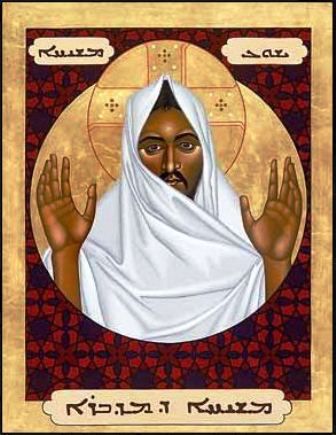
The image of the Aramaic Jesus is by Br Robert Lentz, OFM
Previous Post

August 7, 2022
Recalling the Great Soul Rabindranath Tagore
Next Post
August 12, 2022 Recalling H P Blavatsky on her One Hundred and Ninety-first Birthday
Browse Our Archives
Select a Category A Christmas Carol Abolitionist African-American Ahmadiyya Alan Watts Aldous Huxley Allen Ginsberg Amedkar Jayanti American politics American Zen Anaheim Zen Sangha Anglican Annie Besant April Fool Armageddon Art and Religion artificial intellegence Atheist Awakening B R Ambedkar Barlaam & Josaphat Beatnik Between Bhagavad Gita Bible biography birthday bodhisattva Bodhisattva Precepts Book burning Book of Common Prayer Book of Mormon Brahmo Samaj Buddha Buddhism Buddhist Buddhist Lord's Prayer Butterflies Calendars cartoons cat ChatGPT Chicken Tortilla Soup choices Christian atheism Christian mysticism Christian origins Christian Science Christian Zen Christianity Christianity and Buddhism christmas Christmas Truce Christopher Isherwood Church of Later Day Saints Cinco de Mayo circus covenant critical thinking culture D. T. Suzuki Dalit Buddhism Daniel Defoe Desert Fathers and Mothers dharma talk Dogen Donald Trump Dongshan's Five Ranks Dorothy Day dream Duty Easter ecology Edwin Arnold emptiness Empty Moon Zen Network Episcopal Church Eternal Now Ethics evolution existentialism Faith fantasy Fathers Day film film review fire Five Ranks Folk music food Form and emptiness Four Seals Francis of Assisi Francis Xavier Free thinker friendship George MacDonald Gerald Heard Glenn Taylor Webb God Good Friday Gospel of Gospel of Mark Gospel of Thomas grace Graduate Theological Unioin Graduate Theological Union Guanyin H R Blyth Hakuin Ekaku Hanamatsuri Hanukkah Harada Yasutani Zen Heart Sutra Henry David Thoreau Hermann Hesse Hinduism History and Religion history of religion Holy Spirit home Hospitality Icon Ides of March Isaac Newton Islam Islamic mysticism Jack Kerouac James Luther Adams Jiddu Krishnamurti Joan of Arc Johannes Gutenberg John Donne joke Judaism justice karma kensho King James Bible koan Koun Yamada Kyoto School Lewis Carrol Liberal Christianity Liberal Religion Life Plan Community Liminal literature Literature and Religion Liturgy Lord's Prayer Love Mahatma Gandhi Mahayana Martin Luther King Jr Mary Baker Eddy Mary Magdelene Mary Oliver Mayflower Compact Meditation memories memory metaphor money money and religioin Mormons Mother's Day movie review mysticism mythic Neighborhood Unitarian Universalist Church New Thought Nichiren Buddhism Nonduality not knowing Omar Khayyam Pacific School of Religion pagan Palm Sunday Passover peace Pentecost perennialism Phantastes Philip Kapleau philosophy Pilgrimage poetry Poetry and Religion politics Prayer Precepts Printing Press prophecy prophetic spirituality psychology Pure Land Queer religion queering religion Quietism Ram Mohan Roy rebirth recipe Relationships and religion religion religion and history Religious syncretism Resistance Retirement Retreat review Rissho Kosei Kai Ritual Robert Aitken Roshi Robert Ingersoll Rohatsu Romani religion Rosie the Riveter saints samadhi SanboZen Sangha Satyagraha science science and reigion science and religion science fiction seminary sermon Sesshin Sex and Religion Shinran Sikh Sikh tradition silence Social Justice Socially Engaged Buddhism Society and religion Soto Zen soul spiritual community spiritual practice Spirituality Sufism Suicide superstition Taoism Television Teresa of Avila Thanksgiving theological schools Theosophy Thomas Merton Time Transcendentalism Transcendentalist Trinitarian Trinity Uncategorized unitarian Unitarian Christianity Unitarian Universalist Universalism Vajrayana Vedanta Walking war Willa Cather William Ellery Channing wisdom women and religion women in religion World Teacher Writing zazen Zen Zen Center Zen inspired retriement zen meditation Zen Precepts Zen women
Select a Month September 2026 August 2026 July 2026 June 2026 May 2026 April 2026 March 2026 February 2026 January 2026 December 2025 November 2025 October 2025 September 2025 August 2025 July 2025 June 2025 May 2025 April 2025 March 2025 February 2025 January 2025 December 2024 November 2024 October 2024 September 2024 August 2024 July 2024 June 2024 May 2024 April 2024 March 2024 February 2024 January 2024 December 2023 November 2023 October 2023 September 2023 August 2023 July 2023 June 2023 May 2023 April 2023 March 2023 February 2023 January 2023 December 2022 November 2022 October 2022 September 2022 August 2022 July 2022 June 2022 May 2022 April 2022 March 2022 February 2022 January 2022 December 2021 November 2021 October 2021 September 2021 August 2021 July 2021 June 2021 May 2021 April 2021 March 2021 February 2021 January 2021 December 2020 November 2020 October 2020 September 2020 August 2020 July 2020 June 2020 May 2020 April 2020 March 2020 February 2020 January 2020 December 2019 November 2019 October 2019 September 2019 August 2019 July 2019 June 2019 May 2019 April 2019 March 2019 February 2019 January 2019 December 2018 November 2018 October 2018 September 2018 August 2018 July 2018 June 2018 May 2018 April 2018 March 2018 February 2018 January 2018 December 2017 November 2017 October 2017 September 2017 August 2017 July 2017 June 2017 May 2017 April 2017 March 2017 February 2017 January 2017 December 2016 November 2016 October 2016 September 2016 August 2016 July 2016 June 2016 May 2016 April 2016 March 2016 February 2016 January 2016 December 2015 November 2015 October 2015 September 2015 August 2015 July 2015 June 2015 May 2015 April 2015 March 2015 February 2015 January 2015 December 2014 November 2014 October 2014 September 2014 August 2014 July 2014 June 2014 May 2014 April 2014 March 2014 February 2014 January 2014 December 2013 November 2013 October 2013 September 2013 August 2013 July 2013 June 2013 May 2013 April 2013 March 2013 February 2013 January 2013 December 2012 November 2012 October 2012 September 2012 August 2012 July 2012 June 2012 May 2012 April 2012 March 2012 February 2012 January 2012 December 2011 November 2011 October 2011 September 2011 August 2011 July 2011 June 2011 May 2011 April 2011 March 2011 February 2011 January 2011 December 2010 November 2010 October 2010 September 2010 August 2010 July 2010 June 2010 May 2010 April 2010 March 2010 February 2010 January 2010 December 2009 November 2009 October 2009 September 2009 August 2009 July 2009 June 2009 May 2009 April 2009 March 2009 February 2009 January 2009 December 2008 November 2008 October 2008 September 2008 August 2008 July 2008 June 2008 May 2008 April 2008 March 2008 February 2008 January 2008 December 2007 November 2007 October 2007 September 2007 August 2007 July 2007 June 2007 May 2007 April 2007 March 2007 February 2007 January 2007 December 2006 November 2006 October 2006 September 2006
Follow Us!
TAKE THE
Religious Wisdom Quiz
How many daughters did Job have after his restoration?
Select your answer to see how you score.
Seven Three Two Five
Related posts from Monkey Mind


Which Is the True Qian? A Koan About...


TRENDING AT PATHEOS Buddhist

Jad Gillies on New Hillsong Worship Songs and...
For worship leader Jad Gillies, Hillsong Worship’s next chapter is not about...

Looking at the Largest Orthodox Cathedral on Earth
There is often a considerable amount of anger and, shall we...

The Problem with False Prophets
Miller’s Station UMC| 10/18/26| Anchor Verse: Jeremiah 23: 1, 9-23 I...

Emotion in Early Christianity by Andrew Crislip
Andrew Crislip’s Emotion in Early Christianity examines an often overlooked dimension of...

16 Spiritual Touchstones for a More Grounded Life
After decades of spiritual study, here are 16 principles I try...

Catholic Evangelization: Sharing Your Faith Every Day
Welcome back to the Graceful Awakening mini-series called, “From Faith to Mission.” ...
view all Buddhist blogs
Ad-Free & Subscriber Log-In Subscription Support
- About Us
- 2026 Calendar
- Videos
- Podcasts
- Library of World Religions
- Faith In Media Tracker
- Advertise With Us
- Write for Us
- Privacy Policy
- Terms of Service
- Do Not Sell My Data
- Contact Us
- Radiant Digital
- Manage Newsletter Subscriptions
- Unsubscribe From Notifications
- Sitemap
Copyright 2008-2026, Patheos. All rights reserved.
Subscription Support Ad-Free & Subscriber Log-In
Follow Patheos