
BuddhistCatholicContemplativeEvangelicalGeneral ChristianHinduJewishLatter-day SaintMuslimNew VisionsProgressive Christian
Beliefs
- Buddhist
- Catholic
- Contemplative
- Evangelical
- General Christian
- Hindu
- Jewish
- Latter-day Saint
- More Voices
- Muslim
- New Visions
- Pagan
- Progressive Christian
Topics
- Religion News
- Food and Religion
- Sports and Religion
- Religious Art
- Religious Music and Entertainment
- Religious Events
- History and Religion
- Style and Religion
- Politics and Religion
- Women in Religion
- Recreation Outdoors and Religion
- Business Finance and Religion
- Careers Workplace and Religion
- Education and Religion
- Family Parenting and Religion
- Health Fitness and Religion
- Home and Religion
- Relationships and Religion
- Technology and Religion
- Travel and Religion
Columnists
- Buddhist Columnists
- Business Finance and Religion Columnists
- Careers Workplace and Religion Columnists
- Catholic Columnists
- Contemplative Columnists
- Education and Religion Columnists
- Evangelists Columnists
- Family Parenting and Religion Columnists
- General Christian Columnists
- Health Fitness and Religion Columnists
- Hindu Columnists
- History and Religion Columnists
- Home and Religion Columnists
- Jewish Columnists
- More Voices Columnists
- Latter Day Columnists
- Muslim Columnists
- New Visions Columnists
- Nonreligious Columnists
- Pagan Columnists
- Politics and Religion Columnists
- Progressive Columnists
- Recreation Outdoors and Religion Columnists
- Relationships and Religion Columnists
- Religion News Columnists
- Religious Art Columnists
- Religious Events Columnists
- Religious Music and Entertainment Columnists
- Sports and Religion Columnists
- Style and Religion Columnists
- Technology and Religion Columnists
- Travel and Religion Columnists
- Women in Religion Columnists
Resource Library
- 2026 Calendar
- Library of World Religions
- The 100 Most Holy Places on Earth
- Patheos Answers
- Podcasts
- Videos
- Faith Leaders Database
- Anglican Episcopalian
- Bahai
- Baptist
- Buddhism
- Christianity
- Confucianism
- Eastern Orthodoxy
- Hinduism
- Holiness and Pentecostal
- ISKCON
- Islam
- Judaism
- Lutheran
- Methodist
- The Church of Jesus Christ of Latter-day Saints
- New Age
- Paganism
- Presbytarian and Reformed
- Protestantism
- Religion Behind the Scenes
- Roman Catholic
- Scientology
- Shia Islam
- Sikhism
- Sufism
- Sunni Islam
- Taoism
- Zen
- See all religions
Research Tools
 Ad-Free & Subscriber Log-In Subscription Support
Ad-Free & Subscriber Log-In Subscription Support
Follow Patheos 

- Trending:
- Forgiveness
- |
- Marriage
- |
- Consciousness
- |
- Death Penalty
- |
- Election
- |
- Halloween

- Home
- Buddhist
- Recollecting the Zen Pioneer Houn Jiyu Kennett
Recollecting the Zen Pioneer Houn Jiyu Kennett
Last updated on: January 1, 2022 at 9:57 am by James Ford
Recollecting the Zen Pioneer Houn Jiyu Kennett 2022-01-01T09:57:25-08:00 James Ford
Patheos Explore the world's faith through different perspectives on religion and spirituality! Patheos has the views of the prevalent religions and spiritualities of the world.
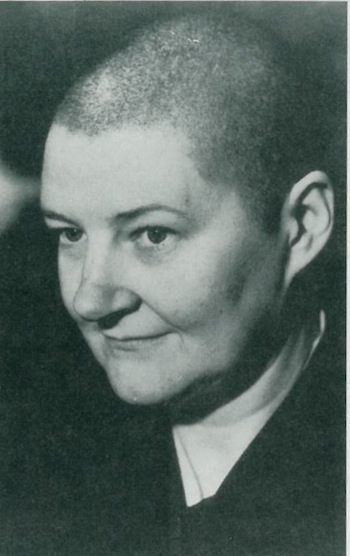
Peggy Teresa Nancy Kennett was born at St Leonards-on-Sea, Sussex, England, on this day, the 1st of January, in 1924.
Houn Jiyu Kennett was the first women Soto Zen master to teach in the West. Her teaching career also opens questions of orthodoxy and authority that begin to define the outer limits of what might be described as traditional Zen. She is the lineage source for Shasta Abbey, Throssel Hole Abbey, and the Order of Buddhist Contemplatives. Breaks from her organization are the source for the priestly lineages at the Dharma Rain Zen Center, Bright Way Zen, Boundless Way Zen, the Buddhist Temple of Toledo, and Empty Moon Zen.
Peggy Theresa Nancy Kennett was born in 1924 in England. Her father, a tailor, was involved in the Theosophical Buddhism organized by Christmas Humphries at the London Buddhist Lodge. In the 1950s, as it moved in a more traditional Buddhist direction and out of this was renamed the London Buddhist Society, Peggy joined and eventually took on various leadership responsibilities.
During the war Peggy enlisted in the Royal Navy and worked for naval intelligence, assigned to coding and decoding. After the war she won a scholarship to Durham University and continued her training at Trinity College of Music in London studying medieval music. She supported herself primarily as a church organist. In addition to her connections to the London Buddhist Society, she studied at the London Buddhist Vihara, a Theravada Mission, and undertook a correspondence course of instruction through the Young Men’s Buddhist Association in Ceylon.
In 1960 when Chisan Koho Zenji, abbot of Sojiji, traveled to the West and visited the London Buddhist Society, she coordinated his visit. He invited her to come to Japan. And, as soon as she could put her affairs in order, she did so.
For reasons that remain unclear, while on her way to Japan she received novice ordination—in January, 1962, while in Malaysia—from Seck Kim Seng, Linchi abbot of the Cheng Hoon Teng Temple in Malacca. However as soon as she arrived in Japan, she was formally received as a student by Chisan Koho, with whom she would go on to study extensively. However, since he was also concerned with the administration of a major temple and denominational affairs, in practice her primary teacher was often Suigan Yogo Roshi, one of Chisan Koho’s senior associates who would also later become abbot of Sojiji.
Jiyu Kennett Roshi received Dharma transmission twice, from both Suigan Yogo Roshi and Chisan Koho Roshi. She was then installed as abbess of Unpukuji, in Mie Perfecture. I originally wrote for my biographical sketch of her life and teaching career in Zen Master Who, that in 1969 she was authorized to start a Zen center in London. This does not appear to be the case. She seems to have left Japan without informing the Soto denominational offices, or, it seems, her teachers. She came to California and the San Francisco Zen Center, deeply curious about their enormous success as a Western mission. She decided to stay in California rather than return to England. Speaking with a couple of her early Western students, I believe she thought she’d always be “Peggy” in the relatively small convert Buddhist community there. While her opportunities to expand her work as “Roshi Kennett” in California were wide open. Whatever her reasons, she started a small temple, and formed the Zen Mission Society, in an apartment in Mission Hill.
This was where I first studied with her. My memories of that time continue vividly—particularly of the intimacy of the tiny, new community. I recall, for instance, sitting with the roshi and several other young monastics on chairs and her bed, drinking lobsang suchong tea and watching “Dark Shadows,” a campy vampire soap opera.
To be brutally honest, my memories of Jiyu Kennett Roshi as a teacher are mixed. She followed in the authoritarian style of her Japanese inheritance. And, I believe, the inclinations of her own personality. Interpersonally, she was remarkably invasive. In my twenties, she pushed me into a marriage with another student that would cause great unhappiness for both of us. On the other hand, she had genuine insight into the boundless realm and also pushed me toward my own deepest experience of the great matter.
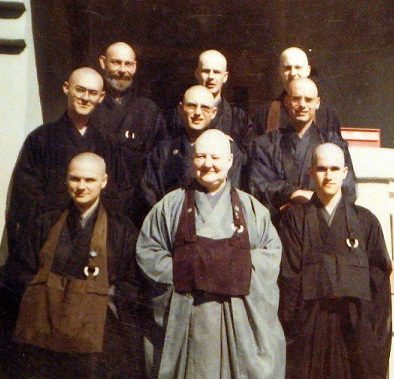
As with most matters in the actual world, she combined a brilliant mind, some authentic practice, and the complex needs of a human being formed out of hurt and hope. She was a complicated person, of course. With great wit, keen intellect, and a substantial dark side. Illustrating all three points, Kyogen Carlson recalls a time at the monastery when it seemed the typical monastic was
“(T)hin, pale, and wears glasses.” One day one of the women (Roshi called us “she-monks” and “he-monks”) returned after a stint at a branch temple. This was a woman of rather generous proportions, and when she entered Roshi’s room, Roshi exclaimed “At last! Finally another woman around here with a decent set of jugs. We’ve had nothing but skin and bones around here lately.”
While often capricious and occasionally even cruel, her real intent did usually seem to be opening the heartmind. As Carlson Roshi observes, “Many times I saw her skillfully push and channel the frustration in a disciple until he or she gave up the struggle itself and broke through to the universal view.”
The Zen Mission Society first moved its temple from San Francisco to Oakland. Finally it established the monastic complex at Mount Shasta in far Northern California. It was at Mount Shasta that I was ordained osho and received Dharma transmission from her in 1971. I left the monastery not long after that. Today her organization, now called Shasta Abbey and the Order of Buddhist Contemplatives, has several branches around North America and Europe, with the majority in England.
Gradually her organization took a decidedly more monastic approach. This was well after she’d established a temple complex along traditional Japanese lines, where priests and monastics could be and often are married. Thus the shift to mandatory celibacy was very controversial and a number of priests either left or were expelled. The Oregon Priory, led by two of her married successors, Kyogen Carlson Roshi and Gyokuko Carlson Sensei, separated from Shasta Abbey at that time to form an independent succession. Their Dharma Rain Zen Center is now one of the larger Zen centers in North America.
Kennett Roshi was always controversial, for reasons small and large. She introduced a broadly “Anglican” style, which included substituting a form of Medieval Christian “plain chant” in liturgy; and, for several years, having clerics wear Western style priest’s collars. Eventually the organ was included in standard liturgies.
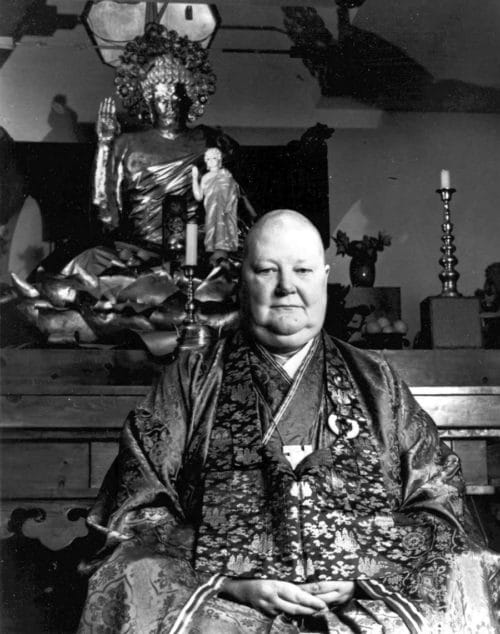 More significant controversies arose following a series of “visions” she experienced in the wake of a severe illness. From this she began offering teachings in significant ways at variance from mainstream Zen. This particularly included a complex scheme of stages of awakening and a pronounced theistic cast to some of her writings.
She died from complications due to diabetes in 1996. Since that time, the Order she established seems to have slowly moved back to a more normative Zen Buddhism. Institutionally, however, the community has been more interested in connecting with Chinese rather than Japanese Buddhism. Upon Kennett Roshi’s death, leadership of the Order has been divided among several senior teachers.
Daishin Morgan—who was already serving as one of two Abbots of the Throssel Hole Buddhist Abbey in England—was joined by Eko Little as Abbot of Shasta Abbey. Later Eko Little was succeeded by Meian Elbert, who continues as abbot. Daizui MacPhillamy was elected Head of the Order of Buddhist Contemplatives. Upon his death in 2003, he was succeeded as Head by Haryo Young, who continues in that position. Mark Daiji Strathern was the founding teacher at Throssel Hole, but became a casualty in the conflicts that arose with her visions, and Daishin Morgan became abbot. He was later succeeded by Leandra Robertshaw, who remains in that position.
In subsequent years after a period of growth the American branch hit a plateau, has begun to age, and contract. The English branch has been more successful, and today is the larger of the Zen communities in that country.
Of the communities that continue her ordination lineage, the oldest continuing of these, Dharma Rain was led by Kyogen and Gyokuko Carlson. They led their community back fully into the mainstream of American Soto Zen. After Kyogen’s death, Gyokuko continued as abbot for many years. She was succeeded by Kakumyo Lowe-Charde. Another of Gyokuko Roshi’s successors Domyo Burk founded Bright Way Zen.
I continued my Zen training within the Harada Yasutani reformed koan curriculum. And the organizations I had a hand in forming all continue that aspect of Zen practice as central to formation, while transmitting Kennett Roshi’s ordination lineage. These communities, Boundless Way Zen (which has in recent years split into several groups, the principal centered at the Worcester temple is led by Melissa Blacker and David Rynick), the Buddhist Temple of Toledo led by Jay Rinsen Weik and Karen Do’On Weik, and Empty Moon Zen led by me, all emphasize the possibilities of a full Zen life for both priests and householders.
As to Kennett Roshi. Whatever her faults, and like for me and everyone else I know, she had them in rich abundance, she was my ordination master, and a central guide for my formation as a person on the intimate way. Most of the hard parts of our relationship have receded into the gathered fragments of memory. The important parts, those aspects of our relationship that helped me become who I am, those are what I principally recall at this time. And for those, I remain endlessly grateful.
Happy birthday, Roshi! Endless bows…
(Substantial portions of this biographical sketch are derived from my book Zen Master Who? A Guide to the People and Stories of Zen (Wisdom Publications, Somerville, 2006)
Previous Post

December 31, 2021
Why Not Become Fire: A Meditation for New Year's Eve
Browse Our Archives
Select a Category A Christmas Carol Abolitionist African-American Ahmadiyya Alan Watts Aldous Huxley Allen Ginsberg Amedkar Jayanti American politics American Zen Anaheim Zen Sangha Anglican Annie Besant April Fool Armageddon Art and Religion artificial intellegence Atheist Awakening B R Ambedkar Barlaam & Josaphat Beatnik Between Bhagavad Gita Bible biography birthday bodhisattva Bodhisattva Precepts Book burning Book of Common Prayer Book of Mormon Brahmo Samaj Buddha Buddhism Buddhist Buddhist Lord's Prayer Butterflies Calendars cartoons cat ChatGPT Chicken Tortilla Soup choices Christian atheism Christian mysticism Christian origins Christian Science Christian Zen Christianity Christianity and Buddhism christmas Christmas Truce Christopher Isherwood Church of Later Day Saints Cinco de Mayo circus covenant critical thinking culture D. T. Suzuki Dalit Buddhism Daniel Defoe Desert Fathers and Mothers dharma talk Dogen Donald Trump Dongshan's Five Ranks Dorothy Day dream Duty Easter ecology Edwin Arnold emptiness Empty Moon Zen Network Episcopal Church Eternal Now Ethics evolution existentialism Faith fantasy Fathers Day film film review fire Five Ranks Folk music food Form and emptiness Four Seals Francis of Assisi Francis Xavier Free thinker friendship George MacDonald Gerald Heard Glenn Taylor Webb God Good Friday Gospel of Gospel of Mark Gospel of Thomas grace Graduate Theological Unioin Graduate Theological Union Guanyin H R Blyth Hakuin Ekaku Hanamatsuri Hanukkah Harada Yasutani Zen Heart Sutra Henry David Thoreau Hermann Hesse Hinduism History and Religion history of religion Holy Spirit home Hospitality Icon Ides of March Isaac Newton Islam Islamic mysticism Jack Kerouac James Luther Adams Jiddu Krishnamurti Joan of Arc Johannes Gutenberg John Donne joke Judaism justice karma kensho King James Bible koan Koun Yamada Kyoto School Lewis Carrol Liberal Christianity Liberal Religion Life Plan Community Liminal literature Literature and Religion Liturgy Lord's Prayer Love Mahatma Gandhi Mahayana Martin Luther King Jr Mary Baker Eddy Mary Magdelene Mary Oliver Mayflower Compact Meditation memories memory metaphor money money and religioin Mormons Mother's Day movie review mysticism mythic Neighborhood Unitarian Universalist Church New Thought Nichiren Buddhism Nonduality not knowing Omar Khayyam Pacific School of Religion pagan Palm Sunday Passover peace Pentecost perennialism Phantastes Philip Kapleau philosophy Pilgrimage poetry Poetry and Religion politics Prayer Precepts Printing Press prophecy prophetic spirituality psychology Pure Land Queer religion queering religion Quietism Ram Mohan Roy rebirth recipe Relationships and religion religion religion and history Religious syncretism Resistance Retirement Retreat review Rissho Kosei Kai Ritual Robert Aitken Roshi Robert Ingersoll Rohatsu Romani religion Rosie the Riveter saints samadhi SanboZen Sangha Satyagraha science science and reigion science and religion science fiction seminary sermon Sesshin Sex and Religion Shinran Sikh Sikh tradition silence Social Justice Socially Engaged Buddhism Society and religion Soto Zen soul spiritual community spiritual practice Spirituality Sufism Suicide superstition Taoism Television Teresa of Avila Thanksgiving theological schools Theosophy Thomas Merton Time Transcendentalism Transcendentalist Trinitarian Trinity Uncategorized unitarian Unitarian Christianity Unitarian Universalist Universalism Vajrayana Vedanta Walking war Willa Cather William Ellery Channing wisdom women and religion women in religion World Teacher Writing zazen Zen Zen Center Zen inspired retriement zen meditation Zen Precepts Zen women
Select a Month September 2026 August 2026 July 2026 June 2026 May 2026 April 2026 March 2026 February 2026 January 2026 December 2025 November 2025 October 2025 September 2025 August 2025 July 2025 June 2025 May 2025 April 2025 March 2025 February 2025 January 2025 December 2024 November 2024 October 2024 September 2024 August 2024 July 2024 June 2024 May 2024 April 2024 March 2024 February 2024 January 2024 December 2023 November 2023 October 2023 September 2023 August 2023 July 2023 June 2023 May 2023 April 2023 March 2023 February 2023 January 2023 December 2022 November 2022 October 2022 September 2022 August 2022 July 2022 June 2022 May 2022 April 2022 March 2022 February 2022 January 2022 December 2021 November 2021 October 2021 September 2021 August 2021 July 2021 June 2021 May 2021 April 2021 March 2021 February 2021 January 2021 December 2020 November 2020 October 2020 September 2020 August 2020 July 2020 June 2020 May 2020 April 2020 March 2020 February 2020 January 2020 December 2019 November 2019 October 2019 September 2019 August 2019 July 2019 June 2019 May 2019 April 2019 March 2019 February 2019 January 2019 December 2018 November 2018 October 2018 September 2018 August 2018 July 2018 June 2018 May 2018 April 2018 March 2018 February 2018 January 2018 December 2017 November 2017 October 2017 September 2017 August 2017 July 2017 June 2017 May 2017 April 2017 March 2017 February 2017 January 2017 December 2016 November 2016 October 2016 September 2016 August 2016 July 2016 June 2016 May 2016 April 2016 March 2016 February 2016 January 2016 December 2015 November 2015 October 2015 September 2015 August 2015 July 2015 June 2015 May 2015 April 2015 March 2015 February 2015 January 2015 December 2014 November 2014 October 2014 September 2014 August 2014 July 2014 June 2014 May 2014 April 2014 March 2014 February 2014 January 2014 December 2013 November 2013 October 2013 September 2013 August 2013 July 2013 June 2013 May 2013 April 2013 March 2013 February 2013 January 2013 December 2012 November 2012 October 2012 September 2012 August 2012 July 2012 June 2012 May 2012 April 2012 March 2012 February 2012 January 2012 December 2011 November 2011 October 2011 September 2011 August 2011 July 2011 June 2011 May 2011 April 2011 March 2011 February 2011 January 2011 December 2010 November 2010 October 2010 September 2010 August 2010 July 2010 June 2010 May 2010 April 2010 March 2010 February 2010 January 2010 December 2009 November 2009 October 2009 September 2009 August 2009 July 2009 June 2009 May 2009 April 2009 March 2009 February 2009 January 2009 December 2008 November 2008 October 2008 September 2008 August 2008 July 2008 June 2008 May 2008 April 2008 March 2008 February 2008 January 2008 December 2007 November 2007 October 2007 September 2007 August 2007 July 2007 June 2007 May 2007 April 2007 March 2007 February 2007 January 2007 December 2006 November 2006 October 2006 September 2006
Follow Us!
TAKE THE
Religious Wisdom Quiz
According to 1 Peter, believers are a chosen people, a royal priesthood, and what else?
Select your answer to see how you score.
Salt of the earth Ambassadors for Christ A light to the world A holy nation, God's special possession
Related posts from Monkey Mind


Which Is the True Qian? A Koan About...


TRENDING AT PATHEOS Buddhist

A new article, written by Jeff Lindsay and Gale L. Pooley,...

Swimfan: Forgotten Aughts Pleasures
This is a recovery effort. In 2002, My Big Fat Greek Wedding...

Top Three Anti-Catholic Lies About Catholicism
This is my initial transcript for the video, "THE 3 WORST...

Pope Leo Celebrates Mass for Nurses & Docs...
I don't have any idea how he did it, but Pope Leo...

The Sermon on the Mount, Part I: Matthew...
The Sermon on the Mount, Part I (Matthew 4:12-5:12) St. Matthew moves...

What's up from Crossway: Reviewing some of their latest A few weeks...
view all Buddhist blogs
Ad-Free & Subscriber Log-In Subscription Support
- About Us
- 2026 Calendar
- Videos
- Podcasts
- Library of World Religions
- Faith In Media Tracker
- Advertise With Us
- Write for Us
- Privacy Policy
- Terms of Service
- Do Not Sell My Data
- Contact Us
- Radiant Digital
- Manage Newsletter Subscriptions
- Unsubscribe From Notifications
- Sitemap
Copyright 2008-2026, Patheos. All rights reserved.
Subscription Support Ad-Free & Subscriber Log-In
Follow Patheos