
BuddhistCatholicContemplativeEvangelicalGeneral ChristianHinduJewishLatter-day SaintMuslimNew VisionsProgressive Christian
Beliefs
- Buddhist
- Catholic
- Contemplative
- Evangelical
- General Christian
- Hindu
- Jewish
- Latter-day Saint
- More Voices
- Muslim
- New Visions
- Pagan
- Progressive Christian
Topics
- Religion News
- Food and Religion
- Sports and Religion
- Religious Art
- Religious Music and Entertainment
- Religious Events
- History and Religion
- Style and Religion
- Politics and Religion
- Women in Religion
- Recreation Outdoors and Religion
- Business Finance and Religion
- Careers Workplace and Religion
- Education and Religion
- Family Parenting and Religion
- Health Fitness and Religion
- Home and Religion
- Relationships and Religion
- Technology and Religion
- Travel and Religion
Columnists
- Buddhist Columnists
- Business Finance and Religion Columnists
- Careers Workplace and Religion Columnists
- Catholic Columnists
- Contemplative Columnists
- Education and Religion Columnists
- Evangelists Columnists
- Family Parenting and Religion Columnists
- General Christian Columnists
- Health Fitness and Religion Columnists
- Hindu Columnists
- History and Religion Columnists
- Home and Religion Columnists
- Jewish Columnists
- More Voices Columnists
- Latter Day Columnists
- Muslim Columnists
- New Visions Columnists
- Nonreligious Columnists
- Pagan Columnists
- Politics and Religion Columnists
- Progressive Columnists
- Recreation Outdoors and Religion Columnists
- Relationships and Religion Columnists
- Religion News Columnists
- Religious Art Columnists
- Religious Events Columnists
- Religious Music and Entertainment Columnists
- Sports and Religion Columnists
- Style and Religion Columnists
- Technology and Religion Columnists
- Travel and Religion Columnists
- Women in Religion Columnists
Resource Library
- 2026 Calendar
- Library of World Religions
- The 100 Most Holy Places on Earth
- Patheos Answers
- Podcasts
- Videos
- Faith Leaders Database
- Anglican Episcopalian
- Bahai
- Baptist
- Buddhism
- Christianity
- Confucianism
- Eastern Orthodoxy
- Hinduism
- Holiness and Pentecostal
- ISKCON
- Islam
- Judaism
- Lutheran
- Methodist
- The Church of Jesus Christ of Latter-day Saints
- New Age
- Paganism
- Presbytarian and Reformed
- Protestantism
- Religion Behind the Scenes
- Roman Catholic
- Scientology
- Shia Islam
- Sikhism
- Sufism
- Sunni Islam
- Taoism
- Zen
- See all religions
Research Tools
 Ad-Free & Subscriber Log-In Subscription Support
Ad-Free & Subscriber Log-In Subscription Support
Follow Patheos 

- Trending:
- Forgiveness
- |
- Marriage
- |
- Consciousness
- |
- Death Penalty
- |
- Election
- |
- Halloween

- Home
- Buddhist
- Why Not Become Fire: A Meditation for New Year’s Eve
Why Not Become Fire: A Meditation for New Year’s Eve
Last updated on: December 31, 2021 at 9:35 am by James Ford
Why Not Become Fire: A Meditation for New Year’s Eve 2021-12-31T09:35:56-08:00 James Ford
Patheos Explore the world's faith through different perspectives on religion and spirituality! Patheos has the views of the prevalent religions and spiritualities of the world.
Today is the last day of the year of our Lord 2021.
I’m not going to say good riddance. Well. At least not without some qualification. For many of us it’s been hard. No doubt. And there’s not a lot of evidence it’s going to get better any time soon. But. And. In the waning hours of 2021, I find my heart going back to Mary Oliver’s poem The Buddha’s Last Instructions.
“Make of yourself a light”
said the Buddha,
before he died.
I think of this every morning
as the east begins
to tear off its many clouds
of darkness, to send up the first
signal—a white fan
streaked with pink and violet,
even green.
An old man, he lay down
between two sala trees,
and he might have said anything,
knowing it was his final hour.
The light burns upward,
it thickens and settles over the fields.
Around him, the villagers gathered
and stretched forward to listen.
Even before the sun itself
hangs, disattached, in the blue air,
I am touched everywhere
by its ocean of yellow waves.
No doubt he thought of everything
that had happened in his difficult life.
And then I feel the sun itself
as it blazes over the hills,
like a million flowers on fire—
clearly I’m not needed,
yet I feel myself turning
into something of inexplicable value.
Slowly, beneath the branches,
he raised his head.
He looked into the faces of that frightened crowd.
I think of the frightened crowd.
There’s a lot to be frightened about. And. Some words of comfort and joy. We do get people who come along and share a word of hope for us. Every generation produces several.
This year one of them, well, several of them died. Desmond Tutu, beloved Anglican bishop, hero of South Africa, and a guide for all of us, certainly is one. But the one who immediately comes to mind is Hans Kung, who died back in April. A flood of thoughts.
In 1993, a hundred years after the renowned World Parliament of Religions met in Chicago a second parliament gathered. The highlight for many was an address by the Dalai Lama. And certainly a worthy thing.
For me, however, the most important thing to come out of that gathering was a document, “Towards a Global Ethic.” The principal author was the Roman Catholic priest and scholar Hans Kung. Father Kung was something of a controversial figure within his church, I once heard him described as the Catholic Church’s finest Lutheran theologian. He was actually considered one of the ecumenical Christian community’s finest minds.
The document declares there are “four broad, ancient guidelines for human behavior which are found in most of the religions of the world,” which it listed as “irrevocable directives” for those who would find peace on and for our planet.
The document was signed by two hundred religious leaders representing, if not officially, pretty much all the world’s religions, including Christians, Jews, Muslims, Taoists, Jains, Hindus, Sikhs, Buddhists, Zoroastrians, Baha’i, Native Americans and other earth-centered traditions. The Dalai Lama signed it, as did, I’m delighted to note, my old mentor the Buddhist scholar Professor Masao Abe.
These irrevocable directives were, I should say, are 1) a commitment to a culture of non-violence and respect for life 2) a commitment to a culture of solidarity and a just economic order 3) a commitment to a culture of tolerance and a life of truthfulness 4) a commitment to a culture of equal rights and partnership between men and women.
I’m deeply moved by this analysis, which I think cuts through the fog of the conservative part of religions, that part which is meant to sustain and transmit a particular culture, defining an inside and an outside, a us and a them – and, which is so often the part of religion used as a club to beat people into conformity. And, instead, really, really succeeds at pointing to the radical heart of pretty much all religions, that part which opens us to the finest of what it means to be human located within and among, fully celebrating, all as a part of some mysterious whole that claims our allegiance. More, claims our very lives.
The first of the directives, a grand intuition of our deep humanity, is that in spite of our natural proclivities to violence, there is always the possibility of a better way. The second tells us we genuinely are responsible for each other, and how our lives need to take that deep truth into account. The third points to our need for broad tolerance, which is found within our commitment to genuine honesty with our selves and with each other. And, finally, that fourth, so buried in so many religions, but implicit at their heart, that women and men need each other, and can only heal from the wounds of life when we see we are all in it together as equals. I would add that the issues of nonbinary reality and sexual minorities are bound up with this last assertion, inevitably, inextricably. Beyond that the major thing missing is a clear statement seeing beyond the wounds of race. Sadly, it is a big thing missing.
Small wonder the Zen Peacemakers founded by the late Roshi Bernie Glassman and other members of the White Plum Asangha have adopted it as a principal document. And, my own Boundless Way Zen first, and now Empty Moon Zen, with some tweaking of the language to address our own sense of the need to fix that one missing point by explicitly including people of every race and condition sharing this small and fragile planet, trying to capture that fullness through the phrase “all people,” also take it as a core document.
I commit myself to a culture of nonviolence and reverence for life;
I commit myself to a culture of solidarity and a just economic order;
I commit myself to a culture of acceptance and a life based on truthfulness;
and I commit myself to a culture of equal rights and partnership among all people.
Here we these four commitments I feel we find something terribly important being held up. It is a call to a life of authenticity and truth. And it shows us a way of healing for hearts and mending a world torn by strife.
And certainly, certainly this is something expressing much of the heart of the Zen way. At least as I’ve come to understand that way of holiness and care through attention to the totally ordinary. For me this document and its four “irrevocables” take us from ink on paper and into our actual lives.
There is a Japanese saying, gyogaku funi, which means “practice and study are not two. And these four deceptively simple statements, these four commitments are a pretty good way to find how that practice and our investigation of the deep matter are in fact not two.
And. There’s a story from the Desert Fathers and Mothers that feels especially apt in the moment. This moment of great turning. We have the vow. But what do we do with it?
Abba Lot went to Abba Joseph. He told him he had found the rule, a simple thing. Not unlike the four commitments. He prayed, he fasted, he dove into the great silences. The authentic way into the deep, seeking the balance between austerities and licentiousness. The true middle way.
“What more can I do?” he asked.
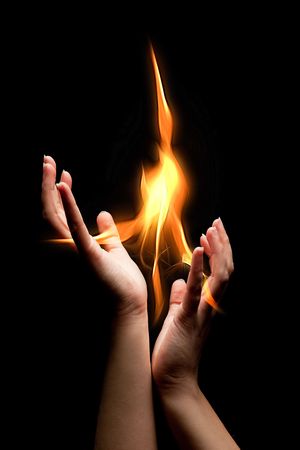
Abba Joseph stretched out his hands to heaven. And he said, “why not become fire?”
And the fingers on his hands became ten flaming lamps.
I think of that story. In the collections of these desert parents there actually aren’t a lot of miracles. Oh, demons come and go. And the odd angel. But, for the most part, we’re left to fend for ourselves.
Hence the various rules. Hence the five commitments.
But, really, really, there is one more step.
It’s kin to this story. It’s kin to the rich young man who went to Jesus and also said he kept the commandments, but felt some lack. And, Jesus replied, sell all you have, give it to the poor, and come, follow me. It’s kin to those frightened faces, knowing the holy one was dying, and they would be alone.
Let only with stories. Left only with a handful of practices.
And here we are. Another year dying. Something new birthing. Will it be a monster? Will it be an angel?
Will it be fire?
Here’s a secret. Just for you. It’s in your hands…
Previous Post

December 30, 2021
The Tiniest Recollection of the Mad Monk
Next Post
January 1, 2022 Recollecting the Zen Pioneer Houn Jiyu Kennett
Browse Our Archives
Select a Category A Christmas Carol Abolitionist African-American Ahmadiyya Alan Watts Aldous Huxley Allen Ginsberg Amedkar Jayanti American politics American Zen Anaheim Zen Sangha Anglican Annie Besant April Fool Armageddon Art and Religion artificial intellegence Atheist Awakening B R Ambedkar Barlaam & Josaphat Beatnik Between Bhagavad Gita Bible biography birthday bodhisattva Bodhisattva Precepts Book burning Book of Common Prayer Book of Mormon Brahmo Samaj Buddha Buddhism Buddhist Buddhist Lord's Prayer Butterflies Calendars cartoons cat ChatGPT Chicken Tortilla Soup choices Christian atheism Christian mysticism Christian origins Christian Science Christian Zen Christianity Christianity and Buddhism christmas Christmas Truce Christopher Isherwood Church of Later Day Saints Cinco de Mayo circus covenant critical thinking culture D. T. Suzuki Dalit Buddhism Daniel Defoe Desert Fathers and Mothers dharma talk Dogen Donald Trump Dongshan's Five Ranks Dorothy Day dream Duty Easter ecology Edwin Arnold emptiness Empty Moon Zen Network Episcopal Church Eternal Now Ethics evolution existentialism Faith fantasy Fathers Day film film review fire Five Ranks Folk music food Form and emptiness Four Seals Francis of Assisi Francis Xavier Free thinker friendship George MacDonald Gerald Heard Glenn Taylor Webb God Good Friday Gospel of Gospel of Mark Gospel of Thomas grace Graduate Theological Unioin Graduate Theological Union Guanyin H R Blyth Hakuin Ekaku Hanamatsuri Hanukkah Harada Yasutani Zen Heart Sutra Henry David Thoreau Hermann Hesse Hinduism History and Religion history of religion Holy Spirit home Hospitality Icon Ides of March Isaac Newton Islam Islamic mysticism Jack Kerouac James Luther Adams Jiddu Krishnamurti Joan of Arc Johannes Gutenberg John Donne joke Judaism justice karma kensho King James Bible koan Koun Yamada Kyoto School Lewis Carrol Liberal Christianity Liberal Religion Life Plan Community Liminal literature Literature and Religion Liturgy Lord's Prayer Love Mahatma Gandhi Mahayana Martin Luther King Jr Mary Baker Eddy Mary Magdelene Mary Oliver Mayflower Compact Meditation memories memory metaphor money money and religioin Mormons Mother's Day movie review mysticism mythic Neighborhood Unitarian Universalist Church New Thought Nichiren Buddhism Nonduality not knowing Omar Khayyam Pacific School of Religion pagan Palm Sunday Passover peace Pentecost perennialism Phantastes Philip Kapleau philosophy Pilgrimage poetry Poetry and Religion politics Prayer Precepts Printing Press prophecy prophetic spirituality psychology Pure Land Queer religion queering religion Quietism Ram Mohan Roy rebirth recipe Relationships and religion religion religion and history Religious syncretism Resistance Retirement Retreat review Rissho Kosei Kai Ritual Robert Aitken Roshi Robert Ingersoll Rohatsu Romani religion Rosie the Riveter saints samadhi SanboZen Sangha Satyagraha science science and reigion science and religion science fiction seminary sermon Sesshin Sex and Religion Shinran Sikh Sikh tradition silence Social Justice Socially Engaged Buddhism Society and religion Soto Zen soul spiritual community spiritual practice Spirituality Sufism Suicide superstition Taoism Television Teresa of Avila Thanksgiving theological schools Theosophy Thomas Merton Time Transcendentalism Transcendentalist Trinitarian Trinity Uncategorized unitarian Unitarian Christianity Unitarian Universalist Universalism Vajrayana Vedanta Walking war Willa Cather William Ellery Channing wisdom women and religion women in religion World Teacher Writing zazen Zen Zen Center Zen inspired retriement zen meditation Zen Precepts Zen women
Select a Month September 2026 August 2026 July 2026 June 2026 May 2026 April 2026 March 2026 February 2026 January 2026 December 2025 November 2025 October 2025 September 2025 August 2025 July 2025 June 2025 May 2025 April 2025 March 2025 February 2025 January 2025 December 2024 November 2024 October 2024 September 2024 August 2024 July 2024 June 2024 May 2024 April 2024 March 2024 February 2024 January 2024 December 2023 November 2023 October 2023 September 2023 August 2023 July 2023 June 2023 May 2023 April 2023 March 2023 February 2023 January 2023 December 2022 November 2022 October 2022 September 2022 August 2022 July 2022 June 2022 May 2022 April 2022 March 2022 February 2022 January 2022 December 2021 November 2021 October 2021 September 2021 August 2021 July 2021 June 2021 May 2021 April 2021 March 2021 February 2021 January 2021 December 2020 November 2020 October 2020 September 2020 August 2020 July 2020 June 2020 May 2020 April 2020 March 2020 February 2020 January 2020 December 2019 November 2019 October 2019 September 2019 August 2019 July 2019 June 2019 May 2019 April 2019 March 2019 February 2019 January 2019 December 2018 November 2018 October 2018 September 2018 August 2018 July 2018 June 2018 May 2018 April 2018 March 2018 February 2018 January 2018 December 2017 November 2017 October 2017 September 2017 August 2017 July 2017 June 2017 May 2017 April 2017 March 2017 February 2017 January 2017 December 2016 November 2016 October 2016 September 2016 August 2016 July 2016 June 2016 May 2016 April 2016 March 2016 February 2016 January 2016 December 2015 November 2015 October 2015 September 2015 August 2015 July 2015 June 2015 May 2015 April 2015 March 2015 February 2015 January 2015 December 2014 November 2014 October 2014 September 2014 August 2014 July 2014 June 2014 May 2014 April 2014 March 2014 February 2014 January 2014 December 2013 November 2013 October 2013 September 2013 August 2013 July 2013 June 2013 May 2013 April 2013 March 2013 February 2013 January 2013 December 2012 November 2012 October 2012 September 2012 August 2012 July 2012 June 2012 May 2012 April 2012 March 2012 February 2012 January 2012 December 2011 November 2011 October 2011 September 2011 August 2011 July 2011 June 2011 May 2011 April 2011 March 2011 February 2011 January 2011 December 2010 November 2010 October 2010 September 2010 August 2010 July 2010 June 2010 May 2010 April 2010 March 2010 February 2010 January 2010 December 2009 November 2009 October 2009 September 2009 August 2009 July 2009 June 2009 May 2009 April 2009 March 2009 February 2009 January 2009 December 2008 November 2008 October 2008 September 2008 August 2008 July 2008 June 2008 May 2008 April 2008 March 2008 February 2008 January 2008 December 2007 November 2007 October 2007 September 2007 August 2007 July 2007 June 2007 May 2007 April 2007 March 2007 February 2007 January 2007 December 2006 November 2006 October 2006 September 2006
Follow Us!
TAKE THE
Religious Wisdom Quiz
What is the name of the tree whose fruit Adam and Eve were forbidden to eat?
Select your answer to see how you score.
Tree of the Knowledge of Good and Evil Olive Tree Fig Tree Tree of Life
Related posts from Monkey Mind


Which Is the True Qian? A Koan About...


TRENDING AT PATHEOS Buddhist

Letters on Living the Faith by C.S. Lewis
Most of us met C.S. Lewis as a public intellectual. Mere Christianity....

When Halloween Unmasks Married Hearts
Written by Dr. David K. Ewen from Eternal Truth Bible College Behind...

Aristotle. He’s been called the father of logic, the father of the...

Methodist Central Hall and Westminster Abbey
Situated on the same square is Methodist Central Hall and Westminster Abbey. ...

57th Dove Awards Honor Dolly Parton, Crown New...
On gospel music’s biggest night, the 57th annual GMA Dove Awards honored...

The First Eucharistic Controversy: Christ’s Real Presence
For Catholics, the Eucharist is the source and summit of the Christian...
view all Buddhist blogs
Ad-Free & Subscriber Log-In Subscription Support
- About Us
- 2026 Calendar
- Videos
- Podcasts
- Library of World Religions
- Faith In Media Tracker
- Advertise With Us
- Write for Us
- Privacy Policy
- Terms of Service
- Do Not Sell My Data
- Contact Us
- Radiant Digital
- Manage Newsletter Subscriptions
- Unsubscribe From Notifications
- Sitemap
Copyright 2008-2026, Patheos. All rights reserved.
Subscription Support Ad-Free & Subscriber Log-In
Follow Patheos