
BuddhistCatholicContemplativeEvangelicalGeneral ChristianHinduJewishLatter-day SaintMuslimNew VisionsProgressive Christian
Beliefs
- Buddhist
- Catholic
- Contemplative
- Evangelical
- General Christian
- Hindu
- Jewish
- Latter-day Saint
- More Voices
- Muslim
- New Visions
- Pagan
- Progressive Christian
Topics
- Religion News
- Food and Religion
- Sports and Religion
- Religious Art
- Religious Music and Entertainment
- Religious Events
- History and Religion
- Style and Religion
- Politics and Religion
- Women in Religion
- Recreation Outdoors and Religion
- Business Finance and Religion
- Careers Workplace and Religion
- Education and Religion
- Family Parenting and Religion
- Health Fitness and Religion
- Home and Religion
- Relationships and Religion
- Technology and Religion
- Travel and Religion
Columnists
- Buddhist Columnists
- Business Finance and Religion Columnists
- Careers Workplace and Religion Columnists
- Catholic Columnists
- Contemplative Columnists
- Education and Religion Columnists
- Evangelists Columnists
- Family Parenting and Religion Columnists
- General Christian Columnists
- Health Fitness and Religion Columnists
- Hindu Columnists
- History and Religion Columnists
- Home and Religion Columnists
- Jewish Columnists
- More Voices Columnists
- Latter Day Columnists
- Muslim Columnists
- New Visions Columnists
- Nonreligious Columnists
- Pagan Columnists
- Politics and Religion Columnists
- Progressive Columnists
- Recreation Outdoors and Religion Columnists
- Relationships and Religion Columnists
- Religion News Columnists
- Religious Art Columnists
- Religious Events Columnists
- Religious Music and Entertainment Columnists
- Sports and Religion Columnists
- Style and Religion Columnists
- Technology and Religion Columnists
- Travel and Religion Columnists
- Women in Religion Columnists
Resource Library
- 2026 Calendar
- Library of World Religions
- The 100 Most Holy Places on Earth
- Patheos Answers
- Podcasts
- Videos
- Faith Leaders Database
- Anglican Episcopalian
- Bahai
- Baptist
- Buddhism
- Christianity
- Confucianism
- Eastern Orthodoxy
- Hinduism
- Holiness and Pentecostal
- ISKCON
- Islam
- Judaism
- Lutheran
- Methodist
- The Church of Jesus Christ of Latter-day Saints
- New Age
- Paganism
- Presbytarian and Reformed
- Protestantism
- Religion Behind the Scenes
- Roman Catholic
- Scientology
- Shia Islam
- Sikhism
- Sufism
- Sunni Islam
- Taoism
- Zen
- See all religions
Research Tools
 Ad-Free & Subscriber Log-In Subscription Support
Ad-Free & Subscriber Log-In Subscription Support
Follow Patheos 

- Trending:
- Forgiveness
- |
- Marriage
- |
- Consciousness
- |
- Death Penalty
- |
- Election
- |
- Halloween

- Home
- Buddhist
- WHO WOULD YOU BE BURIED WITH?
WHO WOULD YOU BE BURIED WITH?
Last updated on: July 18, 2021 at 8:09 pm by James Ford
WHO WOULD YOU BE BURIED WITH? 2021-07-18T20:09:16-07:00 James Ford
Patheos Explore the world's faith through different perspectives on religion and spirituality! Patheos has the views of the prevalent religions and spiritualities of the world.
WHO WOULD YOU BE BURIED WITH?
James Ishmael Ford
A voice from the dark called out,
‘The poets must give us
imagination of peace, to oust the intense, familiar
imagination of disaster. Peace, not only
the absence of war.’
But peace, like a poem,
is not there ahead of itself,
can’t be imagined before it is made,
can’t be known except
in the words of its making,
grammar of justice,
syntax of mutual aid.
A feeling towards it,
dimly sensing a rhythm, is all we have
until we begin to utter its metaphors,
learning them as we speak.
A line of peace might appear
if we restructured the sentence our lives are making,
revoked its reaffirmation of profit and power,
questioned our needs, allowed
long pauses . . .
A cadence of peace might balance its weight
on that different fulcrum; peace, a presence,
an energy field more intense than war,
might pulse then,
stanza by stanza into the world,
each act of living
one of its words, each word
a vibration of light—facets
of the forming crystal.
Making Peace by Denise Levertov
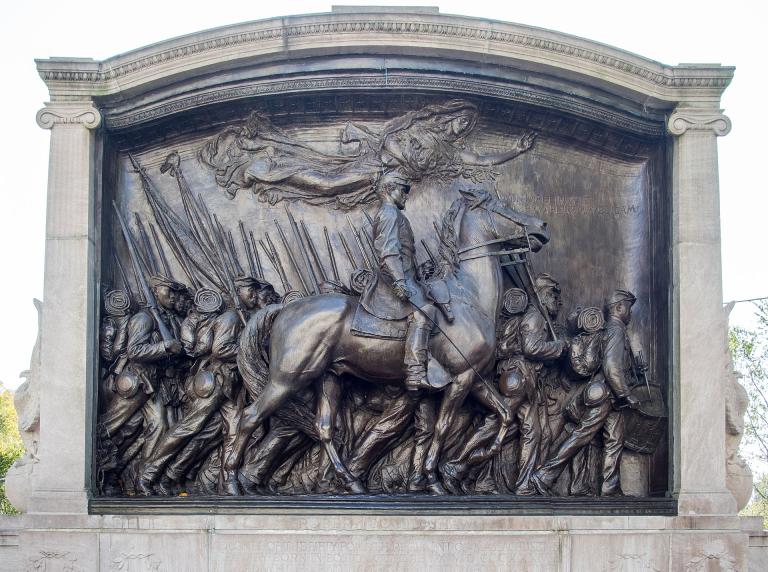
For many years the headquarters for the Unitarian Universalist Association was anchored at 25 Beacon Street, right next to the State House. Right across from the front doors on the Boston Common was an amazing monument. It’s officially named the “Robert Gould Shaw and Massachusetts 54th Regiment Memorial.” It was erected in honor of the second African American regiment mustered in our American Civil War. Two of the enlisted men were Frederick Douglass’ sons. Of course, need I say, of course, the officers were all white. Shaw was their colonel. He came from a prominent Boston Unitarian family, all radical abolitionists. And he features in the center of the image. However, the sculptor, Augustus Saint-Gaudens made sure the black men who composed the actual troops were prominently displayed. It works. They are all of them together. And it is an awesome sight to behold.
I have often stood before that monument commemorating the one hundred seventeen black men and their white officers, half of whom died in a failed assault on a Confederate stronghold at Fort Wagner just outside of Charleston. As it happens that battle occurred one hundred and fifty-eight years ago, today. Today, the 18th of July.
Among the survivors, Sergeant William Carney, was one of the first people of color awarded the Congressional Medal of Honor. Also among the dead was Robert Gould Shaw. While the bodies of the other white officers were returned, the Confederate commander announced of the regiment’s colonel, “We buried him with his niggers.” The bodies of the soldiers had been stripped naked, and then thrown into a ditch as their common grave. Throwing the dead white man with his black soldiers into that ditch the Confederates thought they were adding insult to injury.
So many thoughts and feelings flow out of this. One. I find myself wondering, who would I want to be buried with? An interesting question. Who would you want to be buried with?
What is unique it seems about our humanity is that we can reflect, and we can project at least some of the consequences to our actions. We have been thrown up into the world by the world as the eyes and ears and mind of the world. And I believe with that knowing, we have a host of obligations, to ourselves, to our families, to our neighbors, to the world itself.
Here’s what I know from the bottom of my heart. The individual is precious, beyond calculation. And, at the same time, we don’t exist in isolation. In fact, we have no existence outside of relationships. This is a harsh, and at the same time, if we consider it, a beautiful truth. We’re all in this together. Every single blessed one of us on this globe, every one of us. We are connected. For me, this is axiomatic. It is in fact the core of how I engage the world, spiritually, politically, everything I consciously do.
And. So. As a consequence. In practice, what does this mean?
As I continue to look at the shape of our relationships, with the planet, with other forms of life, and particularly how we relate to each other as humans, I find proximity counts. Why is hard to unpack, although I have opinions about it. But, for the moment I find it enough to assert this as a fact on the ground. We have pressing obligations to ourselves, then family and friends that appear to have stronger demands than to people more distantly related. I am deeply aware of my deepest obligations to my spouse and to my neighbors, both in the literal sense of those with whom I live, and in the somewhat more abstract sense of those who form my communities. I’ll do crazy things to take care of my family. I will do somewhat less crazy things for the church or my Zen community.
By the time we get to the nation state, I find my sense of obligation is real but not so strong as my feelings for those closer. I do feel love for country, particularly the stated ideals upon which we formed our union. The Declaration of Independence for one. And within that terrible Civil War, Lincoln’s Gettysburg Address is another. The rest of it, like the Constitution is trying to put that vision into action. And all of it remains very much a work in progress. It’s always tentative, it’s always subject to falling apart. Our most recent election shows what that can look like.
And, today, I think about the specifics of our American Civil War. It was a horror. 750,000 people died. Those wounded, displaced, brought to poverty probably numbered in the millions. It is easy to see why out of that some radical abolitionists like Julia Ward Howe would turn to pacificism. Others hypothesize some kind of alternative, including waiting out the end of slavery. Something that has gradually become at least the rhetorical assumption of modernity.
However, I am aware of no one of African descent making these arguments. When the Civil War began there were by best estimates approaching 4,000,000 enslaved people. Most were living in situations where abject poverty would have been several steps up. Starvation, rape, humiliations, uncounted humiliations, and murder were normative. I suspect from the position of the enslaved, and their descendants, it is possible to see the Civil War and its horrors simply a bit more equitably distributed for a few years.
I’m deeply stirred by the story of the men of the 54th and feel proud that Colonel Shaw was Unitarian, and how those men fought and died for that unfinished promise by standing up to shameful actions inflicted in the name of profit and justified by a radical dehumanizing of people. I even feel a need to continue that struggle. These feelings in their various degree spread out across the globe.
That’s me.
So, for us, for you and me, what are we to do with these facts on the ground? To frame that, sort of a bottom line, that question. With whom do we wish to be buried?
Here’s how I see it. Through the glass darkly. Always.
Our issue, the real deal for us here in this community, is how to act in a sacred manner in this mess of relationships that are our lives. Faced with the complexities of war and peace and never having enough information, but being the eyes and ears of the world, and the mind and heart, too – what do I do? What do we do?
For me the reality starts with how ultimately it’s impossible to be right in some absolute sense. The great thirteenth century Japanese Zen teacher Eihei Dogen, spoke often of this problem and how it presents. In our contemporary Zen world, we summarize his constant admonition by saying the way, our way, the way of the human, the intimate way, is one continuous mistake. So, there is always that.
I find as someone living in this world starting as it is, as best I can discern, not how I would rather it was, I think about slavery and the 54th. And I believe we are compelled to think about violence as a fact on the ground. And sometimes, it seems justified. With this, a big question. Is this propensity to violence ever justified in practice? And if so, under what circumstances and with what limits?
This is a question for us as individuals. And beyond our individual actions, what about the social nets within which we exist? We may be, and I hope we are, evolving toward a world community. It seems a race with our killing ourselves off as a species, and maybe taking a lot of other life forms with us, but, it also looks to be possible. However, for now we live in webs of nation-states, often in conflict, as well as among independent actors, such as religiously driven groups and multinational corporations, all with contending goals. All potentially if not already, oppressive.
The question is how do we deal with these circumstances, the hard facts of our lives? We live in a world where war is a fact. How do we face this, informed by our liberal religious intuition of a profound interdependence mitigated by the realities of nation-states and religious/cultural/political/economic forces with contending and frequently incompatible values and goals?
One option is Just War theory. There seem to be two kinds. There’s a “hard” one that without much effort pretty much justifies anything the state calls for. Here I think of former president George Bush’s justifications launching two wars in the Middle East as the result of the attacks on 9/11. Twenty years later, we are just winding down from the invasion of Afghanistan.
There is also a “soft,” or more “restrictive” model, which emphasizes reluctance, while allowing for very limited engagement, only focused on self-defense. I think we see what that is meant to look like in President Barack Obama’s 2009 Nobel speech as well as his address on counterterrorism and the use of drones. And I think in President Obama’s administration we see how difficult it was to hold to that more restrictive view. Nation states seem inevitably to drift toward more maximal justification for violent responses to threats. The blood of lots of innocents pour into the dust.
Bottom line as I see it, Just War theory does not actually work.
The principal alternative, of course, to Just War thought is pacifism. Pacifism is actually rather hard to define beyond being a philosophical or religious opposition to war. One scholar suggests there are at least twenty-nine different models of pacifism. Here I’m holding up that number, twenty-nine, as a placeholder for the complexity of the position.
I’ve looked into my own heart, I’ve reflected upon the predator’s incisors in my mouth and the predator’s forward-looking eyes in my head, I’ve held in my heart all the violent thoughts that have ever coursed through my body, sometimes blood hot. And I think about the 54th and their families, and all those who find themselves in situations where revolt is the moral position. I think about who do we owe what? And with whom would I be buried?
For me the dilemma of a hard pacifism is that it doesn’t adequately address the realities on the ground. I recall a pacifist friend when challenged as to what would he do if someone were attacking his wife, to say, he would stand between his spouse and the perpetrator. I found that totally inadequate. In this hypothetical he gives his life to buy seconds, and, ultimately, nothing more. I just cannot accept non-resistance to evil. If someone attacks my spouse Jan, I’m going to do what I can to stop it.
There is also a bottom line where at least some hard pacificism does not work.
With every particle of my being, I know my actions count, everything I do is a pebble thrown into a pool, with ripples, cascading consequences. There is no way to avoid consequences to any action. And, of course, that includes inaction. We’re there; consequences follow.
The question often is, which mistake are you going to make? So. So, knowing it is one continuous mistake, in that last moment, who do I wish to be buried with?
I, like most of us, live within a net of obligation and responsibility. Knowing that I feel we’re called to a path of mindful engagement, one that acknowledges our human propensity for conflict and violence, but which also heartfully takes us toward our larger intuition of interdependence and its ethics of care and justice.
This I believe. There is a larger way, one that acknowledges connections and obligations, and moves us in deeper ways of care and love.
I feel a need to be a citizen in today’s nation-state as a fact on the ground. I am also a citizen of the world. Another fact on the ground. And with these truths I feel obligations which include not standing aside, even when it means dirtying my hands, or worse. But any action needs to be done mindfully, gently as possible, with love for all. After all, if we really are all bound up together, if in a very real last analysis we are all one, one family, well, how does that affect our actions?
This is a call to a realistic encounter, and a realistic stance, not of pacifism, at least in some of the more stringent and unyielding of those twenty-nine variations, but of nonviolence. A subtle, but I feel, a critical nuancing. It is the way I try to follow.
Here’s the deal as I see it. The world is on fire. Human hearts are blazing. Some of this is wonderful. Flame can be good; it warms us on cold nights and cooks our food. The fires that enter our hearts and drive us toward the deepest, most generous and open; those are terribly important. But some fires are horrific; they destroy homes and devastate communities. The fires of fear and anger and certainty and grasping and prejudice feed the flames that can burn the world down to ashes.
And we are called to discern between the fires, between those passions that birth connection and respect and love, and those fires born of hatred and greed. And we need to do this discerning on the run. The world is in motion, and we need to make our decisions while already acting.
Small wonder, one continuous mistake.
A lot of my thinking is informed by the American Zen priest Bernie Glassman. In 1994 as part of a project that has come to be called Zen Peacmakers, he articulated three tenets. I’ve not joined that organization, but the tenets inform how I meet this world of fire.
They are my vow of nonviolence:
1) Not knowing.
2) Bearing witness.
3) Taking action.
Let’s unpack them as an expression of a nonviolent life.
The first is not knowing. It is a call to give up fixed ideas about the universe and ourselves. The second is bearing witness. Simply witnessing fully and without turning away, the joy and the suffering of the world. And last it is a call to loving actions. These actions are equally turned toward others and ourselves.
Denise Levertov says the work of peace is like writing a poem. It is. To side with love, sometimes involves throwing ourselves on the barricades. It might mean storming a fort, knowing it nearly impossible to win. Knowing who you will be buried with.
And still other times it is doing nothing. Doing nothing is an action with consequences, and sometimes doing nothing is exactly the way.
Sensing when to do what requires that we don’t know. Like writing a poem we need to draw upon resources we don’t really understand. So, it involves surrendering certainty. This calls for a profound spiritual agnosticism, something UUs and Buddhists should be good at. And this is a good thing. The great not knowing is the true source of wisdom. Only don’t know is the universal solvent of spirituality and the work of justice.
And this leads to bearing witness. If we don’t know, then we purely witness. We see what is going on. We see the fire around the world. We see the fire within ourselves. We see. Here the perspective we need begins to emerge. We start by witnessing. We continue by witnessing. We end by witnessing. To see is to know where to go. To witness is to find love.
And finally, we must act. In this world of motion, we must act. What we do, what we refrain from doing, everything has consequences. There are no bystanders in this world. But, informed by love, our actions will usually be helpful. If not knowing and bearing witness are alive within me, I will meet the situation as skillful as it is going to be possible.
And the consequences will follow. One continuous mistake.
Not knowing. Bearing witness. Taking action.
It is engaging life with a vow. And, it becomes a poem. It becomes a dance. It becomes the work of God.
And I believe with all my heart it unveils an answer to the question with whom would you be buried?
Exactly, how? Well, that’s in your heart. And that’s in your hands.
Amen.
Previous Post

July 17, 2021
The Zen priest recalls a poem written for his sixty-ninth birthday.
Next Post
July 19, 2021 Zen Master Robert Aitken
Browse Our Archives
Select a Category A Christmas Carol Abolitionist African-American Ahmadiyya Alan Watts Aldous Huxley Allen Ginsberg Amedkar Jayanti American politics American Zen Anaheim Zen Sangha Anglican Annie Besant April Fool Armageddon Art and Religion artificial intellegence Atheist Awakening B R Ambedkar Barlaam & Josaphat Beatnik Between Bhagavad Gita Bible biography birthday bodhisattva Bodhisattva Precepts Book burning Book of Common Prayer Book of Mormon Brahmo Samaj Buddha Buddhism Buddhist Buddhist Lord's Prayer Butterflies Calendars cartoons cat ChatGPT Chicken Tortilla Soup choices Christian atheism Christian mysticism Christian origins Christian Science Christian Zen Christianity Christianity and Buddhism christmas Christmas Truce Christopher Isherwood Church of Later Day Saints Cinco de Mayo circus covenant critical thinking culture D. T. Suzuki Dalit Buddhism Daniel Defoe Desert Fathers and Mothers dharma talk Dogen Donald Trump Dongshan's Five Ranks Dorothy Day dream Duty Easter ecology Edwin Arnold emptiness Empty Moon Zen Network Episcopal Church Eternal Now Ethics evolution existentialism Faith fantasy Fathers Day film film review fire Five Ranks Folk music food Form and emptiness Four Seals Francis of Assisi Francis Xavier Free thinker friendship George MacDonald Gerald Heard Glenn Taylor Webb God Good Friday Gospel of Gospel of Mark Gospel of Thomas grace Graduate Theological Unioin Graduate Theological Union Guanyin H R Blyth Hakuin Ekaku Hanamatsuri Hanukkah Harada Yasutani Zen Heart Sutra Henry David Thoreau Hermann Hesse Hinduism History and Religion history of religion Holy Spirit home Hospitality Icon Ides of March Isaac Newton Islam Islamic mysticism Jack Kerouac James Luther Adams Jiddu Krishnamurti Joan of Arc Johannes Gutenberg John Donne joke Judaism justice karma kensho King James Bible koan Koun Yamada Kyoto School Lewis Carrol Liberal Christianity Liberal Religion Life Plan Community Liminal literature Literature and Religion Liturgy Lord's Prayer Love Mahatma Gandhi Mahayana Martin Luther King Jr Mary Baker Eddy Mary Magdelene Mary Oliver Mayflower Compact Meditation memories memory metaphor money money and religioin Mormons Mother's Day movie review mysticism mythic Neighborhood Unitarian Universalist Church New Thought Nichiren Buddhism Nonduality not knowing Omar Khayyam Pacific School of Religion pagan Palm Sunday Passover peace Pentecost perennialism Phantastes Philip Kapleau philosophy Pilgrimage poetry Poetry and Religion politics Prayer Precepts Printing Press prophecy prophetic spirituality psychology Pure Land Queer religion queering religion Quietism Ram Mohan Roy rebirth recipe Relationships and religion religion religion and history Religious syncretism Resistance Retirement Retreat review Rissho Kosei Kai Ritual Robert Aitken Roshi Robert Ingersoll Rohatsu Romani religion Rosie the Riveter saints samadhi SanboZen Sangha Satyagraha science science and reigion science and religion science fiction seminary sermon Sesshin Sex and Religion Shinran Sikh Sikh tradition silence Social Justice Socially Engaged Buddhism Society and religion Soto Zen soul spiritual community spiritual practice Spirituality Sufism Suicide superstition Taoism Television Teresa of Avila Thanksgiving theological schools Theosophy Thomas Merton Time Transcendentalism Transcendentalist Trinitarian Trinity Uncategorized unitarian Unitarian Christianity Unitarian Universalist Universalism Vajrayana Vedanta Walking war Willa Cather William Ellery Channing wisdom women and religion women in religion World Teacher Writing zazen Zen Zen Center Zen inspired retriement zen meditation Zen Precepts Zen women
Select a Month September 2026 August 2026 July 2026 June 2026 May 2026 April 2026 March 2026 February 2026 January 2026 December 2025 November 2025 October 2025 September 2025 August 2025 July 2025 June 2025 May 2025 April 2025 March 2025 February 2025 January 2025 December 2024 November 2024 October 2024 September 2024 August 2024 July 2024 June 2024 May 2024 April 2024 March 2024 February 2024 January 2024 December 2023 November 2023 October 2023 September 2023 August 2023 July 2023 June 2023 May 2023 April 2023 March 2023 February 2023 January 2023 December 2022 November 2022 October 2022 September 2022 August 2022 July 2022 June 2022 May 2022 April 2022 March 2022 February 2022 January 2022 December 2021 November 2021 October 2021 September 2021 August 2021 July 2021 June 2021 May 2021 April 2021 March 2021 February 2021 January 2021 December 2020 November 2020 October 2020 September 2020 August 2020 July 2020 June 2020 May 2020 April 2020 March 2020 February 2020 January 2020 December 2019 November 2019 October 2019 September 2019 August 2019 July 2019 June 2019 May 2019 April 2019 March 2019 February 2019 January 2019 December 2018 November 2018 October 2018 September 2018 August 2018 July 2018 June 2018 May 2018 April 2018 March 2018 February 2018 January 2018 December 2017 November 2017 October 2017 September 2017 August 2017 July 2017 June 2017 May 2017 April 2017 March 2017 February 2017 January 2017 December 2016 November 2016 October 2016 September 2016 August 2016 July 2016 June 2016 May 2016 April 2016 March 2016 February 2016 January 2016 December 2015 November 2015 October 2015 September 2015 August 2015 July 2015 June 2015 May 2015 April 2015 March 2015 February 2015 January 2015 December 2014 November 2014 October 2014 September 2014 August 2014 July 2014 June 2014 May 2014 April 2014 March 2014 February 2014 January 2014 December 2013 November 2013 October 2013 September 2013 August 2013 July 2013 June 2013 May 2013 April 2013 March 2013 February 2013 January 2013 December 2012 November 2012 October 2012 September 2012 August 2012 July 2012 June 2012 May 2012 April 2012 March 2012 February 2012 January 2012 December 2011 November 2011 October 2011 September 2011 August 2011 July 2011 June 2011 May 2011 April 2011 March 2011 February 2011 January 2011 December 2010 November 2010 October 2010 September 2010 August 2010 July 2010 June 2010 May 2010 April 2010 March 2010 February 2010 January 2010 December 2009 November 2009 October 2009 September 2009 August 2009 July 2009 June 2009 May 2009 April 2009 March 2009 February 2009 January 2009 December 2008 November 2008 October 2008 September 2008 August 2008 July 2008 June 2008 May 2008 April 2008 March 2008 February 2008 January 2008 December 2007 November 2007 October 2007 September 2007 August 2007 July 2007 June 2007 May 2007 April 2007 March 2007 February 2007 January 2007 December 2006 November 2006 October 2006 September 2006
Follow Us!
TAKE THE
Religious Wisdom Quiz
What did God command Job to do after his friends were rebuked?
Select your answer to see how you score.
Go to Uz Pray for his friends Fast for 40 days Offer more sacrifices
Related posts from Monkey Mind


Which Is the True Qian? A Koan About...


TRENDING AT PATHEOS Buddhist

The Iron Gates and the Lion of the...
Yesterday, I didn't finish my report about, well, yesterday. So I'll...

Dolly Parton’s Last Song Wins Dove Award with...
Bluegrass band The Grascals, speaking on the red carpet at the 57th...

The Image: On the Horror of Capitalism and...
The Image Then went the Pharisees, and took counsel how they might...

We are approaching the date of our new American national holiday: October...

Letters on Living the Faith by C.S. Lewis
Most of us met C.S. Lewis as a public intellectual. Mere Christianity....

When Halloween Unmasks Married Hearts
Written by Dr. David K. Ewen from Eternal Truth Bible College Behind...
view all Buddhist blogs
Ad-Free & Subscriber Log-In Subscription Support
- About Us
- 2026 Calendar
- Videos
- Podcasts
- Library of World Religions
- Faith In Media Tracker
- Advertise With Us
- Write for Us
- Privacy Policy
- Terms of Service
- Do Not Sell My Data
- Contact Us
- Radiant Digital
- Manage Newsletter Subscriptions
- Unsubscribe From Notifications
- Sitemap
Copyright 2008-2026, Patheos. All rights reserved.
Subscription Support Ad-Free & Subscriber Log-In
Follow Patheos