
BuddhistCatholicContemplativeEvangelicalGeneral ChristianHinduJewishLatter-day SaintMuslimNew VisionsProgressive Christian
Beliefs
- Buddhist
- Catholic
- Contemplative
- Evangelical
- General Christian
- Hindu
- Jewish
- Latter-day Saint
- More Voices
- Muslim
- New Visions
- Pagan
- Progressive Christian
Topics
- Religion News
- Food and Religion
- Sports and Religion
- Religious Art
- Religious Music and Entertainment
- Religious Events
- History and Religion
- Style and Religion
- Politics and Religion
- Women in Religion
- Recreation Outdoors and Religion
- Business Finance and Religion
- Careers Workplace and Religion
- Education and Religion
- Family Parenting and Religion
- Health Fitness and Religion
- Home and Religion
- Relationships and Religion
- Technology and Religion
- Travel and Religion
Columnists
- Buddhist Columnists
- Business Finance and Religion Columnists
- Careers Workplace and Religion Columnists
- Catholic Columnists
- Contemplative Columnists
- Education and Religion Columnists
- Evangelists Columnists
- Family Parenting and Religion Columnists
- General Christian Columnists
- Health Fitness and Religion Columnists
- Hindu Columnists
- History and Religion Columnists
- Home and Religion Columnists
- Jewish Columnists
- More Voices Columnists
- Latter Day Columnists
- Muslim Columnists
- New Visions Columnists
- Nonreligious Columnists
- Pagan Columnists
- Politics and Religion Columnists
- Progressive Columnists
- Recreation Outdoors and Religion Columnists
- Relationships and Religion Columnists
- Religion News Columnists
- Religious Art Columnists
- Religious Events Columnists
- Religious Music and Entertainment Columnists
- Sports and Religion Columnists
- Style and Religion Columnists
- Technology and Religion Columnists
- Travel and Religion Columnists
- Women in Religion Columnists
Resource Library
- 2026 Calendar
- Library of World Religions
- The 100 Most Holy Places on Earth
- Patheos Answers
- Podcasts
- Videos
- Faith Leaders Database
- Anglican Episcopalian
- Bahai
- Baptist
- Buddhism
- Christianity
- Confucianism
- Eastern Orthodoxy
- Hinduism
- Holiness and Pentecostal
- ISKCON
- Islam
- Judaism
- Lutheran
- Methodist
- The Church of Jesus Christ of Latter-day Saints
- New Age
- Paganism
- Presbytarian and Reformed
- Protestantism
- Religion Behind the Scenes
- Roman Catholic
- Scientology
- Shia Islam
- Sikhism
- Sufism
- Sunni Islam
- Taoism
- Zen
- See all religions
Research Tools
 Ad-Free & Subscriber Log-In Subscription Support
Ad-Free & Subscriber Log-In Subscription Support
Follow Patheos 

- Trending:
- Forgiveness
- |
- Marriage
- |
- Consciousness
- |
- Death Penalty
- |
- Election
- |
- Halloween

- Home
- Buddhist
- OUR ANCESTOR’S DREAMS: Engaging a Zen koan from the Bible
OUR ANCESTOR’S DREAMS: Engaging a Zen koan from the Bible
Last updated on: August 3, 2019 at 6:00 pm by James Ford
OUR ANCESTOR’S DREAMS: Engaging a Zen koan from the Bible 2019-08-03T18:00:58-07:00 James Ford
Patheos Explore the world's faith through different perspectives on religion and spirituality! Patheos has the views of the prevalent religions and spiritualities of the world.
OUR ANCESTOR’S DREAMS
Engaging a koan from the Bible
A Dharma talk delivered at the
Anaheim Zen Sangha
Empty Moon Zen Network
3 August, 2019
James Myoun Ford
One of my dearer friends was once asked if he believed in God. He said no. The questioner then asked, “So, you’re an atheist?” He replied no. Frustrated the person asked, “what do you believe?” And he replied, “As little as I can.”
In my life I’ve tried to strip away unnecessary assumptions. And in the process of looking and letting go of things I find don’t resonate with reality as I encounter it or as can be plausibly explained, what I believe, in the sense of consciously confessing as a belief is relatively small.
For one thing, I can say I am a Buddhist. Out of my experiences and study I have come to believe a number of things as axiomatic about life and my life. I believe the world and everything in it is impermanent. I believe all things made of parts exist in a tension, which in human experience creates an abiding anxiety, a pervading sense of dis-ease. I believe there are no essential substances unconnected to the play of cause and effect, nothing like souls that exist outside of time and space. And, I believe there is a settling of the human heart, a way to see into and through the connections, and finding, if you will, a peace that passes all understanding.
Now, this is a pretty orthodox summation of Buddhism, if with some washes that put me at a particular place on the continuum that can be called Buddhist. And where that is, is worth exploring. But, not here. It’s that last line, which I want to raise in the moment, notice, and reflect on before going into that matter of dis-ease and seeing through, and what exists as my experience, and, who knows, maybe yours. The phrase “peace that passes all understanding” is lifted from Paul’s letter to the Philippians. It comes from the Christian canon. It’s a delicious turn of phrase. And it points.
A peace beyond all understanding.
It points to something truest true. A promise sung to us by our ancestors.
It is what we’re about here.
Me, speaking of causes and conditions, I am the product of many things. I am a confessed Zen Buddhist. I’ve lived in monasteries. I’ve passed literally hundreds of koans. In the arcane tradition developed in Japanese Zen. I’ve been ordained a priest in the Soto Zen tradition. And, I’ve received what is called “dharma transmission,” or the mind-seal as a Zen teacher. I am these things. And, I learned how to read quite literally at my grandmother’s knee, out of a large illustrated King James version of the Bible. I was raised what is perhaps best called a “poor-people’s Baptist.” I formally rejected the Christianity of my childhood in my adolescence, first embracing pretty full on a naturalistic view of things, but also over the years have studied at varying degrees of depth several of the world’s religions. At the greatest depth, Christianity and most especially Buddhism.
And, as a Buddhist, in our time and this place, I find the best way to express myself is as frequently as not, by alluding to something from the Jewish or Christian scriptures or traditions. And, what that means, is that my Buddhism, whatever else may be said of it, is hybridized. As, I in fact, has always been the case for all religions, including Buddhism. Things add. Things subtract. And, the great rule: all things change. Because of this as it is in my life, I often cannot say where I have an assumption or even turn of phrase that arises out of my natal tradition or my adopted one.
There are good things and bad that come with this. But, here in this reflection, I want to hold up the call to modesty and even a little humility. And, as one of our Zen sages declared herself, to be ready to teach a white haired venerable, and learn from a six-year old child, as the circumstances present. A deep curiosity is the practice. And a confidence the truths of our lives can be found in a deep examination of the world’s spiritual traditions.
We, here, within our Zen community are gifted with some amazing things. We have a basket of practices that are astonishing. Our meditation discipline of the awakened heart is a gift from the unknown to the known. It literally brings heaven and earth together and shows us who we really are. Additionally, we have the gift of koan introspection. Using stories as a framework of engagement, allowing us to front straight on, to understand, if through a cloud darkly, always through a cloud darkly, and over time to integrate. We also have covenants of relationship, precepts that cradle our lives, protect us from many of the consequences that can arise from choosing and acting in unhealthy ways.
And, with that as a bit more than preamble, let me tell you a story about a peace that passes all understanding.
Once upon a time, long ago, and far away there was a man.
He’d been following the intimate way for many years. Eventually this led him on a pilgrimage. On that journey he encountered many teachers, and experienced things that captured his heart and redirected it from what he had long thought was true.
Finally, he was living in the desert, making his living by weaving baskets out of reeds, and selling them to passersby on the road between two great cities. He prayed and worked, and throughout he tried to pay attention. He noticed his body. It’s discomforts. It’s small pleasures. He noticed the heat and the dryness. He felt the smells of desert, of heat, and dust, and when they presented, green things. He heard distant birds and other animals. At night he contemplated the starry sky.
Always, always, he tried to be present.
One night he dreamed a dream.
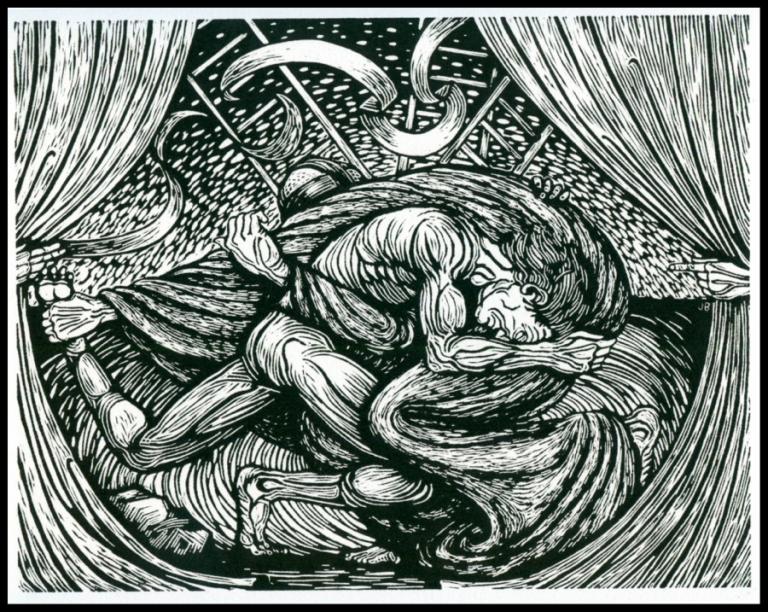
A stranger entered into his hut and grabbed him by the arm. They began to wrestle. He couldn’t understand what was happening, but he knew it had something to do with life and with death. To lose was to die. To win, well, he didn’t have time to think about what that meant. All he knew was there was nothing more important. So, he threw himself into the struggle with all the energy he had. And with the desperation of someone drowing.
At some point the stranger put his knee into the man’s hip and disjointed it. The pain was excruciating. It felt like stars were exploding. But, he continued to struggle. Throughout the night, they contended. He could smell the sweat. He felt the pain. And it was exhausting.
Finally, as day light began to pour through the open doorway of his hut, the stranger said, “It’s now morning. Let me go.”
Not knowing what this was supposed to mean, but also sensing that something to do with life and death was now birthing into the moment, the man replied, “I will not release you unless you give me your blessing.” After he said this, he realized he had no idea where the question had come from. But he also knew it was true. And it was what he needed. Maybe what he had needed from long before he began his pilgrimage of spirit.
The stranger said in a husky voice, obviously tired from the night’s struggle, “What’s your name?”
The man replied, “My name is Supplanter.” He felt a wave of shame, knowing his name came from his aggressive nature, and his desire to take the first place. And it recalled the shameful things he’d done that led to his being given that name.
The stranger replied, “This is no longer your name. You are now “Wrestles with God.”
This sent a current of fear through the man’s body. And shivering despite the alreading rising morning heat Wrestles with God responded, “So, what is your name?” Although in his heart he had a sense he knew. The starry sky, the desert, the calling of distant birds, the smell of heat and sweat. And he shivered.
The stranger laughed and said, “Why do you want to know?” And then gave Wrestles with God a blessing.
The world opened up. That sky. That desert. The distant birds. The smells. All were open. All became gates to walk through. And all had been walked through since before the birthing of the first dream.
The man and the stranger let go of each other and the stranger walked out the door into the dawn.
Later Wrestles with God called that spot, “Encountering the Intimate.”
And for the rest of his days he walked with a limp.
That story is my, how shall we call it, creative retelling of a tale found in the first book of the Bible. So its shared by the Jewish and Christian traditions and now, at least by me, adopted into the Zen world. Nothing so strange in that. It has been around a while and others have taken it up. While it isn’t repeated in the Quran, Muslim religious scholars refence it in their commentaries. There’s a delightful Marxist interpretation that has it a match between an oppressive deity and a clever human who outsmarts the god.
Here, however, I would like to provide a Buddhist commentary, an exhortation, and an invitation. We’re all on a journey. Every blessed one of us. And, at various moments in time we are gifted with portals that take us for a moment and sometimes more to another world. Sometimes it turns out to be the same world, but we get to see it with new eyes., to listen with new ears. Whatever, if we’re open, something happens.
Here the character called Supplanter encounters a mysterious being and is forced into a wrestling match. We never know who that being is, at least not within the original version of the story. Interpreters sometimes say an angel and sometimes say God. Which can make sense, in classical antiquity in areas not all that far from where this story comes, people are caught in matches with several divinities, Achilles and the river god Scamander to begin a list.
And, of course, there’s a Zen way to engage this story. It really is a koan. A koan is a story, or a fragment of a poem, or an account of a conversation. But, the point to it, what makes it a koan is different than in other literary forms. Here we are invited to believe there is a true pointing. That there is some assertion about reality, and with that an invitation to occupy that space. We start imaginatively, but in the doing, something can happen.
So, Supplanter, the man with that awful name, born out of conflict and theft, meets the mystery. And he’s forced into a wrestling match. Not unlike that buzz of anxiety, the hum of change that so distresses our lives as human beings. We are born into a world constantly shifting, turning, and, wounding. And, still, truth of it is there is no escape. There is no other place to go. So, he engages. A pointer for us. He enters into the match with all he has. And it runs through the night. Anyone who has experienced a Zen meditation retreat, even for one day, knows something of what this can be like. But, actually, it is the course of our ordinary lives. If we notice.
And then there is a dawn. All the stories of the great religions have a dawn. Or, many. And at that dawn the mystery itself asks the human a question. What is your name? Another pointer for us. Names are magical things. They are not what we are. Lots of koans force us into a confrontation with that truth. And, yet, somehow, they are exactly what we are. Lots of other koans push us into that engagement. Here both is and is not come together.
They become one of the primordial koans. Who are you? Who am I? What was your true face from before when your parents were born?
And in response he confesses that terrible truth. He is Supplanter. He is the product of so many things, and heavy among them is his betrayal of his brother and his father. We’re all in that boat. Our true name contains many things. Some laudable. Some not. We are all of them. And, we need to face into it. All of it.
But here’s the promise. In that moment there is a great turning. Supplanter is renamed. He becomes Wrestles with God. Now there’s a harsh truth. He is not let off the hook for the bad things he’s done before. There are consequences which will continue to play out until there’s nothing to play out. But, he’s no longer just that. He is something more. Something much larger.
Oh, and did I mention this is about you. And me. We all are invited into that more. We all can become Wrestles with God.
I want to believe as little as possible. So, another question follows. Who is Wrestles with God?
And of the great question of all religions, maybe, it’s just this one question. It may be the gate to that peace which passes all understanding. Or, another pointer. It may in itself be that peace which passes all understanding.
The question. Who are you? Who are you truly? When you let go of all you can let go of. When the lies we tell ourselves burn away in the face of what is. When the distractions are set down. When the ancient songs are ended. In this moment, this moment, following this particular path, beyond differentiation and connection, how are you free?
Peace. Understanding. Beyond.
Beyond East and West, here, now, how are you free?
Let it sink into your bones. All of it. Let it be your ancestor’s dreams.
And you will know for yourself.
Previous Post

August 2, 2019
Recalling Jeanne de Clisson & Women You Don't Mess With
Next Post
August 4, 2019 A Short Meditation on the Three-legged Stool of the Zen Way
Browse Our Archives
Select a Category A Christmas Carol Abolitionist African-American Ahmadiyya Alan Watts Aldous Huxley Allen Ginsberg Amedkar Jayanti American politics American Zen Anaheim Zen Sangha Anglican Annie Besant April Fool Armageddon Art and Religion artificial intellegence Atheist Awakening B R Ambedkar Barlaam & Josaphat Beatnik Between Bhagavad Gita Bible biography birthday bodhisattva Bodhisattva Precepts Book burning Book of Common Prayer Book of Mormon Brahmo Samaj Buddha Buddhism Buddhist Buddhist Lord's Prayer Butterflies Calendars cartoons cat ChatGPT Chicken Tortilla Soup choices Christian atheism Christian mysticism Christian origins Christian Science Christian Zen Christianity Christianity and Buddhism christmas Christmas Truce Christopher Isherwood Church of Later Day Saints Cinco de Mayo circus covenant critical thinking culture D. T. Suzuki Dalit Buddhism Daniel Defoe Desert Fathers and Mothers dharma talk Dogen Donald Trump Dongshan's Five Ranks Dorothy Day dream Duty Easter ecology Edwin Arnold emptiness Empty Moon Zen Network Episcopal Church Eternal Now Ethics evolution existentialism Faith fantasy Fathers Day film film review fire Five Ranks Folk music food Form and emptiness Four Seals Francis of Assisi Francis Xavier Free thinker friendship George MacDonald Gerald Heard Glenn Taylor Webb God Good Friday Gospel of Gospel of Mark Gospel of Thomas grace Graduate Theological Unioin Graduate Theological Union Guanyin H R Blyth Hakuin Ekaku Hanamatsuri Hanukkah Harada Yasutani Zen Heart Sutra Henry David Thoreau Hermann Hesse Hinduism History and Religion history of religion Holy Spirit home Hospitality Icon Ides of March Isaac Newton Islam Islamic mysticism Jack Kerouac James Luther Adams Jiddu Krishnamurti Joan of Arc Johannes Gutenberg John Donne joke Judaism justice karma kensho King James Bible koan Koun Yamada Kyoto School Lewis Carrol Liberal Christianity Liberal Religion Life Plan Community Liminal literature Literature and Religion Liturgy Lord's Prayer Love Mahatma Gandhi Mahayana Martin Luther King Jr Mary Baker Eddy Mary Magdelene Mary Oliver Mayflower Compact Meditation memories memory metaphor money money and religioin Mormons Mother's Day movie review mysticism mythic Neighborhood Unitarian Universalist Church New Thought Nichiren Buddhism Nonduality not knowing Omar Khayyam Pacific School of Religion pagan Palm Sunday Passover peace Pentecost perennialism Phantastes Philip Kapleau philosophy Pilgrimage poetry Poetry and Religion politics Prayer Precepts Printing Press prophecy prophetic spirituality psychology Pure Land Queer religion queering religion Quietism Ram Mohan Roy rebirth recipe Relationships and religion religion religion and history Religious syncretism Resistance Retirement Retreat review Rissho Kosei Kai Ritual Robert Aitken Roshi Robert Ingersoll Rohatsu Romani religion Rosie the Riveter saints samadhi SanboZen Sangha Satyagraha science science and reigion science and religion science fiction seminary sermon Sesshin Sex and Religion Shinran Sikh Sikh tradition silence Social Justice Socially Engaged Buddhism Society and religion Soto Zen soul spiritual community spiritual practice Spirituality Sufism Suicide superstition Taoism Television Teresa of Avila Thanksgiving theological schools Theosophy Thomas Merton Time Transcendentalism Transcendentalist Trinitarian Trinity Uncategorized unitarian Unitarian Christianity Unitarian Universalist Universalism Vajrayana Vedanta Walking war Willa Cather William Ellery Channing wisdom women and religion women in religion World Teacher Writing zazen Zen Zen Center Zen inspired retriement zen meditation Zen Precepts Zen women
Select a Month September 2026 August 2026 July 2026 June 2026 May 2026 April 2026 March 2026 February 2026 January 2026 December 2025 November 2025 October 2025 September 2025 August 2025 July 2025 June 2025 May 2025 April 2025 March 2025 February 2025 January 2025 December 2024 November 2024 October 2024 September 2024 August 2024 July 2024 June 2024 May 2024 April 2024 March 2024 February 2024 January 2024 December 2023 November 2023 October 2023 September 2023 August 2023 July 2023 June 2023 May 2023 April 2023 March 2023 February 2023 January 2023 December 2022 November 2022 October 2022 September 2022 August 2022 July 2022 June 2022 May 2022 April 2022 March 2022 February 2022 January 2022 December 2021 November 2021 October 2021 September 2021 August 2021 July 2021 June 2021 May 2021 April 2021 March 2021 February 2021 January 2021 December 2020 November 2020 October 2020 September 2020 August 2020 July 2020 June 2020 May 2020 April 2020 March 2020 February 2020 January 2020 December 2019 November 2019 October 2019 September 2019 August 2019 July 2019 June 2019 May 2019 April 2019 March 2019 February 2019 January 2019 December 2018 November 2018 October 2018 September 2018 August 2018 July 2018 June 2018 May 2018 April 2018 March 2018 February 2018 January 2018 December 2017 November 2017 October 2017 September 2017 August 2017 July 2017 June 2017 May 2017 April 2017 March 2017 February 2017 January 2017 December 2016 November 2016 October 2016 September 2016 August 2016 July 2016 June 2016 May 2016 April 2016 March 2016 February 2016 January 2016 December 2015 November 2015 October 2015 September 2015 August 2015 July 2015 June 2015 May 2015 April 2015 March 2015 February 2015 January 2015 December 2014 November 2014 October 2014 September 2014 August 2014 July 2014 June 2014 May 2014 April 2014 March 2014 February 2014 January 2014 December 2013 November 2013 October 2013 September 2013 August 2013 July 2013 June 2013 May 2013 April 2013 March 2013 February 2013 January 2013 December 2012 November 2012 October 2012 September 2012 August 2012 July 2012 June 2012 May 2012 April 2012 March 2012 February 2012 January 2012 December 2011 November 2011 October 2011 September 2011 August 2011 July 2011 June 2011 May 2011 April 2011 March 2011 February 2011 January 2011 December 2010 November 2010 October 2010 September 2010 August 2010 July 2010 June 2010 May 2010 April 2010 March 2010 February 2010 January 2010 December 2009 November 2009 October 2009 September 2009 August 2009 July 2009 June 2009 May 2009 April 2009 March 2009 February 2009 January 2009 December 2008 November 2008 October 2008 September 2008 August 2008 July 2008 June 2008 May 2008 April 2008 March 2008 February 2008 January 2008 December 2007 November 2007 October 2007 September 2007 August 2007 July 2007 June 2007 May 2007 April 2007 March 2007 February 2007 January 2007 December 2006 November 2006 October 2006 September 2006
Follow Us!
TAKE THE
Religious Wisdom Quiz
Who was cast out with her son Ishmael?
Select your answer to see how you score.
Dinah Lot's wife Hagar Rebekah
Related posts from Monkey Mind


A Zen Buddhist Response to this Moment


The Suchness of Crows: The Zen teachings of...
TRENDING AT PATHEOS Buddhist

Nearly every morning, I make the drive to Detroit with my high-school-age...

The Real AI Story Is Adoption Without Trust
Artificial intelligence has crossed a political threshold. It is no longer a...

A new article, written by Jeff Lindsay and Gale L. Pooley,...

Swimfan: Forgotten Aughts Pleasures
This is a recovery effort. In 2002, My Big Fat Greek Wedding...

Top Three Anti-Catholic Lies About Catholicism
This is my initial transcript for the video, "THE 3 WORST...

Pope Leo Celebrates Mass for Nurses & Docs...
I don't have any idea how he did it, but Pope Leo...
view all Buddhist blogs
Ad-Free & Subscriber Log-In Subscription Support
- About Us
- 2026 Calendar
- Videos
- Podcasts
- Library of World Religions
- Faith In Media Tracker
- Advertise With Us
- Write for Us
- Privacy Policy
- Terms of Service
- Do Not Sell My Data
- Contact Us
- Radiant Digital
- Manage Newsletter Subscriptions
- Unsubscribe From Notifications
- Sitemap
Copyright 2008-2026, Patheos. All rights reserved.
Subscription Support Ad-Free & Subscriber Log-In
Follow Patheos