
BuddhistCatholicContemplativeEvangelicalGeneral ChristianHinduJewishLatter-day SaintMuslimNew VisionsProgressive Christian
Beliefs
- Buddhist
- Catholic
- Contemplative
- Evangelical
- General Christian
- Hindu
- Jewish
- Latter-day Saint
- More Voices
- Muslim
- New Visions
- Pagan
- Progressive Christian
Topics
- Religion News
- Food and Religion
- Sports and Religion
- Religious Art
- Religious Music and Entertainment
- Religious Events
- History and Religion
- Style and Religion
- Politics and Religion
- Women in Religion
- Recreation Outdoors and Religion
- Business Finance and Religion
- Careers Workplace and Religion
- Education and Religion
- Family Parenting and Religion
- Health Fitness and Religion
- Home and Religion
- Relationships and Religion
- Technology and Religion
- Travel and Religion
Columnists
- Buddhist Columnists
- Business Finance and Religion Columnists
- Careers Workplace and Religion Columnists
- Catholic Columnists
- Contemplative Columnists
- Education and Religion Columnists
- Evangelists Columnists
- Family Parenting and Religion Columnists
- General Christian Columnists
- Health Fitness and Religion Columnists
- Hindu Columnists
- History and Religion Columnists
- Home and Religion Columnists
- Jewish Columnists
- More Voices Columnists
- Latter Day Columnists
- Muslim Columnists
- New Visions Columnists
- Nonreligious Columnists
- Pagan Columnists
- Politics and Religion Columnists
- Progressive Columnists
- Recreation Outdoors and Religion Columnists
- Relationships and Religion Columnists
- Religion News Columnists
- Religious Art Columnists
- Religious Events Columnists
- Religious Music and Entertainment Columnists
- Sports and Religion Columnists
- Style and Religion Columnists
- Technology and Religion Columnists
- Travel and Religion Columnists
- Women in Religion Columnists
Resource Library
- 2026 Calendar
- Library of World Religions
- The 100 Most Holy Places on Earth
- Patheos Answers
- Podcasts
- Videos
- Faith Leaders Database
- Anglican Episcopalian
- Bahai
- Baptist
- Buddhism
- Christianity
- Confucianism
- Eastern Orthodoxy
- Hinduism
- Holiness and Pentecostal
- ISKCON
- Islam
- Judaism
- Lutheran
- Methodist
- The Church of Jesus Christ of Latter-day Saints
- New Age
- Paganism
- Presbytarian and Reformed
- Protestantism
- Religion Behind the Scenes
- Roman Catholic
- Scientology
- Shia Islam
- Sikhism
- Sufism
- Sunni Islam
- Taoism
- Zen
- See all religions
Research Tools
 Ad-Free & Subscriber Log-In Subscription Support
Ad-Free & Subscriber Log-In Subscription Support
Follow Patheos 

- Trending:
- Forgiveness
- |
- Marriage
- |
- Consciousness
- |
- Death Penalty
- |
- Election
- |
- Halloween

- Home
- Buddhist
- A Zen Priest’s Argument With the Argument from Design
A Zen Priest’s Argument With the Argument from Design
Last updated on: April 19, 2019 at 4:01 pm by James Ford
A Zen Priest’s Argument With the Argument from Design 2019-04-19T16:01:29-07:00 James Ford
Patheos Explore the world's faith through different perspectives on religion and spirituality! Patheos has the views of the prevalent religions and spiritualities of the world.
A Zen Priest’s Argument With the Argument from Design
A Bit of a Meander on Why I Don’t Believe What I Don’t, and Why I Do Believe What I Do, Concluding with a Call to Something.
James Myoun Ford
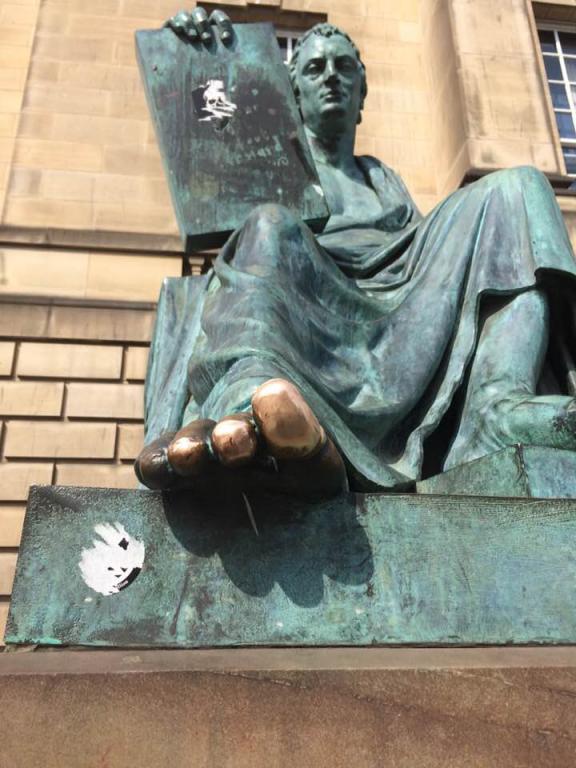
A Facebook friend who I really like is currently on a family trip to Scotland. Today he posted a picture of that statue of David Hume with his toes rubbed shiny from generations of students hoping for some of his brilliance rubbing off on them.
My friend’s comments held up an exaggerated version of Hume’s resistance to assuming causation simply from correlation. He then pointedly claimed that Hume’s putative resistance to causation from correlation led him to not “infer a Creator from the creation.” And with that in one fell swoop collapsing issues of causation with that traditional “argument from design” regarding whether there is a creator. Okay, my friend is an Episcopal bishop. And so maybe mushing a lot of things together for rhetorical purposes is understandable. Still…
Actually over the many years that argument from design has been and continues to be the most revisited justification for a deity who is a creator of the cosmos. Simply put it goes “how can something so beautiful, so integrated, so complex not be the product of a conscious creator?” It has captured any number of hearts as well as been the pole to which many others have tied themselves in the face of a boatload of arguments against any divine.
And, me? Thanks for asking. Frankly, I look at all this great mess, in all its complexity, beauty and horror, and I stand in awe. But I see no necessary next step. My experience of awe doesn’t lead me to infer some human-like consciousness at the center of it. I stop with awe.
That said. An old friend was asked if he believed in God? He replied no. He was then asked if he were an atheist? He replied, no. Frustrated, the questioner asked, what do you believe? He replied, as little as possible.
That’s my position. My North Star. The pole to which I lash myself in the storm.
I consider this the great method of spiritual inquiry: Look. Listen. Touch. Feel. Smell. Consider. And don’t draw conclusions too quickly. All along the way believe, hold some view as axiomatic only when you must, when the evidence of your experience and the cautions of those elders who have gone the way before are all taken into account. And even then always be prepared to revise your belief in the face of new information. This is hard. I know. I constantly find in myself beliefs that I have not subjected to this, how shall we say, “hermeneutic of suspicion” as someone said, “deep not knowing” as I find more accurate.
This doesn’t mean there is nothing to find. Far from it. Rather, I believe those of us on a quest for meaning within this world are often looking in the wrong direction and using the wrong tools. And different folk use different wrong tools. You know, just to keep it interesting.
Unlike my hard atheist friends I do not find belief in a deity the source of the ills of humanity. Not that people haven’t done very bad things in the name of various gods. The truth is people do bad things. And they seem always able to find a good excuse for doing those bad things. Now a god telling them to do what they want to do has been pretty standard operating since from just about forever.
However the rise of the modern atheist states have shown how easy it is to substitute another outsized justification to do the ills to others if we really want. One need go no further than the Khmer Rouge’s reign of horror for a concrete example. Frankly, as far as the propensity to violence goes, no big religion is off the hook from Hinduism to Buddhism to Judaism. As a Buddhist the plight of the Rohingya in Myanmar comes immediately to mind.
Of course as to whether there is a god or not, this is a bit of a digression. God’s existence does not depend upon the deity turning out to be good or evil for we humans. That said, I do not believe there is a god in the sense of that entity with a human-like consciousness that exists outside of the causal world, pointed to at the beginning of this reflection by my Episcopal friend.
For the most part I find the belief in a creator and occasional interferer in the play of history patently human projection. The evidences of intervention offered up tend to be kind of shabby and often sad. Like the saving of one child from some horror while tens of thousands of others are not rescued. The arguments I’ve seen in favor of such a god existing simply do not convince me of anything beyond human being’s need. Many different needs attached to that idea of a god. And out of that bundle of desires perhaps directly connected to a human need for some kind of order to things, we come up with arguments to prove there is a deity.
The most compelling of them is probably that argument from design. Of course for my Christian and other theist friends, this requires setting aside that it supports none of the major religions. Only a creator of some sort or another. And, one that has no evidence of subsequent involvement. It ultimately is a deistic argument.
Me, I simply see no necessity in leaping from seeing everything exists in patterns to thinking a human-like consciousness is at the source of it. I think there’s a vastly more useful conclusion to draw from the observation of pattern in the universe and our human lives. And it is that we human beings can discern them, and discern them in ways with practical application. This suggests to me, not a deity at the heart of it – but that we can know things, not all things, but many things with relative accuracy. And there is magic in that. Something wonderful.
But, to finish with the deity and the closely related (although not necessarily connected) idea of a soul, before moving on to things that I believe are true. I do not think believing in a god or gods a kind of mental illness as some of my friends opine. Nor do I think there’s no strong evidence one way or the other and intellectually honest people can go either way.
I think the belief in a god and the idea of a soul an unfortunate consequence of the way our brains work. Some animals are fast, some are strong, some can fly. We are smart. We observe, and can slice and dice what we observe, and project from that and make decisions. This has made us the most successful creature on the planet. But, like with any animal gifted with an edge through the workings of evolution, that thing isn’t a perfect thing.
And it turns out the shadow of our ability to observe and plan is an inclination to reifying the things we see. That is we see ourselves as nouns when in fact we are verbs. What has been useful for us in many ways, when it comes to how we understand ourselves, this skillset betrays us. We think we are permanent when we are not, and we project our image into the sky and worship it, when the universe is vastly more complex and mysterious and wonderful than our imaginings.
I am deeply taken with the Buddhist analysis that points out the dis-ease of our human condition, the anxiety, anguish, longing we find as universal human experience comes right out of this misunderstanding of who we are and our place in the universe. I think there are some internal contradictions within the Buddhist analysis that need to be questioned, but the general thrust that we find ourselves wounded in some real way, and that it comes out of our misunderstanding of who we are a critical insight.
Based on what I’ve said to this point it should be obvious I’m a big fan of human reason, and its most lovely child, scientific method. Big fan. These have proven to be the most reliable tools we have among the many tools we use. But, of course, they are tools. What reason and scientific method lets us do is know the world around us, and the ways we ourselves are made up with ever increasing accuracy. They allow us to approach the how of things, and with enormous consequence.
What they do not do is explain the why of things. No great revelation in this observation. People have noticed this for a long time. Now, for ages religions were the repository of our collective wisdom about both how and why. Over the years science in its various disciplines have all separated from religions, and in my opinion to the good of both. We still see religions attempting to describe the how of the world by reference to ancient texts, and how persisting in that brings disrepute to the whole religious project. The sooner they get over it, the better for everyone.
But, what about that why? I find as I disentangle the sacred texts of the world that I’ve read, not a whole lot, but the Bible, the Koran, the Bhagavad Gita, some of the Vedas, a bit more of the Upanishads, a variety of the Chinese texts including the Dao De Ching, the Analects of Confucius, the Chuantzu, a handful of other writers, a fistful of Buddhist Sutras, and most deeply the koan anthologies, and of course commentators on much of the above.
They are all subject to critical analysis. The older the texts the more likely they are patched together and represent a variety of opinions only loosely congruent. So, as best I can tell from my reading the scriptures for instance, seeing coherence in the Bible taken together is more an act of will than of anything else.
I believe the official sacred texts are neither collections of adages and prejudices that simply exist to order society, nor am I precisely a perennialist, that interesting assertion that all the world’s religions are at core teaching the same thing, and that these texts all teach some same message. Rather I think they represent the best efforts of human beings to get a handle on the great why.
I have a deep and abiding sympathy for the religious project, the great investigation of why.
Of course, there is another question bubbling within that why. Why a why?
I find it some deeply human thing. It is about the hurt of our lives. It is about uncertainty. Pursuing the why of things is about human love.
And it is here while I find the scientific enterprises have been helpful, they hint at some of the hows of the quest for why, but they cannot carry me across the river. And I believe there is a farther shore.
The story of Job speaks to that place, where in the end Job’s prayer is answered, not by words but by presence. A terrible and beautiful presence. Which we tend to experience as love.
And it is that thing upon which I hang all my hopes.
And it is here I find myself mining the spiritual traditions.
I’ve come to cherish a handful of writings considered primary sacred texts. The book of Job, Ecclesiastes, the Gospel of Mark, the Dao De Ching, the Heart Sutra, the Platform Sutra of the Sixth Ancestor, and the Gateless Gate. A few others. A few more that would considered commentarial or secondary. Mostly these are Zen Buddhists, but also mystics from the Jewish, Christian, and Muslim traditions. Some Hindus. Several Taoists.
But nothing has proven as useful for me as the two great disciplines of the Zen way. The first the practice of presence distilled into an active sitting, engaged with the moment. The second a path of inquiry into the realities of our lives through ancient questions, guided by people who have found them pointers of the heart and who have lived with them for many years.
In my youth I prayed to know God. I prayed with complete earnestness, with the fullness perhaps only a youth can muster with a deal. Show me your face and after that you can kill me. I meant it. And I was met with silence.
Many years have passed. Today, by most conventions I’m an atheist. That is I do not believe in a human-like consciousness that directs things. In a universe of uncertainty I come as close as a human mind can to certainty that there is no deity that acts within history.
And, within my experience there is something. Sometimes I call it presence. Sometimes I call it love. I suspect I know the grubby roots of that love, how it arises within my mammalian consciousness. But, it seems to have a larger existence, as well.
I’ve found how the Unitarian Universalist two truths that the individual is precious and that the individual is created out of a world of mutuality results in an experience of love. I’ve found how the (Zen) Buddhist two truths that everything and everybody in the universe is mutually created through a dance of causality, and that everything and everybody in the universe has no substance, but rather is wildly open, boundless results in an experience of love.
Of course this love is completely a-moral. It is desire and it can extend beyond desire. And it is here I think we find our work as human beings. The Hindu sage Sri Nisargadatta gives a further wrinkle on it all, when he says “wisdom is knowing I am nothing. Love is knowing I am everything, and between the two my life moves.” I find a pointer in this.
How my life is directed out of this experience, and how a range of behaviors as ideals and as pointers, and as warnings emerge. The five Buddhist precepts perhaps the clearest of the many intuitions of this path of intimacy, this path of love.
What I find in this world of hurt and loss is something precious and powerful, terrible and beautiful.
Out of the silence I have indeed found something. As a word love falls so short. It has to do too much work, standing for sentimentality and the burning away of self and other, and so much in between. And presence, well, it doesn’t quite work, either.
But. Language is like that. Falls short. And, and, points…
If we want a meaning in a world that exists beyond meaning and meaninglessness, I suspect this encounter with, if you’ll excuse the image: the face of the divine, is it. Not the god who created heaven and earth, but the god beyond all ideas of a god. The silence on the other side of our chattering about a god. Another name: Presence. Another name: Love. This place this presence is a path to walk. It is a sea in which to swim.
Our source and our sustenance and our destiny.
A terrible and beautiful presence.
What to call that God?
I have no argument…
Previous Post

April 16, 2019
Angels, Demons, & Wolves: A Zen Priest Considers Human Nature
Next Post
April 21, 2019 Easter as a Zen Koan
Browse Our Archives
Select a Category A Christmas Carol Abolitionist African-American Ahmadiyya Alan Watts Aldous Huxley Allen Ginsberg Amedkar Jayanti American politics American Zen Anaheim Zen Sangha Anglican Annie Besant April Fool Armageddon Art and Religion artificial intellegence Atheist Awakening B R Ambedkar Barlaam & Josaphat Beatnik Between Bhagavad Gita Bible biography birthday bodhisattva Bodhisattva Precepts Book burning Book of Common Prayer Book of Mormon Brahmo Samaj Buddha Buddhism Buddhist Buddhist Lord's Prayer Butterflies Calendars cartoons cat ChatGPT Chicken Tortilla Soup choices Christian atheism Christian mysticism Christian origins Christian Science Christian Zen Christianity Christianity and Buddhism christmas Christmas Truce Christopher Isherwood Church of Later Day Saints Cinco de Mayo circus covenant critical thinking culture D. T. Suzuki Dalit Buddhism Daniel Defoe Desert Fathers and Mothers dharma talk Dogen Donald Trump Dongshan's Five Ranks Dorothy Day dream Duty Easter ecology Edwin Arnold emptiness Empty Moon Zen Network Episcopal Church Eternal Now Ethics evolution existentialism Faith fantasy Fathers Day film film review fire Five Ranks Folk music food Form and emptiness Four Seals Francis of Assisi Francis Xavier Free thinker friendship George MacDonald Gerald Heard Glenn Taylor Webb God Good Friday Gospel of Gospel of Mark Gospel of Thomas grace Graduate Theological Unioin Graduate Theological Union Guanyin H R Blyth Hakuin Ekaku Hanamatsuri Hanukkah Harada Yasutani Zen Heart Sutra Henry David Thoreau Hermann Hesse Hinduism History and Religion history of religion Holy Spirit home Hospitality Icon Ides of March Isaac Newton Islam Islamic mysticism Jack Kerouac James Luther Adams Jiddu Krishnamurti Joan of Arc Johannes Gutenberg John Donne joke Judaism justice karma kensho King James Bible koan Koun Yamada Kyoto School Lewis Carrol Liberal Christianity Liberal Religion Life Plan Community Liminal literature Literature and Religion Liturgy Lord's Prayer Love Mahatma Gandhi Mahayana Martin Luther King Jr Mary Baker Eddy Mary Magdelene Mary Oliver Mayflower Compact Meditation memories memory metaphor money money and religioin Mormons Mother's Day movie review mysticism mythic Neighborhood Unitarian Universalist Church New Thought Nichiren Buddhism Nonduality not knowing Omar Khayyam Pacific School of Religion pagan Palm Sunday Passover peace Pentecost perennialism Phantastes Philip Kapleau philosophy Pilgrimage poetry Poetry and Religion politics Prayer Precepts Printing Press prophecy prophetic spirituality psychology Pure Land Queer religion queering religion Quietism Ram Mohan Roy rebirth recipe Relationships and religion religion religion and history Religious syncretism Resistance Retirement Retreat review Rissho Kosei Kai Ritual Robert Aitken Roshi Robert Ingersoll Rohatsu Romani religion Rosie the Riveter saints samadhi SanboZen Sangha Satyagraha science science and reigion science and religion science fiction seminary sermon Sesshin Sex and Religion Shinran Sikh Sikh tradition silence Social Justice Socially Engaged Buddhism Society and religion Soto Zen soul spiritual community spiritual practice Spirituality Sufism Suicide superstition Taoism Television Teresa of Avila Thanksgiving theological schools Theosophy Thomas Merton Time Transcendentalism Transcendentalist Trinitarian Trinity Uncategorized unitarian Unitarian Christianity Unitarian Universalist Universalism Vajrayana Vedanta Walking war Willa Cather William Ellery Channing wisdom women and religion women in religion World Teacher Writing zazen Zen Zen Center Zen inspired retriement zen meditation Zen Precepts Zen women
Select a Month September 2026 August 2026 July 2026 June 2026 May 2026 April 2026 March 2026 February 2026 January 2026 December 2025 November 2025 October 2025 September 2025 August 2025 July 2025 June 2025 May 2025 April 2025 March 2025 February 2025 January 2025 December 2024 November 2024 October 2024 September 2024 August 2024 July 2024 June 2024 May 2024 April 2024 March 2024 February 2024 January 2024 December 2023 November 2023 October 2023 September 2023 August 2023 July 2023 June 2023 May 2023 April 2023 March 2023 February 2023 January 2023 December 2022 November 2022 October 2022 September 2022 August 2022 July 2022 June 2022 May 2022 April 2022 March 2022 February 2022 January 2022 December 2021 November 2021 October 2021 September 2021 August 2021 July 2021 June 2021 May 2021 April 2021 March 2021 February 2021 January 2021 December 2020 November 2020 October 2020 September 2020 August 2020 July 2020 June 2020 May 2020 April 2020 March 2020 February 2020 January 2020 December 2019 November 2019 October 2019 September 2019 August 2019 July 2019 June 2019 May 2019 April 2019 March 2019 February 2019 January 2019 December 2018 November 2018 October 2018 September 2018 August 2018 July 2018 June 2018 May 2018 April 2018 March 2018 February 2018 January 2018 December 2017 November 2017 October 2017 September 2017 August 2017 July 2017 June 2017 May 2017 April 2017 March 2017 February 2017 January 2017 December 2016 November 2016 October 2016 September 2016 August 2016 July 2016 June 2016 May 2016 April 2016 March 2016 February 2016 January 2016 December 2015 November 2015 October 2015 September 2015 August 2015 July 2015 June 2015 May 2015 April 2015 March 2015 February 2015 January 2015 December 2014 November 2014 October 2014 September 2014 August 2014 July 2014 June 2014 May 2014 April 2014 March 2014 February 2014 January 2014 December 2013 November 2013 October 2013 September 2013 August 2013 July 2013 June 2013 May 2013 April 2013 March 2013 February 2013 January 2013 December 2012 November 2012 October 2012 September 2012 August 2012 July 2012 June 2012 May 2012 April 2012 March 2012 February 2012 January 2012 December 2011 November 2011 October 2011 September 2011 August 2011 July 2011 June 2011 May 2011 April 2011 March 2011 February 2011 January 2011 December 2010 November 2010 October 2010 September 2010 August 2010 July 2010 June 2010 May 2010 April 2010 March 2010 February 2010 January 2010 December 2009 November 2009 October 2009 September 2009 August 2009 July 2009 June 2009 May 2009 April 2009 March 2009 February 2009 January 2009 December 2008 November 2008 October 2008 September 2008 August 2008 July 2008 June 2008 May 2008 April 2008 March 2008 February 2008 January 2008 December 2007 November 2007 October 2007 September 2007 August 2007 July 2007 June 2007 May 2007 April 2007 March 2007 February 2007 January 2007 December 2006 November 2006 October 2006 September 2006
Follow Us!
TAKE THE
Religious Wisdom Quiz
Who led the rebuilding of the Jerusalem temple after exile in the book of Ezra?
Select your answer to see how you score.
Nehemiah Ezra Zerubbabel Haggai
Related posts from Monkey Mind

Keizan Jokin: The Zen Master Ancestor You Don't...

What Zen Practice Actually Does With Anger

Nanquan Cuts the Cat: A Jesuit commentary on...

On Taking Refuge in the Dharma
TRENDING AT PATHEOS Buddhist

Pope Leo Celebrates Mass for Nurses & Docs...
I don't have any idea how he did it, but Pope Leo...

The Sermon on the Mount, Part I: Matthew...
The Sermon on the Mount, Part I (Matthew 4:12-5:12) St. Matthew moves...

What's up from Crossway: Reviewing some of their latest A few weeks...

Janie Learns the Way of the Cross: A...
Teaching children about Jesus' Passion can be challenging. Many parents and educators...

Looking For Good Catholic Writing - October 2026
He alone extends the heavens, and he walks upon the waves of...

In "Irreplaceable," our book on vocation and technology, Trevor Sutton and I...
view all Buddhist blogs
Ad-Free & Subscriber Log-In Subscription Support
- About Us
- 2026 Calendar
- Videos
- Podcasts
- Library of World Religions
- Faith In Media Tracker
- Advertise With Us
- Write for Us
- Privacy Policy
- Terms of Service
- Do Not Sell My Data
- Contact Us
- Radiant Digital
- Manage Newsletter Subscriptions
- Unsubscribe From Notifications
- Sitemap
Copyright 2008-2026, Patheos. All rights reserved.
Subscription Support Ad-Free & Subscriber Log-In
Follow Patheos