
BuddhistCatholicContemplativeEvangelicalGeneral ChristianHinduJewishLatter-day SaintMuslimNew VisionsProgressive Christian
Beliefs
- Buddhist
- Catholic
- Contemplative
- Evangelical
- General Christian
- Hindu
- Jewish
- Latter-day Saint
- More Voices
- Muslim
- New Visions
- Pagan
- Progressive Christian
Topics
- Religion News
- Food and Religion
- Sports and Religion
- Religious Art
- Religious Music and Entertainment
- Religious Events
- History and Religion
- Style and Religion
- Politics and Religion
- Women in Religion
- Recreation Outdoors and Religion
- Business Finance and Religion
- Careers Workplace and Religion
- Education and Religion
- Family Parenting and Religion
- Health Fitness and Religion
- Home and Religion
- Relationships and Religion
- Technology and Religion
- Travel and Religion
Columnists
- Buddhist Columnists
- Business Finance and Religion Columnists
- Careers Workplace and Religion Columnists
- Catholic Columnists
- Contemplative Columnists
- Education and Religion Columnists
- Evangelists Columnists
- Family Parenting and Religion Columnists
- General Christian Columnists
- Health Fitness and Religion Columnists
- Hindu Columnists
- History and Religion Columnists
- Home and Religion Columnists
- Jewish Columnists
- More Voices Columnists
- Latter Day Columnists
- Muslim Columnists
- New Visions Columnists
- Nonreligious Columnists
- Pagan Columnists
- Politics and Religion Columnists
- Progressive Columnists
- Recreation Outdoors and Religion Columnists
- Relationships and Religion Columnists
- Religion News Columnists
- Religious Art Columnists
- Religious Events Columnists
- Religious Music and Entertainment Columnists
- Sports and Religion Columnists
- Style and Religion Columnists
- Technology and Religion Columnists
- Travel and Religion Columnists
- Women in Religion Columnists
Resource Library
- 2026 Calendar
- Library of World Religions
- The 100 Most Holy Places on Earth
- Patheos Answers
- Podcasts
- Videos
- Faith Leaders Database
- Anglican Episcopalian
- Bahai
- Baptist
- Buddhism
- Christianity
- Confucianism
- Eastern Orthodoxy
- Hinduism
- Holiness and Pentecostal
- ISKCON
- Islam
- Judaism
- Lutheran
- Methodist
- The Church of Jesus Christ of Latter-day Saints
- New Age
- Paganism
- Presbytarian and Reformed
- Protestantism
- Religion Behind the Scenes
- Roman Catholic
- Scientology
- Shia Islam
- Sikhism
- Sufism
- Sunni Islam
- Taoism
- Zen
- See all religions
Research Tools
 Ad-Free & Subscriber Log-In Subscription Support
Ad-Free & Subscriber Log-In Subscription Support
Follow Patheos 

- Trending:
- Forgiveness
- |
- Marriage
- |
- Consciousness
- |
- Death Penalty
- |
- Election
- |
- Halloween

- Home
- Buddhist
- A Zen Priest Reflects on the Origin of Religion
A Zen Priest Reflects on the Origin of Religion
Last updated on: February 10, 2019 at 3:11 pm by James Ford
A Zen Priest Reflects on the Origin of Religion 2019-02-10T15:11:28-08:00 James Ford
Patheos Explore the world's faith through different perspectives on religion and spirituality! Patheos has the views of the prevalent religions and spiritualities of the world.
The Origin of Religion
A Sermon
Delivered at the
Unitarian Universalist Church of Fullerton
on the
10th February, 2019
James Ishmael Ford
A couple of years ago I was in Connecticut to co-lead a Zen retreat. As the retreat ended one of my co-leaders, Mary Gates, who is both a fully authorized Zen teacher and an Episcopal priest excused herself. Mary explained she had to say mass for the small congregation she served as vicar. Being me, I asked if I could tag along.
The service was held in a tiny stone chapel in West Cornwall. The town is a Norman Rockwell image of old New England. It even has a covered bridge. The chapel, well, built in New England or picked up and moved from some bucolic English countryside, it was picture perfect. There were eighteen of us in that little chapel, and we pretty much filled it.
The service itself was Prayer Book Rite II with all that means for those familiar with the history of Episcopalian religious services. For me as a progressive it’s filled with awkward masculine by preference language and as a Buddhist with a full-on dualistic God out there and you and me, down here theology. Not my cup of tea. And.
First, there were the people. I can’t read hearts with any clarity, certainly not by outward appearances. But it felt the full range of who we are as we come to church on intimate display Young people maybe there on their own, maybe just to make family happy. Older people, some quite elderly, where the actions of the pews came from decades of practice. Maybe done out of rote, but it looked more like well-traveled paths toward something. I’ll return to that. And a fair number in between, some probably happy to have a service that ends early in the morning. Others, well, hard to say. A large basket of life. Although it sure felt most everyone was fully present as they were. Sadness. Hope. Longing. Joy. You know, the human things. The things that we call religious, or, perhaps, today we might rather say spiritual.
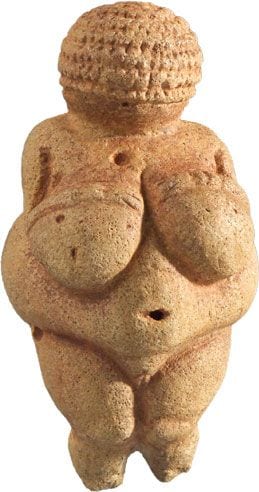
Let’s stick with religion for a bit. Today I find myself concerned with the origins, or maybe it’s the origin of religion. What is the font from which it springs? Or, what tributaries gather to make it what it is? Admittedly, to try to understand what it is, or what our most distant ancestors religious or spiritual views were, are, frankly, more than elusive. What happened, what folk thought before writing, what five thousand years ago, a tad more, can only be inferred by rapidly fading collections of artifacts as we trace back to mother Africa. But they are compelling. Like that Venus of Willendorf figurine, maybe thirty thousand years old. It evokes feelings. And thoughts flow from looking at it, like Pentecost fires. But beyond that atavistic feeling of ancient recollection, what?
I think of those ancient artifacts, and others, haunting evidences like ancient, ancient mountain trails used by our Neanderthal cousins as well as our direct ancestors. Trails that wind through mountains in ways that seem to include at some disadvantage to efficiency but allow enhanced views of distant beauty. There is a cave in Span with what appears to be a 40,000 years-old grave for a Neanderthal toddler. The grave site is surrounded by animal horns, including bison and red deer. Similar sites for homo sapiens with what appear to be intentional burials including grave goods and evidences of layers of flowers poured over the body that seem to range back at least fifty and maybe even a hundred thousand years.
This said as far back as we know with any certainty, religion and culture are profoundly entangled. Any attempt at pulling specifically religious perspectives out of the cultural matrix seems to date no later than during the European Reformation. And no one has ever succeeded in fully untangling religion from the rest of the mess of human lives in specific cultural contexts. In fact, from my perspective, one of the less pleasant aspects of religion is assuring cultural conformity. It sure seems true that religions have always been tied up with the transmission of culture, reinforcing the various ways in which people identify themselves and, critically, separate themselves from others. That us and them thing has from ancient times been religiously reinforced.
Much of what shapes what we usually think of as religion birthed at several places on the Eurasian continent in what is now called the Axial Age. It’s a term coined by the philosopher Karl Jaspers for a culturally fruitful time roughly between the eighth and third centuries before our common era. Jaspers identified the religions that birthed in Greece, Judea, Persia, India, and China all fulfilled that culturally reinforcing, essentially conservative and conserving task within their differing cultures.
Although, critically, with the birth of Buddhism, then a bit later Christianity, and lastly Islam, we find missionary religions. They no doubt carry with them cultural elements from their places of origin. Lots. But they mostly bring certain “big ideas” at their heart that are meant to be shared with the whole world. And with that the absolute connection between religion and given cultures would no longer be quite the same.
That partial untangling has allowed us to notice religion as something not necessarily part of preserving a specific culture. And it has opened the possibility for us to look at that part of what it means to be human that we call religious or spiritual. And, it turns out, from the beginning it’s been a mess. Speculation on what this might be from some sense of a universal energy, to ancestor worship, to scapegoats and sacrifices, to averting natural disasters, to guaranteeing the planet doesn’t simply spin into eternal darkness, to begin a list. The list of things that seem important in religions is very long. And, it doesn’t really add up. Frankly, I’ve found the Twentieth century Unitarian Universalist minister and theologian Forrest Church’s observation most helpful. “Religion is our human response to the dual reality of being alive and (knowing we will) die.”
I suggest when people speak of being spiritual but not religious, they are continuing our uniquely modern, or, maybe that’s post-modern, or, I have trouble keeping up with these things, perhaps it’s a post-post-modern stance of relentless untangling and examining of the parts in hope of understanding the whole. In this case they, okay, we are generally trying to jettison those aspects of religion concerned with preserving and transmitting culture, and most of all those unsavory parts defining who is in and who is out of the group. With that what we call spirituality emerges as a hopefully “purer” distillation at the heart of that matter. Although what that might be remains far from clear.
One can certainly question the degree to which we can extract ourselves from culture. Me, I suspect not a whole lot. But, like the scholar and religious historian Karen Armstrong suggests, I also believe we may indeed be in a new Axial Age, for me starting with the European Enlightenment enriched by a comparative religious sense, particularly arising out of our modern interreligious dialogue. It’s something where things have been taken apart sufficiently, and, surprisingly a new whole is emerging. Something totally unexpected. Like a new dawn, a world perspective. If you will a universalism. Not quite like the earliest forms of universalism, extending heaven to all. But, equally, maybe more deserving of the word universal. Of course, it is contending with those older views. And, in this moment, I certainly wouldn’t put money on what view will prevail. Personally, I can’t put money on our species surviving for a whole lot longer.
Still. Also. Out of all this, my personal stab at defining religion: Religion is that part of culture where our hopes and fears regarding life and death are expressed through stories and symbolic actions. And, I think the spiritual at the heart of it, the secret truth that floats through all religions, that universalist current sometimes held up, sometimes scorned and suppressed, but always present is a knowing that within all our diversity there is some mysterious unity. And, frankly, I think it is our only hope for survival as a species.
If there is a universalism emerging within a new Axial, it is this. Each thing as it arises, you, me, a rock, a star is precious and beautiful. And. It, that you, that me, that star arises out of a profoundly connected web of relationships. That web itself is simply the relationship of things, coming together, holding for a moment, falling away. But each thing as it presents is the universe itself. And, we human beings, blessed beyond all reason, get to notice this.
So, back to that mass in that little Episcopal chapel in West Cornwall, Connecticut, on the eastern side of the North American continent, on a small planet spinning around a middling star at the edge of one of a million million galaxies. As the service worked its way through the story of Jesus and his disciples gathered at their meal. Finally, the consecrated bread and wine were offered to all who were present. Me, I’ve been to many Episcopal services over the years. Episcopalians are without a doubt my favorite Christians. But, I never take communion. As lovely as that tradition is, I always felt just enough of a separation that partaking in that most intimate part of the service never felt appropriate. Not respectful. Not right.
This time was different. Maybe in some degree it was my relationship with the priest. But that hardly would be enough. Something else happened in that little stone chapel. I saw. I noticed. The whole universe was present. All the angels of Western faith and all the devas of the East were present and circling around that little altar that somehow became the navel of the cosmos. And without thinking about it, without worry about theology or proper decorum, without any concern but a longing to come ever closer to the moment of creation, I stepped into that small circle. And I received communion.
This is not the only time I’ve had such a sense of invitation. I can offer a number of examples. But, I’m a Zen teacher. So, when we retired and Jan and I returned home to Southern California a mutual friend made sure I met a local Japanese Zen priest, the Reverend Gyokei Yokoyama. He leads a Japanese-American congregation in Long Beach where he conducts services and preaches sermons and tends to the pastoral needs of the people he serves. As I noted mostly Japanese Americans. In addition to his ministerial duties he leads a Zen meditation group several mornings a week. Sadly, few in the congregation are interested in meditation. And his little group are mostly converts, mostly in the moment at least of European descent.
And. While I am responsible for my own Zen group, I love going to the morning sits he leads. I love it for a couple of reasons. One, I’m not in charge. I get to, as we say in the Zen way, just sit. And over these past couple of years I’ve come to love that early morning schedule. The way the light comes up from the darkness as we begin, the mix of smells, particularly the slight hint of mildew mixed with sandalwood incense that instantly returns me to my youth sitting at the old Berkeley Zendo where I first began my practice many, many years ago. It is delicious.
But, the main reason I’m doing this is that I have committed myself to trying to relearn the sacramental functions of a Soto Zen priest. I first learned them pushing on fifty years ago. But after my time in the monastery I ended up practicing with a koan teacher who was not a priest, and well, that part of my Zen life more or less fell away. In my dotage I’m on a path of integration and a part of that is more fully understanding the priestly part of my path.
I’ve found this in some ways just relearning to bow. Never a bad thing. Not a bad thing for any of us. And, so, Wednesday and Friday mornings, I at least figuratively put on the black robe of a novice priest, sit a bit, and then try to master the liturgical ropes presented by a kind and generous teacher.
One day, not long ago, I found myself standing near the altar as the sensei approached the altar. The form is closely prescribed. Every motion has a thousand years of practice behind it, within it, as it. He walked up with his hands folded at his chest, as he stepped to the altar itself, he put his hands together palm to palm. He picked up a waiting stick of incense and held it to his forehead, bowing slightly.
And, I realized in that moment as Gyokei offered that incense for the world it was the same moment as when Mary held up the chalice in an offering for the world. The truth has always been there.
Hidden in plain sight.
You want to know the origin of religion?
“To see a World in a Grain of Sand/And a Heaven in a Wild Flower/Hold Infinity in the palm of your hand.”
Just notice. Just be present. Just this. Just this.
The origin of religion.
Amen.
Next Post

February 14, 2019 And a Blessed Valentine's Day to You
Browse Our Archives
Select a Category A Christmas Carol Abolitionist African-American Ahmadiyya Alan Watts Aldous Huxley Allen Ginsberg Amedkar Jayanti American politics American Zen Anaheim Zen Sangha Anglican Annie Besant April Fool Armageddon Art and Religion artificial intellegence Atheist Awakening B R Ambedkar Barlaam & Josaphat Beatnik Between Bhagavad Gita Bible biography birthday bodhisattva Bodhisattva Precepts Book burning Book of Common Prayer Book of Mormon Brahmo Samaj Buddha Buddhism Buddhist Buddhist Lord's Prayer Butterflies Calendars cartoons cat ChatGPT Chicken Tortilla Soup choices Christian atheism Christian mysticism Christian origins Christian Science Christian Zen Christianity Christianity and Buddhism christmas Christmas Truce Christopher Isherwood Church of Later Day Saints Cinco de Mayo circus covenant critical thinking culture D. T. Suzuki Dalit Buddhism Daniel Defoe Desert Fathers and Mothers dharma talk Dogen Donald Trump Dongshan's Five Ranks Dorothy Day dream Duty Easter ecology Edwin Arnold emptiness Empty Moon Zen Network Episcopal Church Eternal Now Ethics evolution existentialism Faith fantasy Fathers Day film film review fire Five Ranks Folk music food Form and emptiness Four Seals Francis of Assisi Francis Xavier Free thinker friendship George MacDonald Gerald Heard Glenn Taylor Webb God Good Friday Gospel of Gospel of Mark Gospel of Thomas grace Graduate Theological Unioin Graduate Theological Union Guanyin H R Blyth Hakuin Ekaku Hanamatsuri Hanukkah Harada Yasutani Zen Heart Sutra Henry David Thoreau Hermann Hesse Hinduism History and Religion history of religion Holy Spirit home Hospitality Icon Ides of March Isaac Newton Islam Islamic mysticism Jack Kerouac James Luther Adams Jiddu Krishnamurti Joan of Arc Johannes Gutenberg John Donne joke Judaism justice karma kensho King James Bible koan Koun Yamada Kyoto School Lewis Carrol Liberal Christianity Liberal Religion Life Plan Community Liminal literature Literature and Religion Liturgy Lord's Prayer Love Mahatma Gandhi Mahayana Martin Luther King Jr Mary Baker Eddy Mary Magdelene Mary Oliver Mayflower Compact Meditation memories memory metaphor money money and religioin Mormons Mother's Day movie review mysticism mythic Neighborhood Unitarian Universalist Church New Thought Nichiren Buddhism Nonduality not knowing Omar Khayyam Pacific School of Religion pagan Palm Sunday Passover peace Pentecost perennialism Phantastes Philip Kapleau philosophy Pilgrimage poetry Poetry and Religion politics Prayer Precepts Printing Press prophecy prophetic spirituality psychology Pure Land Queer religion queering religion Quietism Ram Mohan Roy rebirth recipe Relationships and religion religion religion and history Religious syncretism Resistance Retirement Retreat review Rissho Kosei Kai Ritual Robert Aitken Roshi Robert Ingersoll Rohatsu Romani religion Rosie the Riveter saints samadhi SanboZen Sangha Satyagraha science science and reigion science and religion science fiction seminary sermon Sesshin Sex and Religion Shinran Sikh Sikh tradition silence Social Justice Socially Engaged Buddhism Society and religion Soto Zen soul spiritual community spiritual practice Spirituality Sufism Suicide superstition Taoism Television Teresa of Avila Thanksgiving theological schools Theosophy Thomas Merton Time Transcendentalism Transcendentalist Trinitarian Trinity Uncategorized unitarian Unitarian Christianity Unitarian Universalist Universalism Vajrayana Vedanta Walking war Willa Cather William Ellery Channing wisdom women and religion women in religion World Teacher Writing zazen Zen Zen Center Zen inspired retriement zen meditation Zen Precepts Zen women
Select a Month September 2026 August 2026 July 2026 June 2026 May 2026 April 2026 March 2026 February 2026 January 2026 December 2025 November 2025 October 2025 September 2025 August 2025 July 2025 June 2025 May 2025 April 2025 March 2025 February 2025 January 2025 December 2024 November 2024 October 2024 September 2024 August 2024 July 2024 June 2024 May 2024 April 2024 March 2024 February 2024 January 2024 December 2023 November 2023 October 2023 September 2023 August 2023 July 2023 June 2023 May 2023 April 2023 March 2023 February 2023 January 2023 December 2022 November 2022 October 2022 September 2022 August 2022 July 2022 June 2022 May 2022 April 2022 March 2022 February 2022 January 2022 December 2021 November 2021 October 2021 September 2021 August 2021 July 2021 June 2021 May 2021 April 2021 March 2021 February 2021 January 2021 December 2020 November 2020 October 2020 September 2020 August 2020 July 2020 June 2020 May 2020 April 2020 March 2020 February 2020 January 2020 December 2019 November 2019 October 2019 September 2019 August 2019 July 2019 June 2019 May 2019 April 2019 March 2019 February 2019 January 2019 December 2018 November 2018 October 2018 September 2018 August 2018 July 2018 June 2018 May 2018 April 2018 March 2018 February 2018 January 2018 December 2017 November 2017 October 2017 September 2017 August 2017 July 2017 June 2017 May 2017 April 2017 March 2017 February 2017 January 2017 December 2016 November 2016 October 2016 September 2016 August 2016 July 2016 June 2016 May 2016 April 2016 March 2016 February 2016 January 2016 December 2015 November 2015 October 2015 September 2015 August 2015 July 2015 June 2015 May 2015 April 2015 March 2015 February 2015 January 2015 December 2014 November 2014 October 2014 September 2014 August 2014 July 2014 June 2014 May 2014 April 2014 March 2014 February 2014 January 2014 December 2013 November 2013 October 2013 September 2013 August 2013 July 2013 June 2013 May 2013 April 2013 March 2013 February 2013 January 2013 December 2012 November 2012 October 2012 September 2012 August 2012 July 2012 June 2012 May 2012 April 2012 March 2012 February 2012 January 2012 December 2011 November 2011 October 2011 September 2011 August 2011 July 2011 June 2011 May 2011 April 2011 March 2011 February 2011 January 2011 December 2010 November 2010 October 2010 September 2010 August 2010 July 2010 June 2010 May 2010 April 2010 March 2010 February 2010 January 2010 December 2009 November 2009 October 2009 September 2009 August 2009 July 2009 June 2009 May 2009 April 2009 March 2009 February 2009 January 2009 December 2008 November 2008 October 2008 September 2008 August 2008 July 2008 June 2008 May 2008 April 2008 March 2008 February 2008 January 2008 December 2007 November 2007 October 2007 September 2007 August 2007 July 2007 June 2007 May 2007 April 2007 March 2007 February 2007 January 2007 December 2006 November 2006 October 2006 September 2006
Follow Us!
TAKE THE
Religious Wisdom Quiz
What does the Bible say about pride?
Select your answer to see how you score.
It is a virtue It always wins It is harmless It goes before a fall
Related posts from Monkey Mind

Keizan Jokin: The Zen Master Ancestor You Don't...

What Zen Practice Actually Does With Anger

Nanquan Cuts the Cat: A Jesuit commentary on...

On Taking Refuge in the Dharma
TRENDING AT PATHEOS Buddhist

The Dangers of Gradual Accommodation (Winking at Sin)
Recently, the “law of gradualness” resurfaced during the opening of a weeklong,...

The Iron Gates and the Lion of the...
Yesterday, I didn't finish my report about, well, yesterday. So I'll...

Dolly Parton’s Last Song Wins Dove Award with...
Bluegrass band The Grascals, speaking on the red carpet at the 57th...

The Image: On the Horror of Capitalism and...
The Image Then went the Pharisees, and took counsel how they might...

We are approaching the date of our new American national holiday: October...

Letters on Living the Faith by C.S. Lewis
Most of us met C.S. Lewis as a public intellectual. Mere Christianity....
view all Buddhist blogs
Ad-Free & Subscriber Log-In Subscription Support
- About Us
- 2026 Calendar
- Videos
- Podcasts
- Library of World Religions
- Faith In Media Tracker
- Advertise With Us
- Write for Us
- Privacy Policy
- Terms of Service
- Do Not Sell My Data
- Contact Us
- Radiant Digital
- Manage Newsletter Subscriptions
- Unsubscribe From Notifications
- Sitemap
Copyright 2008-2026, Patheos. All rights reserved.
Subscription Support Ad-Free & Subscriber Log-In
Follow Patheos