
BuddhistCatholicContemplativeEvangelicalGeneral ChristianHinduJewishLatter-day SaintMuslimNew VisionsProgressive Christian
Beliefs
- Buddhist
- Catholic
- Contemplative
- Evangelical
- General Christian
- Hindu
- Jewish
- Latter-day Saint
- More Voices
- Muslim
- New Visions
- Pagan
- Progressive Christian
Topics
- Religion News
- Food and Religion
- Sports and Religion
- Religious Art
- Religious Music and Entertainment
- Religious Events
- History and Religion
- Style and Religion
- Politics and Religion
- Women in Religion
- Recreation Outdoors and Religion
- Business Finance and Religion
- Careers Workplace and Religion
- Education and Religion
- Family Parenting and Religion
- Health Fitness and Religion
- Home and Religion
- Relationships and Religion
- Technology and Religion
- Travel and Religion
Columnists
- Buddhist Columnists
- Business Finance and Religion Columnists
- Careers Workplace and Religion Columnists
- Catholic Columnists
- Contemplative Columnists
- Education and Religion Columnists
- Evangelists Columnists
- Family Parenting and Religion Columnists
- General Christian Columnists
- Health Fitness and Religion Columnists
- Hindu Columnists
- History and Religion Columnists
- Home and Religion Columnists
- Jewish Columnists
- More Voices Columnists
- Latter Day Columnists
- Muslim Columnists
- New Visions Columnists
- Nonreligious Columnists
- Pagan Columnists
- Politics and Religion Columnists
- Progressive Columnists
- Recreation Outdoors and Religion Columnists
- Relationships and Religion Columnists
- Religion News Columnists
- Religious Art Columnists
- Religious Events Columnists
- Religious Music and Entertainment Columnists
- Sports and Religion Columnists
- Style and Religion Columnists
- Technology and Religion Columnists
- Travel and Religion Columnists
- Women in Religion Columnists
Resource Library
- 2026 Calendar
- Library of World Religions
- The 100 Most Holy Places on Earth
- Patheos Answers
- Podcasts
- Videos
- Faith Leaders Database
- Anglican Episcopalian
- Bahai
- Baptist
- Buddhism
- Christianity
- Confucianism
- Eastern Orthodoxy
- Hinduism
- Holiness and Pentecostal
- ISKCON
- Islam
- Judaism
- Lutheran
- Methodist
- The Church of Jesus Christ of Latter-day Saints
- New Age
- Paganism
- Presbytarian and Reformed
- Protestantism
- Religion Behind the Scenes
- Roman Catholic
- Scientology
- Shia Islam
- Sikhism
- Sufism
- Sunni Islam
- Taoism
- Zen
- See all religions
Research Tools
 Ad-Free & Subscriber Log-In Subscription Support
Ad-Free & Subscriber Log-In Subscription Support
Follow Patheos 

- Trending:
- Forgiveness
- |
- Marriage
- |
- Consciousness
- |
- Death Penalty
- |
- Election
- |
- Halloween

- Home
- Buddhist
- Walking the Path of Not Knowing: Reflecting on Thomas Merton, a Saint for Our Times
Walking the Path of Not Knowing: Reflecting on Thomas Merton, a Saint for Our Times
Last updated on: December 10, 2018 at 12:54 pm by James Ford
Walking the Path of Not Knowing: Reflecting on Thomas Merton, a Saint for Our Times 2018-12-10T12:54:08-08:00 James Ford
Patheos Explore the world's faith through different perspectives on religion and spirituality! Patheos has the views of the prevalent religions and spiritualities of the world.
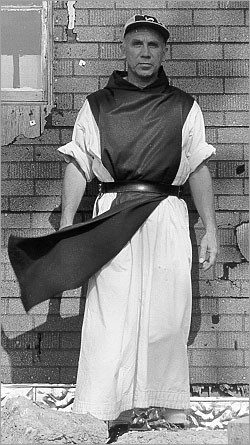
Thomas Merton, Catholic Trappist monk, memoirist, essayist, activist, and mystic, died on this day in 1968.
He was participating at an interfaith monastic conference in Bangkok, Thailand. It appears he touched a faulty floor fan and it sparked a heart attack. By coincidence it was the twenty-seventh anniversary of his entrance into Gethsemane Abbey, a rural Trappists monastery not far outside of Louisville, Kentucky.
And. Today is the fiftieth anniversary of his death. To my mind, to my heart, a worthy moment to reflect on this remarkable man and his ministry.
Thomas Merton is probably most widely known as the author of the best selling spiritual memoir Seven Storey Mountain. However this book was followed by many others, and ironically, the cloistered Merton ended up enthralling two generations of spiritual seekers. And counting…
Also, his influence would extend well beyond his church. In 1937, early on in the formation of his spiritual life, and well before his anchoring his quest within Catholic monasticism, he read Aldous Huxley’s Ends and Means. This led to a life-long interest in Eastern religions, particularly Islamic Sufism, Hinduism, and Buddhism. He would not only read in these traditions but he engaged in long correspondences with practitioners, monastics, teachers, priests, and scholars in these traditions.
The Wikipedia article on Merton tells us he “was perhaps most interested in—and, of all of the Eastern traditions, wrote the most about—Zen. Having studied the Desert Fathers and other Christian mystics as part of his monastic vocation, Merton had a deep understanding of what it was those men sought and experienced in their seeking. He found many parallels between the language of these Christian mystics and the language of Zen philosophy.”
This would prove very important to me. Continuing the article, “In 1959, Merton began a dialogue with D. T. Suzuki which was published in Merton’s Zen and the Birds of Appetite as “Wisdom in Emptiness”. This dialogue began with the completion of Merton’s The Wisdom of the Desert. Merton sent a copy to Suzuki with the hope that he would comment on Merton’s view that the Desert Fathers and the early Zen masters had similar experiences.
“Nearly ten years later, when Zen and the Birds of Appetite was published, Merton wrote in his postface that “any attempt to handle Zen in theological language is bound to miss the point”, calling his final statements “an example of how not to approach Zen.” Merton struggled to reconcile the Western and Christian impulse to catalog and put into words every experience with the ideas of Christian apophatic theology and the unspeakable nature of the Zen experience.”
Because of this broad and sympathetic interest in the world’s mystical traditions and especially his take on Zen, and with that the enormous popularity of his writings, some would opine that his death was not accidental. I personally do not find that particularly plausible. But, it is repeated, and needs to be noted, if only in passing.
As I noted Thomas Merton touched many questing hearts. And, he certainly put a permanent mark on my spiritual life. I’ve read much of his ovure, and consider him among the foremost of those teachers I’ve had who I knew only through their writings.
In 2013 the Unitarian Universalist General Assembly was held in Louisville. For me it was something of a Merton pilgrimage. First, downtown there’s a marker, the only state sanctioned marker I’ve ever encountered that notes someone’s spiritual awakening, in my spirituality, kensho. Merton’s full account speaks to the moment that transformed his heart, and in its flowering influenced so many, including, again, me.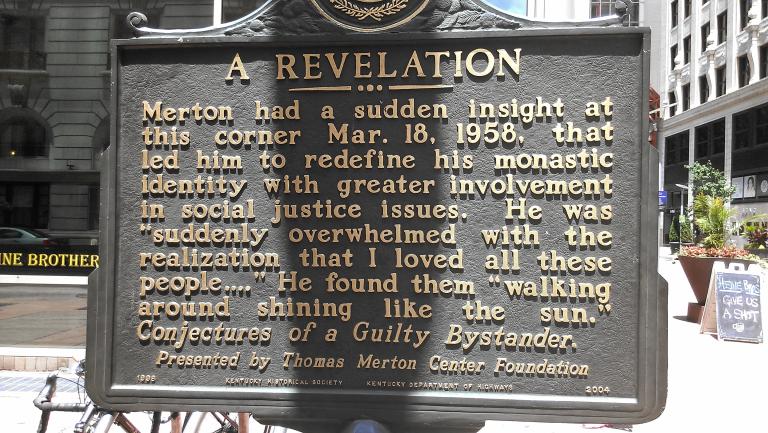
“In Louisville, at the corner of Fourth and Walnut, in the center of the shopping district, I was suddenly overwhelmed with the realization that I loved all those people, that they were mine and I theirs, that we could not be alien to one another even though we were total strangers.
“It was like waking from a dream of separateness, of spurious self-isolation in a special world, the world of renunciation and supposed holiness. The whole illusion of a separate holy existence is a dream.…This sense of liberation from an illusory difference was such a relief and such a joy to me that I almost laughed out loud. And I suppose my happiness could have taken form in the words: ‘Thank God, thank God that I am like other men, that I am only a man among others.’
“It is a glorious destiny to be a member of the human race, though it is a race dedicated to many absurdities and one which makes many terrible mistakes: …A member of the human race! To think that such a commonplace realization should suddenly seem like news that one holds the winning ticket in a cosmic sweepstake. And if only everybody could realize this! But it cannot be explained.
“There is no way of telling people that they are all walking around shining like the sun. They are not ‘they’ but my own self. There are no strangers! Then it was as if I suddenly saw the secret beauty of their hearts, the depths of their hearts where neither sin nor desire nor self-knowledge can reach, the core of their reality. If only they could all see themselves as they really are. If only we could see each other that way all the time. There would be no more war, no more hatred, no more cruelty, no more greed…I suppose the big problem would be that we would fall down and worship each other.”
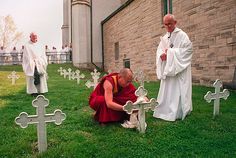
He proceeded to live his life out of that moment. An example for us all. Later during that week in Louisville my colleague and friend Erik Wikstrom and I drove out to the monastery, where we laid flowers on Fr Merton’s grave. He deserves to be remembered.
His teachings were multiple, and I especially felt informed by his versions of the Daoist master Zhuang Zhou. And while not agreeing with everything he said, I loved Zen and the Birds of Appetite and Mystics and Zen Masters. But for me the most important of his teachings are presented within the small book The Wisdom of the Desert.
The curation was carefully designed to emphasize those areas of possible compatibility with Zen Buddhism. Later reading more comprehensive collections such as Benedicta Ward’s magisterial Apophthegmata Patrum, the Sayings of the Desert Fathers, or even Helen Waddell’s more introductory The Desert Fathers, reveals a fascinating, wildly diverse, and even compelling version of an ascetic Christianity.
And, yes, within that wildness there are moments that look quite “Zen.” Merton, from his unique perspective as a deeply committed Christian monastic, but also one with a genuine opening of the heart that was not capturable by a single tradition, he could present a Zen-like take on this ancient ascetics and give a text book of the spiritual life for us today. Maybe, in fact, something a bit more than Zen-like.
For instance, in Father Merton’s version.
Some elders once came to Abbot Anthony, and there was with them also Abbot Joseph. Wishing to test them, Abbot Anthony brought the conversation around to the Holy Scriptures. And he began from the youngest to ask them the meaning of this or that text. Each one replied as best he could, but Abbot Anthony said to them: You have not got it yet. After them all he asked Abbot Joseph: What about you? What do you say this text means? Abbot Joseph replied: I know not! Then Abbot Anthony said: Truly Abbot Joseph alone has found the way, for he replies that he knows not.
In addition to the questions of curation, I am also aware of the dangers of seeking meaning for one’s own spiritual way in the utterances of someone on another way. But, my goodness, sometimes. Sometimes.
When asked what is Zen, the Korean Zen master Seung Sahn said, “Only don’t know.” This is the great secret of Zen spirituality. And, frankly, the secret gateway for us all. And so we find this message collected as case twenty in the Book of Serenity.
Dizang asked Fayen, “Where are you going?” Fayen replied, “I am wandering about aimlessly.” Dizang asked, “So, what do you think of this wandering about?” Fayan said, “I don’t know.” Dizang replied, “Not knowing is most intimate.”
It doesn’t really matter for our purposes who the players in this story are, although I find it interesting that they’re real historical people. Still, we can, and I believe it very helpful, to think of them as the part of our minds that believes it is in control and the part that knows better. “How are you doing?” I can ask myself. “Oh, wandering about,” I might reply. Particularly, right now. Interestingly, some versions of the text say “wandering about on pilgrimage.” Others, however, say “wandering about aimlessly.” These days, wrapped in not knowing, I prefer the second. Then pushed to respond to how I feel about this, I really, really understand that line “I don’t know.”

And, Christians get it. (Yes, not all Christians. The same can be said about many Buddhists…) We got it in that saying from the Desert Fathers. And, here’s something important. Thomas Merton wasn’t inventing anything. He was just pointing. So, as a passing example here’s another Christian text that also points in this direction. The more common version for the title is the Cloud of Unknowing. It could just as easily, just as accurately be titled the Cloud of Not Knowing.
Not knowing. Only don’t know. The cloud of unknowing.
In my own experience, it means that while I like to plan and analyze, sometimes, sometimes in the most important places, I have to surrender my dreams of control, and let what is, be. For me it means shifting a bit, and letting my body guide me, rather more than my head. Right now, living within the bow, within the not knowing, I discover things.
So, I just cannot say how important Thomas Merton was for me as I’ve walked my own spiritual path. There is no doubt in my heart that the leading current for me is Zen Buddhism, and more specifically within the Soto school of Zen as articulated most clearly by Eihei Dogen and the Soto reformed Zen koan curriculum system of spiritual training begun by Daiun Sogaku Harada. But, finding the currents of truth within my natal spiritual tradition has also been a life long interest. Christianity and Buddhism. Each currents of my life. And, nowhere else, have I found it all brought together as helpfully, as healthfully, as in Thomas Merton’s teachings.
He presents us with a field of dreams. The dreams of our not knowing. My dreams hint at things, and I need to notice. My body’s aches and joys tell me things, and I need to notice. Chance encounters and fragments of conversation take on new and luminescent qualities, and I need to notice. Here the water bubbling up out of the well reveals itself, flowing freely, informing, nurturing, opening new ways. It’s something glorious, as well, of course, as unsettling, and occasionally even frightening.
Not knowing. Only don’t know. That cloud of unknowing. Just as Thomas Merton taught.
This not knowing is most intimate. Beyond East and West. Found both in East and West. It reveals who I really am, it loosens my sense of boundaries, shakes off stories of control and certainty, and, and in all that; reveals a wide and wild world as my true home.
Just as Thomas Merton taught. His life and the many blessings of that life deserves celebrating. I’m so glad to know those lovely people in the American Episcopal church observe today formally as a feast in his honor.
And, today, on the fiftieth anniversary of that feast, I pray prays of gratitude.
Previous Post

December 4, 2018
Reflecting (Again) on Zen, Buddhism, Perennialism & Universalism
Next Post
December 11, 2018 Empty Moon Zen's First Rohatsu
Browse Our Archives
Select a Category A Christmas Carol Abolitionist African-American Ahmadiyya Alan Watts Aldous Huxley Allen Ginsberg Amedkar Jayanti American politics American Zen Anaheim Zen Sangha Anglican Annie Besant April Fool Armageddon Art and Religion artificial intellegence Atheist Awakening B R Ambedkar Barlaam & Josaphat Beatnik Between Bhagavad Gita Bible biography birthday bodhisattva Bodhisattva Precepts Book burning Book of Common Prayer Book of Mormon Brahmo Samaj Buddha Buddhism Buddhist Buddhist Lord's Prayer Butterflies Calendars cartoons cat ChatGPT Chicken Tortilla Soup choices Christian atheism Christian mysticism Christian origins Christian Science Christian Zen Christianity Christianity and Buddhism christmas Christmas Truce Christopher Isherwood Church of Later Day Saints Cinco de Mayo circus covenant critical thinking culture D. T. Suzuki Dalit Buddhism Daniel Defoe Desert Fathers and Mothers dharma talk Dogen Donald Trump Dongshan's Five Ranks Dorothy Day dream Duty Easter ecology Edwin Arnold emptiness Empty Moon Zen Network Episcopal Church Eternal Now Ethics evolution existentialism Faith fantasy Fathers Day film film review fire Five Ranks Folk music food Form and emptiness Four Seals Francis of Assisi Francis Xavier Free thinker friendship George MacDonald Gerald Heard Glenn Taylor Webb God Good Friday Gospel of Gospel of Mark Gospel of Thomas grace Graduate Theological Unioin Graduate Theological Union Guanyin H R Blyth Hakuin Ekaku Hanamatsuri Hanukkah Harada Yasutani Zen Heart Sutra Henry David Thoreau Hermann Hesse Hinduism History and Religion history of religion Holy Spirit home Hospitality Icon Ides of March Isaac Newton Islam Islamic mysticism Jack Kerouac James Luther Adams Jiddu Krishnamurti Joan of Arc Johannes Gutenberg John Donne joke Judaism justice karma kensho King James Bible koan Koun Yamada Kyoto School Lewis Carrol Liberal Christianity Liberal Religion Life Plan Community Liminal literature Literature and Religion Liturgy Lord's Prayer Love Mahatma Gandhi Mahayana Martin Luther King Jr Mary Baker Eddy Mary Magdelene Mary Oliver Mayflower Compact Meditation memories memory metaphor money money and religioin Mormons Mother's Day movie review mysticism mythic Neighborhood Unitarian Universalist Church New Thought Nichiren Buddhism Nonduality not knowing Omar Khayyam Pacific School of Religion pagan Palm Sunday Passover peace Pentecost perennialism Phantastes Philip Kapleau philosophy Pilgrimage poetry Poetry and Religion politics Prayer Precepts Printing Press prophecy prophetic spirituality psychology Pure Land Queer religion queering religion Quietism Ram Mohan Roy rebirth recipe Relationships and religion religion religion and history Religious syncretism Resistance Retirement Retreat review Rissho Kosei Kai Ritual Robert Aitken Roshi Robert Ingersoll Rohatsu Romani religion Rosie the Riveter saints samadhi SanboZen Sangha Satyagraha science science and reigion science and religion science fiction seminary sermon Sesshin Sex and Religion Shinran Sikh Sikh tradition silence Social Justice Socially Engaged Buddhism Society and religion Soto Zen soul spiritual community spiritual practice Spirituality Sufism Suicide superstition Taoism Television Teresa of Avila Thanksgiving theological schools Theosophy Thomas Merton Time Transcendentalism Transcendentalist Trinitarian Trinity Uncategorized unitarian Unitarian Christianity Unitarian Universalist Universalism Vajrayana Vedanta Walking war Willa Cather William Ellery Channing wisdom women and religion women in religion World Teacher Writing zazen Zen Zen Center Zen inspired retriement zen meditation Zen Precepts Zen women
Select a Month September 2026 August 2026 July 2026 June 2026 May 2026 April 2026 March 2026 February 2026 January 2026 December 2025 November 2025 October 2025 September 2025 August 2025 July 2025 June 2025 May 2025 April 2025 March 2025 February 2025 January 2025 December 2024 November 2024 October 2024 September 2024 August 2024 July 2024 June 2024 May 2024 April 2024 March 2024 February 2024 January 2024 December 2023 November 2023 October 2023 September 2023 August 2023 July 2023 June 2023 May 2023 April 2023 March 2023 February 2023 January 2023 December 2022 November 2022 October 2022 September 2022 August 2022 July 2022 June 2022 May 2022 April 2022 March 2022 February 2022 January 2022 December 2021 November 2021 October 2021 September 2021 August 2021 July 2021 June 2021 May 2021 April 2021 March 2021 February 2021 January 2021 December 2020 November 2020 October 2020 September 2020 August 2020 July 2020 June 2020 May 2020 April 2020 March 2020 February 2020 January 2020 December 2019 November 2019 October 2019 September 2019 August 2019 July 2019 June 2019 May 2019 April 2019 March 2019 February 2019 January 2019 December 2018 November 2018 October 2018 September 2018 August 2018 July 2018 June 2018 May 2018 April 2018 March 2018 February 2018 January 2018 December 2017 November 2017 October 2017 September 2017 August 2017 July 2017 June 2017 May 2017 April 2017 March 2017 February 2017 January 2017 December 2016 November 2016 October 2016 September 2016 August 2016 July 2016 June 2016 May 2016 April 2016 March 2016 February 2016 January 2016 December 2015 November 2015 October 2015 September 2015 August 2015 July 2015 June 2015 May 2015 April 2015 March 2015 February 2015 January 2015 December 2014 November 2014 October 2014 September 2014 August 2014 July 2014 June 2014 May 2014 April 2014 March 2014 February 2014 January 2014 December 2013 November 2013 October 2013 September 2013 August 2013 July 2013 June 2013 May 2013 April 2013 March 2013 February 2013 January 2013 December 2012 November 2012 October 2012 September 2012 August 2012 July 2012 June 2012 May 2012 April 2012 March 2012 February 2012 January 2012 December 2011 November 2011 October 2011 September 2011 August 2011 July 2011 June 2011 May 2011 April 2011 March 2011 February 2011 January 2011 December 2010 November 2010 October 2010 September 2010 August 2010 July 2010 June 2010 May 2010 April 2010 March 2010 February 2010 January 2010 December 2009 November 2009 October 2009 September 2009 August 2009 July 2009 June 2009 May 2009 April 2009 March 2009 February 2009 January 2009 December 2008 November 2008 October 2008 September 2008 August 2008 July 2008 June 2008 May 2008 April 2008 March 2008 February 2008 January 2008 December 2007 November 2007 October 2007 September 2007 August 2007 July 2007 June 2007 May 2007 April 2007 March 2007 February 2007 January 2007 December 2006 November 2006 October 2006 September 2006
Follow Us!
TAKE THE
Religious Wisdom Quiz
What does the Greek word 'Christos' mean?
Select your answer to see how you score.
Anointed One Lord Redeemer Savior
Related posts from Monkey Mind

Keizan Jokin: The Zen Master Ancestor You Don't...

What Zen Practice Actually Does With Anger

Nanquan Cuts the Cat: A Jesuit commentary on...

On Taking Refuge in the Dharma
TRENDING AT PATHEOS Buddhist

Methodist Central Hall and Westminster Abbey
Situated on the same square is Methodist Central Hall and Westminster Abbey. ...

57th Dove Awards Honor Dolly Parton, Crown New...
On gospel music’s biggest night, the 57th annual GMA Dove Awards honored...

The First Eucharistic Controversy: Christ’s Real Presence
For Catholics, the Eucharist is the source and summit of the Christian...

What a Stop Sign Can Teach Us About...
How to Make a Decision When You Can't Hear God Main point:...

Archdiocese Hosts Military Marriage Retreat in Germany
RASTATT, Germany — The transient military lifestyle, with its frequent deployments and...

Nearly every morning, I make the drive to Detroit with my high-school-age...
view all Buddhist blogs
Ad-Free & Subscriber Log-In Subscription Support
- About Us
- 2026 Calendar
- Videos
- Podcasts
- Library of World Religions
- Faith In Media Tracker
- Advertise With Us
- Write for Us
- Privacy Policy
- Terms of Service
- Do Not Sell My Data
- Contact Us
- Radiant Digital
- Manage Newsletter Subscriptions
- Unsubscribe From Notifications
- Sitemap
Copyright 2008-2026, Patheos. All rights reserved.
Subscription Support Ad-Free & Subscriber Log-In
Follow Patheos