
BuddhistCatholicContemplativeEvangelicalGeneral ChristianHinduJewishLatter-day SaintMuslimNew VisionsProgressive Christian
Beliefs
- Buddhist
- Catholic
- Contemplative
- Evangelical
- General Christian
- Hindu
- Jewish
- Latter-day Saint
- More Voices
- Muslim
- New Visions
- Pagan
- Progressive Christian
Topics
- Religion News
- Food and Religion
- Sports and Religion
- Religious Art
- Religious Music and Entertainment
- Religious Events
- History and Religion
- Style and Religion
- Politics and Religion
- Women in Religion
- Recreation Outdoors and Religion
- Business Finance and Religion
- Careers Workplace and Religion
- Education and Religion
- Family Parenting and Religion
- Health Fitness and Religion
- Home and Religion
- Relationships and Religion
- Technology and Religion
- Travel and Religion
Columnists
- Buddhist Columnists
- Business Finance and Religion Columnists
- Careers Workplace and Religion Columnists
- Catholic Columnists
- Contemplative Columnists
- Education and Religion Columnists
- Evangelists Columnists
- Family Parenting and Religion Columnists
- General Christian Columnists
- Health Fitness and Religion Columnists
- Hindu Columnists
- History and Religion Columnists
- Home and Religion Columnists
- Jewish Columnists
- More Voices Columnists
- Latter Day Columnists
- Muslim Columnists
- New Visions Columnists
- Nonreligious Columnists
- Pagan Columnists
- Politics and Religion Columnists
- Progressive Columnists
- Recreation Outdoors and Religion Columnists
- Relationships and Religion Columnists
- Religion News Columnists
- Religious Art Columnists
- Religious Events Columnists
- Religious Music and Entertainment Columnists
- Sports and Religion Columnists
- Style and Religion Columnists
- Technology and Religion Columnists
- Travel and Religion Columnists
- Women in Religion Columnists
Resource Library
- 2026 Calendar
- Library of World Religions
- The 100 Most Holy Places on Earth
- Patheos Answers
- Podcasts
- Videos
- Faith Leaders Database
- Anglican Episcopalian
- Bahai
- Baptist
- Buddhism
- Christianity
- Confucianism
- Eastern Orthodoxy
- Hinduism
- Holiness and Pentecostal
- ISKCON
- Islam
- Judaism
- Lutheran
- Methodist
- The Church of Jesus Christ of Latter-day Saints
- New Age
- Paganism
- Presbytarian and Reformed
- Protestantism
- Religion Behind the Scenes
- Roman Catholic
- Scientology
- Shia Islam
- Sikhism
- Sufism
- Sunni Islam
- Taoism
- Zen
- See all religions
Research Tools
 Ad-Free & Subscriber Log-In Subscription Support
Ad-Free & Subscriber Log-In Subscription Support
Follow Patheos 

- Trending:
- Forgiveness
- |
- Marriage
- |
- Consciousness
- |
- Death Penalty
- |
- Election
- |
- Halloween

- Home
- Buddhist
- God, an Ox, and Its Tail: Reflecting on a Zen Koan
God, an Ox, and Its Tail: Reflecting on a Zen Koan
Last updated on: December 17, 2018 at 10:06 am by James Ford
God, an Ox, and Its Tail: Reflecting on a Zen Koan 2018-12-17T10:06:21-08:00 James Ford
Patheos Explore the world's faith through different perspectives on religion and spirituality! Patheos has the views of the prevalent religions and spiritualities of the world.
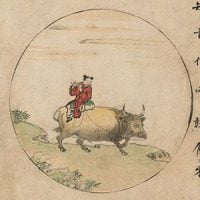
“It is like an Ox that passes through a latticed window. Its head, horns, and four legs all pass through. So, why can’t its tail also pass through?”
Gateless Gate, Case 38
I’m not sure where I first heard the line “If you scratch an Asian Christian, underneath you will find a Buddhist; if you scratch a western Buddhist you will find a Christian.” So, I did a simple google search trying to find the source for it. The only reference I could find was from a Kwan Um Zen teacher the Western born monk Dae Kwang Sunim. He suggested it was something of a commonplace in Korea.
However common a saying it might be or not, at the time I heard it, it really annoyed me. I felt that somehow it was belittling my commitment to my found tradition. And, yet, it has crept into my subconscious and continue to pop up every now and again. Today I find myself thinking about the great clash of East and West as it resides in my heart.
For me the Buddhist analysis, certainly as it is presented within contemporary Zen Buddhism is the clearest of all explanations for the shape our of our human condition. This is captured in two ancient doctrines: the three marks of existence, and the two truths.
The three marks of existence are central. First, everything is impermanent, the technical term is anicca. I find this self-evident. Second, there is no special substance to any thing, the technical term is anatta. Not so immediately obvious to people considering the animating principles of our being, that sense of an “I.” But, with close examination, it becomes obvious a permanent and abiding self is pretty elusive. And, it is an axiomatic assertion of Buddhism that there is no abiding self. And then with, the third assertion: that that this flux of rising and falling is experienced as dis-ease. The technical term is dukkha. I’ve seen this experience also translated as suffering, longing, and angst. It is our normative human state.
And, just as important, certainly to our healing the great hurt is, are the two truths of the relative and the absolute worlds. Classically the relative is the phenomenal world, while the absolute is the “higher” truth of emptiness – that lack of abiding substance within the play of causality. There is an inclination to valorize the empty, to give it the substance that is lacking in things. I’ve seen this emptiness being described as God. I’ve used that language myself, and will be returning to this point in a moment.
I think these assertions are true. And I meet them as a born and bred child of the West, an heir to classical thought and particularly rationalism and humanism. And, about equally, as an heir to the Christian traditions, stories, and myths. Culture clash. And, it makes me wonder how I am experiencing these truths in my own life.
This why I sometimes speak of my physiology of faith (the idea lifted from an anecdote regarding the immortal Erasmus of Rotterdam). I claim a Buddhist brain and a Christian heart. I think Buddhism, but I dream Christianity. Oh, there’s a third bit, as well, my rationalist stomach. Which, perhaps leads to this small reflection…
And with that back to the great clash of civilizations, or more properly the great encounters of the world’s traditions. We get no better example of such clashes writ large and what can happen as when Buddhism arrived in China from India. Two ancient cultures with assumptions and languages carrying their own hidden assumptions met. For the Chinese mostly through merchants and books, as well as with the odd missionary.
Then things happened. Small things and large would happen. For one, what was for the most part a tradition of wandering monks would become settled monastics, with only limited wandering about. Another, and among the more notable for those of us who practice Zen, was the Chinese question, “who are your parents?” Through a long winding road this would lead to first the myth and then the fact of dharma transmission and lineage.
And. For Buddhism in China using indigenous spiritual terms with near meanings would be used for ease of communication, and as with Dao to say Dharma, would subtly shift the meanings. And with that as Dharma becomes Dao a rather richer term emerges informed not only by Buddhist but by Daoism and subtly a host of Chinese understandings about the nature of the world.
Here in the West and in modernity writ large we are seeing new shifts of use.
Some of this is ecclesiastical and practical. So, in trying to understand the rise of the unique ordination model of Japanese Buddhism which is “neither monastic nor lay,” I found the easiest way of understanding it was by a comparison with the relationship between Roman Catholicism and Anglicanism. Where the older tradition disdains the newer, and the newer takes the needs of a particular time and place and by its own lights provides a faithful reinterpretation. And, no doubt, to my observation, something complicated and rich emerges.
The examples, possible and obvious, for this sort of thing are probably near endless.
But, here, today, I find myself thinking about is how often I see Western Zen Buddhists use the word “God.” I think I can make a categorical assertion that all Zen Buddhists in the West reject the idea of a divinity with a human-like consciousness that intervenes in the doings of history. But, while that’s the most common understanding its not the only way God is understood in the West.
A few years back science writer and blogger Razib Khan wrote about the famous Pew Religious Landscape Survey, noticing the majority of Western Buddhists seemed to believe in God. I generally didn’t credit this as much as I might otherwise have, as the survey suggested only seventy-three percent of self-described atheists didn’t believe in God. I suspected there’s a methodological problem here, perhaps in how the question was phrased.
However, a year after that survey Khan offered another reflection, based on a World Values Survey, suggesting that the majority of world Buddhists may believe in God. Culture clashes? Definitional problems? Or? Again, I wonder about methodology. But, I am beginning to suspect that perhaps some significant number, perhaps the majority of self-described Buddhists at least here in the West do indeed have some sense of a deity.
So, what is this Buddhist God?
I have in my library a small collection of Buddhist polemics denouncing the Western ideas of God. Probably the biggest objection is how outsiders really see the projection of human ego on the sky in the most popular portrayals of deity. And there are corners of the inter webs where these polemics are repeated with considerable volume. Many Buddhists have serious problems with this idea of the big human.
In Asia I suspect the God they’re speaking of is a collapsing into something bit more Tien, the Chinese heavenly realm than the all powerful God of the West. And while the prayers addressed to heaven often are petitions, the whole thing is messier than a simple adaptation of the Abrahamic deity.
Still, increasingly, Buddhists here in the West find themselves using the word God. Mostly, as a stand in for sunyata, the great empty, the boundless. Offering my own variation on this, when I was in seminary, and so much smarter than I am today, I was asked what I thought that word God meant? I replied that God is a hole in the language into which we throw all our hopes and fears. To which one of my friends replied, Oh yes. God is a whole in the language into which we throw all our hopes and fears. The great empty is empty. But, it is also a cornucopia from which all things arise. At least from one angle.
There is in fact quite a solid precedent within Western religious thinking for God as the great empty. The apophatic mystics come immediately to mind. And also, in the Christian scriptures that mysterious term kenosis.
As to the Buddhist party of the equation. I was reading Stephen Batchelor’s controversial and wonderful After Buddhism when I came across this line. It’s repeated in both the Udana and the Itivuttaka texts from the Khuddaka Nikaya, translated by Maurice Walshe, slightly modified here.
There is, monks, an unborn, unbecome, unmade, uncompounded. If there were not this unborn… then there would be no deliverance here visible form what is born, become, made, compounded. But sincere there is an unborn, unbecome, unade, uncompounded, therefore a deliverance is visible for what is born, become, made compounded.
Here we get the closest Buddhist scriptures ever come to describing what in Hinduism is called Atman and in the West is called God. For the West this passage from the Pali scriptures is perhaps not all that close.
Except, for each, maybe among some of the mystics.
So, there’s stuff going on. And, maybe, always has been. Of course, the big question is what does this mean in our actual lived lives?
For me it’s a bit like that passage near the end of the book of Job. A silence and a whirlwind. And then it is here I find myself thinking of the Gateless Gate, that Twelfth century anthology of koans, and particularly the 38th case.
“It is like an Ox that passes through a latticed window. Its head, horns, and four legs all pass through. So, why can’t its tail also pass through?”
The editor of the book Wumen throws in the briefest of sermons. My profession for a quarter century has been preaching sermons. There are few I’ve spoken or heard as useful to healing the hurt of human hearts as this one. “If you can get upside down with this one, discern it clearly, and give a turning word to it, then you can meet the Four Obligations above and give comfort to the Three Existences below. But if it is not yet clear, pay close attention to this tail and you will resolve it at last.”
Our four obligations are to our family, to our community, to all beings and to the great way. The three existences are past, present and future. So, finding the upside down and penetrating to its deepest core heals the whole world right to the depths of deepest time. And, then, together with that assertion we are invited to pay attention to the tail in this metaphor of an ox escaping through a window.
So, what is the Ox? And what about that tail? Perhaps the greatest of all koan masters, Hakuin Ekaku, ruminating in the Eighteenth century suggested this particular koan was one of the thorniest, one of most difficult of them all. Now, from the inside of koan work, this isn’t strictly true. To give an acceptable response for this case to a teacher of koan Zen is in fact pretty straightforward. And. To understand it down to the bottoms of our feet, all the way down, to find it penetrate through blood, bone and marrow; that is the hard part.
And with that, back to that koan about the Ox and its tail. I think it offers the great mess that allows us our cultural assumptions, allows us vulnerability to not be trapped by them, and invites us into a great mystery.
The question is put to us by the master Wuzu Fayan. I love him. He’s one of those trickster figures about whom we never know quite enough, but he keeps popping up in our lives. Wuzu means “Fifth Ancestor,” but he isn’t the fifth ancestor, who is Huineng. This Wuzu lived through the last three quarters of the eleventh century, dying just at the beginning of the twelfth.
For me he is particularly interesting because the driving question, the heart koan of his life came out of a conversation with a Sutra master whom he asked about awakening, and was told “it is like drinking water and knowing for oneself whether it is warm or cold.” Wanting to know that taste for himself, he launched into the great way. I’ve used that line over and over as the great invitation of the Zen way – to know for our selves, for your self, for my self, what is and what is not.
At least so far as the great matters of the heart are concerned, the questions that tumble out of us and our knowing we are born and we shall die. After Wuzu resolved the question for himself he went on to teach. One of his students was Yuanwu the editor of the Blue Cliff Record, and a few generations later in his line we are given Wumen, the editor of the Gateless Gate.
Clearly in this koan we are given a metaphor. And the metaphor turns on the Ox and the Ox’s tail. It’s fair to suggest this Ox is the same Ox used in that wondrous map of the way of awakening called the Ten Oxherding pictures. According to my teacher’s teacher this Ox “pulls the plow through the mud of the rice fields and enriches them with its manure. Its power and placid disposition give it a place in the Buddhist pantheon with (Manjushri’s) lion and (Samantabhadra’s) elephant.” In the Oxherding pictures it represents our Buddha nature.
And God? The God within and the God beyond? The kenotic God? Maybe. With a lot of emphasis on the vulnerability of maybe. And it’s power. Here we encounter ourselves encountering life and death and the most profound of mysteries, what is our source, our destiny, and our lives in between?
Buddha nature. So, what is this Buddha nature we’re supposed to know so intimately it is like having come to sip that water, and knowing for ourselves whether warm or cool? First, there’s what we know with our senses. Here is the flow of cause and effect, where we are woven out of many things, and we ourselves by our actions and intentions add new strands to the great web. It is real. Pinch yourself, and you’ll know it is so.
God is a great mystery. God is a placeholder for our hopes and fears. God is the great other. God is a black hole. God is the great emptying. Is it birthed in the West? In the East? Is it the great culture clash? Or? God. God. The Ox. And, its tail.
What about that tail?
Here we also can come back to the Buddha’s assertion of no self, no essence, and at the same time telling stories of lifetime after lifetime that certainly looks like something with an essence. What I find in this is how that emptiness that is as much a part of anything as the thing of it is experienced in our lived lives. We experience emptiness as something.
On my way it has had three manifestations.
First, there was that separation. I feel it. I know I’m not you. And neither of us is the wall we face in meditation, against which our knowing pushes into unknowing.
Then, through some miracle a noticing realizing viscerally, deeply, truly, that I am connected to you. And you to me. And both of us to the wall. And, the Ox’s tail wags at us.
The great emptying? But in what direction?
So. There it is.
The third manifestation. A great mystery. Our heart’s revelations. A dance. A song.
The swish of an Ox’s tail.
Previous Post

December 15, 2018
Raging Against the Night: A Zen Meditation
Next Post
December 18, 2018 The Zen Koan of the Expectation of the Blessed Virgin Mary
Browse Our Archives
Select a Category A Christmas Carol Abolitionist African-American Ahmadiyya Alan Watts Aldous Huxley Allen Ginsberg Amedkar Jayanti American politics American Zen Anaheim Zen Sangha Anglican Annie Besant April Fool Armageddon Art and Religion artificial intellegence Atheist Awakening B R Ambedkar Barlaam & Josaphat Beatnik Between Bhagavad Gita Bible biography birthday bodhisattva Bodhisattva Precepts Book burning Book of Common Prayer Book of Mormon Brahmo Samaj Buddha Buddhism Buddhist Buddhist Lord's Prayer Butterflies Calendars cartoons cat ChatGPT Chicken Tortilla Soup choices Christian atheism Christian mysticism Christian origins Christian Science Christian Zen Christianity Christianity and Buddhism christmas Christmas Truce Christopher Isherwood Church of Later Day Saints Cinco de Mayo circus covenant critical thinking culture D. T. Suzuki Dalit Buddhism Daniel Defoe Desert Fathers and Mothers dharma talk Dogen Donald Trump Dongshan's Five Ranks Dorothy Day dream Duty Easter ecology Edwin Arnold emptiness Empty Moon Zen Network Episcopal Church Eternal Now Ethics evolution existentialism Faith fantasy Fathers Day film film review fire Five Ranks Folk music food Form and emptiness Four Seals Francis of Assisi Francis Xavier Free thinker friendship George MacDonald Gerald Heard Glenn Taylor Webb God Good Friday Gospel of Gospel of Mark Gospel of Thomas grace Graduate Theological Unioin Graduate Theological Union Guanyin H R Blyth Hakuin Ekaku Hanamatsuri Hanukkah Harada Yasutani Zen Heart Sutra Henry David Thoreau Hermann Hesse Hinduism History and Religion history of religion Holy Spirit home Hospitality Icon Ides of March Isaac Newton Islam Islamic mysticism Jack Kerouac James Luther Adams Jiddu Krishnamurti Joan of Arc Johannes Gutenberg John Donne joke Judaism justice karma kensho King James Bible koan Koun Yamada Kyoto School Lewis Carrol Liberal Christianity Liberal Religion Life Plan Community Liminal literature Literature and Religion Liturgy Lord's Prayer Love Mahatma Gandhi Mahayana Martin Luther King Jr Mary Baker Eddy Mary Magdelene Mary Oliver Mayflower Compact Meditation memories memory metaphor money money and religioin Mormons Mother's Day movie review mysticism mythic Neighborhood Unitarian Universalist Church New Thought Nichiren Buddhism Nonduality not knowing Omar Khayyam Pacific School of Religion pagan Palm Sunday Passover peace Pentecost perennialism Phantastes Philip Kapleau philosophy Pilgrimage poetry Poetry and Religion politics Prayer Precepts Printing Press prophecy prophetic spirituality psychology Pure Land Queer religion queering religion Quietism Ram Mohan Roy rebirth recipe Relationships and religion religion religion and history Religious syncretism Resistance Retirement Retreat review Rissho Kosei Kai Ritual Robert Aitken Roshi Robert Ingersoll Rohatsu Romani religion Rosie the Riveter saints samadhi SanboZen Sangha Satyagraha science science and reigion science and religion science fiction seminary sermon Sesshin Sex and Religion Shinran Sikh Sikh tradition silence Social Justice Socially Engaged Buddhism Society and religion Soto Zen soul spiritual community spiritual practice Spirituality Sufism Suicide superstition Taoism Television Teresa of Avila Thanksgiving theological schools Theosophy Thomas Merton Time Transcendentalism Transcendentalist Trinitarian Trinity Uncategorized unitarian Unitarian Christianity Unitarian Universalist Universalism Vajrayana Vedanta Walking war Willa Cather William Ellery Channing wisdom women and religion women in religion World Teacher Writing zazen Zen Zen Center Zen inspired retriement zen meditation Zen Precepts Zen women
Select a Month September 2026 August 2026 July 2026 June 2026 May 2026 April 2026 March 2026 February 2026 January 2026 December 2025 November 2025 October 2025 September 2025 August 2025 July 2025 June 2025 May 2025 April 2025 March 2025 February 2025 January 2025 December 2024 November 2024 October 2024 September 2024 August 2024 July 2024 June 2024 May 2024 April 2024 March 2024 February 2024 January 2024 December 2023 November 2023 October 2023 September 2023 August 2023 July 2023 June 2023 May 2023 April 2023 March 2023 February 2023 January 2023 December 2022 November 2022 October 2022 September 2022 August 2022 July 2022 June 2022 May 2022 April 2022 March 2022 February 2022 January 2022 December 2021 November 2021 October 2021 September 2021 August 2021 July 2021 June 2021 May 2021 April 2021 March 2021 February 2021 January 2021 December 2020 November 2020 October 2020 September 2020 August 2020 July 2020 June 2020 May 2020 April 2020 March 2020 February 2020 January 2020 December 2019 November 2019 October 2019 September 2019 August 2019 July 2019 June 2019 May 2019 April 2019 March 2019 February 2019 January 2019 December 2018 November 2018 October 2018 September 2018 August 2018 July 2018 June 2018 May 2018 April 2018 March 2018 February 2018 January 2018 December 2017 November 2017 October 2017 September 2017 August 2017 July 2017 June 2017 May 2017 April 2017 March 2017 February 2017 January 2017 December 2016 November 2016 October 2016 September 2016 August 2016 July 2016 June 2016 May 2016 April 2016 March 2016 February 2016 January 2016 December 2015 November 2015 October 2015 September 2015 August 2015 July 2015 June 2015 May 2015 April 2015 March 2015 February 2015 January 2015 December 2014 November 2014 October 2014 September 2014 August 2014 July 2014 June 2014 May 2014 April 2014 March 2014 February 2014 January 2014 December 2013 November 2013 October 2013 September 2013 August 2013 July 2013 June 2013 May 2013 April 2013 March 2013 February 2013 January 2013 December 2012 November 2012 October 2012 September 2012 August 2012 July 2012 June 2012 May 2012 April 2012 March 2012 February 2012 January 2012 December 2011 November 2011 October 2011 September 2011 August 2011 July 2011 June 2011 May 2011 April 2011 March 2011 February 2011 January 2011 December 2010 November 2010 October 2010 September 2010 August 2010 July 2010 June 2010 May 2010 April 2010 March 2010 February 2010 January 2010 December 2009 November 2009 October 2009 September 2009 August 2009 July 2009 June 2009 May 2009 April 2009 March 2009 February 2009 January 2009 December 2008 November 2008 October 2008 September 2008 August 2008 July 2008 June 2008 May 2008 April 2008 March 2008 February 2008 January 2008 December 2007 November 2007 October 2007 September 2007 August 2007 July 2007 June 2007 May 2007 April 2007 March 2007 February 2007 January 2007 December 2006 November 2006 October 2006 September 2006
Follow Us!
TAKE THE
Religious Wisdom Quiz
Who said, "My Lord and my God!"?
Select your answer to see how you score.
Peter Thomas Paul John
Related posts from Monkey Mind


Which Is the True Qian? A Koan About...


TRENDING AT PATHEOS Buddhist

Nearly every morning, I make the drive to Detroit with my high-school-age...

The Real AI Story Is Adoption Without Trust
Artificial intelligence has crossed a political threshold. It is no longer a...

A new article, written by Jeff Lindsay and Gale L. Pooley,...

Swimfan: Forgotten Aughts Pleasures
This is a recovery effort. In 2002, My Big Fat Greek Wedding...

Top Three Anti-Catholic Lies About Catholicism
This is my initial transcript for the video, "THE 3 WORST...

Pope Leo Celebrates Mass for Nurses & Docs...
I don't have any idea how he did it, but Pope Leo...
view all Buddhist blogs
Ad-Free & Subscriber Log-In Subscription Support
- About Us
- 2026 Calendar
- Videos
- Podcasts
- Library of World Religions
- Faith In Media Tracker
- Advertise With Us
- Write for Us
- Privacy Policy
- Terms of Service
- Do Not Sell My Data
- Contact Us
- Radiant Digital
- Manage Newsletter Subscriptions
- Unsubscribe From Notifications
- Sitemap
Copyright 2008-2026, Patheos. All rights reserved.
Subscription Support Ad-Free & Subscriber Log-In
Follow Patheos