
BuddhistCatholicContemplativeEvangelicalGeneral ChristianHinduJewishLatter-day SaintMuslimNew VisionsProgressive Christian
Beliefs
- Buddhist
- Catholic
- Contemplative
- Evangelical
- General Christian
- Hindu
- Jewish
- Latter-day Saint
- More Voices
- Muslim
- New Visions
- Pagan
- Progressive Christian
Topics
- Religion News
- Food and Religion
- Sports and Religion
- Religious Art
- Religious Music and Entertainment
- Religious Events
- History and Religion
- Style and Religion
- Politics and Religion
- Women in Religion
- Recreation Outdoors and Religion
- Business Finance and Religion
- Careers Workplace and Religion
- Education and Religion
- Family Parenting and Religion
- Health Fitness and Religion
- Home and Religion
- Relationships and Religion
- Technology and Religion
- Travel and Religion
Columnists
- Buddhist Columnists
- Business Finance and Religion Columnists
- Careers Workplace and Religion Columnists
- Catholic Columnists
- Contemplative Columnists
- Education and Religion Columnists
- Evangelists Columnists
- Family Parenting and Religion Columnists
- General Christian Columnists
- Health Fitness and Religion Columnists
- Hindu Columnists
- History and Religion Columnists
- Home and Religion Columnists
- Jewish Columnists
- More Voices Columnists
- Latter Day Columnists
- Muslim Columnists
- New Visions Columnists
- Nonreligious Columnists
- Pagan Columnists
- Politics and Religion Columnists
- Progressive Columnists
- Recreation Outdoors and Religion Columnists
- Relationships and Religion Columnists
- Religion News Columnists
- Religious Art Columnists
- Religious Events Columnists
- Religious Music and Entertainment Columnists
- Sports and Religion Columnists
- Style and Religion Columnists
- Technology and Religion Columnists
- Travel and Religion Columnists
- Women in Religion Columnists
Resource Library
- 2026 Calendar
- Library of World Religions
- The 100 Most Holy Places on Earth
- Patheos Answers
- Podcasts
- Videos
- Faith Leaders Database
- Anglican Episcopalian
- Bahai
- Baptist
- Buddhism
- Christianity
- Confucianism
- Eastern Orthodoxy
- Hinduism
- Holiness and Pentecostal
- ISKCON
- Islam
- Judaism
- Lutheran
- Methodist
- The Church of Jesus Christ of Latter-day Saints
- New Age
- Paganism
- Presbytarian and Reformed
- Protestantism
- Religion Behind the Scenes
- Roman Catholic
- Scientology
- Shia Islam
- Sikhism
- Sufism
- Sunni Islam
- Taoism
- Zen
- See all religions
Research Tools
 Ad-Free & Subscriber Log-In Subscription Support
Ad-Free & Subscriber Log-In Subscription Support
Follow Patheos 

- Trending:
- Forgiveness
- |
- Marriage
- |
- Consciousness
- |
- Death Penalty
- |
- Election
- |
- Halloween

- Home
- Buddhist
- Being Bodies: Reflecting on the Song of Mehitabel as a Zen Text
Being Bodies: Reflecting on the Song of Mehitabel as a Zen Text
Last updated on: August 11, 2018 at 7:21 am by James Ford
Being Bodies: Reflecting on the Song of Mehitabel as a Zen Text 2018-08-11T07:21:48-07:00 James Ford
Patheos Explore the world's faith through different perspectives on religion and spirituality! Patheos has the views of the prevalent religions and spiritualities of the world.
We are called by the world itself to growth and depth and the miracles of change.
Here I find myself thinking of our being bodies, and especially of the mysteries of our being sexual beings.
If you’re not up on such things, here’s a little help.
Along this way of our full humanity, of being bodies, of being sexual beings, we also need to understand constraint, we need to know time and place. We need to understand power. And we are always dealing with power. Please keep that in the back of your heart as we proceed along here…
All that said, you cannot deal with any of these things without knowing in some deeper way who you are. Any “should” has to follow an understanding of what is. And anyone of a certain age knows how important is, is.
There are any number of ways for us to more consciously explore who we are. For me, it is the Zen way. It has problems, Zen. Historically Buddhism has dealt with sexuality by emphasizing celibacy. But, it also has tended to be more benign in its distaste for sex than most religions. However, Zen. Well, the truth is that once one begins the exploration of reality sitting with who we are – somewhere along the line sexuality, gender identity, all of that will arise.
And, so, the American Zen master Robert Aitken famously said one can’t practice Zen in the closet. I don’t exactly agree. Closet implies doors. And, you don’t have to open doors to everyone. There are many reasons we may not share or overshare our lives. But whether one is in one closet or another or not, the light must be on. That’s the point. We need to know ourselves.
We cannot practice Zen or liberal religion, any authentic spirituality of presence, without bringing our whole selves into the great matter. That which is part of us and which we deny, will, inevitably return to haunt us, a hungry ghost of our night longing.
But, here, in this moment, I’m mostly thinking of what we find as we open our hearts and minds to the mysteries of our lives.
Let’s go in a somewhat different direction for a moment. It might be helpful. Many, many years ago, in seminary when I was in a seminar with the renowned progressive Christian ethicist Karen Lebacqz, the conversation turned to feminism. I stated, perhaps naively, perhaps not fully getting the nuances of it, that I am a feminist.
Several people present did not think it possible. From my perspective today, another dangerous way of dividing us. But, Karen took hold of the conversation and pointed it right for all of us. She said, “James, absolutely, you can be a feminist.” There was a silence, pregnant, if you will. And then she added, “All you have to do is to become a sister.”
Become a sister. So, much in that. Challenge. Invitation. Possibility.
Today in an era of more conscious intersectionality, perhaps the invitation isn’t so startling. But, may I suggest, maybe it really still is. Still. For all of us. Each, of course in our own way. Sexuality and gender identity is powerful, astonishingly powerful; so it might be exactly the place where we can step beyond our ideas, our stories, and begin to see something bigger.
In Zen practice there’s another koan. It goes “a young boy is coming this way.” It’s an invitation into seeing beyond self and other. As the practice came West many of our teachers noticed how it might be a richer question, and don’t forget a koan is that pointing to reality and an invitation to stand in that place, if male identified people might be asked instead, “A young girl is coming this way.”
Now for many of us here, you might ask what’s the big deal? But, for many, it can be a very big deal. In fact, I know as I say these words for many it is a bridge too far. Actually, I think the deeper invitation may be illusive for many of us, whatever our gender by birth or necessity.
I think of that young man who went to the good rabbi and said what must I do to be saved. And he replied love God and love your neighbor. And the young man said, I have done these things, but my mind is not at rest. The rabbi then replied, give up your privilege, and follow me. And the young man couldn’t. I know how Karen’s words lodged in my heart, how for several heartbeats I thought that’s too hard.
And, here, our time together is about seeing bigger. It is about pointers to who we really are. The whole thing, perhaps, maybe, is a koan.
Challenge. Invitation. Possibility.
Jalalluddin Rumi sang of the invitation in still one more way, “Out beyond our ideas of wrong and right, there is a field. I will meet you there.” Out beyond our divisions, which have a certain utility, absolutely, I’m not saying collapse everything into some indistinguishable mush. But. And. The path of the wise heart is harder than simply distinguishing or mushing. It is sharper. It allows us our existence as we are, and it allows us to see we are at the same time so much bigger. Come to that field which include you, it includes me, it includes the whole blessed world.
As we’ve been told nothing human is alien to me.
Our actions have consequences for our relatives as well as for us, you and me. We are in that field one family. If we can find that field in our own lives, we find at the same time a new way to engage the distinctions and differences that are not oppressive, that do not leave some behind. That does not poison our world.
From that field we can engage in ways that heal.
So, what might this look like? Well, I propose we don’t need to look much farther than the Song of Mehitable to find one very good way to see it.
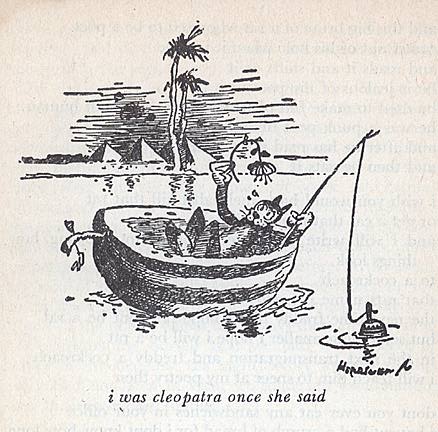
If you don’t recall, Mehitabel’s song is recounted by Archie the cockroach and told to the newspaperman Don Marquis by jumping from key to key on an old upright typewriter. So, there are no capitals or punctuations in Archie’s recounting of things. Now how the cockroach managed the return on the typewriter, I don’t know. It’s one of those mysteries.
Anyway, the story, Mehitabel’s story is ours, yours and mine. Mehitable dreams of past lives – but lives in this one. Her motto is “tojours gai,” which she translates roughly as “wotthehell.” Let me hold her up as a model of our western Dao, our Western way.
Throwing heart wide and living full, “i once was an innocent kit/wotthehell wotthehell/with a ribbon my neck to fit/and bells tied onto it/o wotthehell wotthehell/but a maltese cat came by/with a come hither look in his eye/and a song that soared to the sky/and wotthehell wotthehell/and i followed adown the street/the pad of his rhythmical feet/o permit me again to repeat/wotthehell wotthehell.”
Now, I’m not calling us to a libertine life. I feel the need to underscore this point. And, please, if you need, reference my underscoring how we need to remember there’s enormous power in all this, and constraint and respect are enormous parts of the deal.
What I am calling us to is living full.
Full lives. No lights off in the closet. And Mehitabel frames the whole thing deliciously. “i know that i am bound/for a journey down the sound/in the midst of a refuse mound/but wotthehell wotthehell/oh i should worry and fret/death and i will coquette/there s a dance in the old dame yet/toujours gai toujours gai.”
On our way, I am suggesting, we need to bring it all together. As we ride down the sound on that garbage barge, toward some unknown fate, the terrible and the beautiful are all brought together. Or can be. And as we bring mind and heart together, as we bring body and heart together, a dance does emerge, something beautiful to behold.
Toujours gai.
Toujours gai…
Next Post

August 14, 2018 Saints for Our Times: Thinking of Jonathan & Ruby
Browse Our Archives
Select a Category A Christmas Carol Abolitionist African-American Ahmadiyya Alan Watts Aldous Huxley Allen Ginsberg Amedkar Jayanti American politics American Zen Anaheim Zen Sangha Anglican Annie Besant April Fool Armageddon Art and Religion artificial intellegence Atheist Awakening B R Ambedkar Barlaam & Josaphat Beatnik Between Bhagavad Gita Bible biography birthday bodhisattva Bodhisattva Precepts Book burning Book of Common Prayer Book of Mormon Brahmo Samaj Buddha Buddhism Buddhist Buddhist Lord's Prayer Butterflies Calendars cartoons cat ChatGPT Chicken Tortilla Soup choices Christian atheism Christian mysticism Christian origins Christian Science Christian Zen Christianity Christianity and Buddhism christmas Christmas Truce Christopher Isherwood Church of Later Day Saints Cinco de Mayo circus covenant critical thinking culture D. T. Suzuki Dalit Buddhism Daniel Defoe Desert Fathers and Mothers dharma talk Dogen Donald Trump Dongshan's Five Ranks Dorothy Day dream Duty Easter ecology Edwin Arnold emptiness Empty Moon Zen Network Episcopal Church Eternal Now Ethics evolution existentialism Faith fantasy Fathers Day film film review fire Five Ranks Folk music food Form and emptiness Four Seals Francis of Assisi Francis Xavier Free thinker friendship George MacDonald Gerald Heard Glenn Taylor Webb God Good Friday Gospel of Gospel of Mark Gospel of Thomas grace Graduate Theological Unioin Graduate Theological Union Guanyin H R Blyth Hakuin Ekaku Hanamatsuri Hanukkah Harada Yasutani Zen Heart Sutra Henry David Thoreau Hermann Hesse Hinduism History and Religion history of religion Holy Spirit home Hospitality Icon Ides of March Isaac Newton Islam Islamic mysticism Jack Kerouac James Luther Adams Jiddu Krishnamurti Joan of Arc Johannes Gutenberg John Donne joke Judaism justice karma kensho King James Bible koan Koun Yamada Kyoto School Lewis Carrol Liberal Christianity Liberal Religion Life Plan Community Liminal literature Literature and Religion Liturgy Lord's Prayer Love Mahatma Gandhi Mahayana Martin Luther King Jr Mary Baker Eddy Mary Magdelene Mary Oliver Mayflower Compact Meditation memories memory metaphor money money and religioin Mormons Mother's Day movie review mysticism mythic Neighborhood Unitarian Universalist Church New Thought Nichiren Buddhism Nonduality not knowing Omar Khayyam Pacific School of Religion pagan Palm Sunday Passover peace Pentecost perennialism Phantastes Philip Kapleau philosophy Pilgrimage poetry Poetry and Religion politics Prayer Precepts Printing Press prophecy prophetic spirituality psychology Pure Land Queer religion queering religion Quietism Ram Mohan Roy rebirth recipe Relationships and religion religion religion and history Religious syncretism Resistance Retirement Retreat review Rissho Kosei Kai Ritual Robert Aitken Roshi Robert Ingersoll Rohatsu Romani religion Rosie the Riveter saints samadhi SanboZen Sangha Satyagraha science science and reigion science and religion science fiction seminary sermon Sesshin Sex and Religion Shinran Sikh Sikh tradition silence Social Justice Socially Engaged Buddhism Society and religion Soto Zen soul spiritual community spiritual practice Spirituality Sufism Suicide superstition Taoism Television Teresa of Avila Thanksgiving theological schools Theosophy Thomas Merton Time Transcendentalism Transcendentalist Trinitarian Trinity Uncategorized unitarian Unitarian Christianity Unitarian Universalist Universalism Vajrayana Vedanta Walking war Willa Cather William Ellery Channing wisdom women and religion women in religion World Teacher Writing zazen Zen Zen Center Zen inspired retriement zen meditation Zen Precepts Zen women
Select a Month September 2026 August 2026 July 2026 June 2026 May 2026 April 2026 March 2026 February 2026 January 2026 December 2025 November 2025 October 2025 September 2025 August 2025 July 2025 June 2025 May 2025 April 2025 March 2025 February 2025 January 2025 December 2024 November 2024 October 2024 September 2024 August 2024 July 2024 June 2024 May 2024 April 2024 March 2024 February 2024 January 2024 December 2023 November 2023 October 2023 September 2023 August 2023 July 2023 June 2023 May 2023 April 2023 March 2023 February 2023 January 2023 December 2022 November 2022 October 2022 September 2022 August 2022 July 2022 June 2022 May 2022 April 2022 March 2022 February 2022 January 2022 December 2021 November 2021 October 2021 September 2021 August 2021 July 2021 June 2021 May 2021 April 2021 March 2021 February 2021 January 2021 December 2020 November 2020 October 2020 September 2020 August 2020 July 2020 June 2020 May 2020 April 2020 March 2020 February 2020 January 2020 December 2019 November 2019 October 2019 September 2019 August 2019 July 2019 June 2019 May 2019 April 2019 March 2019 February 2019 January 2019 December 2018 November 2018 October 2018 September 2018 August 2018 July 2018 June 2018 May 2018 April 2018 March 2018 February 2018 January 2018 December 2017 November 2017 October 2017 September 2017 August 2017 July 2017 June 2017 May 2017 April 2017 March 2017 February 2017 January 2017 December 2016 November 2016 October 2016 September 2016 August 2016 July 2016 June 2016 May 2016 April 2016 March 2016 February 2016 January 2016 December 2015 November 2015 October 2015 September 2015 August 2015 July 2015 June 2015 May 2015 April 2015 March 2015 February 2015 January 2015 December 2014 November 2014 October 2014 September 2014 August 2014 July 2014 June 2014 May 2014 April 2014 March 2014 February 2014 January 2014 December 2013 November 2013 October 2013 September 2013 August 2013 July 2013 June 2013 May 2013 April 2013 March 2013 February 2013 January 2013 December 2012 November 2012 October 2012 September 2012 August 2012 July 2012 June 2012 May 2012 April 2012 March 2012 February 2012 January 2012 December 2011 November 2011 October 2011 September 2011 August 2011 July 2011 June 2011 May 2011 April 2011 March 2011 February 2011 January 2011 December 2010 November 2010 October 2010 September 2010 August 2010 July 2010 June 2010 May 2010 April 2010 March 2010 February 2010 January 2010 December 2009 November 2009 October 2009 September 2009 August 2009 July 2009 June 2009 May 2009 April 2009 March 2009 February 2009 January 2009 December 2008 November 2008 October 2008 September 2008 August 2008 July 2008 June 2008 May 2008 April 2008 March 2008 February 2008 January 2008 December 2007 November 2007 October 2007 September 2007 August 2007 July 2007 June 2007 May 2007 April 2007 March 2007 February 2007 January 2007 December 2006 November 2006 October 2006 September 2006
Follow Us!
TAKE THE
Religious Wisdom Quiz
What is a "scroll" most similar to today?
Select your answer to see how you score.
Carpet Table Book Statue
Related posts from Monkey Mind

Keizan Jokin: The Zen Master Ancestor You Don't...

What Zen Practice Actually Does With Anger

Nanquan Cuts the Cat: A Jesuit commentary on...

On Taking Refuge in the Dharma
TRENDING AT PATHEOS Buddhist

Catholic Evangelization: Sharing Your Faith Every Day
Welcome back to the Graceful Awakening mini-series called, “From Faith to Mission.” ...

The Pillar of the Boatmen: the Ancient Monument...
The Pillar of the Boatmen is a Romano-Gaulish sculpture that dates from...

In one sense walking into Westminster Abbey is like walking down the...

'Super Scam Me' Exposes AI Jon Bon Jovi...
Leslie Pickett believed she was in a relationship with Jon Bon Jovi....

The Brazilian Remake of Kendricks' 'Flywheel' Opens in...
“Flywheel,” the story that launched the Kendrick Brothers’ filmmaking career is getting...

The Dangers of Gradual Accommodation (Winking at Sin)
Recently, the “law of gradualness” resurfaced during the opening of a weeklong,...
view all Buddhist blogs
Ad-Free & Subscriber Log-In Subscription Support
- About Us
- 2026 Calendar
- Videos
- Podcasts
- Library of World Religions
- Faith In Media Tracker
- Advertise With Us
- Write for Us
- Privacy Policy
- Terms of Service
- Do Not Sell My Data
- Contact Us
- Radiant Digital
- Manage Newsletter Subscriptions
- Unsubscribe From Notifications
- Sitemap
Copyright 2008-2026, Patheos. All rights reserved.
Subscription Support Ad-Free & Subscriber Log-In
Follow Patheos