
BuddhistCatholicContemplativeEvangelicalGeneral ChristianHinduJewishLatter-day SaintMuslimNew VisionsProgressive Christian
Beliefs
- Buddhist
- Catholic
- Contemplative
- Evangelical
- General Christian
- Hindu
- Jewish
- Latter-day Saint
- More Voices
- Muslim
- New Visions
- Pagan
- Progressive Christian
Topics
- Religion News
- Food and Religion
- Sports and Religion
- Religious Art
- Religious Music and Entertainment
- Religious Events
- History and Religion
- Style and Religion
- Politics and Religion
- Women in Religion
- Recreation Outdoors and Religion
- Business Finance and Religion
- Careers Workplace and Religion
- Education and Religion
- Family Parenting and Religion
- Health Fitness and Religion
- Home and Religion
- Relationships and Religion
- Technology and Religion
- Travel and Religion
Columnists
- Buddhist Columnists
- Business Finance and Religion Columnists
- Careers Workplace and Religion Columnists
- Catholic Columnists
- Contemplative Columnists
- Education and Religion Columnists
- Evangelists Columnists
- Family Parenting and Religion Columnists
- General Christian Columnists
- Health Fitness and Religion Columnists
- Hindu Columnists
- History and Religion Columnists
- Home and Religion Columnists
- Jewish Columnists
- More Voices Columnists
- Latter Day Columnists
- Muslim Columnists
- New Visions Columnists
- Nonreligious Columnists
- Pagan Columnists
- Politics and Religion Columnists
- Progressive Columnists
- Recreation Outdoors and Religion Columnists
- Relationships and Religion Columnists
- Religion News Columnists
- Religious Art Columnists
- Religious Events Columnists
- Religious Music and Entertainment Columnists
- Sports and Religion Columnists
- Style and Religion Columnists
- Technology and Religion Columnists
- Travel and Religion Columnists
- Women in Religion Columnists
Resource Library
- 2026 Calendar
- Library of World Religions
- The 100 Most Holy Places on Earth
- Patheos Answers
- Podcasts
- Videos
- Faith Leaders Database
- Anglican Episcopalian
- Bahai
- Baptist
- Buddhism
- Christianity
- Confucianism
- Eastern Orthodoxy
- Hinduism
- Holiness and Pentecostal
- ISKCON
- Islam
- Judaism
- Lutheran
- Methodist
- The Church of Jesus Christ of Latter-day Saints
- New Age
- Paganism
- Presbytarian and Reformed
- Protestantism
- Religion Behind the Scenes
- Roman Catholic
- Scientology
- Shia Islam
- Sikhism
- Sufism
- Sunni Islam
- Taoism
- Zen
- See all religions
Research Tools
 Ad-Free & Subscriber Log-In Subscription Support
Ad-Free & Subscriber Log-In Subscription Support
Follow Patheos 

- Trending:
- Forgiveness
- |
- Marriage
- |
- Consciousness
- |
- Death Penalty
- |
- Election
- |
- Halloween

- Home
- Buddhist
- The Zen of Yasunarti Kawabata
The Zen of Yasunarti Kawabata
Last updated on: June 14, 2018 at 11:23 am by James Ford
The Zen of Yasunarti Kawabata 2018-06-14T11:23:14-07:00 James Ford
Patheos Explore the world's faith through different perspectives on religion and spirituality! Patheos has the views of the prevalent religions and spiritualities of the world.
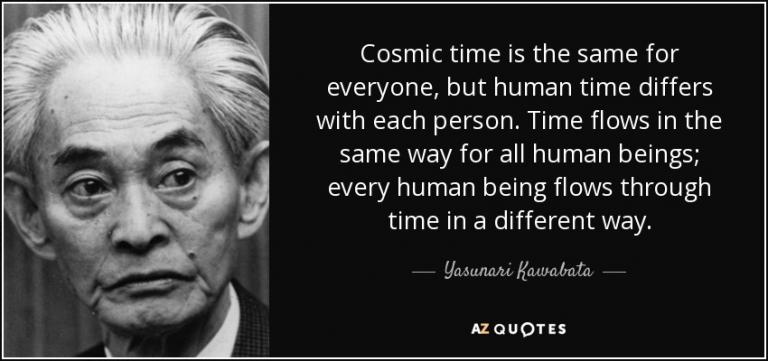
Yasunarti Kawabata was born on this day, the 11th of June, 1899. He was the first Japanese national, and the only Zen Buddhist to win the Nobel prize in literature, awarded it in 1968.
(Two other Buddhists have been awarded Nobel prizes, both the Peace prize, Tenzin Gyatso, the 14th Dalai Lama and Aung Sahn Suu Kyi. Another Japanese Buddhist, Kobo Abe (Kimifusa Abe) was apparently nominated for the literature prize several times, but never won it before his death. Similarly Thich Nhat Hanh was nominated for the Peace prize, notably by Martin Luther King, Jr. But did not win it.)
Kawabata’s Nobel lecture is notable for several reasons, one for his explicit presentation of his understanding of Zen Buddhism.
I share it here.
Japan, the Beautiful and Myself
Yasunari Kawabata
“In the spring, cherry blossoms, in the summer the cuckoo.
In autumn the moon, and in winter the snow, clear, cold.”
“The winter moon comes from the clouds to keep me company.
The wind is piercing, the snow is cold.”
The first of these poems is by the priest Dogen (1200-1253) and bears the title “Innate Spirit”. The second is by the priest Myoe (1173-1232). When I am asked for specimens of calligraphy, it is these poems that I often choose.
The second poem bears an unusually detailed account of its origins, such as to be an explanation of the heart of its meaning: “On the night of the twelfth day of the twelfth month of the year 1224, the moon was behind clouds. I sat in Zen meditation in the Kakyu Hall. When the hour of the midnight vigil came, I ceased meditation and descended from the hall on the peak to the lower quarters, and as I did so the moon came from the clouds and set the snow to glowing. The moon was my companion, and not even the wolf howling in the valley brought fear. When, presently, I came out of the lower quarters again, the moon was again behind clouds. As the bell was signalling the late-night vigil, I made my way once more to the peak, and the moon saw me on the way. I entered the meditation hall, and the moon, chasing the clouds, was about to sink behind the peak beyond, and it seemed to me that it was keeping me secret company.”
There follows the poem I have quoted, and with the explanation that it was composed as Myoe entered the meditation hall after seeing the moon behind the mountain, there comes yet another poem:
“I shall go behind the mountain. Go there too, O moon.
Night after night we shall keep each other company.”
Here is the setting for another poem, after Myoe had spent the rest of the night in the meditation hall, or perhaps gone there again before dawn:
“Opening my eyes from my meditations, I saw the moon in the dawn, lighting the window. In a dark place myself, I felt as if my own heart were glowing with light which seemed to be that of the moon:
‘My heart shines, a pure expanse of light;
And no doubt the moon will think the light its own.’ ”
Because of such a spontaneous and innocent stringing together of mere ejaculations as the following, Myoe has been called the poet of the moon:
“Bright, bright, and bright, bright, bright, and bright, bright.
Bright and bright, bright, and bright, bright moon.”
In his three poems on the winter moon, from late night into the dawn, Myoe follows entirely the bent of Saigyo, another poet-priest, who lived from 1118 to 1190: “Though I compose poetry, I do not think of it as composed poetry.” The thirty-one syllables of each poem, honest and straightforward as if he were addressing the moon, are not merely to “the moon as my companion”. Seeing the moon, he becomes the moon, the moon seen by him becomes him. He sinks into nature, becomes one with nature. The light of the “clear heart” of the priest, seated in the meditation hall in the darkness before the dawn, becomes for the dawn moon its own light.
As we see from the long introduction to the first of Myoe’s poems quoted above, in which the winter moon becomes a companion, the heart of the priest, sunk in meditation upon religion and philosophy, there in the mountain hall, is engaged in a delicate interplay and exchange with the moon; and it is this of which the poet sings. My reason for choosing that first poem when asked for a specimen of my calligraphy has to do with its remarkable gentleness and compassion. Winter moon, going behind the clouds and coming forth again, making bright my footsteps as I go to the meditation hall and descend again, making me unafraid of the wolf: does not the wind sink into you, does not the snow, are you not cold? I choose the poem as a poem of warm, deep, delicate compassion, a poem that has in it the deep quiet of the Japanese spirit.
Dr. Yashiro Yukio, internationally known as a scholar of Botticelli, a man of great learning in the art of the past and the present, of the East and the West, has summed up one of the special characteristics of Japanese art in a single poetic sentence: “The time of the snows, of the moon, of the blossoms – – – then more than ever we think of our comrades.” When we see the beauty of the snow, when we see the beauty of the full moon, when we see the beauty of the cherries in bloom, when in short we brush against and are awakened by the beauty of the four seasons, it is then that we think most of those close to us, and want them to share the pleasure. The excitement of beauty calls forth strong fellow feelings, yearnings for companionship, and the word “comrade” can be taken to mean “human being”. The snow, the moon, the blossoms, words expressive of the seasons as they move one into another, include in the Japanese tradition the beauty of mountains and rivers and grasses and trees, of all the myriad manifestations of nature, of human feelings as well.
That spirit, that feeling for one’s comrades in the snow, the moonlight, under the blossoms, is also basic to the tea ceremony. A tea ceremony is a coming together in feeling, a meeting of good comrades in a good season. I may say in passing, that to see my novel Thousand Cranes as an evocation of the formal and spiritual beauty of the tea ceremony is a misreading. It is a negative work, and expression of doubt about and warning against the vulgarity into which the tea ceremony has fallen.
“In the spring, cherry blossoms, in the summer the cuckoo.
In autumn the full moon, in winter the snow, clear, cold.”
One can, if one chooses, see in Dogen’s poem the beauty of the four seasons no more than a conventional, ordinary, mediocre stringing together, in a most awkward form of representative images from the four seasons. One can see it as a poem that is not really a poem at all. And yet very similar is the deathbed poem of the priest Ryokan (1758-1831):
“What shall be my legacy? The blossoms of spring,
The cuckoo in the hills, the leaves of autumn.”
In this poem, as in Dogen’s, the commonest of figures and the commonest of words are strung together without hesitation – – – no, to particular effect, rather – – – and so they transmit the very essence of Japan. And it is Ryokan’s last poem that I have quoted.
“A long, misty day in spring:
I saw it to a close, playing ball with the children.
“The breeze is fresh, the moon is clear.
Together let us dance the night away, in what is left of old age.”
“It is not that I wish to have none of the world,
It is that I am better at the pleasure enjoyed alone.”
Ryokan, who shook off the modern vulgarity of his day, who was immersed in the elegance of earlier centuries, and whose poetry and calligraphy are much admired in Japan today – – – he lived in the spirit of these poems, a wanderer down country paths, a grass hut for shelter, rags for clothes, farmers to talk to. The profundity of religion and literature was not, for him, in the abstruse. He rather pursued literature and belief in the benign spirit summarized in the Buddhist phrase “a smiling face and gentle words”. In his last poem he offered nothing as a legacy. He but hoped that after his death nature would remain beautiful. That could be his bequest. One feels in the poem the emotions of old Japan, and the heart of a religious faith as well.
“I wondered and wondered when she would come.
And now we are together. What thoughts need I have?”
Ryokan wrote love poetry too. This is an example of which I am fond. An old man of sixty-nine (I might point out that at the same age I am the recipient of the Nobel Prize), Ryokan met a twenty-nine-year old nun named Teishin, and was blessed with love. The poem can be seen as one of happiness at having met the ageless woman, of happiness at having met the one for whom the wait was so long. The last line is simplicity itself.
Ryokan died at the age of seventy-three. He was born in the province of Echigo, the present Niigata Prefecture and the setting of my novel Snow Country, a northerly region on what is known as the reverse side of Japan, where cold winds come down across the Japan Sea from Siberia. He lived his whole life in the snow country, and to his “eyes in their last extremity”, when he was old and tired and knew that death was near, and had attained enlightenment, the snow country, as we see in his last poem, was yet more beautiful, I should imagine. I have an essay with the title “Eyes in their Last Extremity”.
The title comes from the suicide note of the short-story writer Akutagawa Ryunosuke (1892-1927). It is the phrase that pulls at me with the greatest strength. Akutagawa said that he seemed to be gradually losing the animal something known as the strength to live, and continued:
“I am living in a world of morbid nerves, clear and cold as ice… I do not know when I will summon up the resolve to kill myself. But nature is for me more beautiful than it has ever been before. I have no doubt that you will laugh at the contradiction, for here I love nature even when I am contemplating suicide. But nature is beautiful because it comes to my eyes in their last extremity.”
Akutagawa committed suicide in 1927, at the age of thirty-five.
In my essay, “Eyes in their Last Extremity”, I had to say: “How ever alienated one may be from the world, suicide is not a form of enlightenment. However admirable he may be, the man who commits suicide is far from the realm of the saint.” I neither admire nor am in sympathy with suicide. I had another friend who died young, an avant-garde painter. He too thought of suicide over the years, and of him I wrote in this same essay: “He seems to have said over and over that there is no art superior to death, that to die is to live,” I could see, however, that for him, born in a Buddhist temple and educated in a Buddhist school, the concept of death was very different from that in the West. ”
Among those who give thoughts to things, is there one who does not think of suicide?” With me was the knowledge that that fellow Ikkyu (1394-1481) twice contemplated suicide. I have “that fellow”, because the priest Ikkyu is known even to children as a most amusing person, and because anecdotes about his limitlessly eccentric behavior have come down to us in ample numbers. It is said of him that children climbed his knee to stroke his beard, that wild birds took feed from his hand. It would seem from all this that he was the ultimate in mindlessness, that he was an approachable and gentle sort of priest. As a matter of fact he was the most severe and profound of Zen priests. Said to have been the son of an emperor, he entered a temple at the age of six, and early showed his genius as a poetic prodigy. At the same time he was troubled with the deepest of doubts about religion and life. “If there is a god, let him help me. If there is none, let me throw myself to the bottom of the lake and become food for fishes.”
Leaving behind these words he sought to throw himself into a lake, but was held back. On another occasion, numbers of his fellows were incriminated when a priest in his Daitokuji Temple committed suicide. Ikkyu went back to the temple, “the burden heavy on my shoulders,” and sought to starve himself to death. He gave his collected poetry the title “Collection of the Roiling Clouds”, and himself used the expression “Roiling Clouds” as a pen name. In his collection and its successor are poems quite without parallel in the Chinese and especially the Zen poetry of the Japanese middle ages, erotic poems and poems about the secrets of the bedchamber that leave one in utter astonishment. He sought, by eating fish and drinking spirits and having commerce with women, to go beyond the rules and proscriptions of the Zen of his day, and to seek liberation from them, and thus, turning against established religious forms, he sought in the pursuit of Zen the revival and affirmation of the essence of life, of human existence, in a day civil war and moral collapse.
His temple, the Daitokuji at Murasakino in Kyoto, remains a center of the tea ceremony, and specimens of his calligraphy are greatly admired as hangings in alcoves of tea rooms.
I myself have two specimens of Ikkyu’s calligraphy. One of them is a single line: “It is easy to enter the world of the Buddha, it is hard to enter the world of the devil.” Much drawn to these words, I frequently make use of them when asked for a specimen of my own calligraphy. They can be read in any number of ways, as difficult as one chooses, but in that world of the devil added to the world of the Buddha, Ikkyu of Zen comes home to me with great immediacy. The fact that for an artist, seeking truth, good, and beauty, the fear and petition even as a prayer in those words about the world of the devil – – – the fact that it should be there apparent on the surface, hidden behind, perhaps speaks with the inevitability of fate. There can be no world of the Buddha without the world of the devil. And the world of the devil is the world difficult of entry. It is not for the weak of heart.
“If you meet a Buddha, kill him. If you meet a patriarch of the law,
kill him.”
This is a well-known Zen motto. If Buddhism is divided generally into the sects that believe in salvation by faith and those that believe in salvation by one’s own efforts, then of course there must be such violent utterances in Zen, which insists upon salvation by one’s own efforts. On the other side, the side of salvation by faith, Shinran (1173-1262), the founder of the Shin sect, once said: “The good shall be reborn in paradise, and how much more shall it be so with the bad.” This view of things has something in common with Ikkyu’s world of the Buddha and world of the devil, and yet at heart the two have their different inclinations. Shinran also said: “I shall not take a single disciple.”
“If you meet a Buddha, kill him. If you meet a patriarch of the law, kill him.” “I shall not take a single disciple.” In these two statements, perhaps, is the rigorous fate of art.
In Zen there is no worship of images. Zen does have images, but in the hall where the regimen of meditation is pursued, there are neither images nor pictures of Buddhas, nor are there scriptures. The Zen disciple sits for long hours silent and motionless, with his eyes closed. Presently he enters a state of impassivity, free from all ideas and all thoughts. He departs from the self and enters the realm of nothingness. This is not the nothingness or the emptiness of the West. It is rather the reverse, a universe of the spirit in which everything communicates freely with everything, transcending bounds, limitless. There are of course masters of Zen, and the disciple is brought toward enlightenment by exchanging questions and answers with his master, and he studies the scriptures.
The disciple must, however, always be lord of his own thoughts, and must attain enlightenment through his own efforts. And the emphasis is less upon reason and argument than upon intuition, immediate feeling. Enlightenment comes not from teaching but through the eye awakened inwardly. Truth is in “the discarding of words”, it lies “outside words”. And so we have the extreme of “silence like thunder”, in the Vimalakirti Nirdesa Sutra. Tradition has it that Bodhidharma, a southern Indian prince who lived in about the sixth century and was the founder of Zen in China, sat for nine years in silence facing the wall of a cave, and finally attained enlightenment. The Zen practice of silent meditation in a seated posture derives from Bodhidharma.
Here are two religious poems by Ikkyu:
“Then I ask you answer. When I do not you do not.
What is there then on your heart, O Lord Bodhidharma?”
“And what is it, the heart?
It is the sound of the pine breeze in the ink painting.”
Here we have the spirit of Zen in Oriental painting. The heart of the ink painting is in space, abbreviation, what is left undrawn. In the words of the Chinese painter Chin Nung: “You paint the branch well, and you hear the sound of the wind.” And the priest Dogen once more: “Are there not these cases? Enlightenment in the voice of the bamboo. Radiance of heart in the peach blossom.”
Ikenobo Sen’o, a master of flower arranging, once said (the remark is to be found in his Sayings): “With a spray of flowers, a bit of water, one evokes the vastness of rivers and mountains.” The Japanese garden too, of course symbolizes the vastness of nature. The Western garden tends to be symmetrical, the Japanese garden asymmetrical, and this is because the asymmetrical has the greater power to symbolize multiplicity and vastness. The asymmetry, of course, rests upon a balance imposed by delicate sensibilities. Nothing is more complicated, varied, attentive to detail, than the Japanese art of landscape gardening. Thus there is the form called the dry landscape, composed entirely of rocks, in which the arrangement of stones gives expression to mountains and rivers that are not present, and even suggests the waves of the great ocean breaking in upon cliffs. Compressed to the ultimate, the Japanese garden becomes the bonsai dwarf garden, or the bonseki, its dry version.
In the Oriental word for landscape, literally “mountain-water”, with its related implications in landscape painting and landscape gardening, there is contained the concept of the sere and wasted, and even of the sad and the threadbare. Yet in the sad, austere, autumnal qualities so valued by the tea ceremony, itself summarized in the expression “gently respectful, cleanly quiet”, there lies concealed a great richness of spirit; and the tea room, so rigidly confined and simple, contains boundless space and unlimited elegance. The single flower contains more brightness than a hundred flowers. The great sixteenth-century master of the tea ceremony and flower arranging, Rikyu, taught that it was wrong to use fully opened flowers.
Even in the tea ceremony today the general practice is to have in the alcove of the tea room but a single flower, and that a flower in bud. In winter a special flower of winter, let us say a camellia, bearing some such name as White Jewel or Wabisuke, which might be translated literally as “Helpmate in Solitude”, is chosen, a camellia remarkable among camellias for its whiteness and the smallness of its blossoms; and but a single bud is set out in the alcove. White is the cleanest of colors, it contains in itself all the other colors. And there must always be dew on the bud. The bud is moistened with a few drops of water. The most splendid of arrangements for the tea ceremony comes in May, when a peony is put out in a celadon vase; but here again there is but a single bud, always with dew upon it. Not only are there drops of water upon the flower, the vase too is frequently moistured.
Among flower vases, the ware that is given the highest rank is old Iga, from the sixteenth and seventeenth centuries, and it commands the highest price. When old Iga has been dampened, its colors and its glow take on a beauty such as to awaken on afresh. Iga was fired at very high temperatures. The straw ash and the smoke from the fuel fell and flowed against the surface, and as the temperature dropped, became a sort of glaze. Because the colors were not fabricated but were rather the result of nature at work in the kiln, color patterns emerged in such varieties as to be called quirks and freaks of the kiln. The rough, austere, strong surfaces of old Iga take on a voluptuous glow when dampened. It breathes to the rhythm of the dew of the flowers.
The taste of the tea ceremony also asks that the tea bowl be moistened before using, to give it its own soft glow.
Ikenobo Sen’o remarked on another occasion (this too is in his Sayings) that “the mountains and strands should appear in their own forms”. Bringing a new spirit into his school of flower arranging, therefore, he found “flowers” in broken vessels and withered branches, and in them too the enlightenment that comes from flowers. “The ancients arranged flowers and pursued enlightenment.” Here we see awakening to the heart of the Japanese spirit, under the influence of Zen. And in it too, perhaps, is the heart of a man living in the devastation of long civil wars.
The Tales of Ise, compiled in the tenth century, is the oldest Japanese collection of lyrical episodes, numbers of which might be called short stories. In one of them we learn that the poet Ariwara no Yukihira, having invited guests, put in flowers:
“Being a man of feeling, he had in a large jar a most unusual wistaria. The trailing spray of flowers was upwards of three and a half feet long.”
A spray of wistaria of such length is indeed so unusual as to make one have doubts about the credibility of the writer; and yet I can feel in this great spray a symbol of Heian culture. The wistaria is a very Japanese flower, and it has a feminine elegance. Wistaria sprays, as they trail in the breeze, suggest softness, gentleness, reticence. Disappearing and then appearing again in the early summer greenery, they have in them that feeling for the poignant beauty of things long characterized by the Japanese as mono no aware. No doubt there was a particular splendor in that spray upwards of three and a half feet long.
The splendors of Heian culture a millennium ago and the emergence of a peculiarly Japanese beauty were as wondrous as this “most unusual wistaria”, for the culture of T’ang China had at length been absorbed and Japanized. In poetry there came, early in the tenth century, the first of the imperially commissioned anthologies, the Kokinshu, and in fiction, the Tales of Ise, followed by the supreme masterpieces of classical Japanese prose, the Tale of Genji of Lady Murasaki and the Pillow Book of Sei Shonagon, both of whom lived from the late tenth century into the early eleventh. So was established a tradition which influenced and even controlled Japanese literature for eight hundred years.
The Tale of Genji in particular is the highest pinnacle of Japanese literature. Even down to our day there has not been a piece of fiction to compare with it. That such a modern work should have been written in the eleventh century is a miracle, and as a miracle the work is widely known abroad. Although my grasp of classical Japanese was uncertain, the Heian classics were my principal boyhood reading, and it is the Genji, I think, that has meant the most to me. For centuries after it was written, fascination with the Genji persisted, and imitations and reworkings did homage to it. The Genji was a wide and deep source of nourishment for poetry, of course, and for the fine arts and handicrafts as well, and even for landscape gardening.
Murasaki and Sei Shonagon, and such famous poets as Izumi Shikibu, who probably died early in the eleventh century, and Akazome Emon, who probably died in the mid-eleventh century, were all ladies-in-waiting in the imperial court. Japanese culture was court culture, and court culture was feminine. The day of the Genji and the Pillow Book was its finest, when ripeness was moving into decay. One feels in it the sadness at the end of glory, the high tide of Japanese court culture. The court went into its decline, power moved from the court nobility to the military aristocracy, in whose hands it remained through almost seven centuries from the founding of the Kamakura Shogunate in 1192 to the Meiji Restoration in 1867 and 1868. It is not to be thought, however, that either the imperial institution or court culture vanished. In the eighth of the imperial anthologies, the Shinkokinshü of the early thirteenth century, the technical dexterity of the Kokinshu was pushed yet a step further, and sometimes fell into mere verbal dalliance; but there were added elements of the mysterious, the suggestive, the evocative and inferential elements of sensuous fantasy that have something in common with modern symbolist poetry. Saigyo, who has been mentioned earlier, was a representative poet spanning the two ages, Heian and Kamakura.
“I dreamt of him because I was thinking of him.
Had I known it was a dream, I should not have wished to awaken.
“In my dreams I go to him each night without fail.
But this is less than a single glimpse in the waking.”
These are by Ono no Komachi, the leading poetess of the Kokinshu, who sings of dreams, even, with a straightforward realism. But when we come to the following poems of the Empress Eifuku, who lived at about the same time as Ikkyu, in the Muromachi Period, somewhat later than the Shinkokinshu, we have a subtle realism that becomes a melancholy symbolism, delicately Japanese, and seems to me more modern:
“Shining upon the bamboo thicket where the sparrows twitter,
The sunlight takes on the color of the autumn.”
“The autumn wind, scattering the bush clover in the garden,
sinks into one’s bones.
Upon the wall, the evening sun disappears.”
Dogen, whose poem about the clear, cold snow I have quoted, and Myoe, who wrote of the winter moon as his companion, were of generally the Shinkokinshu period. Myoe exchanged poems with Saigyo and the two discussed poetry together. The following is from the biography of Myoe by his disciple Kikai:
“Saigyo frequently came and talked of poetry. His own attitude towards poetry, he said, was far from the ordinary. Cherry blossoms, the cuckoo, the moon, snow: confronted with all the manifold forms of nature, his eyes and his ears were filled with emptiness. And were not all the words that came forth true words? When he sang of the blossoms the blossoms were not on his mind, when he sang of the moon he did not think of the moon. As the occasion presented itself, as the urge arose, he wrote poetry. The red rainbow across the sky was as the sky taking on color. The white sunlight was as the sky growing bright. Yet the empty sky, by its nature, was not something to become bright. It was not something to take on color. With a spirit like the empty sky he gives color to all the manifold scenes but not a trace remained. In such poetry was the Buddha, the manifestation of the ultimate truth.”
Here we have the emptiness, the nothingness, of the Orient. My own works have been described as works of emptiness, but it is not to be taken for the nihilism of the West. The spiritual foundation would seem to be quite different. Dogen entitled his poem about the seasons, “Innate Reality”, and even as he sang of the beauty of the seasons he was deeply immersed in Zen.
From Nobel Lectures, Literature 1968-1980, Editor-in-Charge Tore Frängsmyr, Editor Sture Allén, World Scientific Publishing Co., Singapore, 1993
Next Post

June 15, 2018 Practical Mysticism: A Zen Priest Rapsodizes About Evelyn Underhill
Browse Our Archives
Select a Category A Christmas Carol Abolitionist African-American Ahmadiyya Alan Watts Aldous Huxley Allen Ginsberg Amedkar Jayanti American politics American Zen Anaheim Zen Sangha Anglican Annie Besant April Fool Armageddon Art and Religion artificial intellegence Atheist Awakening B R Ambedkar Barlaam & Josaphat Beatnik Between Bhagavad Gita Bible biography birthday bodhisattva Bodhisattva Precepts Book burning Book of Common Prayer Book of Mormon Brahmo Samaj Buddha Buddhism Buddhist Buddhist Lord's Prayer Butterflies Calendars cartoons cat ChatGPT Chicken Tortilla Soup choices Christian atheism Christian mysticism Christian origins Christian Science Christian Zen Christianity Christianity and Buddhism christmas Christmas Truce Christopher Isherwood Church of Later Day Saints Cinco de Mayo circus covenant critical thinking culture D. T. Suzuki Dalit Buddhism Daniel Defoe Desert Fathers and Mothers dharma talk Dogen Donald Trump Dongshan's Five Ranks Dorothy Day dream Duty Easter ecology Edwin Arnold emptiness Empty Moon Zen Network Episcopal Church Eternal Now Ethics evolution existentialism Faith fantasy Fathers Day film film review fire Five Ranks Folk music food Form and emptiness Four Seals Francis of Assisi Francis Xavier Free thinker friendship George MacDonald Gerald Heard Glenn Taylor Webb God Good Friday Gospel of Gospel of Mark Gospel of Thomas grace Graduate Theological Unioin Graduate Theological Union Guanyin H R Blyth Hakuin Ekaku Hanamatsuri Hanukkah Harada Yasutani Zen Heart Sutra Henry David Thoreau Hermann Hesse Hinduism History and Religion history of religion Holy Spirit home Hospitality Icon Ides of March Isaac Newton Islam Islamic mysticism Jack Kerouac James Luther Adams Jiddu Krishnamurti Joan of Arc Johannes Gutenberg John Donne joke Judaism justice karma kensho King James Bible koan Koun Yamada Kyoto School Lewis Carrol Liberal Christianity Liberal Religion Life Plan Community Liminal literature Literature and Religion Liturgy Lord's Prayer Love Mahatma Gandhi Mahayana Martin Luther King Jr Mary Baker Eddy Mary Magdelene Mary Oliver Mayflower Compact Meditation memories memory metaphor money money and religioin Mormons Mother's Day movie review mysticism mythic Neighborhood Unitarian Universalist Church New Thought Nichiren Buddhism Nonduality not knowing Omar Khayyam Pacific School of Religion pagan Palm Sunday Passover peace Pentecost perennialism Phantastes Philip Kapleau philosophy Pilgrimage poetry Poetry and Religion politics Prayer Precepts Printing Press prophecy prophetic spirituality psychology Pure Land Queer religion queering religion Quietism Ram Mohan Roy rebirth recipe Relationships and religion religion religion and history Religious syncretism Resistance Retirement Retreat review Rissho Kosei Kai Ritual Robert Aitken Roshi Robert Ingersoll Rohatsu Romani religion Rosie the Riveter saints samadhi SanboZen Sangha Satyagraha science science and reigion science and religion science fiction seminary sermon Sesshin Sex and Religion Shinran Sikh Sikh tradition silence Social Justice Socially Engaged Buddhism Society and religion Soto Zen soul spiritual community spiritual practice Spirituality Sufism Suicide superstition Taoism Television Teresa of Avila Thanksgiving theological schools Theosophy Thomas Merton Time Transcendentalism Transcendentalist Trinitarian Trinity Uncategorized unitarian Unitarian Christianity Unitarian Universalist Universalism Vajrayana Vedanta Walking war Willa Cather William Ellery Channing wisdom women and religion women in religion World Teacher Writing zazen Zen Zen Center Zen inspired retriement zen meditation Zen Precepts Zen women
Select a Month September 2026 August 2026 July 2026 June 2026 May 2026 April 2026 March 2026 February 2026 January 2026 December 2025 November 2025 October 2025 September 2025 August 2025 July 2025 June 2025 May 2025 April 2025 March 2025 February 2025 January 2025 December 2024 November 2024 October 2024 September 2024 August 2024 July 2024 June 2024 May 2024 April 2024 March 2024 February 2024 January 2024 December 2023 November 2023 October 2023 September 2023 August 2023 July 2023 June 2023 May 2023 April 2023 March 2023 February 2023 January 2023 December 2022 November 2022 October 2022 September 2022 August 2022 July 2022 June 2022 May 2022 April 2022 March 2022 February 2022 January 2022 December 2021 November 2021 October 2021 September 2021 August 2021 July 2021 June 2021 May 2021 April 2021 March 2021 February 2021 January 2021 December 2020 November 2020 October 2020 September 2020 August 2020 July 2020 June 2020 May 2020 April 2020 March 2020 February 2020 January 2020 December 2019 November 2019 October 2019 September 2019 August 2019 July 2019 June 2019 May 2019 April 2019 March 2019 February 2019 January 2019 December 2018 November 2018 October 2018 September 2018 August 2018 July 2018 June 2018 May 2018 April 2018 March 2018 February 2018 January 2018 December 2017 November 2017 October 2017 September 2017 August 2017 July 2017 June 2017 May 2017 April 2017 March 2017 February 2017 January 2017 December 2016 November 2016 October 2016 September 2016 August 2016 July 2016 June 2016 May 2016 April 2016 March 2016 February 2016 January 2016 December 2015 November 2015 October 2015 September 2015 August 2015 July 2015 June 2015 May 2015 April 2015 March 2015 February 2015 January 2015 December 2014 November 2014 October 2014 September 2014 August 2014 July 2014 June 2014 May 2014 April 2014 March 2014 February 2014 January 2014 December 2013 November 2013 October 2013 September 2013 August 2013 July 2013 June 2013 May 2013 April 2013 March 2013 February 2013 January 2013 December 2012 November 2012 October 2012 September 2012 August 2012 July 2012 June 2012 May 2012 April 2012 March 2012 February 2012 January 2012 December 2011 November 2011 October 2011 September 2011 August 2011 July 2011 June 2011 May 2011 April 2011 March 2011 February 2011 January 2011 December 2010 November 2010 October 2010 September 2010 August 2010 July 2010 June 2010 May 2010 April 2010 March 2010 February 2010 January 2010 December 2009 November 2009 October 2009 September 2009 August 2009 July 2009 June 2009 May 2009 April 2009 March 2009 February 2009 January 2009 December 2008 November 2008 October 2008 September 2008 August 2008 July 2008 June 2008 May 2008 April 2008 March 2008 February 2008 January 2008 December 2007 November 2007 October 2007 September 2007 August 2007 July 2007 June 2007 May 2007 April 2007 March 2007 February 2007 January 2007 December 2006 November 2006 October 2006 September 2006
Follow Us!
TAKE THE
Religious Wisdom Quiz
How many chapters are in the book of Psalms?
Select your answer to see how you score.
100 120 150 200
Related posts from Monkey Mind


A Zen Buddhist Response to this Moment


The Suchness of Crows: The Zen teachings of...
TRENDING AT PATHEOS Buddhist

57th Dove Awards Honor Dolly Parton, Crown New...
On gospel music’s biggest night, the 57th annual GMA Dove Awards honored...

The First Eucharistic Controversy: Christ’s Real Presence
For Catholics, the Eucharist is the source and summit of the Christian...

What a Stop Sign Can Teach Us About...
How to Make a Decision When You Can't Hear God Main point:...

Archdiocese Hosts Military Marriage Retreat in Germany
RASTATT, Germany — The transient military lifestyle, with its frequent deployments and...

Nearly every morning, I make the drive to Detroit with my high-school-age...

The Real AI Story Is Adoption Without Trust
Artificial intelligence has crossed a political threshold. It is no longer a...
view all Buddhist blogs
Ad-Free & Subscriber Log-In Subscription Support
- About Us
- 2026 Calendar
- Videos
- Podcasts
- Library of World Religions
- Faith In Media Tracker
- Advertise With Us
- Write for Us
- Privacy Policy
- Terms of Service
- Do Not Sell My Data
- Contact Us
- Radiant Digital
- Manage Newsletter Subscriptions
- Unsubscribe From Notifications
- Sitemap
Copyright 2008-2026, Patheos. All rights reserved.
Subscription Support Ad-Free & Subscriber Log-In
Follow Patheos