
BuddhistCatholicContemplativeEvangelicalGeneral ChristianHinduJewishLatter-day SaintMuslimNew VisionsProgressive Christian
Beliefs
- Buddhist
- Catholic
- Contemplative
- Evangelical
- General Christian
- Hindu
- Jewish
- Latter-day Saint
- More Voices
- Muslim
- New Visions
- Pagan
- Progressive Christian
Topics
- Religion News
- Food and Religion
- Sports and Religion
- Religious Art
- Religious Music and Entertainment
- Religious Events
- History and Religion
- Style and Religion
- Politics and Religion
- Women in Religion
- Recreation Outdoors and Religion
- Business Finance and Religion
- Careers Workplace and Religion
- Education and Religion
- Family Parenting and Religion
- Health Fitness and Religion
- Home and Religion
- Relationships and Religion
- Technology and Religion
- Travel and Religion
Columnists
- Buddhist Columnists
- Business Finance and Religion Columnists
- Careers Workplace and Religion Columnists
- Catholic Columnists
- Contemplative Columnists
- Education and Religion Columnists
- Evangelists Columnists
- Family Parenting and Religion Columnists
- General Christian Columnists
- Health Fitness and Religion Columnists
- Hindu Columnists
- History and Religion Columnists
- Home and Religion Columnists
- Jewish Columnists
- More Voices Columnists
- Latter Day Columnists
- Muslim Columnists
- New Visions Columnists
- Nonreligious Columnists
- Pagan Columnists
- Politics and Religion Columnists
- Progressive Columnists
- Recreation Outdoors and Religion Columnists
- Relationships and Religion Columnists
- Religion News Columnists
- Religious Art Columnists
- Religious Events Columnists
- Religious Music and Entertainment Columnists
- Sports and Religion Columnists
- Style and Religion Columnists
- Technology and Religion Columnists
- Travel and Religion Columnists
- Women in Religion Columnists
Resource Library
- 2026 Calendar
- Library of World Religions
- The 100 Most Holy Places on Earth
- Patheos Answers
- Podcasts
- Videos
- Faith Leaders Database
- Anglican Episcopalian
- Bahai
- Baptist
- Buddhism
- Christianity
- Confucianism
- Eastern Orthodoxy
- Hinduism
- Holiness and Pentecostal
- ISKCON
- Islam
- Judaism
- Lutheran
- Methodist
- The Church of Jesus Christ of Latter-day Saints
- New Age
- Paganism
- Presbytarian and Reformed
- Protestantism
- Religion Behind the Scenes
- Roman Catholic
- Scientology
- Shia Islam
- Sikhism
- Sufism
- Sunni Islam
- Taoism
- Zen
- See all religions
Research Tools
 Ad-Free & Subscriber Log-In Subscription Support
Ad-Free & Subscriber Log-In Subscription Support
Follow Patheos 

- Trending:
- Forgiveness
- |
- Marriage
- |
- Consciousness
- |
- Death Penalty
- |
- Election
- |
- Halloween

- Home
- Buddhist
- Evelyn Underhill on Walking the Spiritual Path
Evelyn Underhill on Walking the Spiritual Path
Last updated on: April 8, 2018 at 7:54 am by James Ford
Evelyn Underhill on Walking the Spiritual Path 2018-04-08T07:54:55-07:00 James Ford
Patheos Explore the world's faith through different perspectives on religion and spirituality! Patheos has the views of the prevalent religions and spiritualities of the world.
Walking the Spiritual Path: An Invitation
Evelyn Underhill
The following essay is the concluding chapter to Evelyn Underhill’s small book Practical Mysticism.
Evelyn Underhill is one of my heroes.
She is one of the singular Western spiritual thinkers from the first half of the twentieth century. And as a Zen practitioner I’m not alone in this assessment. The late master of Zen Mountain Monastery, Daido Loori Roshi included several of her books on his must-read list. She rose well above sectarian concern, citing the Quaker George Fox and the Unitarian Anglican Florence Nightingale among others as practitioners of the deep way, and suitable guides for us all.
No doubt there are justifiable criticisms of her and her thinking. But, for me, taking it all whole, she is genuinely one of the great teachers of the universal way. I think this essay shows that.
I’ve made modest edits throughout this essay, principally breaking up the paragraphing, making it a bit more consonant with our contemporary usages. Similarly, I’ve shifted English spellings to American, at least mostly. And I’ve edited some usages to conform to more contemporary styling, including shifting the then normative “masculine by preference” terms to more gender inclusive, as well as rendering technical terms like the “Real” to the lower case “real.” This later shift recognizing the, and my Buddhist bias toward the ordinary even when we approach what is most extraordinary.
All of this done with my sincere intention of making this wonderful writer and spiritual director just a little more accessible to our contemporary reader. To you. I hope I succeeded. She certainly is worth knowing better.
I hope you find her and her guidance as compelling as I have.
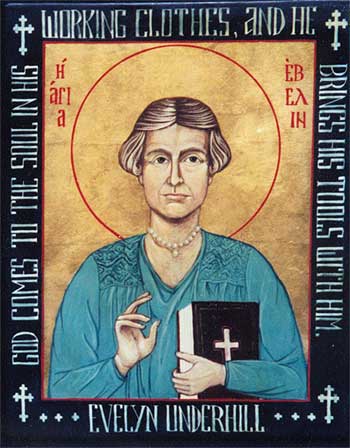
The icon portrait of Evelyn Underhill is by Suzanne Schleck.
This new way of attending to life – this deepening and widening of outlook – may at least be as helpful to all of us as many things to which we have unhesitatingly consecrated much time and diligence in the past: our long journeys to new countries, for instance, or long hours spent in acquiring new ‘facts,’ relabeling old experiences, gaining skill in new arts and games.
These, it is true, were quite worth the effort expended upon them: for they gave you in exchange for your labor and attention, a fresh view of certain fragmentary things, a new point of contact with the rich world of possibilities, a tiny enlargement of your universe in one direction or another.
Your love and patient study of nature, art, science, politics, business – even of sport- repaid you thus. But I… offer you, in exchange for a meek and industrious attention to another aspect of the world, hitherto somewhat neglected by you, an enlargement which shall include and transcend all these; and be conditioned only by the perfection of your generosity, courage, and surrender.
Nor are you to suppose that this enlargement will be limited to certain new spiritual perceptions, which the arts of contemplation make possible for you: that it will merely draw the curtain from a window out of which you have never looked. This new wide world is not to be for you something seen, but something lived in: and you – since we are creatures of response – will insensibly change under its influence, growing into a more perfect conformity with it.
Living in this atmosphere of (reality, we can, in fact), become more real. Hence, if you – and I acknowledge that there at the beginning an attitude of faith is essential – and if you practice with diligence the arts (we are given): then, sooner or later, you will inevitably find yourself deeply and permanently changed by them – will perceive that you have become a “new person.” Not merely will you have acquired new powers of perception and new ideas of reality; but a quiet and complete transformation, a strengthening and maturing of your personality will take place.
You are still, it is true, living the ordinary life of the body. You are immersed in the stream of duration; a part of the human, the social, the national group. The emotions, instincts, needs, of that group affect you. Your changing scrap of vitality contributes to its corporate life; and contributes the more effectively since a new, intuitive sympathy has now made its interests your own.
Because of that corporate life, transfusing you, giving to you and taking from you – conditioning you as it does in countless oblique and unapparent ways – you are still compelled to react to many suggestions which you are no longer able to respect: controlled, to the last moment of your bodily existence and perhaps afterwards, by habit, custom, the good old average way of misunderstanding the world. To this extent, the crowd-spirit has you in its grasp.
Yet in spite of all this, we are now released from that crowd’s tyrannically overwhelming consciousness as we never were before. We can feel ourselves now a separate vivid entity, a real, whole person: dependent on the whole, and gladly so dependent, yet with that whole a free self-governing thing. Perhaps you always fancied that your will was free – that you were actually, as you may have sometimes said, the ‘captain of your soul.’
If so, this was merely one amongst the many illusions which supported your old, constrained career. As a matter of fat, you were driven along a road, unaware of anything that lay beyond the hedges, pressed on every side by other members of the flock; getting perhaps a certain satisfaction out of the deep warm stir of the collective life, but ignorant of your destination, and with your personal initiative limited to the snatching of grass as you went along, the pushing of your way to the softer side of the track.
These operations made up together that which you called success. But now, because you have achieved a certain power of gathering yourself together, perceiving yourself as a person, a spirit, and observing your relation with these other individual lives – because too, hearing now and again the mysterious piping of the Shepherd*, you realize your own perpetual forward movement and that of the flock, in its relation to that living guide – you have a far deeper, truer knowledge than ever before both of the general and the individual existence; and so are able to handle life with a surer hand.
Do not suppose from this that your new career is to be perpetually supported by agreeable spiritual contacts, or occupy itself in the mild contemplation of the great world through which you move. True, it is said of the Shepherd that he carries the lambs in his bosom: but the sheep are expected to walk, and put up with the inequalities of the road, the bunts and blunders of the flock.
It is to vigor rather than to comfort that we are called. Since the transcendental aspect of your being has been brought into focus you are now raised out of the mere push-forward, the blind passage through time of the flock, into a position of creative responsibility. You are aware of personal correspondences with the Shepherd. You correspond, too, with a larger, deeper, broader world.
The sky and the hedges, the wide lands through which you are moving, the corporate charater and meaning of the group to which you belong – all these are now within the circle of your consciousness; and each little event, each separate demand or invitation which comes to you is now seen in a truer proportion, because you bring to it your awareness of the whole. Your journey ceases to be an automatic progress, and takes on some of the characters of a free act: for ‘things’ are now under you, you are no longer under them.
You will hardly deny that this is a practical gain: that this widening and deepening of the range over which your powers of perception work makes you more of a whole person than you were before, and thus adds to rather than subtracts from your total practical efficiency. It is indeed only when one reaches these levels, and feels within this creative freedom –this full actualization of oneself – on the one hand: on the other hand, the sense of a world-order, a love and energy on which one can depend and with whose interests the person is now at one, that person finally becomes fully human, capable of living the real life of eternity in the midst of the world of time.
And what, when you have come to it, do you suppose to be your own function in this vast two-fold scheme? Is it for nothing, do you think, that you are thus a meeting-place of two orders? Surely it is your business, so far as you may, to express in action something of the real character of that universe within which you now know yourself to live?
Artists, aware of a more vivid and more beautiful world than others, are always driven by their love and enthusiasm to try and express, bring into direct manifestation, those deeper significances of form, sound, rhythm, which they have been able to apprehend: and, doing this, they taste deeper and deeper truths, make ever closer unions with the real.
For them, the duty of creation is tightly bound up with the gifts of love. In their passionate outflowing to the universe which offers itself under one of its many aspects to their adoration, that other-worldly fruition of beauty is always followed, balanced, completed, by a this-world impulse to creation: a desire to fix within the time-order, and share with others, the vision by which they were possessed.
Each one, thus bringing new aspects of beauty, new ways of seeing and hearing within the reach of their corner of our human condition, does something to amend the sorry universe of common sense, the more hideous universe of greed, and redeem our companions from their old, slack servitude to a lower range of significances. It is in action, then, that these find their truest and safest point of insertion into the living, active world of reality: in sharing and furthering its work of manifestation they know its secrets best.
For them contemplation and action are not opposites, but tow interdependent forms of a life that is one–a life that rushes out to a passionate communion with the true and beautiful, only that it may raw from this direct experience of reality a new intensity wherewith to handle the world of things; and remake it, or at least some little bit of it, ‘nearer to the heart’s desire.’
Again, the great mystics tell us that the ‘vision of God in his own light’ – the direct contact of the soul’s substance with the absolute – to which awful experience you drew as near as the quality of your spirit would permit in the third degree of contemplation (2), is the prelude, not to a further revelation of the eternal order given to us, but to an utter change, a vivid life springing up within, which is sometimes called the ‘transforming union’ or the ‘birth of the Son in the soul.’
By this is meant that the spark of spiritual stuff, that high special power or character of human nature, by which we first desired, then tended to, then achieved contact with reality, is as it were fertilized by this profound communion with its origin; becomes strong and vigorous, invades and transmutes the whole personality, and makes of it, not a ‘dreamy mystic’ but an active and impassioned servant of the eternal wisdom.
So that when these full-grown, fully vital mystics try to tell us about the life they have achieved, it is always an intensely active life that they describe. They say, not that they ’dwell in restful fruition,’ though the deep and joyous knowledge of this, perhaps too the perpetual longing for an utter self-loss in it, is always possessed by them – but that they ‘go up anddown the Ladder of contemplation.’
They stretch up towards the point, the unique reality to which all the intricate and many-colored lines of life flow, and in which they are merged; and rush out towards those various lives in a passion of active love and service. This double activity, this swinging between rest and work – this alone, they say, is truly the life of our humanity; because this alone represents on human levels something of that inexhaustibly rich yet simple life, ‘ever active yet ever at rest,’ which they find in God.
When we get to this, then we have indeed actualized our union with reality; because then we are a part of the perpetual creative act, the eternal generation of the divine thought and love. Therefore contemplation, even at its highest, dearest, and most intimate, is not to be for us an end in itself.
It shall only be truly ours when it impels us to action: when the double movement of transcendent love, drawing inwards to unity and fruition, and rushing out again to creative acts, is realized in us. We are to be a living, ardent tool with which the supreme artist works: one of the instruments of his, its, that great mysteries self-manifestation, the perpetual process by which reality is brought into expression.
Now the expression of vision, of reality, of beauty, at an artist’s hands – the creation of new life in all forms – has two factors: the living molding creative spirit, and the material in which it works. Between these two there is inevitably a difference of tension. The material is at best inert, and merely patient of the informing idea; at worst, directly recalcitrant to it. Hence, according to the balance of these two factors, the amount of resistance offered by stuff to tool, a greater or less energy must be expended, greater or less perfection of result will be achieved.
We, accepting the wide deep universe of the mystic, and the responsibilities that go with it, have by this act taken sides once for all with creative spirit: with the higher tension, the unrelaxed effort, the passion for a better, intenser, and more significant life. The adoption to which we are vowed is not an affair of red hassocks and authorized hymn books; but a burning and consuming fire.
We will find, then, that the world, going its own gait, busily occupied with its own system of correspondences – yielding to every gust of passion, intent on the satisfaction of greed, the struggle for comfort or for power – will oppose our new eagerness; perhaps with violence, but more probably with the exasperating calmness of a heavy animal which refuses to get up.
If our new life is worth anything, it will flame to sharper power when it strikes against this dogged inertness of things; for we need resistances on which to act. ‘The road to a yes lies through a no,’ and righteous warfare is the only way to a living and lasting peace.
Further, we can observe more and more clearly, that the stuff of our external world, the method and machinery of our common life, is not merely passively but actively inconsistent with our sharp interior vision of the truth. The heavy animal is diseased as well as indolent. All of our perverse ways of seeing our universe, all the perverse and hideous acts which have sprung from them – these have set up reactions, have produced deep disorders in the world of things.
We are free, and hold the keys of hell as well as those of heaven. Within the love-driven universe which we have learned to see as a whole, we can also find egotism, rebellion, meanness, brutality, squalor: the work of separated selves whose energies are set athwart the stream. But every aspect of life, however falsely imagined, can still be ‘saved,’ turned to the purposes of reality: for ‘all-thing hath their being by the love of God.’
Its oppositions are no part of its realness; and therefore they can be overcome. Is there not here, then, abundance of practical work for you to do; work which is the direct outcome of our mystical experience? Are there not here, as the French proverb has it, plenty of cats for you to comb? And isn’t it just here, in the new foothold it gives us, the new clear vision and certitude – in its noble, serious, and invulnerable faith – that mysticism is ‘useful;’ even for the most ‘scientific’ of social reformers, the most belligerent of politicians, the least sentimental of philanthropists?
To ‘bring eternity into time,’ the ‘invisible into concrete expression;’ to ‘be to the eternal goodness what one’s own hand is to a person’ – these are plainly expressed desires of all the great mystics. One and all, they demand earnest and deliberate action, the insertion of the purified and ardent will into the world of things.
The mystics are artists; and he stuff in which they work is most often human life. They want to heal the disharmony between the actual and the real: an since, in the white-hot radiance of that faith, hope, and charity which burns in them, they discern sucha reconciliation to be possible, they are able to work for it with a singleness of purpose and an invincible optimism toward others.
This was the instinct which drove St Francis of Assisi to the practical experience of that poverty which he recognized as the highest wisdom; St Catherine of Siena from contemplation to politics; Joan of Arc to the salvation of France; St Teresa to the formation of an ideal religious family; George Fox to the proclaiming of a world-religion in which all people should be guided by the inner light; Florence Nightingale to battle with officials, vermin, dirt, and disease in the soldiers’ hospitals; Octavia Hill to make in London slums something a little nearer the ‘shadows of the angels’ houses’ than that which the practical landlord usually provided.
All these have felt sure that a great part in the drama of creation has been given to the free spirit: that bit by bit, through an by the divine, the scattered worlds of love and thought and acion shall be realized again as one. It is for those who have found the thread on which those worlds are strung, to bring this knowledge out of the hiddenness; to use it, as the old alchemists declared that they could use their tincture, to transmute all baser metals into gold.
So here is our vocation set out: a vocation so various in its opportunities, that we, each of us, can hardly fail to find something to do. It is your business to actualize within the world of time and space – perhaps by great endeavors in the fields of heroic action, perhaps only by small ones in field and market, commuting life, office, or at home, in the perpetual give-and-take of our common life – that more real life, that holy creative energy, which this world manifests as a whole but indifferently.
We can work for mercy, order, beauty, significance: we can mend wher ewe find things broken, make where we find the need. ‘Adoro te devote, latens Deitas,’ said, Thomas in his great mystical hymn: and the practical side of that adoration consists in the brining of the real presence from its hiddenness, and exhibiting it before the eyes of all others.
Hereto you may have not been very active in this matter: yet it is the purpose for which you exist, and your contemplative consciousness, if you educate it, will soon make this fact clear to you. The teeming life of nature has yielded up to your loving attention many sacramental images of reality; seen in the light of charity, it is far more sacred and significant than you may have supposed.
What about yourlife? Is that a theophany too? ‘Each oak doth cry I am,’ says Thomas Vaughan. Do you proclaim by your existence the grandeur, the beauty, the intensity, the living wonder of that eternal reality within which, at this moment, you stand? Do your hours of contemplation and of action harmonize?(3)
If they did harmonize – if everybody’s did – then, by these individual adjustments the complete group-consciousness of humanity would be changed, brought back into conformity with the transcendent; and the spiritual world would be actualized within the temporal order at last. Then, that world of false imagination, senseless conflicts, and sham values, into which our children are now born, would be annihilated.
The whole of our species, not merely a few of its noblest, most clear-sighted spirits, would be ‘in union with God;’ and people, transfused by the mysterious light and heat, direct and willing agents of the that pure activity, would achieve that completeness of life which the mystics dare to call ‘deification.’ This is the substance of that redemption of the world, which all religions proclaim or demand: the consummation which is crudely imagined in the Apocalyptic dreams of the prophets and seers.
It is the true incarnation of the divine wisdom: and you must learn to see with Paul the pains and disorders of creation – your own pains, efforts, and difficulties too – as incidents in the travail of that royal birth. Patriots have sometimes been asked to ‘think patriotically.’ Mystics are asked to think celestially; and this, not when considering the things usually called spiritual, but when dealing with the concrete manifestations, the evil and sadness, the cruelty, failure, and degenerations of life.
So, what is being offered to you is not merely a choice amongst new states of consciousness, new emotional experiences – though these are indeed involved in it – but, above all else, a larger an intenser life, a career, a total consecration to the interests of the real. This life shall not be abstract and dreamy, made up, as some imagine, of negations. It shall be violently practical and affirmative; giving scope for a limitless activity of will, heart, and mind working within the rhythms of the divine ideal.
It shall cost much, making perpetual demands on your loyalty, trust, and self-sacrifice: proving now the need and the worth of that training in renunciation which was forced on you at the beginning of your interior life. It shall be both deep and wide, embracing in its span all those aspects of reality which the gradual extension of your contemplative powers has disclosed to you: making ‘the inner and outer worlds to be indivisibly one.’
And because the emphasis is now for ever shifted from the accidents to the substance of life, it will matter little where and how this career is actualized – whether in convent or factory, study or battlefield, multitude or solitude, sickness or strength. These fluctuations of circumstance will no longer dominate you; since ‘it is love that payeth for all.’
Yet by all this it is not meant that te opening up of the universe, the vivid consciousness of a living reality and your relation with it, which came to you I contemplation, will necessarily e a constant or a governable feature of your experience. Een under the most favorable circumstances, you shall and must move easily and frequently between that spiritual fruition and active work in the world.
Often enough it will slip from you utterly; often your most diligent effort will fail to recapture it, and only its fragrance will remain. The more intense those contacts have been, the more terrible will be your hunger and desolation when they are thus withdrawn: for increase of susceptibility means more pain as well as more pleasure, as every artist knows.
But you will find in all that happens to you, all that opposes and grieves you – even in those inevitable hours of darkness when the doors of our true perception seem to close, and the cruel tangles of the world are all that you can discern – an inward sense of security which will never cease. All the waves that buffet you about, shaking sometimes the strongest faith and hope, are yet parts and aspects of one ocean.
Did they wreck you utterly, that ocean would receive you; and there you would find, overwhelming and transfusing you, the unfathomable substance of all life and joy. Whether you realize it in its personal or impersonal manifestations, the universe is now friendly to you; and as it is a suspicious and unworthy lover who asks every day for renewed demonstrations of love, so you o not demand from it perpetual reassurances.
It is enough, that once it showed you its heart. A link of love now binds you to it for evermore: in spite of derelictions, in spite of darkness and suffering, your will is harmonized with the wild that informs the whole.
We said, at the beginning that mysticism was the art of union with reality: that it was, above all else, a science of love. Hence the condition to which it looks forward and towards which the should of the contemplative has been stretching out, is a condition of being, and not of seeing. As the bodily senses have been produced under pressure of our physical environment, and our true aim is not the enhancement of pleasure or knowledge, but a perfecting of our adjustment to those aspects of the natural world which concern us – so the use and meaning of the spiritual senses are strictly practical too.
These, when developed by a suitable training, reveal to us a certain measure of reality: not in order that we mau gaze upon it, but in order that we may react to it, learn to live in, with, and for it; growing and stretching into more perfect harmony with the eternal order, until at last, lie the blessed ones of Dante’s vision, the clearness of that flame responds to the unspeakable radiance of the enkindling light.
- 1. Ms Underhill’s shepherd is Christ, if the mystical Christ. I suggest there are others worthy of that title “Shepherd,” as well. I think of the Buddha. I think of the ancestors of the Zen way.
- 2. The three “degrees” of contemplation are explored earlier in the book. In the first stage one finds unity with the natural world, and its constant becoming, in the second one finds unity with the spiritual realms and the world of being, and finally in the third world one finds unity with the world of “the real.”
- 3. The great question, and, frankly, the test of an authentic interior life. Does it have some sort of fruiting within ordinary life? Does your insight lead you to some sort of reahing out to another?
Next Post

April 9, 2018 Zen, Enlightenment, When, And...
Browse Our Archives
Select a Category A Christmas Carol Abolitionist African-American Ahmadiyya Alan Watts Aldous Huxley Allen Ginsberg Amedkar Jayanti American politics American Zen Anaheim Zen Sangha Anglican Annie Besant April Fool Armageddon Art and Religion artificial intellegence Atheist Awakening B R Ambedkar Barlaam & Josaphat Beatnik Between Bhagavad Gita Bible biography birthday bodhisattva Bodhisattva Precepts Book burning Book of Common Prayer Book of Mormon Brahmo Samaj Buddha Buddhism Buddhist Buddhist Lord's Prayer Butterflies Calendars cartoons cat ChatGPT Chicken Tortilla Soup choices Christian atheism Christian mysticism Christian origins Christian Science Christian Zen Christianity Christianity and Buddhism christmas Christmas Truce Christopher Isherwood Church of Later Day Saints Cinco de Mayo circus covenant critical thinking culture D. T. Suzuki Dalit Buddhism Daniel Defoe Desert Fathers and Mothers dharma talk Dogen Donald Trump Dongshan's Five Ranks Dorothy Day dream Duty Easter ecology Edwin Arnold emptiness Empty Moon Zen Network Episcopal Church Eternal Now Ethics evolution existentialism Faith fantasy Fathers Day film film review fire Five Ranks Folk music food Form and emptiness Four Seals Francis of Assisi Francis Xavier Free thinker friendship George MacDonald Gerald Heard Glenn Taylor Webb God Good Friday Gospel of Gospel of Mark Gospel of Thomas grace Graduate Theological Unioin Graduate Theological Union Guanyin H R Blyth Hakuin Ekaku Hanamatsuri Hanukkah Harada Yasutani Zen Heart Sutra Henry David Thoreau Hermann Hesse Hinduism History and Religion history of religion Holy Spirit home Hospitality Icon Ides of March Isaac Newton Islam Islamic mysticism Jack Kerouac James Luther Adams Jiddu Krishnamurti Joan of Arc Johannes Gutenberg John Donne joke Judaism justice karma kensho King James Bible koan Koun Yamada Kyoto School Lewis Carrol Liberal Christianity Liberal Religion Life Plan Community Liminal literature Literature and Religion Liturgy Lord's Prayer Love Mahatma Gandhi Mahayana Martin Luther King Jr Mary Baker Eddy Mary Magdelene Mary Oliver Mayflower Compact Meditation memories memory metaphor money money and religioin Mormons Mother's Day movie review mysticism mythic Neighborhood Unitarian Universalist Church New Thought Nichiren Buddhism Nonduality not knowing Omar Khayyam Pacific School of Religion pagan Palm Sunday Passover peace Pentecost perennialism Phantastes Philip Kapleau philosophy Pilgrimage poetry Poetry and Religion politics Prayer Precepts Printing Press prophecy prophetic spirituality psychology Pure Land Queer religion queering religion Quietism Ram Mohan Roy rebirth recipe Relationships and religion religion religion and history Religious syncretism Resistance Retirement Retreat review Rissho Kosei Kai Ritual Robert Aitken Roshi Robert Ingersoll Rohatsu Romani religion Rosie the Riveter saints samadhi SanboZen Sangha Satyagraha science science and reigion science and religion science fiction seminary sermon Sesshin Sex and Religion Shinran Sikh Sikh tradition silence Social Justice Socially Engaged Buddhism Society and religion Soto Zen soul spiritual community spiritual practice Spirituality Sufism Suicide superstition Taoism Television Teresa of Avila Thanksgiving theological schools Theosophy Thomas Merton Time Transcendentalism Transcendentalist Trinitarian Trinity Uncategorized unitarian Unitarian Christianity Unitarian Universalist Universalism Vajrayana Vedanta Walking war Willa Cather William Ellery Channing wisdom women and religion women in religion World Teacher Writing zazen Zen Zen Center Zen inspired retriement zen meditation Zen Precepts Zen women
Select a Month September 2026 August 2026 July 2026 June 2026 May 2026 April 2026 March 2026 February 2026 January 2026 December 2025 November 2025 October 2025 September 2025 August 2025 July 2025 June 2025 May 2025 April 2025 March 2025 February 2025 January 2025 December 2024 November 2024 October 2024 September 2024 August 2024 July 2024 June 2024 May 2024 April 2024 March 2024 February 2024 January 2024 December 2023 November 2023 October 2023 September 2023 August 2023 July 2023 June 2023 May 2023 April 2023 March 2023 February 2023 January 2023 December 2022 November 2022 October 2022 September 2022 August 2022 July 2022 June 2022 May 2022 April 2022 March 2022 February 2022 January 2022 December 2021 November 2021 October 2021 September 2021 August 2021 July 2021 June 2021 May 2021 April 2021 March 2021 February 2021 January 2021 December 2020 November 2020 October 2020 September 2020 August 2020 July 2020 June 2020 May 2020 April 2020 March 2020 February 2020 January 2020 December 2019 November 2019 October 2019 September 2019 August 2019 July 2019 June 2019 May 2019 April 2019 March 2019 February 2019 January 2019 December 2018 November 2018 October 2018 September 2018 August 2018 July 2018 June 2018 May 2018 April 2018 March 2018 February 2018 January 2018 December 2017 November 2017 October 2017 September 2017 August 2017 July 2017 June 2017 May 2017 April 2017 March 2017 February 2017 January 2017 December 2016 November 2016 October 2016 September 2016 August 2016 July 2016 June 2016 May 2016 April 2016 March 2016 February 2016 January 2016 December 2015 November 2015 October 2015 September 2015 August 2015 July 2015 June 2015 May 2015 April 2015 March 2015 February 2015 January 2015 December 2014 November 2014 October 2014 September 2014 August 2014 July 2014 June 2014 May 2014 April 2014 March 2014 February 2014 January 2014 December 2013 November 2013 October 2013 September 2013 August 2013 July 2013 June 2013 May 2013 April 2013 March 2013 February 2013 January 2013 December 2012 November 2012 October 2012 September 2012 August 2012 July 2012 June 2012 May 2012 April 2012 March 2012 February 2012 January 2012 December 2011 November 2011 October 2011 September 2011 August 2011 July 2011 June 2011 May 2011 April 2011 March 2011 February 2011 January 2011 December 2010 November 2010 October 2010 September 2010 August 2010 July 2010 June 2010 May 2010 April 2010 March 2010 February 2010 January 2010 December 2009 November 2009 October 2009 September 2009 August 2009 July 2009 June 2009 May 2009 April 2009 March 2009 February 2009 January 2009 December 2008 November 2008 October 2008 September 2008 August 2008 July 2008 June 2008 May 2008 April 2008 March 2008 February 2008 January 2008 December 2007 November 2007 October 2007 September 2007 August 2007 July 2007 June 2007 May 2007 April 2007 March 2007 February 2007 January 2007 December 2006 November 2006 October 2006 September 2006
Follow Us!
TAKE THE
Religious Wisdom Quiz
What did Job famously say in response to loss: "The Lord gave and..."?
Select your answer to see how you score.
I have nothing left I will run away May His name be praised The Lord has taken away
Related posts from Monkey Mind

Keizan Jokin: The Zen Master Ancestor You Don't...

What Zen Practice Actually Does With Anger

Nanquan Cuts the Cat: A Jesuit commentary on...

On Taking Refuge in the Dharma
TRENDING AT PATHEOS Buddhist

Methodist Central Hall and Westminster Abbey
Situated on the same square is Methodist Central Hall and Westminster Abbey. ...

57th Dove Awards Honor Dolly Parton, Crown New...
On gospel music’s biggest night, the 57th annual GMA Dove Awards honored...

The First Eucharistic Controversy: Christ’s Real Presence
For Catholics, the Eucharist is the source and summit of the Christian...

What a Stop Sign Can Teach Us About...
How to Make a Decision When You Can't Hear God Main point:...

Archdiocese Hosts Military Marriage Retreat in Germany
RASTATT, Germany — The transient military lifestyle, with its frequent deployments and...

Nearly every morning, I make the drive to Detroit with my high-school-age...
view all Buddhist blogs
Ad-Free & Subscriber Log-In Subscription Support
- About Us
- 2026 Calendar
- Videos
- Podcasts
- Library of World Religions
- Faith In Media Tracker
- Advertise With Us
- Write for Us
- Privacy Policy
- Terms of Service
- Do Not Sell My Data
- Contact Us
- Radiant Digital
- Manage Newsletter Subscriptions
- Unsubscribe From Notifications
- Sitemap
Copyright 2008-2026, Patheos. All rights reserved.
Subscription Support Ad-Free & Subscriber Log-In
Follow Patheos