
BuddhistCatholicContemplativeEvangelicalGeneral ChristianHinduJewishLatter-day SaintMuslimNew VisionsProgressive Christian
Beliefs
- Buddhist
- Catholic
- Contemplative
- Evangelical
- General Christian
- Hindu
- Jewish
- Latter-day Saint
- More Voices
- Muslim
- New Visions
- Pagan
- Progressive Christian
Topics
- Religion News
- Food and Religion
- Sports and Religion
- Religious Art
- Religious Music and Entertainment
- Religious Events
- History and Religion
- Style and Religion
- Politics and Religion
- Women in Religion
- Recreation Outdoors and Religion
- Business Finance and Religion
- Careers Workplace and Religion
- Education and Religion
- Family Parenting and Religion
- Health Fitness and Religion
- Home and Religion
- Relationships and Religion
- Technology and Religion
- Travel and Religion
Columnists
- Buddhist Columnists
- Business Finance and Religion Columnists
- Careers Workplace and Religion Columnists
- Catholic Columnists
- Contemplative Columnists
- Education and Religion Columnists
- Evangelists Columnists
- Family Parenting and Religion Columnists
- General Christian Columnists
- Health Fitness and Religion Columnists
- Hindu Columnists
- History and Religion Columnists
- Home and Religion Columnists
- Jewish Columnists
- More Voices Columnists
- Latter Day Columnists
- Muslim Columnists
- New Visions Columnists
- Nonreligious Columnists
- Pagan Columnists
- Politics and Religion Columnists
- Progressive Columnists
- Recreation Outdoors and Religion Columnists
- Relationships and Religion Columnists
- Religion News Columnists
- Religious Art Columnists
- Religious Events Columnists
- Religious Music and Entertainment Columnists
- Sports and Religion Columnists
- Style and Religion Columnists
- Technology and Religion Columnists
- Travel and Religion Columnists
- Women in Religion Columnists
Resource Library
- 2026 Calendar
- Library of World Religions
- The 100 Most Holy Places on Earth
- Patheos Answers
- Podcasts
- Videos
- Faith Leaders Database
- Anglican Episcopalian
- Bahai
- Baptist
- Buddhism
- Christianity
- Confucianism
- Eastern Orthodoxy
- Hinduism
- Holiness and Pentecostal
- ISKCON
- Islam
- Judaism
- Lutheran
- Methodist
- The Church of Jesus Christ of Latter-day Saints
- New Age
- Paganism
- Presbytarian and Reformed
- Protestantism
- Religion Behind the Scenes
- Roman Catholic
- Scientology
- Shia Islam
- Sikhism
- Sufism
- Sunni Islam
- Taoism
- Zen
- See all religions
Research Tools
 Ad-Free & Subscriber Log-In Subscription Support
Ad-Free & Subscriber Log-In Subscription Support
Follow Patheos 

- Trending:
- Forgiveness
- |
- Marriage
- |
- Consciousness
- |
- Death Penalty
- |
- Election
- |
- Halloween

- Home
- Buddhist
- A Meditation on Our Broken World, Zen’s Ten Oxherding Pictures, & the Intimate Way
A Meditation on Our Broken World, Zen’s Ten Oxherding Pictures, & the Intimate Way
Last updated on: February 18, 2018 at 1:27 pm by James Ford
A Meditation on Our Broken World, Zen’s Ten Oxherding Pictures, & the Intimate Way 2018-02-18T13:27:00-08:00 James Ford
Patheos Explore the world's faith through different perspectives on religion and spirituality! Patheos has the views of the prevalent religions and spiritualities of the world.
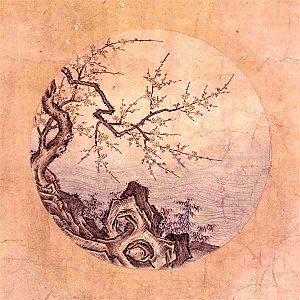
Mapping Our Spiritual Journey
A Meditation on Our Broken World, Zen’s Ten Oxherding Pictures, & the Intimate Way
18 February 2018
Orange Coast Unitarian Universalist Church
Costa Mesa, California
James Ishmael Ford
We shall not cease from exploration, and the end of all our exploring will be to arrive where we started and know the place for the first time.
T. S. Eliot, Little Gidding
Vision without action is a dream
Action without vision is a nightmare.
Japanese proverb
Recently I was contacted by someone who explained he’d been made a spiritual teacher by the Tibetan master Padmasambhava. As that particular master has been dead for about twelve hundred years, I admit I was suspicious. He then went on to explain how there are serious problems in my spiritual tradition, Zen, and particularly with the discipline that I principally teach, koan introspection. I’ve been a practitioner on this way for nearly fifty years and a teacher for more than twenty, so hearing there were problems, well, no surprise.
He then went on to explain that real spiritual practices, like, he said, koans, are all “mechanical.” You stick yourself in one end and enlightenment comes out the other. Kind of like a meat grinder. He continued how the discipline as it is usually taught isn’t quite right. And that’s why not everyone who practices koan Zen gets enlightened. He then generously offered his fix, sort of a spiritual version of a computer patch. I replied I wasn’t interested, thank you. My mother taught me always to be polite. And then I blocked him. That’s another computer term.
The exchange did set me to thinking, however. Not about sure-fire fixes for our spiritual practices. Well, a little about that. But, mostly about our paths themselves, the whys and the ways we bring intentionality to the matter of life and death and meaning. It set me to thinking about what I’d call our maps of the spiritual life.
Of course, with a talk to a bunch of Unitarian Universalists beginning with some definitions of terms might be in order. So, first that messy and complicated word “spiritual.” It can mean so many things. That’s both the joy and the difficulty of language and particularly words. We could spend all our time here unpacking “spiritual.” But, let me simply summarize. Spiritual has its metaphorical roots in breath. And, something I find really interesting is how in fact pretty much all cultures and their religions use this primary metaphor of breath for that quest for meaning and purpose in life.
I take some particular significance out of that near, perhaps actually universal use of spiritual for the great quest of our human hearts. And that brings up a second term necessary for this reflection. I first stumbled upon the term “perennialism” in Aldous Huxley’s lovely book the Perennial Philosophy, which I found in my mid adolescence. For me in my youth searching for an intellectually honest spiritual path, which meant to me not obviously conflicting with the natural world, this book together with Richard Maurice Bucke’s Cosmic Consciousness, and William James’ Varieties of Religious Experience outlined the general direction for my quest for meaning and purpose in life. It definitely doesn’t end there. In fact, today I have serious criticisms of all three books. But they were how I started.
That noted, I have a complicated relationship with perennialism. On the one hand, I think it broadly points in the right direction when it suggests there are universal truths that each religion touch. This insight is a big reason I would eventually find myself a Unitarian Universalist. On the other hand, it seems pretty obvious to me that there is not a single mountain with all religions following their separate paths up to the same summit. Lots of different mountains. Pretty obvious to anyone who reads more than headlines about religions. And, with that, some of these religions, I find, are more useful than others. Which is probably why Zen Buddhism and its disciplines remains the core of my actual interior life.
Looking broadly, I find there are currents of religion that seem pretty obviously rooted in our biology. Making those things “universal,” at least so far as humans are concerned. And if I read that correctly, I hope it would also be obvious these are insights available without any religion at all. Still, it is the primacy project of religion. And with that another definition. Religion, I find, consists of those attempts within cultures to coalesce their collective wisdom about meaning.
Finding meaning, awakening, salvation, all those different words that point to some great healing of some terrible rift are in fact about our totally human, absolutely natural sense of dis-connection, and with that, our deep ability to see into our connections. So. The real stuff, authentic spirituality, religion that matters, is all about, as the Zen teacher Dosho Port tells us, “nondual embodiment.” Everything else is extras
And with that, spiritual maps. We’ve well been warned by Alfred Korzybski that “the map is not the territory.” And, Gregory Bateson makes sure we get it by adding “the name is not the thing named.” The reason that I close to immediately blocked my astrally ordained spiritual master was not the astral thing, although given my taste buds in such matters that could have been enough. But because he reduced my spiritual path to a mechanical thing that just needed some oil at the juncture of some gears. That let me know he had no clue. There are spiritual disciplines. They can be enormously useful. I’ve given my life to one. But, they are not mechanical. They are organic. I would add they are also human things, developed by people, and subject to absue. And, always, always, they only help. They only point, they only shepherd, they only guide.
Two other things have to happen, not directly connected to the spiritual technologies we take up. One is volitional. We, that is you or me, we have to want, we have to be willing, we have to open our hearts and minds to the project. Or, to use another difficult word, we have to surrender into the process. And, still, that isn’t quite enough. Then, in some mysterious and frankly unfathomable, unmappable, unpredictable way, the insight, the opening, the grace that allows us to see the whole thing in all its particulars, happens when it happens. To quote the scriptures of the Western tradition, the spirit rests where it will.
All this said: messy, map isn’t the territory, spirit rests where it will, many truths: there are, nonetheless, genuine pointers for those of us who wish to walk the paths of spirit, who seek to know with our own lives the deeper realities of this life. There are maps we can trust. Trust, that is, as far as maps can be trusted. Words, I hope that echo with all sorts of hesitations for anyone who has found their favorite GPS map taking them in an endless loop at one time or another. If we use maps, we need to remember, every once in a while, to lift our heads and look around. Get that bigger picture. Do that and then these maps can be quite helpful.
Possibly among the oldest strata of stories that help us mark out a spiritual path is “Hero’s Journey.” Similarly, the Greek mysteries rites, and here in the modern West, the life of Jesus turned into a cycle, as a path for us all.
One of the most compelling maps for me is the sixteenth century Spanish Christian mystic John of the Cross’s map described as the ascent of Mount Carmel. While over the years many have found John Bunyan’s seventeenth century classic, sometimes called the first English language novel, the Pilgrim’s Progress enormously helpful.
And, bottom line, the map I’ve found most useful over the many years comes out of the Zen tradition. It’s called by several names, most commonly either the Ten Oxherding Pictures, or even more simply, the Ten Bulls.
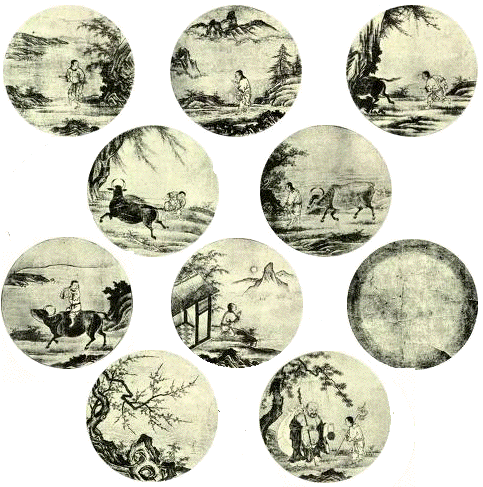
The metaphor of a bull or ox as the image of ourselves and our hidden hearts is ancient. In the putative earliest strata of Buddhist texts the Mahagopalaka Sutta features the image of our path as taming a wild calf. The earliest strata of this actual map in Zen appears to be a five-step version by the eleventh century Chinese master Seikyo, which featured a gradual whitening of the image of the bull until there is simply an empty circle. This conclusion is “corrected” by a rough contemporary, another Zen master Jitoku Ki, who adds in a sixth picture after that experience of emptiness. Also, there’s another map with eight pictures.
But the version that has captured most of us on the path, who find in it a true representation of our way was formulated by a twelfth century Chinese Rinzai Zen master, Kakuan Shien. It became wildly popular. And eventually it made its way to Japan. And, by way of the early translator and interpreter of Zen to the West, D. T. Suzuki, to us. Today there are numerous commentaries on the text, starting with those from Kakuan. Rummaging around my bookshelves I found five by contemporary teachers, Chinese, Japanese, and American. It’s a perennial on the perennial way.
Let’s quickly look at this map of our human hearts, of our longing, and our finding.
First.

It begins with noticing something is missing. For each of us this might be something different. For me at first it was all about God. At the beginning it was “is there a god?”
And, then, somehow, subtly there was a shift, as I realized that God didn’t have to be either the creator and sustainer, or even the destroyer, but rather as I wrote back in seminary, when I was much smarter than I am now, “God is a hole in the language into which we throw all our hopes and fears.” Hole, gaping wide. Although one of my professors helped me on the way to knowing a bit less, when she offered that, “Yes, God is a whole in the language…” Whole as in completion. Although, I’ve long since learned any so-called completion only leads to something new. Whatever, we begin. In the images of the tradition we name that longing of our hearts the Ox.
Second.
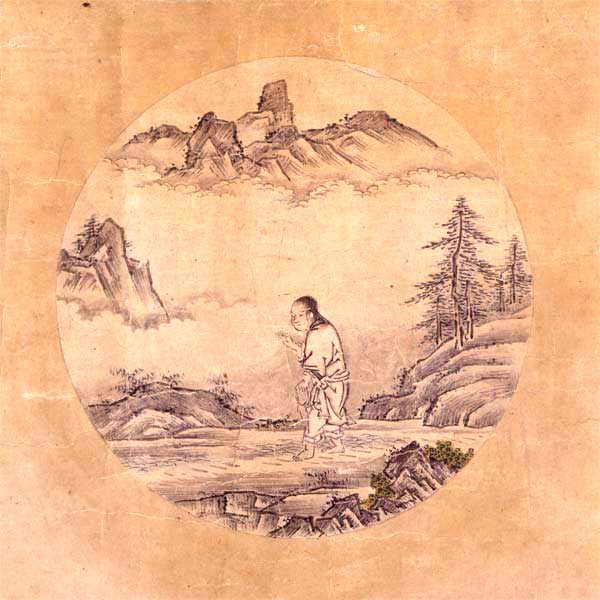
We find some traces. A footprint, maybe some spoor. For me, again, it was probably that shift of attitude from “is” to “what.” There is a mysterious turning when we launch on the spiritual journey, if we pay attention, if we allow our hearts to open to the possibilities. Then it turns out possibilities abound.
Third.

Then, if we’re lucky, we confront the Ox. The power and beauty as terrible as it is, well, it presents. Maybe its seeing your new born child for the first time. Possibly it is a kiss. Maybe it’s finding a job that is more than a job. It can happen walking in the woods or on the beach. It can, and I find this most compelling, it can happen in prison or a foxhole. However it presents that confrontation with reality, with that Ox, changes everything.
Fourth.
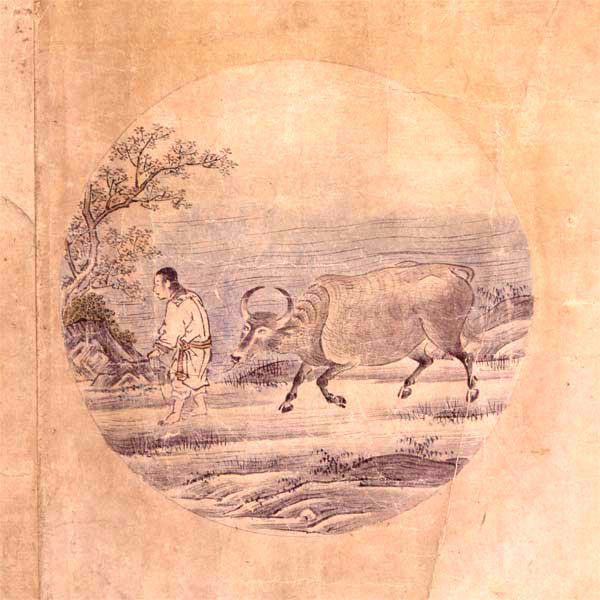
In Zen there are many arguments, endless apparently about whether you practice hard and then get enlightened, or, you get enlightened and then practice hard. What I find is that practice and awakening are intimately connected, but not in any causal way. They are two facets of the same thing. But, with a glimpse of the real, those of us committed to the way, we find our hearts calling, and redouble the disciplines of the heart. For me they are summarized as sit down, shut up, pay attention. And, then, repeat. Each of us needs to find that practice which is right for us.
Fifth.
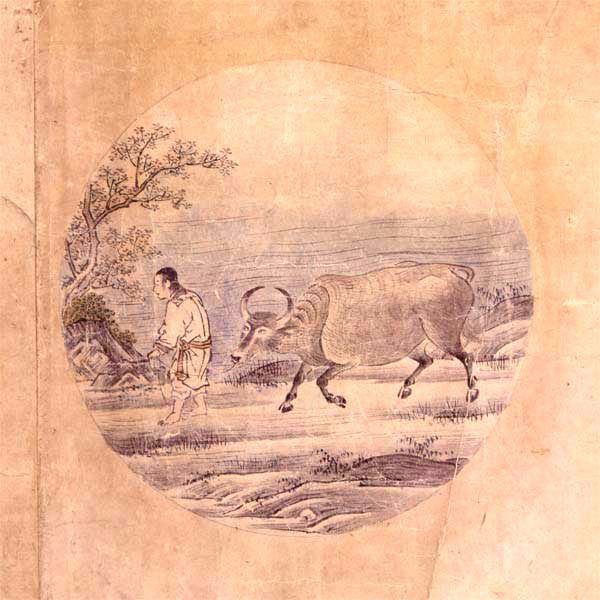
Here is the long path where we begin to find the disciplines are not so much rules that contain us but the boundaries of our own heart. They are permeable, we cross freely from inside to out, and outside to in. The whole world becomes ours. Here we discover the play of the world.
Sixth.
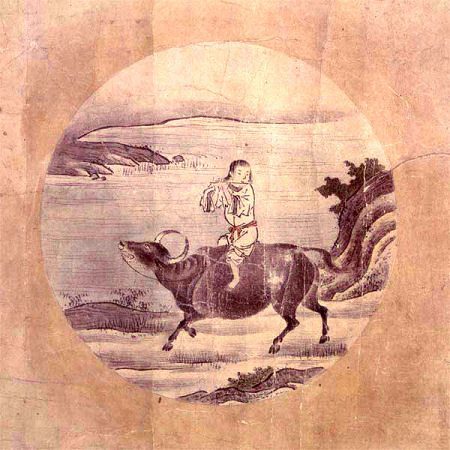
And with that we hear the distant song. It may be faint. But, it enough. And we begin to follow it home.
Seventh.
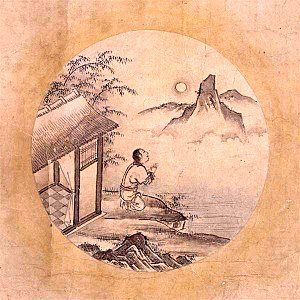
Here we forget all the stuff and bother. In the images we find a simple hut. It’s all we need.
Eighth.
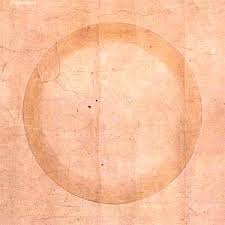
The image is an empty circle. Here we discover that nameless place the Daoist poem describes. “The (way) that can be told/Is not the eternal (way)/The name that can be named/Is not the eternal name.//The unnamable is the eternally real.” In many Eastern spiritual traditions, this is the summum bonum. In fact, as I mentioned, in the earliest version of the Oxherding pictures, for many it ends here. But. But. That would be too bad.
Ninth.
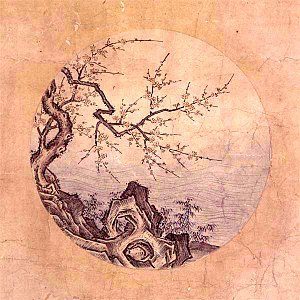
The image clutters up a bit. Here we get a picture of nature. Here we find our mother. Or, if you prefer, our Father. Me, I love that continuing of the Dao de jing I just cited, where we see “Naming is the origin/Of all particular things.” Everything named. Everything authentic, if passing. You. Me. But now discovered with new eyes. Now held with open hands. Now encountered with a different kind of love.
And, yet, even that isn’t the end.
Tenth.
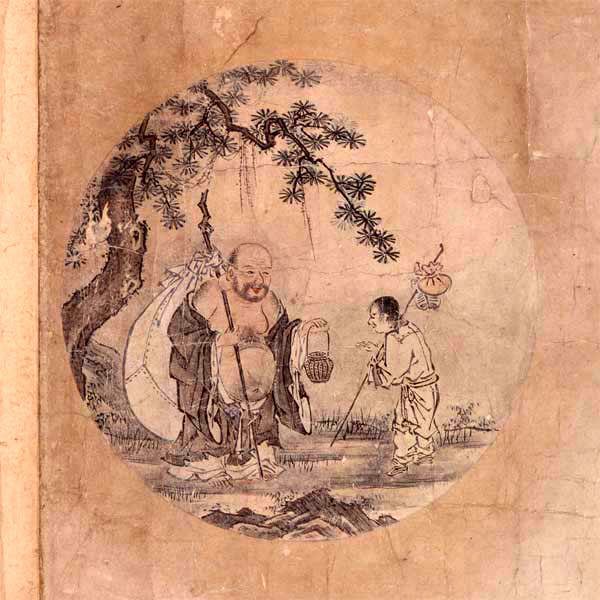
The tenth Oxherding picture shows a fat man encountering the world. In some versions of the pictures the figure is actually walking into a marketplace. One traditional commentary says it is “returning to the world with bliss bestowing hands.” The small inside Buddhist joke is that the image is of Putei or Hotei. He’s the fat monk with the bag of gifts sometimes called the “Laughing Buddha.” Not the Buddha of history, but a Zen monk who will become the Buddha of the next age. Part of the joke is that he represents our common inheritance, our common future. We’re all the Buddha of a next age.
So, that’s one mapping of the spiritual path. One that I’ve found particularly helpful. And maybe you will too. But, let me add in a little bit of direction. Another map of something important in my past was Elisabeth Kubler-Ross’s five stages of grief. Perhaps you know them: denial, anger, bargaining, depression, acceptance. They proved to be an amazing gift to people helping the dying, and, also for many who were dying.
Except that people quickly settled into these “are” the five stages. First you deny. And then so on up to acceptance. But, people turned out to be messy. She named five true things. But, people did them as they wanted. And in no particular order. And, also, and this is important:often returning or starting over.
Well, I suggest we may find the ten Oxherding pictures are equally messy. I’ve known people who’ve manifested that returning to the world without ever having taken on a spiritual path. Not many. But. And, well, pick your picture, it might be the beginning. And then you might discover you’re jumping around. Probably will. That map, as Alfred Korzybski told us, is not the territory. Unlike the guidance of that astrally anointed spiritual teacher, the way is not mechanical.
As T. S. Eliot sang into our hearts, “We shall not cease from exploration, and the end of all our exploring will be to arrive where we started and know the place for the first time.” The spiritual way.
And. One more thing. These are hard times. This is a particularly difficult moment. There’s a Japanese saying, I repeat all the time. I need to hear it. Maybe you do, as well. Vision without action is simply a dream. However, action without vision becomes a nightmare.
You want to be of use in this world? You want to heal the wounds of your own heart? Well, there are maps on that way. The real ones all take you, take us, into the mysteries of intimacy. How are we connected? How are we different?
Find this and you will know what to do.
The intimate way.
Amen.
Previous Post

February 17, 2018
The Cloud of Not Knowing: A Meditation on Zen and the World's Faiths
Browse Our Archives
Select a Category A Christmas Carol Abolitionist African-American Ahmadiyya Alan Watts Aldous Huxley Allen Ginsberg Amedkar Jayanti American politics American Zen Anaheim Zen Sangha Anglican Annie Besant April Fool Armageddon Art and Religion artificial intellegence Atheist Awakening B R Ambedkar Barlaam & Josaphat Beatnik Between Bhagavad Gita Bible biography birthday bodhisattva Bodhisattva Precepts Book burning Book of Common Prayer Book of Mormon Brahmo Samaj Buddha Buddhism Buddhist Buddhist Lord's Prayer Butterflies Calendars cartoons cat ChatGPT Chicken Tortilla Soup choices Christian atheism Christian mysticism Christian origins Christian Science Christian Zen Christianity Christianity and Buddhism christmas Christmas Truce Christopher Isherwood Church of Later Day Saints Cinco de Mayo circus covenant critical thinking culture D. T. Suzuki Dalit Buddhism Daniel Defoe Desert Fathers and Mothers dharma talk Dogen Donald Trump Dongshan's Five Ranks Dorothy Day dream Duty Easter ecology Edwin Arnold emptiness Empty Moon Zen Network Episcopal Church Eternal Now Ethics evolution existentialism Faith fantasy Fathers Day film film review fire Five Ranks Folk music food Form and emptiness Four Seals Francis of Assisi Francis Xavier Free thinker friendship George MacDonald Gerald Heard Glenn Taylor Webb God Good Friday Gospel of Gospel of Mark Gospel of Thomas grace Graduate Theological Unioin Graduate Theological Union Guanyin H R Blyth Hakuin Ekaku Hanamatsuri Hanukkah Harada Yasutani Zen Heart Sutra Henry David Thoreau Hermann Hesse Hinduism History and Religion history of religion Holy Spirit home Hospitality Icon Ides of March Isaac Newton Islam Islamic mysticism Jack Kerouac James Luther Adams Jiddu Krishnamurti Joan of Arc Johannes Gutenberg John Donne joke Judaism justice karma kensho King James Bible koan Koun Yamada Kyoto School Lewis Carrol Liberal Christianity Liberal Religion Life Plan Community Liminal literature Literature and Religion Liturgy Lord's Prayer Love Mahatma Gandhi Mahayana Martin Luther King Jr Mary Baker Eddy Mary Magdelene Mary Oliver Mayflower Compact Meditation memories memory metaphor money money and religioin Mormons Mother's Day movie review mysticism mythic Neighborhood Unitarian Universalist Church New Thought Nichiren Buddhism Nonduality not knowing Omar Khayyam Pacific School of Religion pagan Palm Sunday Passover peace Pentecost perennialism Phantastes Philip Kapleau philosophy Pilgrimage poetry Poetry and Religion politics Prayer Precepts Printing Press prophecy prophetic spirituality psychology Pure Land Queer religion queering religion Quietism Ram Mohan Roy rebirth recipe Relationships and religion religion religion and history Religious syncretism Resistance Retirement Retreat review Rissho Kosei Kai Ritual Robert Aitken Roshi Robert Ingersoll Rohatsu Romani religion Rosie the Riveter saints samadhi SanboZen Sangha Satyagraha science science and reigion science and religion science fiction seminary sermon Sesshin Sex and Religion Shinran Sikh Sikh tradition silence Social Justice Socially Engaged Buddhism Society and religion Soto Zen soul spiritual community spiritual practice Spirituality Sufism Suicide superstition Taoism Television Teresa of Avila Thanksgiving theological schools Theosophy Thomas Merton Time Transcendentalism Transcendentalist Trinitarian Trinity Uncategorized unitarian Unitarian Christianity Unitarian Universalist Universalism Vajrayana Vedanta Walking war Willa Cather William Ellery Channing wisdom women and religion women in religion World Teacher Writing zazen Zen Zen Center Zen inspired retriement zen meditation Zen Precepts Zen women
Select a Month September 2026 August 2026 July 2026 June 2026 May 2026 April 2026 March 2026 February 2026 January 2026 December 2025 November 2025 October 2025 September 2025 August 2025 July 2025 June 2025 May 2025 April 2025 March 2025 February 2025 January 2025 December 2024 November 2024 October 2024 September 2024 August 2024 July 2024 June 2024 May 2024 April 2024 March 2024 February 2024 January 2024 December 2023 November 2023 October 2023 September 2023 August 2023 July 2023 June 2023 May 2023 April 2023 March 2023 February 2023 January 2023 December 2022 November 2022 October 2022 September 2022 August 2022 July 2022 June 2022 May 2022 April 2022 March 2022 February 2022 January 2022 December 2021 November 2021 October 2021 September 2021 August 2021 July 2021 June 2021 May 2021 April 2021 March 2021 February 2021 January 2021 December 2020 November 2020 October 2020 September 2020 August 2020 July 2020 June 2020 May 2020 April 2020 March 2020 February 2020 January 2020 December 2019 November 2019 October 2019 September 2019 August 2019 July 2019 June 2019 May 2019 April 2019 March 2019 February 2019 January 2019 December 2018 November 2018 October 2018 September 2018 August 2018 July 2018 June 2018 May 2018 April 2018 March 2018 February 2018 January 2018 December 2017 November 2017 October 2017 September 2017 August 2017 July 2017 June 2017 May 2017 April 2017 March 2017 February 2017 January 2017 December 2016 November 2016 October 2016 September 2016 August 2016 July 2016 June 2016 May 2016 April 2016 March 2016 February 2016 January 2016 December 2015 November 2015 October 2015 September 2015 August 2015 July 2015 June 2015 May 2015 April 2015 March 2015 February 2015 January 2015 December 2014 November 2014 October 2014 September 2014 August 2014 July 2014 June 2014 May 2014 April 2014 March 2014 February 2014 January 2014 December 2013 November 2013 October 2013 September 2013 August 2013 July 2013 June 2013 May 2013 April 2013 March 2013 February 2013 January 2013 December 2012 November 2012 October 2012 September 2012 August 2012 July 2012 June 2012 May 2012 April 2012 March 2012 February 2012 January 2012 December 2011 November 2011 October 2011 September 2011 August 2011 July 2011 June 2011 May 2011 April 2011 March 2011 February 2011 January 2011 December 2010 November 2010 October 2010 September 2010 August 2010 July 2010 June 2010 May 2010 April 2010 March 2010 February 2010 January 2010 December 2009 November 2009 October 2009 September 2009 August 2009 July 2009 June 2009 May 2009 April 2009 March 2009 February 2009 January 2009 December 2008 November 2008 October 2008 September 2008 August 2008 July 2008 June 2008 May 2008 April 2008 March 2008 February 2008 January 2008 December 2007 November 2007 October 2007 September 2007 August 2007 July 2007 June 2007 May 2007 April 2007 March 2007 February 2007 January 2007 December 2006 November 2006 October 2006 September 2006
Follow Us!
TAKE THE
Religious Wisdom Quiz
Who was Isaac's wife?
Select your answer to see how you score.
Rachel Rebekah Leah Sarah
Related posts from Monkey Mind

Keizan Jokin: The Zen Master Ancestor You Don't...

What Zen Practice Actually Does With Anger

Nanquan Cuts the Cat: A Jesuit commentary on...

On Taking Refuge in the Dharma
TRENDING AT PATHEOS Buddhist

When Halloween Unmasks Married Hearts
Written by Dr. David K. Ewen from Eternal Truth Bible College Behind...

Aristotle. He’s been called the father of logic, the father of the...

Methodist Central Hall and Westminster Abbey
Situated on the same square is Methodist Central Hall and Westminster Abbey. ...

57th Dove Awards Honor Dolly Parton, Crown New...
On gospel music’s biggest night, the 57th annual GMA Dove Awards honored...

The First Eucharistic Controversy: Christ’s Real Presence
For Catholics, the Eucharist is the source and summit of the Christian...

What a Stop Sign Can Teach Us About...
How to Make a Decision When You Can't Hear God Main point:...
view all Buddhist blogs
Ad-Free & Subscriber Log-In Subscription Support
- About Us
- 2026 Calendar
- Videos
- Podcasts
- Library of World Religions
- Faith In Media Tracker
- Advertise With Us
- Write for Us
- Privacy Policy
- Terms of Service
- Do Not Sell My Data
- Contact Us
- Radiant Digital
- Manage Newsletter Subscriptions
- Unsubscribe From Notifications
- Sitemap
Copyright 2008-2026, Patheos. All rights reserved.
Subscription Support Ad-Free & Subscriber Log-In
Follow Patheos