
BuddhistCatholicContemplativeEvangelicalGeneral ChristianHinduJewishLatter-day SaintMuslimNew VisionsProgressive Christian
Beliefs
- Buddhist
- Catholic
- Contemplative
- Evangelical
- General Christian
- Hindu
- Jewish
- Latter-day Saint
- More Voices
- Muslim
- New Visions
- Pagan
- Progressive Christian
Topics
- Religion News
- Food and Religion
- Sports and Religion
- Religious Art
- Religious Music and Entertainment
- Religious Events
- History and Religion
- Style and Religion
- Politics and Religion
- Women in Religion
- Recreation Outdoors and Religion
- Business Finance and Religion
- Careers Workplace and Religion
- Education and Religion
- Family Parenting and Religion
- Health Fitness and Religion
- Home and Religion
- Relationships and Religion
- Technology and Religion
- Travel and Religion
Columnists
- Buddhist Columnists
- Business Finance and Religion Columnists
- Careers Workplace and Religion Columnists
- Catholic Columnists
- Contemplative Columnists
- Education and Religion Columnists
- Evangelists Columnists
- Family Parenting and Religion Columnists
- General Christian Columnists
- Health Fitness and Religion Columnists
- Hindu Columnists
- History and Religion Columnists
- Home and Religion Columnists
- Jewish Columnists
- More Voices Columnists
- Latter Day Columnists
- Muslim Columnists
- New Visions Columnists
- Nonreligious Columnists
- Pagan Columnists
- Politics and Religion Columnists
- Progressive Columnists
- Recreation Outdoors and Religion Columnists
- Relationships and Religion Columnists
- Religion News Columnists
- Religious Art Columnists
- Religious Events Columnists
- Religious Music and Entertainment Columnists
- Sports and Religion Columnists
- Style and Religion Columnists
- Technology and Religion Columnists
- Travel and Religion Columnists
- Women in Religion Columnists
Resource Library
- 2026 Calendar
- Library of World Religions
- The 100 Most Holy Places on Earth
- Patheos Answers
- Podcasts
- Videos
- Faith Leaders Database
- Anglican Episcopalian
- Bahai
- Baptist
- Buddhism
- Christianity
- Confucianism
- Eastern Orthodoxy
- Hinduism
- Holiness and Pentecostal
- ISKCON
- Islam
- Judaism
- Lutheran
- Methodist
- The Church of Jesus Christ of Latter-day Saints
- New Age
- Paganism
- Presbytarian and Reformed
- Protestantism
- Religion Behind the Scenes
- Roman Catholic
- Scientology
- Shia Islam
- Sikhism
- Sufism
- Sunni Islam
- Taoism
- Zen
- See all religions
Research Tools
 Ad-Free & Subscriber Log-In Subscription Support
Ad-Free & Subscriber Log-In Subscription Support
Follow Patheos 

- Trending:
- Forgiveness
- |
- Marriage
- |
- Consciousness
- |
- Death Penalty
- |
- Election
- |
- Halloween

- Home
- Buddhist
- Marking the Birth of Phineas Quimby & the Earliest Beginnings of the New Thought Movement
Marking the Birth of Phineas Quimby & the Earliest Beginnings of the New Thought Movement
Last updated on: February 16, 2018 at 7:46 am by James Ford
Marking the Birth of Phineas Quimby & the Earliest Beginnings of the New Thought Movement 2018-02-16T07:46:10-08:00 James Ford
Patheos Explore the world's faith through different perspectives on religion and spirituality! Patheos has the views of the prevalent religions and spiritualities of the world.
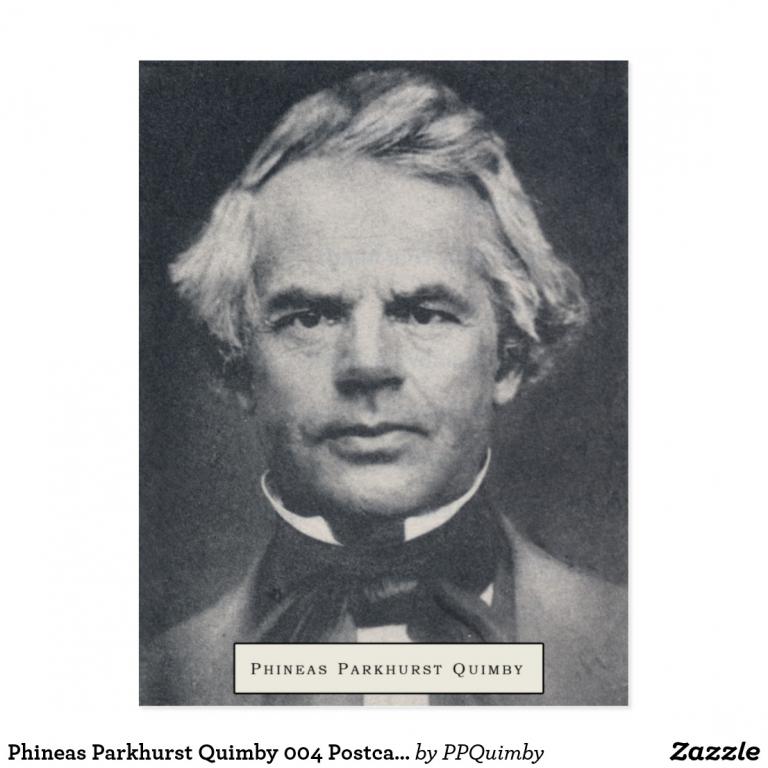
In my view there are two great American original religions. One is the Church of Jesus Christ of Later-Day Saints, the Mormon religion. The other is New Thought. While people who write about New Thought give it a hundred mothers, I think we can actually start with Phineas Quimby.
Phineas Parkhurst Quimby was born on this day, the 16th of February 1802 in Lebanon, New Hampshire. His father was a blacksmith. He received negligible education before being apprenticed to a clockmaker. He was clearly brilliant, and eventually held several patents.
However, what makes him important to me and, well, to anyone interested in religious studies and particularly American religious studies started with his contracting tuberculosis. He quickly felt that medicine as it was available to him was woefully inadequate to his needs. He began to reflect on the nature of illness and cure.
Then on the ever popular lecture circuit Quimby began to learn about mesmerism. He was particularly interested in the lectures of the French mesmerist Charles Poyen and the writings of Robert H Collyer. Soon he began his own tour. The subject of his talks was simple. He began declaring that illness and health were intimately connected with one’s beliefs. And he began proscribing cures to what ails.
Quimby opened an office to practice his new psychosomatic medicine in Portland, Maine, in 1859.
Among those attracted to his theories and practices were Annetta and Julius Dresser and Mary Baker Eddy. After Quimby’s death Annetta and Julius began teaching the “Quimby System of Mental Treatment of Diseases” and Mary Baker Eddy began the Church of Christ, Science, the Christian Science movement.
The Dresser’s son Horatio, a Swedenborgian minister who would earn his doctorate at Harvard became the first historian of the movement that begins with Quimby. While he didn’t coin the term, he normalized it as New Thought. Dr Dresser would also provide a seven point summary of Phineas Quimby’s teachings:
1. The omnipresent Wisdom, the warm, loving Father of us all, Creator of all the universe, whose works are good, whose substance is an invisible reality.
2. The real man, whose life is eternal in the invisible kingdom of God, whose senses are spiritual and function independently of matter.
3. The visible world, which Dr. Quimby once characterized as “the shadow of Wisdom’s amusements”; that is, nature is only the outward projection or manifestation of an inward activity far more real and enduring.
4. Spiritual matter, or fine interpenetrating substance, directly responsive to thought and subconsciously embodying in the flesh the fears, beliefs, hopes, errors, and joys of the mind.
5. Disease is due to false reasoning in regard to sensations, which man unwittingly develops by impressing wrong thoughts and mental pictures upon the subconscious spiritual matter.
6. As disease is due to false reasoning, so health is due to knowledge of the truth. To remove disease permanently, it is necessary to know the cause, the error which led to it. “The explanation is the cure.”
7. To know the truth about life is therefore the sovereign remedy for all ills. This truth Jesus came to declare. Jesus knew how he cured and Dr. Quimby, without taking any credit to himself as a discoverer, believed that he understood and practiced the same great truth or science.
Writing from an outsider, although not unsympathetic perspective, William James noted in his Varieties of Religious Experience, which I found at Wikipedia explains New Thought:
“...for the sake of having a brief designation, I will give the title of the ‘Mind-cure movement.’ There are various sects of this ‘New Thought,’ to use another of the names by which it calls itself; but their agreements are so profound that their differences may be neglected for my present purpose, and I will treat the movement, without apology, as if it were a simple thing.
“It is an optimistic scheme of life, with both a speculative and a practical side. In its gradual development during the last quarter of a century, it has taken up into itself a number of contributory elements, and it must now be reckoned with as a genuine religious power. It has reached the stage, for example, when the demand for its literature is great enough for insincere stuff, mechanically produced for the market, to be to a certain extent supplied by publishers – a phenomenon never observed, I imagine, until a religion has got well past its earliest insecure beginnings.
“One of the doctrinal sources of Mind-cure is the four Gospels; another is Emersonianism or New England transcendentalism; another is Berkeleyan idealism; another is spiritism, with its messages of “law” and “progress” and “development”; another the optimistic popular science evolutionism of which I have recently spoken; and, finally, Hinduism has contributed a strain.
“But the most characteristic feature of the mind-cure movement is an inspiration much more direct. The leaders in this faith have had an intuitive belief in the all-saving power of healthy-minded attitudes as such, in the conquering efficacy of courage, hope, and trust, and a correlative contempt for doubt, fear, worry, and all nervously precautionary states of mind. Their belief has in a general way been corroborated by the practical experience of their disciples; and this experience forms to-day a mass imposing in amount.”
Personally I am fascinated with that Hindu thread. And, I have noticed on occasion New Thought teachers who more clearly wind that element into this unique American tradition. But, outside the scope of this small note.
All this said, while both Mormonism and New Thought, as I noted at the beginning, are genuine American religions, I think that through various forms including some “mainstreaming” through “positive thinking” and the “prosperity gospel,” it is New Thought that has become a current that has had the greatest influence.
And, for good or, probably and ill, it all begins with Mr Quimby…
Previous Post

February 15, 2018
Two Versions of a Buddha's Last Sermon
Next Post
February 17, 2018 The Cloud of Not Knowing: A Meditation on Zen and the World's Faiths
Browse Our Archives
Select a Category A Christmas Carol Abolitionist African-American Ahmadiyya Alan Watts Aldous Huxley Allen Ginsberg Amedkar Jayanti American politics American Zen Anaheim Zen Sangha Anglican Annie Besant April Fool Armageddon Art and Religion artificial intellegence Atheist Awakening B R Ambedkar Barlaam & Josaphat Beatnik Between Bhagavad Gita Bible biography birthday bodhisattva Bodhisattva Precepts Book burning Book of Common Prayer Book of Mormon Brahmo Samaj Buddha Buddhism Buddhist Buddhist Lord's Prayer Butterflies Calendars cartoons cat ChatGPT Chicken Tortilla Soup choices Christian atheism Christian mysticism Christian origins Christian Science Christian Zen Christianity Christianity and Buddhism christmas Christmas Truce Christopher Isherwood Church of Later Day Saints Cinco de Mayo circus covenant critical thinking culture D. T. Suzuki Dalit Buddhism Daniel Defoe Desert Fathers and Mothers dharma talk Dogen Donald Trump Dongshan's Five Ranks Dorothy Day dream Duty Easter ecology Edwin Arnold emptiness Empty Moon Zen Network Episcopal Church Eternal Now Ethics evolution existentialism Faith fantasy Fathers Day film film review fire Five Ranks Folk music food Form and emptiness Four Seals Francis of Assisi Francis Xavier Free thinker friendship George MacDonald Gerald Heard Glenn Taylor Webb God Good Friday Gospel of Gospel of Mark Gospel of Thomas grace Graduate Theological Unioin Graduate Theological Union Guanyin H R Blyth Hakuin Ekaku Hanamatsuri Hanukkah Harada Yasutani Zen Heart Sutra Henry David Thoreau Hermann Hesse Hinduism History and Religion history of religion Holy Spirit home Hospitality Icon Ides of March Isaac Newton Islam Islamic mysticism Jack Kerouac James Luther Adams Jiddu Krishnamurti Joan of Arc Johannes Gutenberg John Donne joke Judaism justice karma kensho King James Bible koan Koun Yamada Kyoto School Lewis Carrol Liberal Christianity Liberal Religion Life Plan Community Liminal literature Literature and Religion Liturgy Lord's Prayer Love Mahatma Gandhi Mahayana Martin Luther King Jr Mary Baker Eddy Mary Magdelene Mary Oliver Mayflower Compact Meditation memories memory metaphor money money and religioin Mormons Mother's Day movie review mysticism mythic Neighborhood Unitarian Universalist Church New Thought Nichiren Buddhism Nonduality not knowing Omar Khayyam Pacific School of Religion pagan Palm Sunday Passover peace Pentecost perennialism Phantastes Philip Kapleau philosophy Pilgrimage poetry Poetry and Religion politics Prayer Precepts Printing Press prophecy prophetic spirituality psychology Pure Land Queer religion queering religion Quietism Ram Mohan Roy rebirth recipe Relationships and religion religion religion and history Religious syncretism Resistance Retirement Retreat review Rissho Kosei Kai Ritual Robert Aitken Roshi Robert Ingersoll Rohatsu Romani religion Rosie the Riveter saints samadhi SanboZen Sangha Satyagraha science science and reigion science and religion science fiction seminary sermon Sesshin Sex and Religion Shinran Sikh Sikh tradition silence Social Justice Socially Engaged Buddhism Society and religion Soto Zen soul spiritual community spiritual practice Spirituality Sufism Suicide superstition Taoism Television Teresa of Avila Thanksgiving theological schools Theosophy Thomas Merton Time Transcendentalism Transcendentalist Trinitarian Trinity Uncategorized unitarian Unitarian Christianity Unitarian Universalist Universalism Vajrayana Vedanta Walking war Willa Cather William Ellery Channing wisdom women and religion women in religion World Teacher Writing zazen Zen Zen Center Zen inspired retriement zen meditation Zen Precepts Zen women
Select a Month September 2026 August 2026 July 2026 June 2026 May 2026 April 2026 March 2026 February 2026 January 2026 December 2025 November 2025 October 2025 September 2025 August 2025 July 2025 June 2025 May 2025 April 2025 March 2025 February 2025 January 2025 December 2024 November 2024 October 2024 September 2024 August 2024 July 2024 June 2024 May 2024 April 2024 March 2024 February 2024 January 2024 December 2023 November 2023 October 2023 September 2023 August 2023 July 2023 June 2023 May 2023 April 2023 March 2023 February 2023 January 2023 December 2022 November 2022 October 2022 September 2022 August 2022 July 2022 June 2022 May 2022 April 2022 March 2022 February 2022 January 2022 December 2021 November 2021 October 2021 September 2021 August 2021 July 2021 June 2021 May 2021 April 2021 March 2021 February 2021 January 2021 December 2020 November 2020 October 2020 September 2020 August 2020 July 2020 June 2020 May 2020 April 2020 March 2020 February 2020 January 2020 December 2019 November 2019 October 2019 September 2019 August 2019 July 2019 June 2019 May 2019 April 2019 March 2019 February 2019 January 2019 December 2018 November 2018 October 2018 September 2018 August 2018 July 2018 June 2018 May 2018 April 2018 March 2018 February 2018 January 2018 December 2017 November 2017 October 2017 September 2017 August 2017 July 2017 June 2017 May 2017 April 2017 March 2017 February 2017 January 2017 December 2016 November 2016 October 2016 September 2016 August 2016 July 2016 June 2016 May 2016 April 2016 March 2016 February 2016 January 2016 December 2015 November 2015 October 2015 September 2015 August 2015 July 2015 June 2015 May 2015 April 2015 March 2015 February 2015 January 2015 December 2014 November 2014 October 2014 September 2014 August 2014 July 2014 June 2014 May 2014 April 2014 March 2014 February 2014 January 2014 December 2013 November 2013 October 2013 September 2013 August 2013 July 2013 June 2013 May 2013 April 2013 March 2013 February 2013 January 2013 December 2012 November 2012 October 2012 September 2012 August 2012 July 2012 June 2012 May 2012 April 2012 March 2012 February 2012 January 2012 December 2011 November 2011 October 2011 September 2011 August 2011 July 2011 June 2011 May 2011 April 2011 March 2011 February 2011 January 2011 December 2010 November 2010 October 2010 September 2010 August 2010 July 2010 June 2010 May 2010 April 2010 March 2010 February 2010 January 2010 December 2009 November 2009 October 2009 September 2009 August 2009 July 2009 June 2009 May 2009 April 2009 March 2009 February 2009 January 2009 December 2008 November 2008 October 2008 September 2008 August 2008 July 2008 June 2008 May 2008 April 2008 March 2008 February 2008 January 2008 December 2007 November 2007 October 2007 September 2007 August 2007 July 2007 June 2007 May 2007 April 2007 March 2007 February 2007 January 2007 December 2006 November 2006 October 2006 September 2006
Follow Us!
TAKE THE
Religious Wisdom Quiz
Which Persian king allowed the Jews to return and rebuild Jerusalem?
Select your answer to see how you score.
Xerxes Artaxerxes Cyrus Darius
Related posts from Monkey Mind

The American Unitarian Association Marks Two Hundred Years

Reflecting on Blogging for Seventeen Years as Monkey...
A Briefest Meditation on Quietism and Zen Meditation
TRENDING AT PATHEOS Buddhist

Methodist Central Hall and Westminster Abbey
Situated on the same square is Methodist Central Hall and Westminster Abbey. ...

57th Dove Awards Honor Dolly Parton, Crown New...
On gospel music’s biggest night, the 57th annual GMA Dove Awards honored...

The First Eucharistic Controversy: Christ’s Real Presence
For Catholics, the Eucharist is the source and summit of the Christian...

What a Stop Sign Can Teach Us About...
How to Make a Decision When You Can't Hear God Main point:...

Archdiocese Hosts Military Marriage Retreat in Germany
RASTATT, Germany — The transient military lifestyle, with its frequent deployments and...

Nearly every morning, I make the drive to Detroit with my high-school-age...
view all Buddhist blogs
Ad-Free & Subscriber Log-In Subscription Support
- About Us
- 2026 Calendar
- Videos
- Podcasts
- Library of World Religions
- Faith In Media Tracker
- Advertise With Us
- Write for Us
- Privacy Policy
- Terms of Service
- Do Not Sell My Data
- Contact Us
- Radiant Digital
- Manage Newsletter Subscriptions
- Unsubscribe From Notifications
- Sitemap
Copyright 2008-2026, Patheos. All rights reserved.
Subscription Support Ad-Free & Subscriber Log-In
Follow Patheos