
BuddhistCatholicContemplativeEvangelicalGeneral ChristianHinduJewishLatter-day SaintMuslimNew VisionsProgressive Christian
Beliefs
- Buddhist
- Catholic
- Contemplative
- Evangelical
- General Christian
- Hindu
- Jewish
- Latter-day Saint
- More Voices
- Muslim
- New Visions
- Pagan
- Progressive Christian
Topics
- Religion News
- Food and Religion
- Sports and Religion
- Religious Art
- Religious Music and Entertainment
- Religious Events
- History and Religion
- Style and Religion
- Politics and Religion
- Women in Religion
- Recreation Outdoors and Religion
- Business Finance and Religion
- Careers Workplace and Religion
- Education and Religion
- Family Parenting and Religion
- Health Fitness and Religion
- Home and Religion
- Relationships and Religion
- Technology and Religion
- Travel and Religion
Columnists
- Buddhist Columnists
- Business Finance and Religion Columnists
- Careers Workplace and Religion Columnists
- Catholic Columnists
- Contemplative Columnists
- Education and Religion Columnists
- Evangelists Columnists
- Family Parenting and Religion Columnists
- General Christian Columnists
- Health Fitness and Religion Columnists
- Hindu Columnists
- History and Religion Columnists
- Home and Religion Columnists
- Jewish Columnists
- More Voices Columnists
- Latter Day Columnists
- Muslim Columnists
- New Visions Columnists
- Nonreligious Columnists
- Pagan Columnists
- Politics and Religion Columnists
- Progressive Columnists
- Recreation Outdoors and Religion Columnists
- Relationships and Religion Columnists
- Religion News Columnists
- Religious Art Columnists
- Religious Events Columnists
- Religious Music and Entertainment Columnists
- Sports and Religion Columnists
- Style and Religion Columnists
- Technology and Religion Columnists
- Travel and Religion Columnists
- Women in Religion Columnists
Resource Library
- 2026 Calendar
- Library of World Religions
- The 100 Most Holy Places on Earth
- Patheos Answers
- Podcasts
- Videos
- Faith Leaders Database
- Anglican Episcopalian
- Bahai
- Baptist
- Buddhism
- Christianity
- Confucianism
- Eastern Orthodoxy
- Hinduism
- Holiness and Pentecostal
- ISKCON
- Islam
- Judaism
- Lutheran
- Methodist
- The Church of Jesus Christ of Latter-day Saints
- New Age
- Paganism
- Presbytarian and Reformed
- Protestantism
- Religion Behind the Scenes
- Roman Catholic
- Scientology
- Shia Islam
- Sikhism
- Sufism
- Sunni Islam
- Taoism
- Zen
- See all religions
Research Tools
 Ad-Free & Subscriber Log-In Subscription Support
Ad-Free & Subscriber Log-In Subscription Support
Follow Patheos 

- Trending:
- Forgiveness
- |
- Marriage
- |
- Consciousness
- |
- Death Penalty
- |
- Election
- |
- Halloween

- Home
- Buddhist
- MY ZEN BUDDHIST EASTER
MY ZEN BUDDHIST EASTER
Last updated on: April 1, 2018 at 7:27 am by James Ford
MY ZEN BUDDHIST EASTER 2018-04-01T07:27:49-07:00 James Ford
Patheos Explore the world's faith through different perspectives on religion and spirituality! Patheos has the views of the prevalent religions and spiritualities of the world.
MY ZEN BUDDHIST EASTER
A Sermon
James Ishmael Ford
16 April 2017
Unitarian Universalist Church
Long Beach, California
I served most of my years as a parish minister among our New England congregations. They are generally more traditional in their structure, and, frankly, more comfortable with our Christian origins and heritage than either our Midwestern or Western churches usually are.
What that meant was that I was always expected me to preach about Easter on Easter Sunday, and they tended to want a real Christmas Eve service, candles, lessons, carols, the whole thing. Also, for that Easter Sunday sermon, despite our much vaunted “freedom of the pulpit,” they generally expected me not to go for a bunny rabbits or the “it’s all about the Spring” sermon. They seemed to like watching me twist around and struggle with what this holiday can mean to a crowd that despite liking our Christian origins, today includes humanists, Jews, pagans, Hindus, Buddhists, and, yes, if not traditional Christian, certainly friends of Jesus. You know, us, Unitarian Universalists, the spiritual but barely religious.
And I’ve gotten used to that exercise. So, with some genuine respect for what the tradition is, and acknowledging we UUs very much have a connection to the Christian inheritance, what can Easter mean for us that motley spiritual crew that are barely religious? Of course, we are Unitarian Universalists, so maybe a quick review of what that story is might be in order at the beginning. The Gospel of Mark is generally considered the oldest of the canonical gospels, the time-hallowed stories of Jesus and his ministry. The sixteenth chapter of Mark tells the story of Easter in its most unelaborated version.
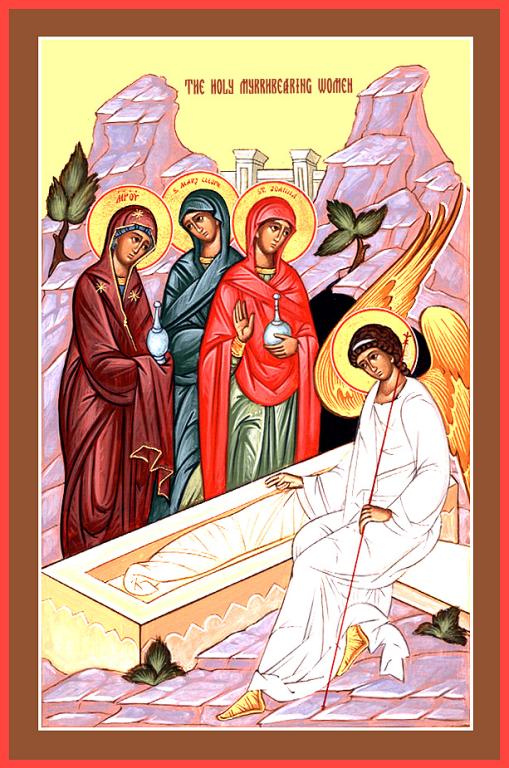
And when the sabbath was past, Mary Magdalene, and Mary the mother of James, and Salome… came… at the rising of the sun (with) sweet spices, that they might… anoint him.. (They were worried who they could get to roll the great stone away from the entrance. However, when they arrived) they saw that the stone was (already) rolled away… And.. (inside) they saw a young man sitting… (there) clothed in a long white garment; and they were (afraid). …(He said) to them, Be not (afraid): You seek Jesus of Nazareth, (who) was crucified: he is risen; he is not here… (Go and) tell his disciples and Peter that he (goes) before you (to) Galilee: there (you shall) see him… And they went out quickly, and fled from the sepulchre; (trembling and amazed): (none saying) any thing to any man; for they were afraid.
That’s it. Now, people don’t like to let things hang quite like they do in this story, and so, somewhere along the line ten more verses are added on. They are largely what would be called “theological,” that is they line out what this story is supposed to mean. As a bit of an aside I find it interesting it’s at these added in parts we get things like handling serpents and drinking poison.
Me, I’m very taken with the actual unvarnished version. In the plain telling it looks a lot like something happened to the women, Mary Magdalene, Mary the mother of James in Mark, but therefore also of Jesus for those who aren’t concerned that he would have siblings, and Salome. Something distressing happens. The tomb is empty. That could be explained easily enough. But, then who is the man in the white robe? And what does that line “he is risen” mean? What does it mean that he would be seen in Galilee? And, most of all there’s that hanging ending. What about that trembling, and amazement, and fear? What about that silence? Talk about an invitation into the world of not knowing, the mysterious source of all learning.
The Zen Buddhist priest Norman Fischer tells of attending an interfaith conference hosted at Gethsemane Abbey a Roman Catholic monastery in Kentucky, perhaps most famous as Thomas Merton, the spiritual writer and social justice activist’s monastery. Norman, a Buddhist who was raised Jewish, was surprised at the number and actually at the graphic quality of the crucifixes he saw everywhere in the monastery. And so, he asked the monks why such a terrible and sad symbol and why so many of them? He wrote of their responses, “Most… said that they did see suffering in the crucifixes, but they also saw love, and they saw redemption, they saw freedom, and they saw joy. The cross wasn’t just sad; it was much more than that, also.”
Then Norman concluded, “This, I suppose, is the theme of Easter.” For me add in that empty tomb, that man making a strange assertion, and the women leaving trembling, and filled with amazement and fear, and yes, silence; and I think Norman is pointing right. The whole pageant of Christianity plays out from this event.
Now, as a Buddhist (of the naturalist and rational sort, by which I mean not inclined to the supernatural and finding reason a great light of human life) I also find in the Easter accounts, particularly Mark’s a hint of something deep and true, part of that treasure trove of human culture. It is about something terribly sad, and at the same time something else, as well. It’s all about our facing into not-knowing, fronting the mystery of our lives.
And it’s personal, real personal. As some here know Jan and I moved my mother and her sister, my auntie in with us shortly after I began parish ministry, now looking on thirty years ago. My mother died five years later. Auntie died the day before Easter two years ago, actually bare months before we came out here to Long Beach. The second bedroom in our condo was supposed to be hers. Actually we still call it “auntie’s room.”
She is very much on my mind today. She was a believer. She believed in Easter, not as a metaphor for something psychological, as profound as I find that can be, but as a simple factual truth. As she lay dying in the midst of Easter tide, through Maundy Thursday, through Good Friday, she knew she was in some very real sense going home, going to a risen Jesus who would embrace her with physical arms. And this marks what I’m saying today. It gives my rationalist, naturalistic Buddhist and Unitarian Universalist heart caution. And it points beyond the mere details of the story, to things I myself believe are true, deepest true.
I believe that our human condition is characterized by hurt. Now, I don’t find a lot of help in the damaged goods view of that hurt, as we get in the idea of original sin, except in so far as we have eaten the fruit of the knowledge of good and evil, and with that dualistic mind have very much cast ourselves into a world filled with pain and desire, loss and longing. But, I also see that our human condition is at the same time always open to something else, to a great healing. In Buddhism it’s called enlightenment, or, and I prefer the word, awakening. And, I believe I also see that sense of awakening in the Easter story. In fact I believe Easter is the Christian story of awakening.
Let me introduce another story that might illuminate what this means. It’s a famous Zen koan collected in the early Twelfth century anthology, the Blue Cliff Record. It’s the sixth story in the collection and it’s all about awakening. It’s really short. Yunmen asked his assembly, “I don’t ask you about before the 15th of the month. Tell me something about after the 15th.” No one spoke, so he responded himself, “Every day is a good day.”
This isn’t a complete non sequitur. The 15th is the time of the full moon, and is a common metaphor in East Asia for the moment of awakening. Also, it probably doesn’t hurt to note that Yunmen lived in harsh, politically unstable times, where armies were on the march and famine and hunger and danger the common currency of the day, So it would be very hard to find the phrase “every day is a good day” meaning “don’t worry, be happy.” No smiley faces in this assertion.
In some schools of the Zen tradition people who’ve been acknowledged as teachers, after a ceremony that takes place in private at midnight, the next day they’re often expected to give a talk on this koan. Also, just a little on that word koan. Koan has entered popular use within our English language meaning a thorny problem, or, for those a little more familiar with it as a spiritual thing, often as a question that has no answer. Neither is what koan really means, at least within the context of its use as part of a spiritual discipline. In that primary sense a koan is a statement about reality, and an invitation into presence. A koan is a pointer to the real, the deepest real, and with that an invitation to come and stand in that real place.
And this is most important. It is within presence we find our awakening, our waking up from the slumber of a life that has been distracted from the most important matters. We slumber with our apparently endless desires. We slumber with our anger and hatred. We slumber as we figure something out as true and defend, fiercely that idea of true, sometimes even to the death. Sometimes our own, too often someone else’s.
Waking up is waking up from all this grasping at wanting and resenting and hating, and knowing for sure, into something else. And, and this is most important: this waking up is also our common human experience. It comes to us as Christians. It comes to us as Jews. It comes to us as Muslims, and as Hindus, and as Buddhists. It comes to us without any religion at all.
Did my auntie find this place? I don’t know. She seemed a bit too sure of the literal reality. But, then, it’s always seeing through a glass, darkly. This is why a psychological definition for this experience isn’t quite on point, either. We’re speaking of what that interdependent web really is, the one, the open, the boundless. And we only ever come to know it through the particular, or more specifically as the particular. You. Me. Eating. Walking. Playing with a child. Standing up to one oppression or another.
And, so, Easter. The Easter of those women. The Easter of auntie struggling for her last breath. The Easter for Jan and me and those long hours sitting at her bedside. The Easter of our friends coming and helping prepare her body, washing it, and dressing her in her Sunday go to meeting dress, and with a shawl closed with one of her favorite dragon broaches.
Easter as this moment, as this mind, as this heart, filled with all its sadness and all its glory. And with our fully opening ourselves to what is, with that complete disruption of what we thought was the way things are. And with that awakening into something new: mystery piled upon mystery. Wonder, and joy, and, yes, absolutely, fear.
And with that back to the story. The Mary’s and Salome experienced a terrible and wonderful moment; a complete disruption of what they thought was so. Where they, each of them, had an awakening, each in their own way, as themselves and no one else, finding the one awakening. Everyday is a good day.
With Easter we’re being invited into a new place, a moment, a stance that can change how we live in this world. I find Easter is a response to the invitation to not turn away from any part, the hurt, the agonies, the failures, the sweet and joyful moments. To open up, and to open up more, until even death is just a part of the mystery.
Find that, and then, the stories tell us, there is a new birth. Like Spring. Like Easter. Like the mind of Easter. Like the heart of Easter.
Amen.
And, absolutely, Hallelujah.
Next Post

April 17, 2017 Soto Zen: A Collection of Videos
Browse Our Archives
Select a Category A Christmas Carol Abolitionist African-American Ahmadiyya Alan Watts Aldous Huxley Allen Ginsberg Amedkar Jayanti American politics American Zen Anaheim Zen Sangha Anglican Annie Besant April Fool Armageddon Art and Religion artificial intellegence Atheist Awakening B R Ambedkar Barlaam & Josaphat Beatnik Between Bhagavad Gita Bible biography birthday bodhisattva Bodhisattva Precepts Book burning Book of Common Prayer Book of Mormon Brahmo Samaj Buddha Buddhism Buddhist Buddhist Lord's Prayer Butterflies Calendars cartoons cat ChatGPT Chicken Tortilla Soup choices Christian atheism Christian mysticism Christian origins Christian Science Christian Zen Christianity Christianity and Buddhism christmas Christmas Truce Christopher Isherwood Church of Later Day Saints Cinco de Mayo circus covenant critical thinking culture D. T. Suzuki Dalit Buddhism Daniel Defoe Desert Fathers and Mothers dharma talk Dogen Donald Trump Dongshan's Five Ranks Dorothy Day dream Duty Easter ecology Edwin Arnold emptiness Empty Moon Zen Network Episcopal Church Eternal Now Ethics evolution existentialism Faith fantasy Fathers Day film film review fire Five Ranks Folk music food Form and emptiness Four Seals Francis of Assisi Francis Xavier Free thinker friendship George MacDonald Gerald Heard Glenn Taylor Webb God Good Friday Gospel of Gospel of Mark Gospel of Thomas grace Graduate Theological Unioin Graduate Theological Union Guanyin H R Blyth Hakuin Ekaku Hanamatsuri Hanukkah Harada Yasutani Zen Heart Sutra Henry David Thoreau Hermann Hesse Hinduism History and Religion history of religion Holy Spirit home Hospitality Icon Ides of March Isaac Newton Islam Islamic mysticism Jack Kerouac James Luther Adams Jiddu Krishnamurti Joan of Arc Johannes Gutenberg John Donne joke Judaism justice karma kensho King James Bible koan Koun Yamada Kyoto School Lewis Carrol Liberal Christianity Liberal Religion Life Plan Community Liminal literature Literature and Religion Liturgy Lord's Prayer Love Mahatma Gandhi Mahayana Martin Luther King Jr Mary Baker Eddy Mary Magdelene Mary Oliver Mayflower Compact Meditation memories memory metaphor money money and religioin Mormons Mother's Day movie review mysticism mythic Neighborhood Unitarian Universalist Church New Thought Nichiren Buddhism Nonduality not knowing Omar Khayyam Pacific School of Religion pagan Palm Sunday Passover peace Pentecost perennialism Phantastes Philip Kapleau philosophy Pilgrimage poetry Poetry and Religion politics Prayer Precepts Printing Press prophecy prophetic spirituality psychology Pure Land Queer religion queering religion Quietism Ram Mohan Roy rebirth recipe Relationships and religion religion religion and history Religious syncretism Resistance Retirement Retreat review Rissho Kosei Kai Ritual Robert Aitken Roshi Robert Ingersoll Rohatsu Romani religion Rosie the Riveter saints samadhi SanboZen Sangha Satyagraha science science and reigion science and religion science fiction seminary sermon Sesshin Sex and Religion Shinran Sikh Sikh tradition silence Social Justice Socially Engaged Buddhism Society and religion Soto Zen soul spiritual community spiritual practice Spirituality Sufism Suicide superstition Taoism Television Teresa of Avila Thanksgiving theological schools Theosophy Thomas Merton Time Transcendentalism Transcendentalist Trinitarian Trinity Uncategorized unitarian Unitarian Christianity Unitarian Universalist Universalism Vajrayana Vedanta Walking war Willa Cather William Ellery Channing wisdom women and religion women in religion World Teacher Writing zazen Zen Zen Center Zen inspired retriement zen meditation Zen Precepts Zen women
Select a Month September 2026 August 2026 July 2026 June 2026 May 2026 April 2026 March 2026 February 2026 January 2026 December 2025 November 2025 October 2025 September 2025 August 2025 July 2025 June 2025 May 2025 April 2025 March 2025 February 2025 January 2025 December 2024 November 2024 October 2024 September 2024 August 2024 July 2024 June 2024 May 2024 April 2024 March 2024 February 2024 January 2024 December 2023 November 2023 October 2023 September 2023 August 2023 July 2023 June 2023 May 2023 April 2023 March 2023 February 2023 January 2023 December 2022 November 2022 October 2022 September 2022 August 2022 July 2022 June 2022 May 2022 April 2022 March 2022 February 2022 January 2022 December 2021 November 2021 October 2021 September 2021 August 2021 July 2021 June 2021 May 2021 April 2021 March 2021 February 2021 January 2021 December 2020 November 2020 October 2020 September 2020 August 2020 July 2020 June 2020 May 2020 April 2020 March 2020 February 2020 January 2020 December 2019 November 2019 October 2019 September 2019 August 2019 July 2019 June 2019 May 2019 April 2019 March 2019 February 2019 January 2019 December 2018 November 2018 October 2018 September 2018 August 2018 July 2018 June 2018 May 2018 April 2018 March 2018 February 2018 January 2018 December 2017 November 2017 October 2017 September 2017 August 2017 July 2017 June 2017 May 2017 April 2017 March 2017 February 2017 January 2017 December 2016 November 2016 October 2016 September 2016 August 2016 July 2016 June 2016 May 2016 April 2016 March 2016 February 2016 January 2016 December 2015 November 2015 October 2015 September 2015 August 2015 July 2015 June 2015 May 2015 April 2015 March 2015 February 2015 January 2015 December 2014 November 2014 October 2014 September 2014 August 2014 July 2014 June 2014 May 2014 April 2014 March 2014 February 2014 January 2014 December 2013 November 2013 October 2013 September 2013 August 2013 July 2013 June 2013 May 2013 April 2013 March 2013 February 2013 January 2013 December 2012 November 2012 October 2012 September 2012 August 2012 July 2012 June 2012 May 2012 April 2012 March 2012 February 2012 January 2012 December 2011 November 2011 October 2011 September 2011 August 2011 July 2011 June 2011 May 2011 April 2011 March 2011 February 2011 January 2011 December 2010 November 2010 October 2010 September 2010 August 2010 July 2010 June 2010 May 2010 April 2010 March 2010 February 2010 January 2010 December 2009 November 2009 October 2009 September 2009 August 2009 July 2009 June 2009 May 2009 April 2009 March 2009 February 2009 January 2009 December 2008 November 2008 October 2008 September 2008 August 2008 July 2008 June 2008 May 2008 April 2008 March 2008 February 2008 January 2008 December 2007 November 2007 October 2007 September 2007 August 2007 July 2007 June 2007 May 2007 April 2007 March 2007 February 2007 January 2007 December 2006 November 2006 October 2006 September 2006
Follow Us!
TAKE THE
Religious Wisdom Quiz
Which people attacked Israel at Rephidim and were defeated as Moses held up his hands?
Select your answer to see how you score.
Philistines Midianites Moabites Amalekites
Related posts from Monkey Mind

Keizan Jokin: The Zen Master Ancestor You Don't...

What Zen Practice Actually Does With Anger

Nanquan Cuts the Cat: A Jesuit commentary on...

On Taking Refuge in the Dharma
TRENDING AT PATHEOS Buddhist

57th Dove Awards Honor Dolly Parton, Crown New...
On gospel music’s biggest night, the 57th annual GMA Dove Awards honored...

The First Eucharistic Controversy: Christ’s Real Presence
For Catholics, the Eucharist is the source and summit of the Christian...

What a Stop Sign Can Teach Us About...
How to Make a Decision When You Can't Hear God Main point:...

Archdiocese Hosts Military Marriage Retreat in Germany
RASTATT, Germany — The transient military lifestyle, with its frequent deployments and...

Nearly every morning, I make the drive to Detroit with my high-school-age...

The Real AI Story Is Adoption Without Trust
Artificial intelligence has crossed a political threshold. It is no longer a...
view all Buddhist blogs
Ad-Free & Subscriber Log-In Subscription Support
- About Us
- 2026 Calendar
- Videos
- Podcasts
- Library of World Religions
- Faith In Media Tracker
- Advertise With Us
- Write for Us
- Privacy Policy
- Terms of Service
- Do Not Sell My Data
- Contact Us
- Radiant Digital
- Manage Newsletter Subscriptions
- Unsubscribe From Notifications
- Sitemap
Copyright 2008-2026, Patheos. All rights reserved.
Subscription Support Ad-Free & Subscriber Log-In
Follow Patheos