
BuddhistCatholicContemplativeEvangelicalGeneral ChristianHinduJewishLatter-day SaintMuslimNew VisionsProgressive Christian
Beliefs
- Buddhist
- Catholic
- Contemplative
- Evangelical
- General Christian
- Hindu
- Jewish
- Latter-day Saint
- More Voices
- Muslim
- New Visions
- Pagan
- Progressive Christian
Topics
- Religion News
- Food and Religion
- Sports and Religion
- Religious Art
- Religious Music and Entertainment
- Religious Events
- History and Religion
- Style and Religion
- Politics and Religion
- Women in Religion
- Recreation Outdoors and Religion
- Business Finance and Religion
- Careers Workplace and Religion
- Education and Religion
- Family Parenting and Religion
- Health Fitness and Religion
- Home and Religion
- Relationships and Religion
- Technology and Religion
- Travel and Religion
Columnists
- Buddhist Columnists
- Business Finance and Religion Columnists
- Careers Workplace and Religion Columnists
- Catholic Columnists
- Contemplative Columnists
- Education and Religion Columnists
- Evangelists Columnists
- Family Parenting and Religion Columnists
- General Christian Columnists
- Health Fitness and Religion Columnists
- Hindu Columnists
- History and Religion Columnists
- Home and Religion Columnists
- Jewish Columnists
- More Voices Columnists
- Latter Day Columnists
- Muslim Columnists
- New Visions Columnists
- Nonreligious Columnists
- Pagan Columnists
- Politics and Religion Columnists
- Progressive Columnists
- Recreation Outdoors and Religion Columnists
- Relationships and Religion Columnists
- Religion News Columnists
- Religious Art Columnists
- Religious Events Columnists
- Religious Music and Entertainment Columnists
- Sports and Religion Columnists
- Style and Religion Columnists
- Technology and Religion Columnists
- Travel and Religion Columnists
- Women in Religion Columnists
Resource Library
- 2026 Calendar
- Library of World Religions
- The 100 Most Holy Places on Earth
- Patheos Answers
- Podcasts
- Videos
- Faith Leaders Database
- Anglican Episcopalian
- Bahai
- Baptist
- Buddhism
- Christianity
- Confucianism
- Eastern Orthodoxy
- Hinduism
- Holiness and Pentecostal
- ISKCON
- Islam
- Judaism
- Lutheran
- Methodist
- The Church of Jesus Christ of Latter-day Saints
- New Age
- Paganism
- Presbytarian and Reformed
- Protestantism
- Religion Behind the Scenes
- Roman Catholic
- Scientology
- Shia Islam
- Sikhism
- Sufism
- Sunni Islam
- Taoism
- Zen
- See all religions
Research Tools
 Ad-Free & Subscriber Log-In Subscription Support
Ad-Free & Subscriber Log-In Subscription Support
Follow Patheos 

- Trending:
- Forgiveness
- |
- Marriage
- |
- Consciousness
- |
- Death Penalty
- |
- Election
- |
- Halloween

- Home
- Buddhist
- Who is Our Neighbor: A Zen Buddhist Reflection on a Christian America
Who is Our Neighbor: A Zen Buddhist Reflection on a Christian America
Last updated on: February 2, 2017 at 6:56 am by James Ford
Who is Our Neighbor: A Zen Buddhist Reflection on a Christian America 2017-02-02T06:56:47-08:00 James Ford
Patheos Explore the world's faith through different perspectives on religion and spirituality! Patheos has the views of the prevalent religions and spiritualities of the world.
I was distressed to see a new Pew survey written up at FiveThirtyEight that shows that a majority of Americans think being an American also means being a Christian. Thirty-two percent of those surveyed stated they believed it is very important to be a Christian if one is to be an American, while a softer nineteen percent only felt it “somewhat important.” Together that counted for fifty-one percent. Of course that does mean almost the same number believed it wasn’t very important (seventeen percent) or not important at all (thirty-one percent.)
Further unpacking showed a skew heavily toward older people believing this. But, also a majority of women. As to political affiliation it was, hardly a surprise I would say, that Republicans skewed much more heavily in believing this than did either Democrats or declared Independents.
First, as someone who is an ordained Buddhist priest, I find this distressing. I also think about my Jewish friends. I think about my Muslim friends. Hindus. Pagans. Atheists. Of course, I’m also a Unitarian Universalist minister, and UUism is a crowd that includes all the above, and a good number of folk who fit the “other” category. All Americans. (Yes, I know folk who are not Americans, as well, but let’s keep focused, friends…) So, I know a lot of people who are Americans who can’t find this survey a positive thing.
And, second, I found myself thinking about how we are culturally so imbued with Christian assumptions, narratives, stories, which are themselves often in fact Jewish. Particularly when derived from the scriptures. This has a pervasiveness about it for us that causes me on occasion to speak of the “Western tradition.” Me I think of our Western tradition as sort of a magpie thing with a bunch of ancient Greek thought, a goodly dash of pre-Christian European paganism mixed throughly with Jewish and Christian texts and traditions, salted with humanism, rationalism, Adam Smith and Karl Marx, stirred well, and now simmering over a low heat. And these days more than a few of us have been throwing in some Buddhism, Daoism, and Hinduism as well as some perspectives from Africa. Quite a stew. No doubt.
And, third, I found myself wondering what parts of that Christian (and often in fact Jewish) tradition is in fact stuff I hold true, and which I suspect many of us, should we choose to look into our hearts, consider true? And that’s when I noticed the blog post “Trump has already led me to the Bible” by the always wise Justin Whitaker. He himself drew upon Jesse Carey’s essay “What the Bible Says About How to Treat Refugees.” Mr Carey lists a dozen passages. Dr Whitaker lists seven of them.
I share Justin’s seven with my own comments.
First four from the Hebrew scriptures.
Leviticus 19:33-34 calls us to treat the stranger, foreigner, refugee, different translations show us how inclusive that “other” is meant to be, to treat that other as ourselves. Me, I find this echoes the great insight of all traditions that we are bound up together in an web of intimacy that national boundaries cannot contain.
Ezekiel 16:49 points to the real sin of Sodom, which has never been about sexuality, but rather hospitality. In the King James Version (hey, good enough for Jesus, good enough for me…) “Behold, this was the iniquity of thy sister Sodom, pride, fulness of bread, and abundance of idleness was in her and in her daughters, neither did she strengthen the hand of the poor and needy.”
Exodus 23:9 is a flat out commandment to not oppress the perceived other, that stranger, foreigner, or refugee – and is itself a haunting call to the myth of the Egyptian captivity, a story for all of us, and here a chilling reminder, we, too were, could be, and yet might be, strangers in a strange land.
And, Job 31:32, listing how he has been faithful to God’s commandments and that his door was always open to that stranger, foreigner, refugee. Little good that it did him, of course…
And three from the Christian texts.
Matthew 25:25-36, where in my red letter Bible Jesus described those who would inherit the Kingdom, “…I was hungry and you gave Me food; I was thirsty and you gave Me drink; I was a stranger and you took Me in; I was naked and you clothed Me; I was sick and you visited Me; I was in prison and you came to Me.” And when those to whom he was speaking, asked when did they do this, the good rabbi responded, in verse 40 “Assuredly, I say to you, inasmuch as you did it to one of the least of these My brethren, you did it to Me.’”
Galatians 5:15, “For all the law is fulfilled in one word, even in this; Thou shalt love thy neighbour as thyself.” It echoes the ancient traditions going right back to that Leviticus text. And is one of the most beautiful summations I can think of, of the call out of the heart of knowing the web of interdependence, of which we are all of us a part. And, for me, of Dr Martin Luther King Jr.’s inescapable network of mutuality. The deep knowing of who we really are, and a pointer on what that means in our lives.
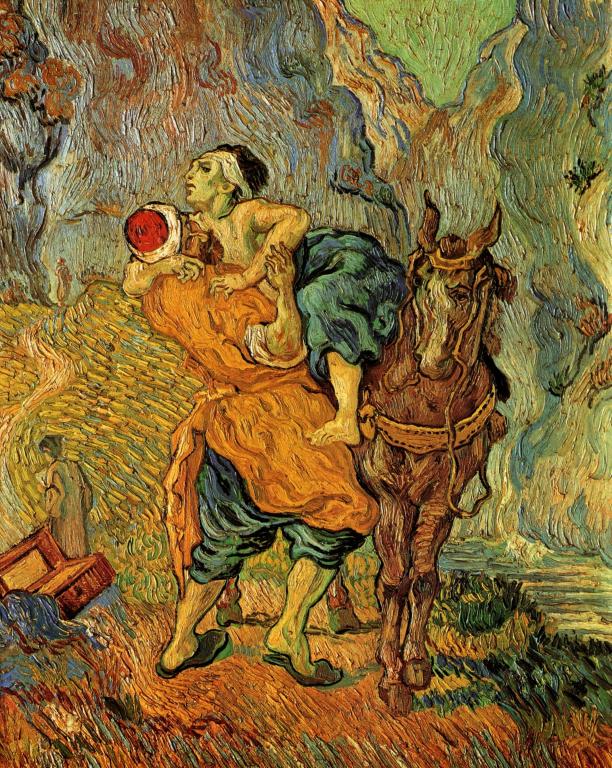
And, last, for this briefest of lists, Luke 10:29-37. One of my favorite texts from the scriptures of the West.
And, behold, a certain lawyer stood up, and tempted him, saying, Master, what shall I do to inherit eternal life He said unto him, What is written in the law? how readest thou? And he answering said, Thou shalt love the Lord thy God with all thy heart, and with all thy soul, and with all thy strength, and with all thy mind; and thy neighbour as thyself. And he said unto him, Thou hast answered right: this do, and thou shalt live. But he, willing to justify himself, said unto Jesus, And who is my neighbour? And Jesus answering said, A certain man went down from Jerusalem to Jericho, and fell among thieves, which stripped him of his raiment, and wounded him, and departed, leaving him half dead. And by chance there came down a certain priest that way: and when he saw him, he passed by on the other side. And likewise a Levite, when he was at the place, came and looked on him, and passed by on the other side. But a certain Samaritan, as he journeyed, came where he was: and when he saw him, he had compassion on him, And went to him, and bound up his wounds, pouring in oil and wine, and set him on his own beast, and brought him to an inn, and took care of him. And on the morrow when he departed, he took out two pence, and gave them to the host, and said unto him, Take care of him; and whatsoever thou spendest more, when I come again, I will repay thee. Which now of these three, thinkest thou, was neighbour unto him that fell among the thieves? And he said, He that shewed mercy on him. Then said Jesus unto him, Go, and do thou likewise.
This story appears only in the Gospel of Luke, which makes it a little bit suspect for those on that quixotic quest for the historical Jesus. Although the majority of biblical scholars seem to concur that it is indeed a story attributable to Jesus, in part because the obvious point is consistent with the general direction of his teachings.
The story has a set up, the lawyer who asks about who is “one’s neighbor” is following on an earlier passage where perhaps the same lawyer asks, apparently as an entrapment, there are a lot of these set ups recorded where enemies ask leading questions that could earn the word heresy, or, worse, sedition. These were indeed dangerous times. Perhaps we can recognize these times.
In this case the lawyer asks how to earn eternal life, to which Jesus responds, what do you think? The lawyer then says, “Love God and love your neighbor,” when taken together what has come to be called the Great Commandment. Jesus agrees with him. In fact this pronouncement is recorded straight out of Jesus’ mouth in both Mark and Matthew. However, then the lawyer goes in a very interesting direction, asking, “Who is my neighbor?”
There is a world of comment on this parable. Frankly, I find most of it not particularly compelling. The earliest strata of these comments are, typical of late antiquity, pure analogy with Jesus himself understood to be the Good Samaritan. In more recent years Liberationists and others put a lot of emphasis on the outsider qualities of a Samaritan to some good effect. I kind of like how Christopher Hitchens, late raconteur and atheist polemicist cited the Good Samaritan parable as evidence that you don’t have to be religious to be ethical.
One of my mentors is Ruben Habito, a former Jesuit priest who now teaches comparative religion at the Perkins School of Theology at Southern Methodist University in Dallas. In one of his books he comments on this parable, saying it can in fact be seen as something more than a moral injunction, however useful, and whether God-given or as natural as nature itself. Ruben points out that it all turns on the question framed at the beginning of the conversation with that lawyer. “What do I do to earn eternal life?”
Eternal life: a lovely placeholder for the great longing of the human heart. For some perhaps it is a literal hope of living beyond our physical deaths. It is also, and I find vastly more important, recognizing a sense of separation, of hurt, perhaps of wound, and with that a hope of reconciliation with that from which we seem separated. For me that phrase “eternal life” is a way of acknowledging our divided hearts, of finding ourselves lost and longing for our true home.
For Ruben, Jesuit priest for a dozen or more years, oh, and did I mention today a Zen teacher of some renown, I no longer recall exactly, this eternal life is the same as that kingdom of God which in various other biblical passages is clearly something not elsewhere, or at least not entirely elsewhere. Rather the kingdom the realm is right at hand, within us, and among us. I think about that and all of a sudden I find myself very interested in what that might mean for this parable.
So, what about that eternal life, that peace that passes all understanding, that hope for a healing of broken hearts, that finding of our true home? That place, I suggest, which when found, corrects the misunderstandings we bring to our desire to be of use in the world, and frustrates our desire to find justice, to do mercy. It is the anchor, it is the North Star that can guide us on our way, making our actions useful rather than harmful. So, it is critically important. It is about a fundamental reorienting of our selves and our lives. It is about the path of harmony and love.
For Ruben loving God and loving neighbor are one thing. Identical. Me, I tend to prefer the placeholder the Holy rather than God. But God works. The critical point is that there is no other place to find the Holy, God, than right here, in this place, within my own heart, and among us, within your own hearts and among us. In my very ordinariness, in your very ordinariness, that is exactly where the Holy is, where God is.
For Ruben this parable becomes a direct pointing to the deep and true and an invitation into a conversation, into a more intimate presence with our own hearts and with the world itself, all of it. From this perspective of wild intimacy God and love and neighbor cannot be disentangled. As Ruben says, “As we see our neighbor as not separate from ourselves, but as embraced in the same circle of Love that we ourselves are embraced in, in the same way, we embrace them with our whole soul, our whole mind, our whole heart, our whole strength.”
Of course we play all the parts. We are the wounded man. We are the thieves who set upon him. We are the Samaritan and the innkeeper. And, yes, we are the donkey. And we are the inn and the road between Jerusalem and Jericho, and the sky, and the sun, and the moon, and the stars in heaven. We are all of these people and things. Yes. And.
We open our hearts and we see it and know it. Like someone who takes a drink of water and knows for herself whether it is cool or warm.
Then the mysteries of remembering and forgetting and acting all come together like a song or a dance. And perhaps then we come to understand that line from one of those ancient Chinese worthies, who when asked why is it that the Bodhisattva of Mercy has all those hands and eyes? Replies, it is like someone in her sleep, who reaches behind her head and adjusts the pillow.
Or, it is like a man walking down a road and sees another who has been set upon by thieves, and lies broken and wounded. No theology. No commandments. Unencumbered by should or should not, he simply does what needs doing.
Here is the great way. All we need do is open our minds and hearts. Here we find the intimate way. We see how each of us is as different as night and day. Of course we are, that’s as obvious as the nose on your face. And, when we look deeper, truer, truest, each of us is also one thing, like a hand and a heart, like a cause and an effect, where we cannot see which part it is we play, perhaps, perhaps in some ancient dream, all of them. All of it, all of us, you and me, earthworms and galaxies: a thread within a seamless garment, a point within a vast web of interdependence.
And all of it, shot right through like a deep breath, dazzling, amazing, wondrously, with Love. That’s what that parable is about. Love. That’s the great pointing. Love. That’s the invitation. Into love. Into the great healing.
Is that what these people who think America should be a Christian nation are thinking?
If so, I think that’s pretty good. Actually, if so, I think it is wonderful.
If not, if they mean some sort of code for another us versus them thing, for the washed and unwashed, for the good us and the evil other, well, then, no.
Perhaps you want it a little more eloquently put? Here you go…
Sanitation workers.
Strangers.
Refugees.
Foreigners.
The least of these.
The least of these…
Previous Post

February 1, 2017
The British Invade!
Next Post
February 3, 2017 Recalling the Immortal Chaplains
Browse Our Archives
Select a Category A Christmas Carol Abolitionist African-American Ahmadiyya Alan Watts Aldous Huxley Allen Ginsberg Amedkar Jayanti American politics American Zen Anaheim Zen Sangha Anglican Annie Besant April Fool Armageddon Art and Religion artificial intellegence Atheist Awakening B R Ambedkar Barlaam & Josaphat Beatnik Between Bhagavad Gita Bible biography birthday bodhisattva Bodhisattva Precepts Book burning Book of Common Prayer Book of Mormon Brahmo Samaj Buddha Buddhism Buddhist Buddhist Lord's Prayer Butterflies Calendars cartoons cat ChatGPT Chicken Tortilla Soup choices Christian atheism Christian mysticism Christian origins Christian Science Christian Zen Christianity Christianity and Buddhism christmas Christmas Truce Christopher Isherwood Church of Later Day Saints Cinco de Mayo circus covenant critical thinking culture D. T. Suzuki Dalit Buddhism Daniel Defoe Desert Fathers and Mothers dharma talk Dogen Donald Trump Dongshan's Five Ranks Dorothy Day dream Duty Easter ecology Edwin Arnold emptiness Empty Moon Zen Network Episcopal Church Eternal Now Ethics evolution existentialism Faith fantasy Fathers Day film film review fire Five Ranks Folk music food Form and emptiness Four Seals Francis of Assisi Francis Xavier Free thinker friendship George MacDonald Gerald Heard Glenn Taylor Webb God Good Friday Gospel of Gospel of Mark Gospel of Thomas grace Graduate Theological Unioin Graduate Theological Union Guanyin H R Blyth Hakuin Ekaku Hanamatsuri Hanukkah Harada Yasutani Zen Heart Sutra Henry David Thoreau Hermann Hesse Hinduism History and Religion history of religion Holy Spirit home Hospitality Icon Ides of March Isaac Newton Islam Islamic mysticism Jack Kerouac James Luther Adams Jiddu Krishnamurti Joan of Arc Johannes Gutenberg John Donne joke Judaism justice karma kensho King James Bible koan Koun Yamada Kyoto School Lewis Carrol Liberal Christianity Liberal Religion Life Plan Community Liminal literature Literature and Religion Liturgy Lord's Prayer Love Mahatma Gandhi Mahayana Martin Luther King Jr Mary Baker Eddy Mary Magdelene Mary Oliver Mayflower Compact Meditation memories memory metaphor money money and religioin Mormons Mother's Day movie review mysticism mythic Neighborhood Unitarian Universalist Church New Thought Nichiren Buddhism Nonduality not knowing Omar Khayyam Pacific School of Religion pagan Palm Sunday Passover peace Pentecost perennialism Phantastes Philip Kapleau philosophy Pilgrimage poetry Poetry and Religion politics Prayer Precepts Printing Press prophecy prophetic spirituality psychology Pure Land Queer religion queering religion Quietism Ram Mohan Roy rebirth recipe Relationships and religion religion religion and history Religious syncretism Resistance Retirement Retreat review Rissho Kosei Kai Ritual Robert Aitken Roshi Robert Ingersoll Rohatsu Romani religion Rosie the Riveter saints samadhi SanboZen Sangha Satyagraha science science and reigion science and religion science fiction seminary sermon Sesshin Sex and Religion Shinran Sikh Sikh tradition silence Social Justice Socially Engaged Buddhism Society and religion Soto Zen soul spiritual community spiritual practice Spirituality Sufism Suicide superstition Taoism Television Teresa of Avila Thanksgiving theological schools Theosophy Thomas Merton Time Transcendentalism Transcendentalist Trinitarian Trinity Uncategorized unitarian Unitarian Christianity Unitarian Universalist Universalism Vajrayana Vedanta Walking war Willa Cather William Ellery Channing wisdom women and religion women in religion World Teacher Writing zazen Zen Zen Center Zen inspired retriement zen meditation Zen Precepts Zen women
Select a Month September 2026 August 2026 July 2026 June 2026 May 2026 April 2026 March 2026 February 2026 January 2026 December 2025 November 2025 October 2025 September 2025 August 2025 July 2025 June 2025 May 2025 April 2025 March 2025 February 2025 January 2025 December 2024 November 2024 October 2024 September 2024 August 2024 July 2024 June 2024 May 2024 April 2024 March 2024 February 2024 January 2024 December 2023 November 2023 October 2023 September 2023 August 2023 July 2023 June 2023 May 2023 April 2023 March 2023 February 2023 January 2023 December 2022 November 2022 October 2022 September 2022 August 2022 July 2022 June 2022 May 2022 April 2022 March 2022 February 2022 January 2022 December 2021 November 2021 October 2021 September 2021 August 2021 July 2021 June 2021 May 2021 April 2021 March 2021 February 2021 January 2021 December 2020 November 2020 October 2020 September 2020 August 2020 July 2020 June 2020 May 2020 April 2020 March 2020 February 2020 January 2020 December 2019 November 2019 October 2019 September 2019 August 2019 July 2019 June 2019 May 2019 April 2019 March 2019 February 2019 January 2019 December 2018 November 2018 October 2018 September 2018 August 2018 July 2018 June 2018 May 2018 April 2018 March 2018 February 2018 January 2018 December 2017 November 2017 October 2017 September 2017 August 2017 July 2017 June 2017 May 2017 April 2017 March 2017 February 2017 January 2017 December 2016 November 2016 October 2016 September 2016 August 2016 July 2016 June 2016 May 2016 April 2016 March 2016 February 2016 January 2016 December 2015 November 2015 October 2015 September 2015 August 2015 July 2015 June 2015 May 2015 April 2015 March 2015 February 2015 January 2015 December 2014 November 2014 October 2014 September 2014 August 2014 July 2014 June 2014 May 2014 April 2014 March 2014 February 2014 January 2014 December 2013 November 2013 October 2013 September 2013 August 2013 July 2013 June 2013 May 2013 April 2013 March 2013 February 2013 January 2013 December 2012 November 2012 October 2012 September 2012 August 2012 July 2012 June 2012 May 2012 April 2012 March 2012 February 2012 January 2012 December 2011 November 2011 October 2011 September 2011 August 2011 July 2011 June 2011 May 2011 April 2011 March 2011 February 2011 January 2011 December 2010 November 2010 October 2010 September 2010 August 2010 July 2010 June 2010 May 2010 April 2010 March 2010 February 2010 January 2010 December 2009 November 2009 October 2009 September 2009 August 2009 July 2009 June 2009 May 2009 April 2009 March 2009 February 2009 January 2009 December 2008 November 2008 October 2008 September 2008 August 2008 July 2008 June 2008 May 2008 April 2008 March 2008 February 2008 January 2008 December 2007 November 2007 October 2007 September 2007 August 2007 July 2007 June 2007 May 2007 April 2007 March 2007 February 2007 January 2007 December 2006 November 2006 October 2006 September 2006
Follow Us!
TAKE THE
Religious Wisdom Quiz
What does "forgive us our trespasses as we forgive"" mean in the Lord's Prayer?
Select your answer to see how you score.
Ask for wealth Pray for revenge We should forgive others Hold grudges
Related posts from Monkey Mind

A Zen Buddhist Response to this Moment

The Suchness of Crows: The Zen teachings of...
Yogi Chen & Chinese Vajrayana: A Personal Account
Hildegard as a Pan-Spiritual Saint
TRENDING AT PATHEOS Buddhist

Methodist Central Hall and Westminster Abbey
Situated on the same square is Methodist Central Hall and Westminster Abbey. ...

57th Dove Awards Honor Dolly Parton, Crown New...
On gospel music’s biggest night, the 57th annual GMA Dove Awards honored...

The First Eucharistic Controversy: Christ’s Real Presence
For Catholics, the Eucharist is the source and summit of the Christian...

What a Stop Sign Can Teach Us About...
How to Make a Decision When You Can't Hear God Main point:...

Archdiocese Hosts Military Marriage Retreat in Germany
RASTATT, Germany — The transient military lifestyle, with its frequent deployments and...

Nearly every morning, I make the drive to Detroit with my high-school-age...
view all Buddhist blogs
Ad-Free & Subscriber Log-In Subscription Support
- About Us
- 2026 Calendar
- Videos
- Podcasts
- Library of World Religions
- Faith In Media Tracker
- Advertise With Us
- Write for Us
- Privacy Policy
- Terms of Service
- Do Not Sell My Data
- Contact Us
- Radiant Digital
- Manage Newsletter Subscriptions
- Unsubscribe From Notifications
- Sitemap
Copyright 2008-2026, Patheos. All rights reserved.
Subscription Support Ad-Free & Subscriber Log-In
Follow Patheos