
BuddhistCatholicContemplativeEvangelicalGeneral ChristianHinduJewishLatter-day SaintMuslimNew VisionsProgressive Christian
Beliefs
- Buddhist
- Catholic
- Contemplative
- Evangelical
- General Christian
- Hindu
- Jewish
- Latter-day Saint
- More Voices
- Muslim
- New Visions
- Pagan
- Progressive Christian
Topics
- Religion News
- Food and Religion
- Sports and Religion
- Religious Art
- Religious Music and Entertainment
- Religious Events
- History and Religion
- Style and Religion
- Politics and Religion
- Women in Religion
- Recreation Outdoors and Religion
- Business Finance and Religion
- Careers Workplace and Religion
- Education and Religion
- Family Parenting and Religion
- Health Fitness and Religion
- Home and Religion
- Relationships and Religion
- Technology and Religion
- Travel and Religion
Columnists
- Buddhist Columnists
- Business Finance and Religion Columnists
- Careers Workplace and Religion Columnists
- Catholic Columnists
- Contemplative Columnists
- Education and Religion Columnists
- Evangelists Columnists
- Family Parenting and Religion Columnists
- General Christian Columnists
- Health Fitness and Religion Columnists
- Hindu Columnists
- History and Religion Columnists
- Home and Religion Columnists
- Jewish Columnists
- More Voices Columnists
- Latter Day Columnists
- Muslim Columnists
- New Visions Columnists
- Nonreligious Columnists
- Pagan Columnists
- Politics and Religion Columnists
- Progressive Columnists
- Recreation Outdoors and Religion Columnists
- Relationships and Religion Columnists
- Religion News Columnists
- Religious Art Columnists
- Religious Events Columnists
- Religious Music and Entertainment Columnists
- Sports and Religion Columnists
- Style and Religion Columnists
- Technology and Religion Columnists
- Travel and Religion Columnists
- Women in Religion Columnists
Resource Library
- 2026 Calendar
- Library of World Religions
- The 100 Most Holy Places on Earth
- Patheos Answers
- Podcasts
- Videos
- Faith Leaders Database
- Anglican Episcopalian
- Bahai
- Baptist
- Buddhism
- Christianity
- Confucianism
- Eastern Orthodoxy
- Hinduism
- Holiness and Pentecostal
- ISKCON
- Islam
- Judaism
- Lutheran
- Methodist
- The Church of Jesus Christ of Latter-day Saints
- New Age
- Paganism
- Presbytarian and Reformed
- Protestantism
- Religion Behind the Scenes
- Roman Catholic
- Scientology
- Shia Islam
- Sikhism
- Sufism
- Sunni Islam
- Taoism
- Zen
- See all religions
Research Tools
 Ad-Free & Subscriber Log-In Subscription Support
Ad-Free & Subscriber Log-In Subscription Support
Follow Patheos 

- Trending:
- Forgiveness
- |
- Marriage
- |
- Consciousness
- |
- Death Penalty
- |
- Election
- |
- Halloween

- Home
- Buddhist
- Reading Stephen Batchelor’s After Buddhism
Reading Stephen Batchelor’s After Buddhism
Last updated on: April 13, 2017 at 7:29 am by James Ford
Reading Stephen Batchelor’s After Buddhism 2017-04-13T07:29:55-07:00 James Ford
Patheos Explore the world's faith through different perspectives on religion and spirituality! Patheos has the views of the prevalent religions and spiritualities of the world.
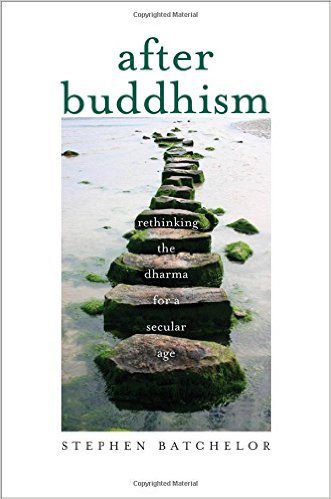
I can’t believe Stephen Batchelor’s After Buddhism sat in my bedside pile of books for a full year. Having just finished it, I’m really sorry I waited so long.
The book opens with two quotes. The first from the Buddha himself. “The dharma is clearly visible, immediate, inviting, uplifting, to be personally sensed by the wise.” Paired with it is one from the ninth century Chan master Linji. “The dharma of the buddhas has no special undertakings. Just act ordinarily, without trying to do anything in particular. Move your bowels, piss, get dressed, eat your rice, and if you get tired, lie down.”
And with this we get to ride along with Stephen Batchelor as he unfolds a powerful and compelling story of what he believes is an original Buddhism. He has asserted this several times in his past writings. And he has been taken to task for it. Here Stephen (I struggled with how to address him in this review. After trying to be more formal, either using Mr Batchelor or Batchelor to refer to him, I find a need to use the more contemporary and informal style of simply using his first name. I think he would prefer that.) pulls out all the stops. He shows us the texts, explores them, unpacks them, contextualizes them, and he presents something really, really interesting.
Stephen describes his project. “On the basis of sparse evidence, I am seeking to reconstruct the life of the man known as Gotama and the dharma he taught. In both cases, I try imaginatively to re-inhabit the world of fifth century BCE India in order to recover glimpses of the historical Gotama before he mutated into the quasi-divine Buddha, and the core elements of his teaching before they mutated into the various orthodoxies of Buddhism.” And this he does. However, while it is sparse evidence, it is presented compellingly.
From this investigation, he presents an invitation to a much more humble spirituality, but something really, really interesting. Quite simply, I believe After Buddhism is the first major theological analysis of what is sometimes called Modern or Modernist Buddhism, sometimes Naturalistic Buddhism. Drawing upon the emergent theologies associated with the radical Protestant movement, I’ve called this phenomenon Liberal Buddhism. Stephen Batchelor prefers to call it Secular Buddhism. Time only will tell what name is finally attached to this movement that has been taking shape since about the middle of the nineteenth century, actually he argues from at least the very end of the eighteenth. While we’re still in the infancy of this, if you’ll forgive the mixing of metaphors, facet of the jewel that is the Buddha Way, what we have here, as I said, is the major theological reflection to date of this emergent school.
In the book he focuses on Gautama Siddhartha, the Buddha of history, the culture, and the people among whom he moved, and with particularly focus on the lay, as he calls them adherents. Batchelor’s Buddha lives in a world at once alien to us and completely recognizable, inhabited by living people making decisions that have immediate consequences in their lives, and in the case of kings and spiritual sages, in the lives of many others. He succeeds in painting a compelling picture of a generally attractive figure, who in addition to being a mendicant sage can navigate the complex and frequently violent politics of his time and place – and do so for more than forty years.
With a flesh and blood Buddha, whom he tends to refer to by his family name of Gotama we have someone who is not, and actually cannot be above the fray. But rather a person who, if he hopes for his project to succeed, must deal with not only merchants and others engaged in the messiness of life, but the political and military leaders of the society. People, Stephen points out, who can be bloodthirsty and capricious, and who could end the Buddha’s enterprise at any time.
This retelling is itself a powerful portrayal, and for me as I read it utterly compelling. But there is very much more to the book. Stephen’s major contention is that Gotama lacked a metaphysical bone in his body. Possibly not unlike Stephen, himself. Stephen demonstrates relentlessly how he finds this this-worldly pragmatism by searching and analyzing the texts we have available to us.
And it really is compelling. More important Stephen’s vision of a pragmatic Gotama’s teachings are convincing as an invitation to a way of life to be lived here and now. At the core of this analysis Stephen reformulates the four truths, or, rather feels he has captured their pre-sectarian use as “four tasks,” in what he considers a more faithful version.
1) Suffering is to be comprehended
2) The arising is to be let go of
3) The ceasing is to be beheld
4) The path is to be cultivated.
Later on in the book Stephen restates these tasks as 1) embrace suffering, 2) let go of reactivity, 3) behold the ceasing of reactivity, & 4) cultivate an integrated way of life. He puts a great deal of reflection into what that integrated life looks like.
For Stephen “Gotama’s ‘all’ is an unsentimental inventory of fleeting, tragic, impersonal experience.” And he recoils at any assertion of something beyond that. And so, for Stephen, Nirvana “does not refer to the attainment of a transcendent, absolute state apart form the conditions of life but to the possibility of living here and now emancipated form the inclinations of desire, hatred, and delusion.” For him awakening “occurs entirely within the context of empirical experience…” And that awakening “consists of a threefold reorientation to experience rather than the attainment of a single privileged insight into an ultimate truth such as the Unconditioned.” The key “lies in emancipating oneself from the pernicious habit of grasping…” emancipated from reactivity, or, the “conditioning power of desire, hatred, and delusion.”
Throughout Stephen examines the doctrines the Buddha is presenting in the light of his pragmatic, and the other critical word skeptical Gotama. He eviscerates the two-truths model, which is actually foundational to my own Buddhism. But, I will forgo here an attempt at first fairly laying out his argument and then countering with my views – too long, and unnecessary for this review. Maybe later and in another venue.
But to give a taste of this revisiting, challenging and reinterpreting core Buddhist teachings as another example, in another significant departure from the general assertions of Buddhism, Stephen flatly states that suffering does not end. “What Buddhists trumpet as the ‘end of suffering’ cannot mean what it says.” He tells us. “Not only does it make little sense, the discourses themselves clearly state that it means the end of reactivity. To let go of reactivity and behold its ceasing is certainly no easy task, but at least it is something to which we can aspire, whereas the end of suffering will remain a pipe dream for as long as we are pulsating, breathing, ingesting, digesting, defecating bodies.”
As startling as his assertions and then compelling in his arguments, at the same time I continue to have trouble accepting Stephen’s view of an original pragmatic, ethical Buddhism lost through the accretions of religious sensibilities. My take away is that the ideas that Stephen Batchelor puts together likely all did exist at least to some degree from the earliest stages of Buddhism. But, these as the Buddha’s teaching specifically, and coherently? That’s a bridge too far for me. And I continue to question his need for the teachings to actually come from the Buddha to justify his presenting them.
All that said, what matters to me most is the religion Stephen presents. It, call it what you like, Secular Buddhism, Liberal Buddhism, Modernist Buddhism, Naturalist Buddhism; it is worth listening to, reflecting on, and even trying on. It might even at least in broad strokes be the faith for our times. I know I’m quite taken with Stephen’s reduced Buddhism, stripped of all metaphysics, and focused on the principle of conditionality, the practices of a “fourfold task,” his narrowed focus on meditation’s purposes and practice, and, finally as he presents it, self-reliance. Not, I rush to say a self-reliance that is isolation from others and the world. Actually here he seems more comfortable with the “both and” of things than elsewhere. People are individuals to be respected fully. And, we’re bound up together as intimate as can be.
He systematically presents his view of a “pre-orthodox dharma,” which is built upon “ethical, contemplative, and philosophical practice,” which he finds “optimizing human flourishing in a secular age”. It reflects a lifetime scholarly investigation of the Pali literature, Stephen’s own genuine heart, and authenticity to what he finds as the real world. A real world, as I see it, most akin to Philip K Dick’s dictum, “reality is that which, when you stop believing in it, doesn’t go away.”
One thing I’ve been completely convinced by in reading this book is that Stephen is correct asserting the Pali texts are something of a hodgepodge, including various strands of Buddhist thought, often contradictory, mashed together into what has become the canon. Not unlike what we find in the Bible, particularly in the Pentateuch, where various oral traditions are pasted together by a third party, or, probably third parties, often leaving patchy evidence of the scissors and glue. In fact it is pretty clear that Stephen is using the same tools as Christian scholars have put to use in examining their sacred texts and traditions. In some ways this is book is the culmination of an early form critical analysis of the Pali texts. This is no doubt something that we need more of.
But there’s another important point here. His “secular” Buddhism in no way lacks wonder. It’s just that, as he asserts, “A sense of the sublimity and interconnectedness of life does not require retaining or reverting to the cosmological beliefs of ancient India.” And as an example of a totally satisfactory alternative that maps the Buddhism he believes, Stephen cites Charles Darwin, who wrote in his On the Origin of Species, “There is a grandeur in this view of life, with its several powers, having been originally breathed into a few forms or into one; and that, whilst this planet has gone cycling on according to the fixed law of gravity, from so simple a beginning endless forms most beautiful and most wonderful have been, and are being, evolved.” There are several moments of ecstatic appreciation in the book. This is just one.
For me Stephen’s natural world as he experiences it speaks to a sense of wonder that is compelling, and even resonant with the best of the world’s mystics as much as it is an embrace of the modern project and the world science has revealed. But, he he relentlessly uses the word “secular” to summarize that sense, which carries within it a whole other world with a divide between it and “sacred.” It becomes “material” as the opposite of “spiritual,” inevitably including other hidden connotations, like “dead.” For me, as I read him I find someone who has tasted something wonderful, but as he presents it, wants it to fit as closely as he can honestly make it, to our contemporary scientific world-view.
And, here, I find the greatest difficulties. We stumble into the semantic wars around spirituality that are a hallmark of our times. I’ve just participated in a Facebook thread where a couple of people find they absolutely must enforce a definition of God that fits their argument, despite the actually messiness of that word which has and continues to be used in a multiplicity of ways. Here we find the language wars around spirituality and our times raging like a fire.
Stephen brings a rigor to the project that I cannot help but admire deeply. I feel, he needs to let the mystery that he, again to me obviously has experienced, a little more room to play. How, is not at all clear. But it is a problem, maybe a flaw in his presentation. At least as I read it.
That said. Bottom line: Maybe After Buddhism is a flawed masterpiece. But, it is a masterpiece.
You care about Buddhism and its variations? You care about a life of meaning in our times? You should read this book.
It really is important.

Browse Our Archives
Select a Category A Christmas Carol Abolitionist African-American Ahmadiyya Alan Watts Aldous Huxley Allen Ginsberg Amedkar Jayanti American politics American Zen Anaheim Zen Sangha Anglican Annie Besant April Fool Armageddon Art and Religion artificial intellegence Atheist Awakening B R Ambedkar Barlaam & Josaphat Beatnik Between Bhagavad Gita Bible biography birthday bodhisattva Bodhisattva Precepts Book burning Book of Common Prayer Book of Mormon Brahmo Samaj Buddha Buddhism Buddhist Buddhist Lord's Prayer Butterflies Calendars cartoons cat ChatGPT Chicken Tortilla Soup choices Christian atheism Christian mysticism Christian origins Christian Science Christian Zen Christianity Christianity and Buddhism christmas Christmas Truce Christopher Isherwood Church of Later Day Saints Cinco de Mayo circus covenant critical thinking culture D. T. Suzuki Dalit Buddhism Daniel Defoe Desert Fathers and Mothers dharma talk Dogen Donald Trump Dongshan's Five Ranks Dorothy Day dream Duty Easter ecology Edwin Arnold emptiness Empty Moon Zen Network Episcopal Church Eternal Now Ethics evolution existentialism Faith fantasy Fathers Day film film review fire Five Ranks Folk music food Form and emptiness Four Seals Francis of Assisi Francis Xavier Free thinker friendship George MacDonald Gerald Heard Glenn Taylor Webb God Good Friday Gospel of Gospel of Mark Gospel of Thomas grace Graduate Theological Unioin Graduate Theological Union Guanyin H R Blyth Hakuin Ekaku Hanamatsuri Hanukkah Harada Yasutani Zen Heart Sutra Henry David Thoreau Hermann Hesse Hinduism History and Religion history of religion Holy Spirit home Hospitality Icon Ides of March Isaac Newton Islam Islamic mysticism Jack Kerouac James Luther Adams Jiddu Krishnamurti Joan of Arc Johannes Gutenberg John Donne joke Judaism justice karma kensho King James Bible koan Koun Yamada Kyoto School Lewis Carrol Liberal Christianity Liberal Religion Life Plan Community Liminal literature Literature and Religion Liturgy Lord's Prayer Love Mahatma Gandhi Mahayana Martin Luther King Jr Mary Baker Eddy Mary Magdelene Mary Oliver Mayflower Compact Meditation memories memory metaphor money money and religioin Mormons Mother's Day movie review mysticism mythic Neighborhood Unitarian Universalist Church New Thought Nichiren Buddhism Nonduality not knowing Omar Khayyam Pacific School of Religion pagan Palm Sunday Passover peace Pentecost perennialism Phantastes Philip Kapleau philosophy Pilgrimage poetry Poetry and Religion politics Prayer Precepts Printing Press prophecy prophetic spirituality psychology Pure Land Queer religion queering religion Quietism Ram Mohan Roy rebirth recipe Relationships and religion religion religion and history Religious syncretism Resistance Retirement Retreat review Rissho Kosei Kai Ritual Robert Aitken Roshi Robert Ingersoll Rohatsu Romani religion Rosie the Riveter saints samadhi SanboZen Sangha Satyagraha science science and reigion science and religion science fiction seminary sermon Sesshin Sex and Religion Shinran Sikh Sikh tradition silence Social Justice Socially Engaged Buddhism Society and religion Soto Zen soul spiritual community spiritual practice Spirituality Sufism Suicide superstition Taoism Television Teresa of Avila Thanksgiving theological schools Theosophy Thomas Merton Time Transcendentalism Transcendentalist Trinitarian Trinity Uncategorized unitarian Unitarian Christianity Unitarian Universalist Universalism Vajrayana Vedanta Walking war Willa Cather William Ellery Channing wisdom women and religion women in religion World Teacher Writing zazen Zen Zen Center Zen inspired retriement zen meditation Zen Precepts Zen women
Select a Month September 2026 August 2026 July 2026 June 2026 May 2026 April 2026 March 2026 February 2026 January 2026 December 2025 November 2025 October 2025 September 2025 August 2025 July 2025 June 2025 May 2025 April 2025 March 2025 February 2025 January 2025 December 2024 November 2024 October 2024 September 2024 August 2024 July 2024 June 2024 May 2024 April 2024 March 2024 February 2024 January 2024 December 2023 November 2023 October 2023 September 2023 August 2023 July 2023 June 2023 May 2023 April 2023 March 2023 February 2023 January 2023 December 2022 November 2022 October 2022 September 2022 August 2022 July 2022 June 2022 May 2022 April 2022 March 2022 February 2022 January 2022 December 2021 November 2021 October 2021 September 2021 August 2021 July 2021 June 2021 May 2021 April 2021 March 2021 February 2021 January 2021 December 2020 November 2020 October 2020 September 2020 August 2020 July 2020 June 2020 May 2020 April 2020 March 2020 February 2020 January 2020 December 2019 November 2019 October 2019 September 2019 August 2019 July 2019 June 2019 May 2019 April 2019 March 2019 February 2019 January 2019 December 2018 November 2018 October 2018 September 2018 August 2018 July 2018 June 2018 May 2018 April 2018 March 2018 February 2018 January 2018 December 2017 November 2017 October 2017 September 2017 August 2017 July 2017 June 2017 May 2017 April 2017 March 2017 February 2017 January 2017 December 2016 November 2016 October 2016 September 2016 August 2016 July 2016 June 2016 May 2016 April 2016 March 2016 February 2016 January 2016 December 2015 November 2015 October 2015 September 2015 August 2015 July 2015 June 2015 May 2015 April 2015 March 2015 February 2015 January 2015 December 2014 November 2014 October 2014 September 2014 August 2014 July 2014 June 2014 May 2014 April 2014 March 2014 February 2014 January 2014 December 2013 November 2013 October 2013 September 2013 August 2013 July 2013 June 2013 May 2013 April 2013 March 2013 February 2013 January 2013 December 2012 November 2012 October 2012 September 2012 August 2012 July 2012 June 2012 May 2012 April 2012 March 2012 February 2012 January 2012 December 2011 November 2011 October 2011 September 2011 August 2011 July 2011 June 2011 May 2011 April 2011 March 2011 February 2011 January 2011 December 2010 November 2010 October 2010 September 2010 August 2010 July 2010 June 2010 May 2010 April 2010 March 2010 February 2010 January 2010 December 2009 November 2009 October 2009 September 2009 August 2009 July 2009 June 2009 May 2009 April 2009 March 2009 February 2009 January 2009 December 2008 November 2008 October 2008 September 2008 August 2008 July 2008 June 2008 May 2008 April 2008 March 2008 February 2008 January 2008 December 2007 November 2007 October 2007 September 2007 August 2007 July 2007 June 2007 May 2007 April 2007 March 2007 February 2007 January 2007 December 2006 November 2006 October 2006 September 2006
Follow Us!
TAKE THE
Religious Wisdom Quiz
What Christian group is known for avoiding modern technology?
Select your answer to see how you score.
Pentecostals Baptists Amish Methodists
Related posts from Monkey Mind


A Zen Buddhist Response to this Moment


The Suchness of Crows: The Zen teachings of...
TRENDING AT PATHEOS Buddhist

Nearly every morning, I make the drive to Detroit with my high-school-age...

The Real AI Story Is Adoption Without Trust
Artificial intelligence has crossed a political threshold. It is no longer a...

A new article, written by Jeff Lindsay and Gale L. Pooley,...

Swimfan: Forgotten Aughts Pleasures
This is a recovery effort. In 2002, My Big Fat Greek Wedding...

Top Three Anti-Catholic Lies About Catholicism
This is my initial transcript for the video, "THE 3 WORST...

Pope Leo Celebrates Mass for Nurses & Docs...
I don't have any idea how he did it, but Pope Leo...
view all Buddhist blogs
Ad-Free & Subscriber Log-In Subscription Support
- About Us
- 2026 Calendar
- Videos
- Podcasts
- Library of World Religions
- Faith In Media Tracker
- Advertise With Us
- Write for Us
- Privacy Policy
- Terms of Service
- Do Not Sell My Data
- Contact Us
- Radiant Digital
- Manage Newsletter Subscriptions
- Unsubscribe From Notifications
- Sitemap
Copyright 2008-2026, Patheos. All rights reserved.
Subscription Support Ad-Free & Subscriber Log-In
Follow Patheos