
BuddhistCatholicContemplativeEvangelicalGeneral ChristianHinduJewishLatter-day SaintMuslimNew VisionsProgressive Christian
Beliefs
- Buddhist
- Catholic
- Contemplative
- Evangelical
- General Christian
- Hindu
- Jewish
- Latter-day Saint
- More Voices
- Muslim
- New Visions
- Pagan
- Progressive Christian
Topics
- Religion News
- Food and Religion
- Sports and Religion
- Religious Art
- Religious Music and Entertainment
- Religious Events
- History and Religion
- Style and Religion
- Politics and Religion
- Women in Religion
- Recreation Outdoors and Religion
- Business Finance and Religion
- Careers Workplace and Religion
- Education and Religion
- Family Parenting and Religion
- Health Fitness and Religion
- Home and Religion
- Relationships and Religion
- Technology and Religion
- Travel and Religion
Columnists
- Buddhist Columnists
- Business Finance and Religion Columnists
- Careers Workplace and Religion Columnists
- Catholic Columnists
- Contemplative Columnists
- Education and Religion Columnists
- Evangelists Columnists
- Family Parenting and Religion Columnists
- General Christian Columnists
- Health Fitness and Religion Columnists
- Hindu Columnists
- History and Religion Columnists
- Home and Religion Columnists
- Jewish Columnists
- More Voices Columnists
- Latter Day Columnists
- Muslim Columnists
- New Visions Columnists
- Nonreligious Columnists
- Pagan Columnists
- Politics and Religion Columnists
- Progressive Columnists
- Recreation Outdoors and Religion Columnists
- Relationships and Religion Columnists
- Religion News Columnists
- Religious Art Columnists
- Religious Events Columnists
- Religious Music and Entertainment Columnists
- Sports and Religion Columnists
- Style and Religion Columnists
- Technology and Religion Columnists
- Travel and Religion Columnists
- Women in Religion Columnists
Resource Library
- 2026 Calendar
- Library of World Religions
- The 100 Most Holy Places on Earth
- Patheos Answers
- Podcasts
- Videos
- Faith Leaders Database
- Anglican Episcopalian
- Bahai
- Baptist
- Buddhism
- Christianity
- Confucianism
- Eastern Orthodoxy
- Hinduism
- Holiness and Pentecostal
- ISKCON
- Islam
- Judaism
- Lutheran
- Methodist
- The Church of Jesus Christ of Latter-day Saints
- New Age
- Paganism
- Presbytarian and Reformed
- Protestantism
- Religion Behind the Scenes
- Roman Catholic
- Scientology
- Shia Islam
- Sikhism
- Sufism
- Sunni Islam
- Taoism
- Zen
- See all religions
Research Tools
 Ad-Free & Subscriber Log-In Subscription Support
Ad-Free & Subscriber Log-In Subscription Support
Follow Patheos 

- Trending:
- Forgiveness
- |
- Marriage
- |
- Consciousness
- |
- Death Penalty
- |
- Election
- |
- Halloween

- Home
- Buddhist
- A REFELCTION ON BUDDHISM, CHRISTIANITY, AND UNITARIAN UNIVERSALISM
A REFELCTION ON BUDDHISM, CHRISTIANITY, AND UNITARIAN UNIVERSALISM
Last updated on: September 5, 2017 at 5:34 pm by James Ford
A REFELCTION ON BUDDHISM, CHRISTIANITY, AND UNITARIAN UNIVERSALISM 2017-09-05T17:34:47-07:00 James Ford
Patheos Explore the world's faith through different perspectives on religion and spirituality! Patheos has the views of the prevalent religions and spiritualities of the world.
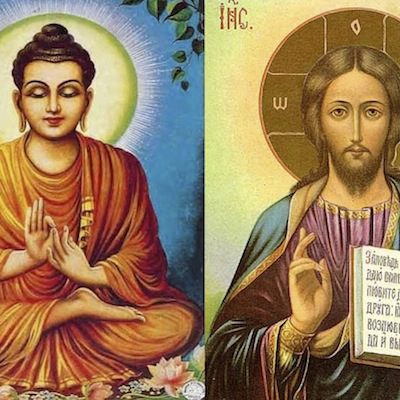
A Reflection on Buddhism, Christianity and Unitarian Universalism
by James Ishmael Ford
Yesterday I posted a blog post in honor of the Feast of Sts Barlaam and Josaphat, where I mused on my fantasy of a Buddhist Christian, or maybe it would be a Christian Buddhist church. After which a friend linked me to an archive of newsletters for the UU Buddhist Sangha, which included this article by me written in 1998. In yesterday’s meditation I wrote of the lost Luminous Religion of China as one possible paradigm for such a thing. In this 1998 article I dig into other theological considerations from different sources. Whatever, as it turns out, seventeen years on and I still think about a marriage of Buddhism and Christianity…
For many, many years the Catholic church observed the feast of Sts Barlaam and Josaphat every November 27th. The Orthodox church also remembered these saints, on November 9th. No less a figure than the renowned eighth century doctor of the church, John of Damascus, wrote the definitive spiritual biography of these two holy men.
The Oxford Dictionary of the Christian Church briefly outlines their story. “It having been prophesized in the infancy of Joasaph (or ‘Josaphat’), the son of a heathen Indian king, that he would be converted to Christianity, he was shut up in a palace so that he should know nothing of the facts or evils of life. Thence he escaped, and was found and won to the Christian faith by the hermit Barlaam. For a time he ruled the kingdom with his father, but later retired to the wilderness with Barlaam.”
Wonderful story. But, then in the great nineteenth century rush of critical scholarship, people began to notice how this story of Barlaam and Josaphat was eerily like that of the Buddha. And indeed, it turned out, it was the story of the Buddha. So, by the beginning of this century, Christians quietly dropped this feast from their calendars.
From near the beginning there seem to have been connections between Buddhists and Christians. There are several references in antiquity to Indian “gymnosophists” visiting the west. Undoubtedly most would have been Hindu yogis. But by that time Buddhism had extended into what is today Afghanistan. So who knows whether some of these visiting “Indians” were not Buddhist monks?
And Christians returned the favor. Some scholars maintain the Pure Land school of Mahayana Buddhism was birthed out of the meeting of Chinese Buddhism and missionaries from the Nestorian church. This is disputed, but not beyond the realm of possibility. But it is fairly certain that from the beginning there has been a cross-fertilization of these great spiritual traditions.
So it shouldn’t be surprising that today there is much conversation and more going on between Buddhism and Christianity. This brief essay has mostly to do with that “more.” When I was a young Zen monk I was with a group who visited a Trappist monastery. There we found Christians who knew quite a bit about Zen meditation. Certainly they knew more about our disciplines than we did theirs. Since that time I’ve visited several Christian monasteries. Long ago I ceased being surprised to find stacks of zafus, traditional Zen meditation cushions, at nearly every one of those Christian communities.
In 1925, one of the first American Buddhists, Dwight Goddard visited a Christian-Buddhist monastery in Nanking, China, that had been established by Karl Reichelt. I once ran across a volume that described how in the years before the second world war, a Japanese Buddhist community had adapted a version of the Rule of St Francis to their practice of the Dharma.
Perhaps the most notable of spiritual cross-fertilizations between Buddhists and Christians has taken place within one particular branch of Japanese Zen, the so-called Harada-Yasutani lineage. It is a reform of the Soto school, having adapted a full koan curriculum from the Rinzai school. While quite small in Japan, it has had an inordinate influence on the shape of western Zen.
Philip Kapleau, Robert Aitken and Taizan Maezumi, three towering figures in western Zen, all trained within the Harada-Yasutani lineage. To study koan Zen in the west is almost certainly to study within this lineage. What is fascinating are the number of Christians who have completed formal training within this school and have gone on to become authorized Zen teachers. While not the only Zen school to authorize “Christian Zen masters,” it has led the way, counting in its various branches possibly twenty Christians, mostly Catholic priests or nuns, who have been authorized in some way as Zen teachers.
So, what is this all about? And, most importantly, perhaps, what are we facing today? Are we looking at some new Buddhist-Christian synthesis? In a “Letter to the Bishops of the Catholic Church on Some Aspects of Christian Meditation,” Joseph Cardinal Ratzinger has warned Catholics that Buddhist spirituality is a seductive danger. And the Dalai Lama, looking with a jaundiced eye at Christian theism, warns “against people calling themselves ‘Buddhist-Christians,’ just as one should not try ‘to put a yak’s head on a sheep’s body.'”
We’ve arrived at a stage where the Benedictine monk, and Zen roshi, Willigis Jaeger can tell a gathering at an International Buddhist Christian Conference in Berkeley in 1987, “Many can argue whether a Christian can validly do Zen or teach Zen, or not. The fact is, I am doing it.” Perhaps a sheep with a yak’s head, but an eloquent yak-sheep, no doubt.
The primary difficulty rises in our understanding of the nature of God. Buddhism denies (or, perhaps more devastatingly, ignores) a Supreme Being who creates and sustains the world in the sense most Christians would understand as being “God.” And, closely related to this, Buddhism denies as delusional the belief in an immortal soul. These two fundamental differences would seem to make any Christian-Buddhist synthesis that impossible joining of yak and sheep.
But, still, it happens. I spoke briefly about this subject with a Catholic Zen teacher, Pat Hawk. He held up his hand palm out and said “Christian.” He then turned it so the back faced me and said “Zen.” A very zen expression, beautiful and graceful. But, when push comes to shove, does it work?
I don’t claim to know. Clearly there are moments in our lives when we can drop our conceptions, our notions, our ideas, and simply be present to what is. Many of us have experienced this, whatever the spiritual tradition within which we practice. At that point we can truly say we are neither Christian nor Buddhist. At that point all words fall away. Instead, we are simply present. I suggest this is Buddhist enlightenment, and maybe this can be Christian heaven.
People have struggled with their experience of this “full and yet empty present,” and tried to explain it in ways that make sense across culture and religion. Most notable of efforts at finding common ground are the writers in the Kyoto School of Japanese philosophical Buddhism. They have taken a great interest in the Christological hymn in Paul’s Epistle to the Philippians, Chapter 2, verses 5-12. The turning point for them is “kenosis,” the “emptying” of self, which they find suggestive of Buddhist sunyata, or emptiness.
A number of scholars have lept upon this possibility, following ideas first opened in the west by Thomas J.J. Altizer and other “death of God” theologians. It certainly is a rich vein to mine. The only problem, but a large one, is that it depends upon stretching the biblical use of kenosis in a way that occurs no where else in the original literature.
Others have sought the basis for dialogue and cross-fertilization in the shared images of compassion and love. Here we find that first category which bursts out of the unnamable experience of silence which Christians, Buddhists, and so many others have shared. Here I, too, find some great possibilities. But, what might come of it, I can’t even begin to imagine.
Which brings us to Unitarian Universalism.
Andrew Rawlinson, in his The Book of Enlightened Masters: Western Teachers in Eastern Traditions, writes one of the first surveys I’ve seen of this phenomenon of “Christian Zen.” He does it in an essay titled “Father Hugo Enomiya-Lassalle (and Christian Zen).” It is Enomiya-Lassalle rather than Thomas Merton, as many people might think, who opened the door to actual Christian-Buddhist practice. He was the first Christian to be authorized as a Zen master.
And Rawlinson’s study is among the first to delve, even if briefly, into the subject. In this essay he includes a table of Christians who have been authorized as Zen teachers. I found my own name in that table. I have been authorized to teach in the Soto school. And, I now am a spiritual director within the Harada-Yasutani school. The question is whether I should be counted as a Zen Christian?
Rawlinson lists me as a Protestant minister. Actually, I have little problem with that. In the shorthand necessary in a study as massive as his book, collapsing Unitarian Universalism into Protestantism is reasonable enough.
Of course, we Unitarian Universalists know this isn’t exactly true. Historically, we are children of the Reformation and specifically New England Congregationalism (if we skip over our Hungarian speaking cousins and the various independent and Presbyterian movements that became the English and Irish churches).
But, what are we theologically?
This is a question with which we’ve struggled for generations. And, I rather doubt we’re going to resolve it anytime soon. But, perhaps just because of that theological ambiguity, we are the perfect place for this Buddhist-Christian synthesis, or synergy, or whatever it is, to happen. If it is going to happen we seem the place and the people. We’re open to experiment. Many of us are non-theistic, in the traditional western use of the word. And, as a community, we’re thirsty for spiritual discipline.
Here I find myself a fairly typical Unitarian Universalist. I am drawn to the “kenotic God,” of Buddhist-Christian dialogue, as well as the divine darkness in The Cloud of Unknowing, the writings of Meister Eckhart and other apophatic mystics. Nonetheless, I simply do not believe in that creating and sustaining Supreme Being most westerners seem to mean when they use the word God. Nor do I believe in a soul as we usually use that word in western theology. While I do consider myself culturally and even heartfully Christian, by the standards of normative contemporary Christianity, I am not one. I’m too rationalist and humanistic to be accepted by nearly any modern Christian community. Except, of course, our own ambiguous Unitarian Universalism.
No wonder there is a Unitarian Universalist Buddhist Fellowship. We represent great possibilities within modern spirituality. Still, we need to be careful. Most of us in our liberal tradition may not think highly of Cardinal Ratzinger. He is head of what was once called the “Inquisition,” after all. But, he is not without insight. He suggests we need to be conscious of differences and resist mushing things together.
Victoria Urubshurow, a theologian writing in Buddhist-Christian Studies (volume 11, 1991), says in response to the Cardinal’s famous letter, “There is no doubt about it: important differences, even blatant contradictions exist between Christianity and Buddhism. Often the discrepancies stem not merely from problems of religious language, but from deep structural variations.”
We need to be wary of shallow eclecticism. What makes eclecticism subject to being shallow is that by its very nature it encourages us to simply pick and choose what is convenient or easy. If we avoid the difficult we not only miss the depths of a tradition, but we miss the possibility of our own coming to depth, to wisdom. On a genuine spiritual way we need the challenge of those difficult moments. They are what open our hearts and minds.
In this vein Urubshurow goes on to quote Thomas Merton. “There must be scrupulous respect for important differences, and where one no longer understands or agrees, this must be kept clear—without useless debate. There are differences that are not debatable, and it is a useless, silly temptation to try and argue them out. Let them be left intact until a moment of greater understanding.”
I suggest we Unitarian Universalists may bring about that moment of greater understanding. We have created a spiritual community that is one grand inter-religious conversation. We are Christians, Jews, Humanists, Neo-pagans, Buddhists, and many others, all of whom have agreed to come together as sisters and brothers.
Here we find, I believe, some great alchemy of heart, which allows us to be present each to the other, as well as to our own true selves. When we’ve talked and talked and finally have lapsed into a profound silence, I believe it is at that moment we find ourselves coming to something genuine.
It is this moment before conversation, before words, before ideas, that can be named both sunyata and the kenotic God. Here we find a moment pregnant with possibility. If we are willing to let our dreams fly and yet to ground ourselves in the practices of silence, together we may find a grand spiritual synthesis where Christ and Buddha are forgotten, but their realities remain.
When east and west are truly forgotten, we may find a wonderful field out of which some beautiful new plant may flower. It might even be like that mustard seed, the smallest of all seeds, that when planted and tended, becomes a great bush under which the birds of heaven may truly find rest.
Well, something of a homiletic extravagance! I am a preacher, after all. But, I look at the range of Unitarian Universalist Buddhism, and feel hope welling up from within me. What directions we’ll take, who knows? Will we retain many elements of our Christian and Jewish origins in our Unitarian Universalist Buddhism? Or not?
At this point it is impossible to say. Many UU Buddhists have had enough of our ancestral faith. Many of us want a simple and pure western Buddhism. Others among us feel the tug of our Protestant hearts. I am one of those. So, who knows? Where might this lead? Who knows?
But in this I have no doubt: as we go forward in the great conversations of east and west, Unitarian Universalism will be one of those places where the speaking and the listening will occur. And if we are to come to some place where we’ve gone beyond east and west, it will be within Unitarian Universalism. A yak-sheep? A wonderful mustard bush? Perhaps in our Unitarian Universalist churches we will restore the celebration of the feast of Sts Barlaam and Josaphat. I think it might be very appropriate.
Next Post

November 29, 2015 A Spotlight on Spotlight: A Movie to See
Browse Our Archives
Select a Category A Christmas Carol Abolitionist African-American Ahmadiyya Alan Watts Aldous Huxley Allen Ginsberg Amedkar Jayanti American politics American Zen Anaheim Zen Sangha Anglican Annie Besant April Fool Armageddon Art and Religion artificial intellegence Atheist Awakening B R Ambedkar Barlaam & Josaphat Beatnik Between Bhagavad Gita Bible biography birthday bodhisattva Bodhisattva Precepts Book burning Book of Common Prayer Book of Mormon Brahmo Samaj Buddha Buddhism Buddhist Buddhist Lord's Prayer Butterflies Calendars cartoons cat ChatGPT Chicken Tortilla Soup choices Christian atheism Christian mysticism Christian origins Christian Science Christian Zen Christianity Christianity and Buddhism christmas Christmas Truce Christopher Isherwood Church of Later Day Saints Cinco de Mayo circus covenant critical thinking culture D. T. Suzuki Dalit Buddhism Daniel Defoe Desert Fathers and Mothers dharma talk Dogen Donald Trump Dongshan's Five Ranks Dorothy Day dream Duty Easter ecology Edwin Arnold emptiness Empty Moon Zen Network Episcopal Church Eternal Now Ethics evolution existentialism Faith fantasy Fathers Day film film review fire Five Ranks Folk music food Form and emptiness Four Seals Francis of Assisi Francis Xavier Free thinker friendship George MacDonald Gerald Heard Glenn Taylor Webb God Good Friday Gospel of Gospel of Mark Gospel of Thomas grace Graduate Theological Unioin Graduate Theological Union Guanyin H R Blyth Hakuin Ekaku Hanamatsuri Hanukkah Harada Yasutani Zen Heart Sutra Henry David Thoreau Hermann Hesse Hinduism History and Religion history of religion Holy Spirit home Hospitality Icon Ides of March Isaac Newton Islam Islamic mysticism Jack Kerouac James Luther Adams Jiddu Krishnamurti Joan of Arc Johannes Gutenberg John Donne joke Judaism justice karma kensho King James Bible koan Koun Yamada Kyoto School Lewis Carrol Liberal Christianity Liberal Religion Life Plan Community Liminal literature Literature and Religion Liturgy Lord's Prayer Love Mahatma Gandhi Mahayana Martin Luther King Jr Mary Baker Eddy Mary Magdelene Mary Oliver Mayflower Compact Meditation memories memory metaphor money money and religioin Mormons Mother's Day movie review mysticism mythic Neighborhood Unitarian Universalist Church New Thought Nichiren Buddhism Nonduality not knowing Omar Khayyam Pacific School of Religion pagan Palm Sunday Passover peace Pentecost perennialism Phantastes Philip Kapleau philosophy Pilgrimage poetry Poetry and Religion politics Prayer Precepts Printing Press prophecy prophetic spirituality psychology Pure Land Queer religion queering religion Quietism Ram Mohan Roy rebirth recipe Relationships and religion religion religion and history Religious syncretism Resistance Retirement Retreat review Rissho Kosei Kai Ritual Robert Aitken Roshi Robert Ingersoll Rohatsu Romani religion Rosie the Riveter saints samadhi SanboZen Sangha Satyagraha science science and reigion science and religion science fiction seminary sermon Sesshin Sex and Religion Shinran Sikh Sikh tradition silence Social Justice Socially Engaged Buddhism Society and religion Soto Zen soul spiritual community spiritual practice Spirituality Sufism Suicide superstition Taoism Television Teresa of Avila Thanksgiving theological schools Theosophy Thomas Merton Time Transcendentalism Transcendentalist Trinitarian Trinity Uncategorized unitarian Unitarian Christianity Unitarian Universalist Universalism Vajrayana Vedanta Walking war Willa Cather William Ellery Channing wisdom women and religion women in religion World Teacher Writing zazen Zen Zen Center Zen inspired retriement zen meditation Zen Precepts Zen women
Select a Month September 2026 August 2026 July 2026 June 2026 May 2026 April 2026 March 2026 February 2026 January 2026 December 2025 November 2025 October 2025 September 2025 August 2025 July 2025 June 2025 May 2025 April 2025 March 2025 February 2025 January 2025 December 2024 November 2024 October 2024 September 2024 August 2024 July 2024 June 2024 May 2024 April 2024 March 2024 February 2024 January 2024 December 2023 November 2023 October 2023 September 2023 August 2023 July 2023 June 2023 May 2023 April 2023 March 2023 February 2023 January 2023 December 2022 November 2022 October 2022 September 2022 August 2022 July 2022 June 2022 May 2022 April 2022 March 2022 February 2022 January 2022 December 2021 November 2021 October 2021 September 2021 August 2021 July 2021 June 2021 May 2021 April 2021 March 2021 February 2021 January 2021 December 2020 November 2020 October 2020 September 2020 August 2020 July 2020 June 2020 May 2020 April 2020 March 2020 February 2020 January 2020 December 2019 November 2019 October 2019 September 2019 August 2019 July 2019 June 2019 May 2019 April 2019 March 2019 February 2019 January 2019 December 2018 November 2018 October 2018 September 2018 August 2018 July 2018 June 2018 May 2018 April 2018 March 2018 February 2018 January 2018 December 2017 November 2017 October 2017 September 2017 August 2017 July 2017 June 2017 May 2017 April 2017 March 2017 February 2017 January 2017 December 2016 November 2016 October 2016 September 2016 August 2016 July 2016 June 2016 May 2016 April 2016 March 2016 February 2016 January 2016 December 2015 November 2015 October 2015 September 2015 August 2015 July 2015 June 2015 May 2015 April 2015 March 2015 February 2015 January 2015 December 2014 November 2014 October 2014 September 2014 August 2014 July 2014 June 2014 May 2014 April 2014 March 2014 February 2014 January 2014 December 2013 November 2013 October 2013 September 2013 August 2013 July 2013 June 2013 May 2013 April 2013 March 2013 February 2013 January 2013 December 2012 November 2012 October 2012 September 2012 August 2012 July 2012 June 2012 May 2012 April 2012 March 2012 February 2012 January 2012 December 2011 November 2011 October 2011 September 2011 August 2011 July 2011 June 2011 May 2011 April 2011 March 2011 February 2011 January 2011 December 2010 November 2010 October 2010 September 2010 August 2010 July 2010 June 2010 May 2010 April 2010 March 2010 February 2010 January 2010 December 2009 November 2009 October 2009 September 2009 August 2009 July 2009 June 2009 May 2009 April 2009 March 2009 February 2009 January 2009 December 2008 November 2008 October 2008 September 2008 August 2008 July 2008 June 2008 May 2008 April 2008 March 2008 February 2008 January 2008 December 2007 November 2007 October 2007 September 2007 August 2007 July 2007 June 2007 May 2007 April 2007 March 2007 February 2007 January 2007 December 2006 November 2006 October 2006 September 2006
Follow Us!
TAKE THE
Religious Wisdom Quiz
What does the name "Jacob" mean?
Select your answer to see how you score.
Supplanter Full of light Justified Friend of God
Related posts from Monkey Mind


Which Is the True Qian? A Koan About...


TRENDING AT PATHEOS Buddhist

Letters on Living the Faith by C.S. Lewis
Most of us met C.S. Lewis as a public intellectual. Mere Christianity....

When Halloween Unmasks Married Hearts
Written by Dr. David K. Ewen from Eternal Truth Bible College Behind...

Aristotle. He’s been called the father of logic, the father of the...

Methodist Central Hall and Westminster Abbey
Situated on the same square is Methodist Central Hall and Westminster Abbey. ...

57th Dove Awards Honor Dolly Parton, Crown New...
On gospel music’s biggest night, the 57th annual GMA Dove Awards honored...

The First Eucharistic Controversy: Christ’s Real Presence
For Catholics, the Eucharist is the source and summit of the Christian...
view all Buddhist blogs
Ad-Free & Subscriber Log-In Subscription Support
- About Us
- 2026 Calendar
- Videos
- Podcasts
- Library of World Religions
- Faith In Media Tracker
- Advertise With Us
- Write for Us
- Privacy Policy
- Terms of Service
- Do Not Sell My Data
- Contact Us
- Radiant Digital
- Manage Newsletter Subscriptions
- Unsubscribe From Notifications
- Sitemap
Copyright 2008-2026, Patheos. All rights reserved.
Subscription Support Ad-Free & Subscriber Log-In
Follow Patheos