
BuddhistCatholicContemplativeEvangelicalGeneral ChristianHinduJewishLatter-day SaintMuslimNew VisionsProgressive Christian
Beliefs
- Buddhist
- Catholic
- Contemplative
- Evangelical
- General Christian
- Hindu
- Jewish
- Latter-day Saint
- More Voices
- Muslim
- New Visions
- Pagan
- Progressive Christian
Topics
- Religion News
- Food and Religion
- Sports and Religion
- Religious Art
- Religious Music and Entertainment
- Religious Events
- History and Religion
- Style and Religion
- Politics and Religion
- Women in Religion
- Recreation Outdoors and Religion
- Business Finance and Religion
- Careers Workplace and Religion
- Education and Religion
- Family Parenting and Religion
- Health Fitness and Religion
- Home and Religion
- Relationships and Religion
- Technology and Religion
- Travel and Religion
Columnists
- Buddhist Columnists
- Business Finance and Religion Columnists
- Careers Workplace and Religion Columnists
- Catholic Columnists
- Contemplative Columnists
- Education and Religion Columnists
- Evangelists Columnists
- Family Parenting and Religion Columnists
- General Christian Columnists
- Health Fitness and Religion Columnists
- Hindu Columnists
- History and Religion Columnists
- Home and Religion Columnists
- Jewish Columnists
- More Voices Columnists
- Latter Day Columnists
- Muslim Columnists
- New Visions Columnists
- Nonreligious Columnists
- Pagan Columnists
- Politics and Religion Columnists
- Progressive Columnists
- Recreation Outdoors and Religion Columnists
- Relationships and Religion Columnists
- Religion News Columnists
- Religious Art Columnists
- Religious Events Columnists
- Religious Music and Entertainment Columnists
- Sports and Religion Columnists
- Style and Religion Columnists
- Technology and Religion Columnists
- Travel and Religion Columnists
- Women in Religion Columnists
Resource Library
- 2026 Calendar
- Library of World Religions
- The 100 Most Holy Places on Earth
- Patheos Answers
- Podcasts
- Videos
- Faith Leaders Database
- Anglican Episcopalian
- Bahai
- Baptist
- Buddhism
- Christianity
- Confucianism
- Eastern Orthodoxy
- Hinduism
- Holiness and Pentecostal
- ISKCON
- Islam
- Judaism
- Lutheran
- Methodist
- The Church of Jesus Christ of Latter-day Saints
- New Age
- Paganism
- Presbytarian and Reformed
- Protestantism
- Religion Behind the Scenes
- Roman Catholic
- Scientology
- Shia Islam
- Sikhism
- Sufism
- Sunni Islam
- Taoism
- Zen
- See all religions
Research Tools
 Ad-Free & Subscriber Log-In Subscription Support
Follow Patheos 

- Trending:
- Advent
- |
- Forgiveness
- |
- Thanksgiving
- |
- Election
- |
- Seasonal Holidays
- |
- Marriage

- Home
- Buddhist
- THE PASSION OF FANNIE LOU HAMER
THE PASSION OF FANNIE LOU HAMER
Last updated on: October 6, 2013 at 1:46 pm by James Ford
THE PASSION OF FANNIE LOU HAMER 2013-10-06T13:46:41-07:00 James Ford
Patheos Explore the world's faith through different perspectives on religion and spirituality! Patheos has the views of the prevalent religions and spiritualities of the world.
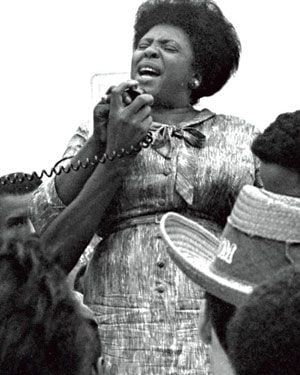
THE PASSION OF FANNIE LOU HAMER
6 October 2013
James Ishmael Ford
Senior Minister
First Unitarian Church
Providence, Rhode Island
Text
Not out of mere charity, but because peace in our time requires the constant advance of those principles that our common creed describes; tolerance and opportunity, human dignity and justice. We the people declare today that the most evident of truth that all of us are created equal—is the star that guides us still; just as it guided our forebears through Seneca Falls and Selma and Stonewall; just as it guided all those men and women, sung and unsung, who left footprints along this great mall, to hear a preacher say that we cannot walk alone; to hear a King proclaim that our individual freedom is inextricably bound to the freedom of every soul on Earth.
Barack Obama, Second Inaugural Address
Fannie Lou Hamer would have been ninety-seven today.
She was born Fannie Lou Townsend in Montgomery County, Mississippi, on the 6th of October 1917. Her parents Ella and Jim were poor sharecroppers. She was the youngest of their twenty children. Fannie Lou began working when she was six, at twelve dropped out of school, and by the time she was thirteen was picking some two to three hundred pounds of cotton a day.
When she was sixteen she appears to have had a brush with polio, and was no longer able to do hard field labor. But because she could read and write and was obviously smarter than most, she was employed by the plantation’s owner as a time and record keeper, as well as doing the cooking and cleaning for his house.
In 1944 Fannie Lou married Perry Hamer, a tractor driver on the plantation. She would say of her husband, “he was a good man of few words,” and, also, and it would prove important, that he was “steady as a rock.” When she had surgery to remove a tumor, as part of a now notorious program to reduce the number of poor blacks in Mississippi, without her knowledge Fannie Lou was sterilized. Never one to allow adversity to beat her down she and Perry, Pap, as he was known, adopted four children, all from people in even worse straights than theirs. An early hint of what kind of people they were.
The 23rd of August 1962 was a life changer for Fannie Lou. She attended a worship service in Ruleville, where the Reverend James Bevel, an organizer for the Student Nonviolent Coordinating Committee, urged the congregation to register to vote. Fannie Lou was the first to sign on. She would later explain, “I guess if I had any sense, I’d have been a little scared.” Then continued, “But, what was the point of being scared? The only thing they could do was kill me, and it kinda seemed like they’d been trying to do that a little bit at a time since I could remember.”
She joined a little band of seventeen from out of that service, who traveled on a rented bus to Indianola to register. On that ride Fannie Lou sang to the riders on the bus, and she asked them to join her. The songs she chose, played out of her deep Baptist faith, like “Go Tell it on the Mountain” and “This Little Light of Mine.” These and other songs she chose, after this bus ride would become staples of the Civil Rights movement underscoring the spiritual foundations of the movement itself. Before her it was implicit, with her, it was a shining forth of a deep truth. This was a spiritual struggle, as it continues to be.
As was true throughout the South in Indianola they had a literacy test set up, one that apparently most any white person could pass, but for some reason few blacks could. When pretty much as a matter of course she was told she had failed the test, Fannie Lou replied she would come back every thirty days, which was the required time between tests, until she passed. They got the message and Fannie Lou was registered to vote after her third try.
As she would say many times, “I am sick and tired of being sick and tired.” She was not going to lie down and take it anymore.
For registering to vote she was fired from the plantation she and her husband had worked at for some twenty years, and with that their family was driven off the land and from their home. The Ku Klux Klan followed them when they left and fired shots into the home where they had taken shelter. But what followed probably wasn’t what the KKK thought would be the case. As she told a reporter many years later, “When they kicked me off the plantation, they set me free. It’s the best thing that could happen. Now I could work for my people.”
In fact SNCC’s Mississippi organizer, Bob Moses had already heard of her being such a rock on the way to registration, and during the struggle to register, and told his assistant, to go and “find (that) lady who sings the hymns.” He had work for Fannie Lou. Recruited into the Civil Rights struggle she began to travel, to sing, and to call people to their better angels, to a better life for all of us.
She suffered threats, arrests, beatings, and was even shot at. After training in Winona, Fannie Lou and two other activists were arrested and taken to a police station. That night a State Highway Patrol officer ordered another prisoner to beat her with a blackjack he provided. When the prisoner collapsed from exhaustion from beating her, the officer dragged in another prisoner, to continue. It took three days for SNCC to get her released and to a hospital. Fannie Lou never fully recovered from the nightmare, suffered severe kidney damage, and limped for the rest of her life.
But she didn’t stop. Fannie Lou went on to become a major figure in the “Freedom Ballot Campaign,” and most particularly known for her work during the 1964 “Freedom Summer,” where many young white women and men who had come south for the work, found her a surrogate mother during trying and frightening and sometimes dangerous times, offering comfort and song as well as a motherly ear.
That summer she joined an upstart group, the Mississippi Freedom Democratic Party to challenge the state’s all white, segregationist delegation to the Democratic National Convention. Fannie Lou was elected their vice-chair.
Despite enormous opposition they managed to get a hearing before the convention’s credentials committee. Her words were recorded and reported widely. She described her many difficulties, her being jailed, her being beaten. And she concluded, “All of this is on account we want to register, to become first-class citizens, and if the Freedom Democratic Party is not seated now, I question America. Is this America, the land of the free and the home of the brave where we have to sleep with our telephones off the hooks because our lives be threatened daily because we want to live as decent human beings – in America?”
President Johnson was, and justifiably, afraid the Democratic south would turn, as we know it did turn, Republican because of the part Democrats were playing in the advance of racial justice. He was afraid, “that illiterate woman” as we get from Oval office recordings, could even cost him the election. Trying to handle the situation, the leadership offered a compromise where the upstart Freedom Democrats would be given two non-voting seats at the convention. This was political hardball, obviously, in the face of real danger to the campaign, and reluctantly even Martin Luther King, Jr and the Southern Christian Leadership Conference, swallowed hard and accepted it as the price for electoral victory.
But Fannie Lou did not. When Hubert Humphrey told her of the compromise, she responded, and again it was recorded, “Do you mean to tell me that your position is more important than four hundred thousand black people’s lives? Senator Humphrey, I know lots of people in Mississippi who have lost their jobs trying to register to vote. I had to leave the plantation where I worked in Sunflower County… Now if you lose this job of Vice-President because you do what is right, because you help (us), everything will be all right. God will take care of you. But if you take (the nomination) this way, why, you will never be able to do any good for civil rights, for poor people, for peace, or any of those things you talk about. Senator Humphrey, I’m going to pray to Jesus for you.”
The Freedom Democrats lost that battle. But it showed Fannie Lou as a moral force to be reckoned with. The next time around, in 1968, she was a part of an integrated Mississippi delegation to the Democratic National Convention. In the following years Fannie Lou would be active in many more projects and campaigns, including a Freedom Farm cooperative, establishing Head Start, Dr King’s Poor People’s Campaign, and later, the National Women’s Political Caucus.
In 1976 she was diagnosed with breast cancer. She also suffered from hypertension, and on March 14th, 1977, at the age of fifty-nine Fanny Lou suffered a heart attack, which killed her. The crowds were too large for her church, so the service was held at the local High School, where Ambassador Andrew Young delivered Fannie Lou’s eulogy. As he reminded those present and all who have followed, “None of us would be where we are today had she not been there then.” No doubt that’s true.
Personally, I find the great causes require people working from both inside and out. There is no doubt to my heart that without Lyndon Johnson and Hubert Humphrey and a host of other legislators and movers and shakers, who worked, the great advances for civil rights of that time would not have happened. They delivered the legislation.
And, at the same time, without Fannie Lou and a host of others standing on the outside knocking on the door, and knocking, and saying not another day – well, without them, without that urgency, I fear Lyndon and Hubert and all those others would not have pushed as hard as they did, and all of their efforts would have come to much less effect.
Instead.
On that cold November evening in 2004, when Barack Obama was elected president of our United States, many of us watched him speak to us from Millennial Park in Chicago. In that speech he echoed both the great Unitarian Divine Theodore Parker and our American hero Martin Luther King, Jr, and put his own unique twist on their words.
The president-elect said, “It’s the answer that led those who’ve been told for so long by so many to be cynical and fearful and doubtful about what we can achieve to put their hands on the arc of history and bend it once more toward the hope of a better day.”
The arc of history is no doubt long. The arc of history may indeed bend toward justice. But, it bends, I am sure, from the bottom of my heart, because people, human beings, Theodore, Martin, Lyndon, and Fannie Lou, to name some who deserve their names called out, sometimes at great cost, sometimes at the cost of their lives, putting their hands on that great arc, and bending it. Bending it…
This was Fannie Lou’s work. And she reminded us all how it is sacred work.
And, dear ones, it is the work to which we are called, by our faith, by our knowing how intimately we all are bound up with each other.
That simple. Fannie Lou showed us.
That hard. Fannie Lou showed us.
That worthwhile. Fannie Lou showed us.
Amen.
Previous Post

October 5, 2013
Two Hundred, Seventy Words on Why I Support the New Health Care Law
Next Post
October 8, 2013 A Song of the Cat
Browse Our Archives
Select a Category A Christmas Carol Abolitionist African-American Ahmadiyya Alan Watts Aldous Huxley Allen Ginsberg Amedkar Jayanti American politics American Zen Anaheim Zen Sangha Anglican Annie Besant April Fool Armageddon Art and Religion artificial intellegence Atheist Awakening B R Ambedkar Barlaam & Josaphat Beatnik Between Bhagavad Gita Bible biography birthday bodhisattva Bodhisattva Precepts Book burning Book of Common Prayer Book of Mormon Brahmo Samaj Buddha Buddhism Buddhist Buddhist Lord's Prayer Butterflies Calendars cartoons cat ChatGPT Chicken Tortilla Soup choices Christian atheism Christian mysticism Christian origins Christian Science Christian Zen Christianity Christianity and Buddhism christmas Christmas Truce Christopher Isherwood Church of Later Day Saints Cinco de Mayo circus covenant critical thinking culture D. T. Suzuki Dalit Buddhism Daniel Defoe Desert Fathers and Mothers dharma talk Dogen Donald Trump Dongshan's Five Ranks Dorothy Day dream Duty Easter ecology Edwin Arnold emptiness Empty Moon Zen Network Episcopal Church Eternal Now Ethics evolution existentialism Faith fantasy Fathers Day film film review fire Five Ranks Folk music food Form and emptiness Four Seals Francis of Assisi Francis Xavier Free thinker friendship George MacDonald Gerald Heard Glenn Taylor Webb God Good Friday Gospel of Gospel of Mark Gospel of Thomas grace Graduate Theological Unioin Graduate Theological Union Guanyin H R Blyth Hakuin Ekaku Hanamatsuri Hanukkah Harada Yasutani Zen Heart Sutra Henry David Thoreau Hermann Hesse Hinduism History and Religion history of religion Holy Spirit home Hospitality Icon Ides of March Isaac Newton Islam Islamic mysticism Jack Kerouac James Luther Adams Jiddu Krishnamurti Joan of Arc Johannes Gutenberg John Donne joke Judaism justice karma kensho King James Bible koan Koun Yamada Kyoto School Lewis Carrol Liberal Christianity Liberal Religion Life Plan Community Liminal literature Literature and Religion Liturgy Lord's Prayer Love Mahatma Gandhi Mahayana Martin Luther King Jr Mary Baker Eddy Mary Magdelene Mary Oliver Mayflower Compact Meditation memories memory metaphor money money and religioin Mormons Mother's Day movie review mysticism mythic Neighborhood Unitarian Universalist Church New Thought Nichiren Buddhism Nonduality not knowing Omar Khayyam Pacific School of Religion pagan Palm Sunday Passover peace Pentecost perennialism Phantastes Philip Kapleau philosophy Pilgrimage poetry Poetry and Religion politics Prayer Precepts Printing Press prophecy prophetic spirituality psychology Pure Land Queer religion queering religion Quietism Ram Mohan Roy rebirth recipe Relationships and religion religion religion and history Religious syncretism Resistance Retirement Retreat review Rissho Kosei Kai Ritual Robert Aitken Roshi Robert Ingersoll Rohatsu Romani religion Rosie the Riveter saints samadhi SanboZen Sangha Satyagraha science science and reigion science and religion science fiction seminary sermon Sesshin Sex and Religion Shinran Sikh Sikh tradition silence Social Justice Socially Engaged Buddhism Society and religion Soto Zen soul spiritual community spiritual practice Spirituality Sufism Suicide superstition Taoism Television Teresa of Avila Thanksgiving theological schools Theosophy Thomas Merton Time Transcendentalism Transcendentalist Trinitarian Trinity Uncategorized unitarian Unitarian Christianity Unitarian Universalist Universalism Vajrayana Vedanta Walking war Willa Cather William Ellery Channing wisdom women and religion women in religion World Teacher Writing zazen Zen Zen Center Zen inspired retriement zen meditation Zen Precepts Zen women
Select a Month November 2026 October 2026 September 2026 August 2026 July 2026 June 2026 May 2026 April 2026 March 2026 February 2026 January 2026 December 2025 November 2025 October 2025 September 2025 August 2025 July 2025 June 2025 May 2025 April 2025 March 2025 February 2025 January 2025 December 2024 November 2024 October 2024 September 2024 August 2024 July 2024 June 2024 May 2024 April 2024 March 2024 February 2024 January 2024 December 2023 November 2023 October 2023 September 2023 August 2023 July 2023 June 2023 May 2023 April 2023 March 2023 February 2023 January 2023 December 2022 November 2022 October 2022 September 2022 August 2022 July 2022 June 2022 May 2022 April 2022 March 2022 February 2022 January 2022 December 2021 November 2021 October 2021 September 2021 August 2021 July 2021 June 2021 May 2021 April 2021 March 2021 February 2021 January 2021 December 2020 November 2020 October 2020 September 2020 August 2020 July 2020 June 2020 May 2020 April 2020 March 2020 February 2020 January 2020 December 2019 November 2019 October 2019 September 2019 August 2019 July 2019 June 2019 May 2019 April 2019 March 2019 February 2019 January 2019 December 2018 November 2018 October 2018 September 2018 August 2018 July 2018 June 2018 May 2018 April 2018 March 2018 February 2018 January 2018 December 2017 November 2017 October 2017 September 2017 August 2017 July 2017 June 2017 May 2017 April 2017 March 2017 February 2017 January 2017 December 2016 November 2016 October 2016 September 2016 August 2016 July 2016 June 2016 May 2016 April 2016 March 2016 February 2016 January 2016 December 2015 November 2015 October 2015 September 2015 August 2015 July 2015 June 2015 May 2015 April 2015 March 2015 February 2015 January 2015 December 2014 November 2014 October 2014 September 2014 August 2014 July 2014 June 2014 May 2014 April 2014 March 2014 February 2014 January 2014 December 2013 November 2013 October 2013 September 2013 August 2013 July 2013 June 2013 May 2013 April 2013 March 2013 February 2013 January 2013 December 2012 November 2012 October 2012 September 2012 August 2012 July 2012 June 2012 May 2012 April 2012 March 2012 February 2012 January 2012 December 2011 November 2011 October 2011 September 2011 August 2011 July 2011 June 2011 May 2011 April 2011 March 2011 February 2011 January 2011 December 2010 November 2010 October 2010 September 2010 August 2010 July 2010 June 2010 May 2010 April 2010 March 2010 February 2010 January 2010 December 2009 November 2009 October 2009 September 2009 August 2009 July 2009 June 2009 May 2009 April 2009 March 2009 February 2009 January 2009 December 2008 November 2008 October 2008 September 2008 August 2008 July 2008 June 2008 May 2008 April 2008 March 2008 February 2008 January 2008 December 2007 November 2007 October 2007 September 2007 August 2007 July 2007 June 2007 May 2007 April 2007 March 2007 February 2007 January 2007 December 2006 November 2006 October 2006 September 2006
Follow Us!
TAKE THE
Religious Wisdom Quiz
Who interpreted Nebuchadnezzar's dream of a statue of gold, silver, bronze, iron, and clay?
Select your answer to see how you score.
Daniel Ezekiel Hosea Obadiah
Related posts from Monkey Mind
If I Stop Becoming, Will I Disappear?

James Ishmael Ford's books on Zen
Taking Refuge in the (Zen) Sangha

Recalling the Amazing Alexandra David-Neel
TRENDING AT PATHEOS Buddhist

Watch and Pray: On Mark 13:33-37
Jesus said to his disciples: “Be watchful! Be alert! You do not...

Debate on Purgatory & Biblical Evidences for It
This is from a combox on my video channel, Catholic Bible Highlights....

Set the table for the coming King
On Thursday we visited my sister-in-law for Thanksgiving, and throughout the entire...

If I Stop Becoming, Will I Disappear?
(At our most recent half day Zen retreat, Dr Chris Hoff, a...

A Modest Proposal for President Trump
Trump should just quit the loser Republicans who failed him so badly...
Praise and Thanks As Natural as Breathing
This week I had the privilege of sitting down with Deacon Tom...
view all Buddhist blogs
Ad-Free & Subscriber Log-In Subscription Support
- About Us
- 2026 Calendar
- Videos
- Podcasts
- Library of World Religions
- Faith In Media Tracker
- Advertise With Us
- Write for Us
- Privacy Policy
- Terms of Service
- Do Not Sell My Data
- Contact Us
- Radiant Digital
- Manage Newsletter Subscriptions
- Unsubscribe From Notifications
- Sitemap
Copyright 2008-2026, Patheos, part of the Radiant Digital network of media brands. All rights reserved.
Subscription Support Ad-Free & Subscriber Log-In
Follow Patheos