
BuddhistCatholicContemplativeEvangelicalGeneral ChristianHinduJewishLatter-day SaintMuslimNew VisionsProgressive Christian
Beliefs
- Buddhist
- Catholic
- Contemplative
- Evangelical
- General Christian
- Hindu
- Jewish
- Latter-day Saint
- More Voices
- Muslim
- New Visions
- Pagan
- Progressive Christian
Topics
- Religion News
- Food and Religion
- Sports and Religion
- Religious Art
- Religious Music and Entertainment
- Religious Events
- History and Religion
- Style and Religion
- Politics and Religion
- Women in Religion
- Recreation Outdoors and Religion
- Business Finance and Religion
- Careers Workplace and Religion
- Education and Religion
- Family Parenting and Religion
- Health Fitness and Religion
- Home and Religion
- Relationships and Religion
- Technology and Religion
- Travel and Religion
Columnists
- Buddhist Columnists
- Business Finance and Religion Columnists
- Careers Workplace and Religion Columnists
- Catholic Columnists
- Contemplative Columnists
- Education and Religion Columnists
- Evangelists Columnists
- Family Parenting and Religion Columnists
- General Christian Columnists
- Health Fitness and Religion Columnists
- Hindu Columnists
- History and Religion Columnists
- Home and Religion Columnists
- Jewish Columnists
- More Voices Columnists
- Latter Day Columnists
- Muslim Columnists
- New Visions Columnists
- Nonreligious Columnists
- Pagan Columnists
- Politics and Religion Columnists
- Progressive Columnists
- Recreation Outdoors and Religion Columnists
- Relationships and Religion Columnists
- Religion News Columnists
- Religious Art Columnists
- Religious Events Columnists
- Religious Music and Entertainment Columnists
- Sports and Religion Columnists
- Style and Religion Columnists
- Technology and Religion Columnists
- Travel and Religion Columnists
- Women in Religion Columnists
Resource Library
- 2026 Calendar
- Library of World Religions
- The 100 Most Holy Places on Earth
- Patheos Answers
- Podcasts
- Videos
- Faith Leaders Database
- Anglican Episcopalian
- Bahai
- Baptist
- Buddhism
- Christianity
- Confucianism
- Eastern Orthodoxy
- Hinduism
- Holiness and Pentecostal
- ISKCON
- Islam
- Judaism
- Lutheran
- Methodist
- The Church of Jesus Christ of Latter-day Saints
- New Age
- Paganism
- Presbytarian and Reformed
- Protestantism
- Religion Behind the Scenes
- Roman Catholic
- Scientology
- Shia Islam
- Sikhism
- Sufism
- Sunni Islam
- Taoism
- Zen
- See all religions
Research Tools
 Ad-Free & Subscriber Log-In Subscription Support
Ad-Free & Subscriber Log-In Subscription Support
Follow Patheos 

- Trending:
- Forgiveness
- |
- Marriage
- |
- Consciousness
- |
- Death Penalty
- |
- Election
- |
- Halloween

- Home
- Buddhist
- LIFE’S PILGRIMAGE A Meditation on a Once and Future Spiritual Discipline
LIFE’S PILGRIMAGE A Meditation on a Once and Future Spiritual Discipline
Last updated on: September 29, 2013 at 2:06 pm by James Ford
LIFE’S PILGRIMAGE A Meditation on a Once and Future Spiritual Discipline 2013-09-29T14:06:28-07:00 James Ford
Patheos Explore the world's faith through different perspectives on religion and spirituality! Patheos has the views of the prevalent religions and spiritualities of the world.
LIFE’S PILGRIMAGE
A Meditation on a Once and Future Spiritual Discipline
29 September 2013
James Ishmael Ford
Senior Minister
First Unitarian Church
Providence, Rhode Island
Text
What is rooted is easy to nourish.
What is recent is easy to correct.
What is brittle is easy to break.
What is small is easy to scatter.
Prevent trouble before it arises.
Put things in order before they exist.
The giant pine tree
grows from a tiny sprout.
The journey of a thousand miles
starts from beneath your feet.
Rushing into action, you fail.
Trying to grasp things, you lose them.
Forcing a project to completion,
you ruin what was almost ripe.
Therefore the Master takes action
by letting things take their course.
He remains as calm
at the end as at the beginning.
She has nothing,
thus has nothing to lose.
What he desires is non-desire;
what he learns is to unlearn.
She simply reminds people
of who they have always been.
He cares about nothing but the Tao.
Thus he can care for all things.
Tao Te Ching, Chapter 64
Rendered by Stephen Mitchell, with slight changes
I believe we are called by our lives into the deep.
I also believe people grow deep just by living. The joys and sorrows of the years push us to open our hearts and minds, and in that opening, we find the deep.
But, also, we humans have a natural propensity to work with nature, to shape things, and push them along, and just so, in our spiritual lives, in that path toward depth, we have found ways to move things along, to sharpen our focus, to achieve that great goal of finding our life’s purpose. We call these things spiritual practices. There are many, an astonishing number, in fact. The good thing with this is if one doesn’t work for you, there is always another.
Our own chalice circles here at First Unitarian take our joy in conversation and make it an art of the heart. I find it uniquely appropriate for Unitarian Universalists and others drawn to paths of the mind, what the Hindus call jnana yoga, the path of wise knowledge. Chalice circles certainly are the most popular of the disciplines found among us here. And if you haven’t tried it, I suggest you take advantage of the opportunity to do so during today’s coffee hour, following our service.
But, also, I suggest, we rarely have only one spiritual discipline. Just as agriculture and building have a number of tools, so does the work of the heart. And, with that, I’ve found myself thinking a lot about pilgrimage as a spiritual discipline this week.
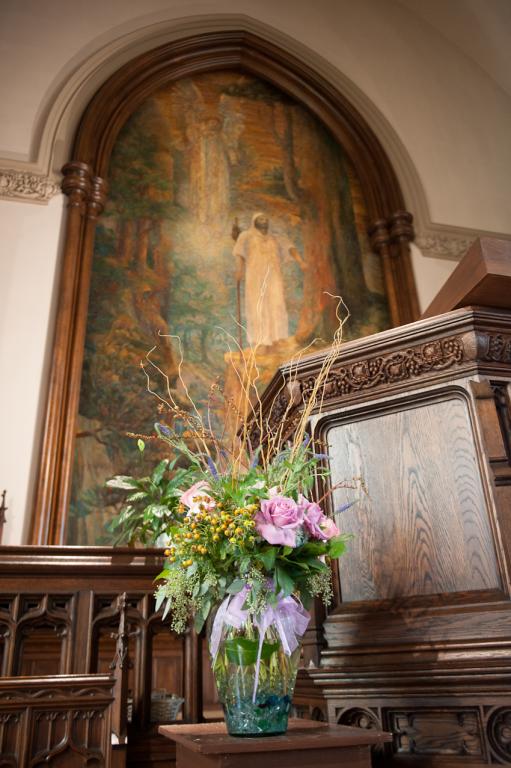
So, it was a bit of a surprise on Thursday when I arrived at the First Unitarian Church in New Bedford for a clergy gathering. As we filed into the sanctuary I found my breath taken away as I saw for the first time their astonishing Tiffany mosaic on the wall behind the pulpit. Even partially obscured by some amateur’s attempt at preservation through a thick application of shellac, you can’t miss how amazing it is, and the luminosity of the mosaic shining though, the image, titled, of course, “Life’s Pilgrimage.”
Life’s pilgrimage.
I shouldn’t have been all that surprised at the sweet coincidence of thinking and reading about pilgrimage and quest, and to find myself in the moment confronted with that glorious image. Life is often like that. Perhaps you’ve noticed. At three hundred square feet it is the largest of Tiffany’s many mosaics. I would add, like that grand mosaic, some things in life are unavoidable. I’m coming to suspect pilgrimage is one of them.
The mosaic features a bearded man on what is obviously a dangerous mountain path with an angel just behind him. Made me think of that once ubiquitous bumper sticker, “Not all who wander are lost,” a slight paraphrase of a line in a poem in J. R. R. Tolkien’s novel, the Fellowship of the Ring, “Not all those who wander are lost.” And there I was confronted with wandering, thinking I’m doing one thing, going to a meeting, and what does it turn out to be but a pilgrimage!
And, talking about images that point the way. That way is seen, always, as the line goes, through a glass darkly. There’s always some confusion. The way is cloudy, like going through a mist. And, and, there in front of me, the glory was indeed partially obscured by that well-meaning but wrong-headed shellac. I take that as a sign, as a reminder to remind us we should make sure we’re all more or less on the same page. Let’s hold up two words for a little closer inspection right at the beginning. The first is quest. And the second is pilgrimage. They’re closely connected.
The online version of my personal favorite dictionary for American English, Merriam-Webster gives two definitions for that word “quest.” First as “a journey made in search of something” and second, “a long and difficult effort to find or do something.” “Pilgrimage,” as it turns out, is also given two definitions. The first is “a journey to a holy place” and the second is “a journey to a special or unusual place.”
The dictionary goes on to cite the first usages for both English words in the fourteenth century. That can be a bit confusing as pilgrimage is one of the oldest of spiritual practices, and the idea of a quest is perhaps the oldest literary motif there is, songs of quest were sung around campfires, and became the subjects of the first bards in far distant antiquity. The quest is our human desire to find the treasures of our hearts. Pilgrimage is the journey of the heart. They are something critical for us, if we ever want to move from our status quo, from the comfortable shallows of our lives, and into our depths.
And, let’s be clear, like pretty much all spiritual practices, pilgrimage can be a way of avoiding the real deal, becoming tourists rather than pilgrims. There’s that famous story where a businessman, infamous for his harsh dealings with others, telling Mark Twain of his plans to take a pilgrimage to the Holy Land. “I’m going to climb Mt Sinai,” he explains. “And from the top of the mountain I’m going to read out the Ten Commandments to the world.” Twain replies, somewhat dryly, I imagine, “Or, you could stay in Boston, and try to keep them.”
I’ve known people who see their spiritual journey as a pilgrimage in a way that misses the point. The dream quest for them is a running away from the problems and difficulties of life. I suspect we need to take heed of that Buddhist text which proclaims, “how sad that people ignore the near, and search for truth afar.” Pilgrimage is not about running from, but rather running to.
Pilgrimage is a lot like that Medieval Jewish story of the man who dreams of a treasure buried by a lamppost at the edge of a bridge, who takes off on his quest, on his pilgrimage, and after much hardship finds the spot. While digging at the foot of the lamppost a policeman stops him. When the pilgrim tells his story, the policeman laughs and says he had such a dream himself, and in minute detail describes the man’s own basement. But, the policeman continues, you don’t see me chasing off after such things. Leaving the man in peace to return home and dig up the treasure.
That man had to wander in order to come home. Life’s pilgrimage is taking that walk, wandering out, and then going home. Often in order to find the true treasure we need to step out, to walk about, to experience the sacred way, in order to find our home.
It’s as natural as breathing. Who, as a child or, maybe today, hasn’t had a fantasy about embarking on an adventure and toward some wonderful object? This intuition, dream, aspiration, is about as baseline human as it gets. We all, or, just about every one of us, dreams of that better. I suggest the dream version is itself the origin of all quest. And, I think pilgrimage brings the dream of quest down to the earth. Pilgrimage is what we actually do out of that great dream.
It’s about taking that walk, long or short, home.
One would be hard put to find a religion that doesn’t honor pilgrimage one way or another. There’s the Spanish Way of St James, one of the great Medieval Christian pilgrimage routes, a path I know a number of us have walked, second only, perhaps to making one’s way to Jerusalem. And, that’s just two of many, many Christian pilgrimage sites. In ancient Judaism the Temple was a destination for pilgrims and even today Jews make their way to that last standing remnant of Herod’s temple to remember and to pray. Throughout the Muslim world there are many pilgrimage sites, the great Haj, one of the five foundations of Islam, merely being the most notable. In India, Hindus have numerous sites of pilgrimage. Buddhists make their way to the sites of the Buddha’s life and other great shrines.
Of the great religions, only Confucians, at least once in government, were suspicious of pilgrimage. Suspicious of peasants leaving home, I suspect, and of the social disruptions that can follow such journeys of discovery. Frankly, I find that negative take on pilgrimage particularly informative. Pilgrimage, rightly done, disrupts the order of things. And, I notice in modern times people marked by the many positive aspects of Confucianism like to visit the site of the master’s birth in what is today the city of Qufu. So, now, even Confucians have pilgrimages.
Pilgrimage is not even bound by the terms “faith” or “spiritual,” at least in its usual sense. Think of the “Freedom trail” up in Boston. Or, mixing it all up for me, secular and spiritual, taking a walk around Walden Pond, something I’ve done nearly annually since moving to New England. We might discuss circumambulation and its close cousin, walking the labyrinth as variations on pilgrimage.
So, what about us? You know, you and me, faithful and faithless. Us. How can we encounter pilgrimage as our spiritual practice? I suggest we can, each of us, claim pilgrimage as part of our spiritual lives.
So, what would it look like? In an essay on pilgrimage, my colleague, the UU minister Alan Taylor enumerates four points he finds useful in making a personal pilgrimage. He suggests 1) setting an intention, 2) preparing, particularly by stripping away all that is unnecessary, 3) when on pilgrimage to be open to all encounters, and 4) to let the lessons appear as they appear, not as we would like them to. I really like these pointers, and think they are very helpful.
And, I’ve my own four points, as well. If you want to try pilgrimage as a spiritual discipline there’s 1) a beginning, there are 2) obligations while on the journey, there is 3) the destination and our relationship with that destination as a goal, and then, finally, 4) there is coming home, where the journey and the goal collapse into the moment of presence. Let me unravel these points, just a little. Let’s see how we can create our own personal pilgrimage, taking us out on the path home.
First, everything begins with attention. We notice. We look. We listen. Pick your sense. Use it. Without this we’re not on pilgrimage, we are just wandering, wandering among the weeds and grasses. We’re just tourists. With attention, everything becomes sacred. In fact, do this, and you have it all.
Still, there are more things we can do. So, two: those obligations along the way. People on pilgrimage mark the journey out as special, one way or another. Often, folk wear special clothing; the medieval pilgrim’s badge leaps to my mind, as do the robes of a pilgrim on Hajj. Sometimes people refrain from eating certain foods for the duration. Again, I think the important thing here is creating a way of constantly reminding oneself that this is a pilgrimage, not just a stroll in the neighborhood. Although, I believe, done right, that stroll can become the pilgrim’s way. Mark it out in some manner. Carry something, a pebble from the beach, wear that string of beads a child made for you.
Three: recalling that destination of our pilgrimage. It isn’t yet home; it is an ideal, a goal, an aspiration. But giving a little heart to the matter, bringing our heart’s longing into the project hints at what home is. Now as a spiritual practice the destination needs to be a real place, it needs to be a real spot in time and space. X marks the spot. Is it a trip to see the site of the Buddha’s birth? Or, to go to Walden Pond and place another stone on the pile next to the site of Thoreau’s long gone shack? Is it to some place that you always went as a child, when everything was right? Perhaps it’s a particular stretch of beach? Or, maybe it’s cabin on a lake? Or, possibly, a park in a city with too few of them? Is it a trip to this Meeting House on a Sunday? Or, that walk in the neighborhood? Pick your pilgrimage. And, attending along the way, begin to see what it means to you, what it reveals to your heart. What is your true relationship to this particular spot that is different than your relationship to any other?
And four: that last thing. Coming home. In our coming fully to the place we sought, recalling all the things that led to it, our setting our intention, our bringing our attention, our noticing each step, well, you know, it isn’t rocket science.
Doing this we discover it, the object of our heart’s longing, the true deep, is nowhere other than our own heart, our own body, this very place.
The goal of every pilgrimage.
Amen.
Previous Post

September 28, 2013
A Small Tip of the Hat to the Remarkable William Jones
Next Post
September 30, 2013 Recalling Rumi
Browse Our Archives
Select a Category A Christmas Carol Abolitionist African-American Ahmadiyya Alan Watts Aldous Huxley Allen Ginsberg Amedkar Jayanti American politics American Zen Anaheim Zen Sangha Anglican Annie Besant April Fool Armageddon Art and Religion artificial intellegence Atheist Awakening B R Ambedkar Barlaam & Josaphat Beatnik Between Bhagavad Gita Bible biography birthday bodhisattva Bodhisattva Precepts Book burning Book of Common Prayer Book of Mormon Brahmo Samaj Buddha Buddhism Buddhist Buddhist Lord's Prayer Butterflies Calendars cartoons cat ChatGPT Chicken Tortilla Soup choices Christian atheism Christian mysticism Christian origins Christian Science Christian Zen Christianity Christianity and Buddhism christmas Christmas Truce Christopher Isherwood Church of Later Day Saints Cinco de Mayo circus covenant critical thinking culture D. T. Suzuki Dalit Buddhism Daniel Defoe Desert Fathers and Mothers dharma talk Dogen Donald Trump Dongshan's Five Ranks Dorothy Day dream Duty Easter ecology Edwin Arnold emptiness Empty Moon Zen Network Episcopal Church Eternal Now Ethics evolution existentialism Faith fantasy Fathers Day film film review fire Five Ranks Folk music food Form and emptiness Four Seals Francis of Assisi Francis Xavier Free thinker friendship George MacDonald Gerald Heard Glenn Taylor Webb God Good Friday Gospel of Gospel of Mark Gospel of Thomas grace Graduate Theological Unioin Graduate Theological Union Guanyin H R Blyth Hakuin Ekaku Hanamatsuri Hanukkah Harada Yasutani Zen Heart Sutra Henry David Thoreau Hermann Hesse Hinduism History and Religion history of religion Holy Spirit home Hospitality Icon Ides of March Isaac Newton Islam Islamic mysticism Jack Kerouac James Luther Adams Jiddu Krishnamurti Joan of Arc Johannes Gutenberg John Donne joke Judaism justice karma kensho King James Bible koan Koun Yamada Kyoto School Lewis Carrol Liberal Christianity Liberal Religion Life Plan Community Liminal literature Literature and Religion Liturgy Lord's Prayer Love Mahatma Gandhi Mahayana Martin Luther King Jr Mary Baker Eddy Mary Magdelene Mary Oliver Mayflower Compact Meditation memories memory metaphor money money and religioin Mormons Mother's Day movie review mysticism mythic Neighborhood Unitarian Universalist Church New Thought Nichiren Buddhism Nonduality not knowing Omar Khayyam Pacific School of Religion pagan Palm Sunday Passover peace Pentecost perennialism Phantastes Philip Kapleau philosophy Pilgrimage poetry Poetry and Religion politics Prayer Precepts Printing Press prophecy prophetic spirituality psychology Pure Land Queer religion queering religion Quietism Ram Mohan Roy rebirth recipe Relationships and religion religion religion and history Religious syncretism Resistance Retirement Retreat review Rissho Kosei Kai Ritual Robert Aitken Roshi Robert Ingersoll Rohatsu Romani religion Rosie the Riveter saints samadhi SanboZen Sangha Satyagraha science science and reigion science and religion science fiction seminary sermon Sesshin Sex and Religion Shinran Sikh Sikh tradition silence Social Justice Socially Engaged Buddhism Society and religion Soto Zen soul spiritual community spiritual practice Spirituality Sufism Suicide superstition Taoism Television Teresa of Avila Thanksgiving theological schools Theosophy Thomas Merton Time Transcendentalism Transcendentalist Trinitarian Trinity Uncategorized unitarian Unitarian Christianity Unitarian Universalist Universalism Vajrayana Vedanta Walking war Willa Cather William Ellery Channing wisdom women and religion women in religion World Teacher Writing zazen Zen Zen Center Zen inspired retriement zen meditation Zen Precepts Zen women
Select a Month September 2026 August 2026 July 2026 June 2026 May 2026 April 2026 March 2026 February 2026 January 2026 December 2025 November 2025 October 2025 September 2025 August 2025 July 2025 June 2025 May 2025 April 2025 March 2025 February 2025 January 2025 December 2024 November 2024 October 2024 September 2024 August 2024 July 2024 June 2024 May 2024 April 2024 March 2024 February 2024 January 2024 December 2023 November 2023 October 2023 September 2023 August 2023 July 2023 June 2023 May 2023 April 2023 March 2023 February 2023 January 2023 December 2022 November 2022 October 2022 September 2022 August 2022 July 2022 June 2022 May 2022 April 2022 March 2022 February 2022 January 2022 December 2021 November 2021 October 2021 September 2021 August 2021 July 2021 June 2021 May 2021 April 2021 March 2021 February 2021 January 2021 December 2020 November 2020 October 2020 September 2020 August 2020 July 2020 June 2020 May 2020 April 2020 March 2020 February 2020 January 2020 December 2019 November 2019 October 2019 September 2019 August 2019 July 2019 June 2019 May 2019 April 2019 March 2019 February 2019 January 2019 December 2018 November 2018 October 2018 September 2018 August 2018 July 2018 June 2018 May 2018 April 2018 March 2018 February 2018 January 2018 December 2017 November 2017 October 2017 September 2017 August 2017 July 2017 June 2017 May 2017 April 2017 March 2017 February 2017 January 2017 December 2016 November 2016 October 2016 September 2016 August 2016 July 2016 June 2016 May 2016 April 2016 March 2016 February 2016 January 2016 December 2015 November 2015 October 2015 September 2015 August 2015 July 2015 June 2015 May 2015 April 2015 March 2015 February 2015 January 2015 December 2014 November 2014 October 2014 September 2014 August 2014 July 2014 June 2014 May 2014 April 2014 March 2014 February 2014 January 2014 December 2013 November 2013 October 2013 September 2013 August 2013 July 2013 June 2013 May 2013 April 2013 March 2013 February 2013 January 2013 December 2012 November 2012 October 2012 September 2012 August 2012 July 2012 June 2012 May 2012 April 2012 March 2012 February 2012 January 2012 December 2011 November 2011 October 2011 September 2011 August 2011 July 2011 June 2011 May 2011 April 2011 March 2011 February 2011 January 2011 December 2010 November 2010 October 2010 September 2010 August 2010 July 2010 June 2010 May 2010 April 2010 March 2010 February 2010 January 2010 December 2009 November 2009 October 2009 September 2009 August 2009 July 2009 June 2009 May 2009 April 2009 March 2009 February 2009 January 2009 December 2008 November 2008 October 2008 September 2008 August 2008 July 2008 June 2008 May 2008 April 2008 March 2008 February 2008 January 2008 December 2007 November 2007 October 2007 September 2007 August 2007 July 2007 June 2007 May 2007 April 2007 March 2007 February 2007 January 2007 December 2006 November 2006 October 2006 September 2006
Follow Us!
TAKE THE
Religious Wisdom Quiz
What does Paul tell Timothy to fan into flame?
Select your answer to see how you score.
His zeal The gift of God The Holy Spirit His faith
Related posts from Monkey Mind


Which Is the True Qian? A Koan About...


TRENDING AT PATHEOS Buddhist

'Super Scam Me' Exposes AI Jon Bon Jovi...
Leslie Pickett believed she was in a relationship with Jon Bon Jovi....

The Brazilian Remake of Kendricks' 'Flywheel' Opens in...
“Flywheel,” the story that launched the Kendrick Brothers’ filmmaking career is getting...

The Dangers of Gradual Accommodation (Winking at Sin)
Recently, the “law of gradualness” resurfaced during the opening of a weeklong,...

The Iron Gates and the Lion of the...
Yesterday, I didn't finish my report about, well, yesterday. So I'll...

The Image: On the Horror of Capitalism and...
The Image Then went the Pharisees, and took counsel how they might...

We are approaching the date of our new American national holiday: October...
view all Buddhist blogs
Ad-Free & Subscriber Log-In Subscription Support
- About Us
- 2026 Calendar
- Videos
- Podcasts
- Library of World Religions
- Faith In Media Tracker
- Advertise With Us
- Write for Us
- Privacy Policy
- Terms of Service
- Do Not Sell My Data
- Contact Us
- Radiant Digital
- Manage Newsletter Subscriptions
- Unsubscribe From Notifications
- Sitemap
Copyright 2008-2026, Patheos. All rights reserved.
Subscription Support Ad-Free & Subscriber Log-In
Follow Patheos