
BuddhistCatholicContemplativeEvangelicalGeneral ChristianHinduJewishLatter-day SaintMuslimNew VisionsProgressive Christian
Beliefs
- Buddhist
- Catholic
- Contemplative
- Evangelical
- General Christian
- Hindu
- Jewish
- Latter-day Saint
- More Voices
- Muslim
- New Visions
- Pagan
- Progressive Christian
Topics
- Religion News
- Food and Religion
- Sports and Religion
- Religious Art
- Religious Music and Entertainment
- Religious Events
- History and Religion
- Style and Religion
- Politics and Religion
- Women in Religion
- Recreation Outdoors and Religion
- Business Finance and Religion
- Careers Workplace and Religion
- Education and Religion
- Family Parenting and Religion
- Health Fitness and Religion
- Home and Religion
- Relationships and Religion
- Technology and Religion
- Travel and Religion
Columnists
- Buddhist Columnists
- Business Finance and Religion Columnists
- Careers Workplace and Religion Columnists
- Catholic Columnists
- Contemplative Columnists
- Education and Religion Columnists
- Evangelists Columnists
- Family Parenting and Religion Columnists
- General Christian Columnists
- Health Fitness and Religion Columnists
- Hindu Columnists
- History and Religion Columnists
- Home and Religion Columnists
- Jewish Columnists
- More Voices Columnists
- Latter Day Columnists
- Muslim Columnists
- New Visions Columnists
- Nonreligious Columnists
- Pagan Columnists
- Politics and Religion Columnists
- Progressive Columnists
- Recreation Outdoors and Religion Columnists
- Relationships and Religion Columnists
- Religion News Columnists
- Religious Art Columnists
- Religious Events Columnists
- Religious Music and Entertainment Columnists
- Sports and Religion Columnists
- Style and Religion Columnists
- Technology and Religion Columnists
- Travel and Religion Columnists
- Women in Religion Columnists
Resource Library
- 2026 Calendar
- Library of World Religions
- The 100 Most Holy Places on Earth
- Patheos Answers
- Podcasts
- Videos
- Faith Leaders Database
- Anglican Episcopalian
- Bahai
- Baptist
- Buddhism
- Christianity
- Confucianism
- Eastern Orthodoxy
- Hinduism
- Holiness and Pentecostal
- ISKCON
- Islam
- Judaism
- Lutheran
- Methodist
- The Church of Jesus Christ of Latter-day Saints
- New Age
- Paganism
- Presbytarian and Reformed
- Protestantism
- Religion Behind the Scenes
- Roman Catholic
- Scientology
- Shia Islam
- Sikhism
- Sufism
- Sunni Islam
- Taoism
- Zen
- See all religions
Research Tools
 Ad-Free & Subscriber Log-In Subscription Support
Ad-Free & Subscriber Log-In Subscription Support
Follow Patheos 

- Trending:
- Forgiveness
- |
- Marriage
- |
- Consciousness
- |
- Death Penalty
- |
- Election
- |
- Halloween

- Home
- Buddhist
- Fee for Service Buddhism: A Small Meditation on Money and the Dharma
Fee for Service Buddhism: A Small Meditation on Money and the Dharma
Last updated on: September 20, 2013 at 12:04 pm by James Ford
Fee for Service Buddhism: A Small Meditation on Money and the Dharma 2013-09-20T12:04:32-07:00 James Ford
Patheos Explore the world's faith through different perspectives on religion and spirituality! Patheos has the views of the prevalent religions and spiritualities of the world.
Two blogs I regularly check out are Notes in Samsara and American (in England) Buddhist Perspective. Through them I also on occasion dip into the blog Speculative Non-Buddhism.
At the moment there’s a bit of a brouhaha they’re all in varying degree caught up with. They’re all critical, again, in varying degree of Buddhist Geeks, which seems to me to be mostly young or younger Dharma practitioners from several different disciplines who have a web based presence as well as sponsoring an annual conference. They’ve been called out upon occasion for having so few people of color, particularly Asian or Asian-American practitioners and teachers, particularly at their conferences. I feel no doubt the color divide among us is a terrible thing and while it is something we are all complicit in, for those coming out of the dominant cultural groupings, healing this breach is mostly our responsibility. So, as the Geeks are pretty high profile, and it seems getting higher profile, this challenge sure looks legitimate to me.
But, there are other issues about them, as well, being aired by Justin, the pseudnonymous Mumon and the team at Speculative. One of the more interesting, I think, have been their challenges to “Integral” influenced Buddhisms, which seem to mark a significant proportion of the Geeks. Personally, I know little of Ken Wilbur, beyond having read two of his earlier books some years ago. I admit to a visceral distrust of systems that answer all questions, and, over the years, my personal red flags have raised around the company Mr Wilber has kept within his warm embrace even when they’ve gone seriously off the rails (notably Franklin Jones & Dennis Merzel), so, I’ve not delved deeply into the system. However, Justin, Mumon and the team have drilled down a bit and offer their perspectives on the shortcomings of the integral system, and what they raise looks helpful to me. And might be worth a further look from you.
However, what brings me to offer a thought or two here comes from a very recent posting from Mumon. He questions a tweet from Justin describing someone connected to the Geeks named Kenneth Folk as a “major” Western Buddhist. As my Dharmic circles don’t extend far beyond the Zen universe, I can’t say I’d ever heard of Mr Folk before. So, I have no dog in the hunt regarding his relevance to the Buddhist world.
In his listings of the man’s shortcomings, Mumon, takes umbrage at Mr Folk offering meditation instruction online for a fee (with a discount coupon).
Mumon’s arguments are several, and, as he points out in the blog posting I cite, he’s covered his concerns at greater length, elsewhere.
Me, I have little interest in fee scales, one of Mumon’s issues, although I have to admit I smiled at learning there was a discount coupon. But I do have views on the idea of fee for service teaching of the Dharma. And that’s the subject of my meditation here…
Mumon is hardly the first Buddhist commentator to raise questions about the ethical appropriateness of charging for teaching Buddhism in one aspect or another. The relevant line for many is a direct connection between “charging money” and “Dharma.” The Dharma is free is the response and charging money is wrong. The strongest specific argument I think is that no one should be turned away from access to the Dharma because of financial constraint.
Me, I see a conundrum. On the one hand the Dharma is a saving thing, succor for the hurt of the world. And those of us who have found healing in the Buddhadharma have some obligation to make it available to others. On the other hand, to draw upon another tradition for an image, the “laborer is worthy of his wages.”
The question for me in this reflection turns on those who bring the Dharma to people, increasingly as the full time focus of their lives, and how they also earn their keep.
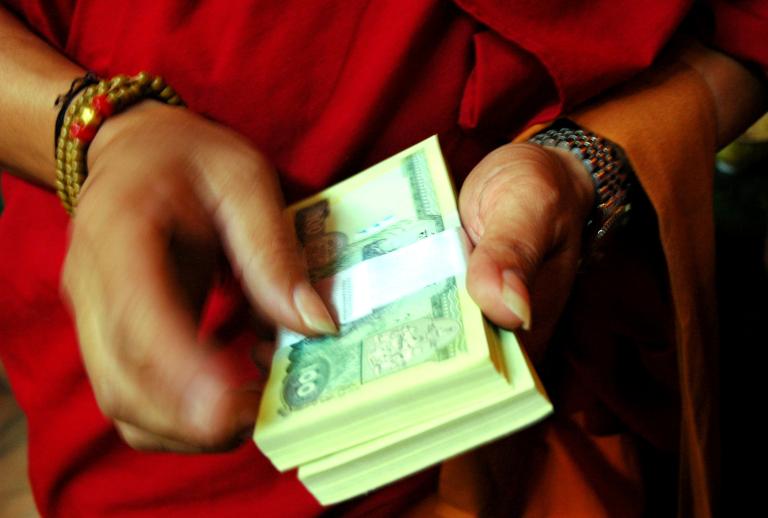
The carriers of the Buddhist way have for the most part over the larger part of history been renunciants, who by their rule cannot even touch money. Their support flows out of a complex structure of dana, or free giving. This system was birthed within a cultural context where monastics were supported by the larger community, and even when Buddhism was just one aberrant band among a larger proto-Hindu culture, they could already rely upon support from the larger lay community who had a tradition of supporting spiritual mendicants. In Buddhist cultures this system was expanded and sustained by the belief that gifts to renunicants produced greater positive karma than gifts to anyone else. And for those getting on with their lives and for whom spiritual efforts were mostly left to the professionals, the benefits of supporting the community was, how shall we put it, money in the bank, potentially leading to a better future life.
Each time Buddhism has moved into a new culture there have been shifts and adaptations. Perhaps the most notable until modernity was when Buddhism moved into China, and where monastics moved from being wandering beggars to settling down into communities, often supported by large land grants tilled by serfs (slave could also be used).
Today, as the many schools of Buddhism have come to the West there has been a wild range of ways to deal with the support of teachers of the Buddhist way.
In many ethnic enclaves there have been successful transplanting of East and South Asian monastic communities. And, more power to them, and those who have crossed ethnic barriers to embrace this ancient and noble path. But, there have been other models taking shape, as well. Japan had long since abandoned Vinaya monasticism in favor of an ordination model that increasingly looks like a Western ministry model something akin to Presbyterianism. Here in the West, one, a large Japanese Shin sect has created a church complete with seminary trained ministers. They have had their ups and downs, but I think their story has yet to look toward an end. I look to them with enormous admiration.
My own Zen schools have been struggling with priestly identity pretty much since they’ve arrived on Western soil. As non monastics using monastic terminology they and those they serve have had a hard time finding the right place. Personally, I think looking to the BCA could be helpful. But, what is certain is that story is not done, yet, either.
And, there has arisen within Zen and the larger Dharma community the phenomenon of lay teachers. There have always been lay teachers, but within its Western formations lay teachers have come to the fore in an unprecidented manner.
So, given the complexities of the Japanese ordination models which have produced many Dharma teachers here in the West as well as the significant numbers of lay teachers, we have come up front and ugly, to confront that connection between money and teaching.
Among the options I see, we can
1) scrap the non monastic ordained and lay teacher models.
2) keep these systems amateur (in the most positive use of that term), where the teacher is expected to make her or his living in some way unconnected to the Dharma.
3) revisit the “ethics” of financial support for non monastic teachers.
Frankly, I think the horse has been out of the barn vastly too long for option one.
Option two is what many are doing, myself included. I’m endlessly grateful for having stumbled into a line of work that has, I think, fruitfully, pushed me and challenged me as a Dharma teacher. I think those who have taken on various uniquely Western disciplines as psychologists, social workers, coaches and the various related, also fit into this option two adaptation.
And, I think, as good as it has been for me, and a number of other teachers, it isn’t an ideal model. For one where is the line between a psychological counseling and Buddhist teaching? Or, coaching? Or, the rising discipline of “spiritual direction?” I find that line so movable depending on this or that as to be almost meaningless.
So. Acknowledging it isn’t going to be easy, still, I think we need to go with all deliberation toward option three.
One of the axioms of the Buddha way is seeing through clinging to that which is passing as if it were permanent. For many this has meant abandoning the world. In the Zen way as I’ve learned it and practice it letting go of clinging does not necessarily have to do with retreat from life in the world.
This is in part a response to the various problems that have arisen with too tight a clinging to renunciation as “the” way.
In addition, and I can’t begin to say what is chicken and what is egg, the whole dana scheme has collapsed in the West, where for the most part it has been reduced to another Western concept, tips. I was visiting with a very prominent Insight meditation teacher at a very large center and asked him about how dana is working for them. He admitted how he felt slightly embarrassed about it, but he’s doing well. I think the embarrassment had to do much with the fact, as he also added, that most of his colleagues were struggling to survive.
So, money as one of the grand conundrums of Buddhism come West.
And, of course, it brings with it a whole new set of problems. One or two perhaps illustrated by Mr Folk’s discounted fee schedule.
What I hope for is more open and honest discussions about money and Dharma. I would also hope for some reflection by those who don’t like the idea of “professional” Buddhist teachers, to consider what exactly their problem is, and to articulate it in as open and heartful a way as they can.
I especially hope we tone down the rhetoric as we deal with this difficult issue. The people involved are for the most part devoted to the Dharma and trying to find ways to make a living while living out their commitments, and in service to something deeply loved and cared for.
And, I hope, not use charging a fee for instruction as evidence of someone’s perfidity. Or, at the very least, contextualize the criticism – is really always wrong, or is there an appropriate medium, and what is that medium?
And, of course, for those of us who support revisioning the ways we financially support our Dharma teachers to offer clear thinking on the matter. No facile dismissals in this discussion…
Do this.
And who knows, we might even struggle into something that serves the great way…
For those interested in this subject Mumon has offered some further reflections I found worth a read…
Previous Post

September 17, 2013
Religion and Violence, a Brief Aside in a Larger Conversation
Next Post
September 20, 2013 Beatnik Horror
Browse Our Archives
Select a Category A Christmas Carol Abolitionist African-American Ahmadiyya Alan Watts Aldous Huxley Allen Ginsberg Amedkar Jayanti American politics American Zen Anaheim Zen Sangha Anglican Annie Besant April Fool Armageddon Art and Religion artificial intellegence Atheist Awakening B R Ambedkar Barlaam & Josaphat Beatnik Between Bhagavad Gita Bible biography birthday bodhisattva Bodhisattva Precepts Book burning Book of Common Prayer Book of Mormon Brahmo Samaj Buddha Buddhism Buddhist Buddhist Lord's Prayer Butterflies Calendars cartoons cat ChatGPT Chicken Tortilla Soup choices Christian atheism Christian mysticism Christian origins Christian Science Christian Zen Christianity Christianity and Buddhism christmas Christmas Truce Christopher Isherwood Church of Later Day Saints Cinco de Mayo circus covenant critical thinking culture D. T. Suzuki Dalit Buddhism Daniel Defoe Desert Fathers and Mothers dharma talk Dogen Donald Trump Dongshan's Five Ranks Dorothy Day dream Duty Easter ecology Edwin Arnold emptiness Empty Moon Zen Network Episcopal Church Eternal Now Ethics evolution existentialism Faith fantasy Fathers Day film film review fire Five Ranks Folk music food Form and emptiness Four Seals Francis of Assisi Francis Xavier Free thinker friendship George MacDonald Gerald Heard Glenn Taylor Webb God Good Friday Gospel of Gospel of Mark Gospel of Thomas grace Graduate Theological Unioin Graduate Theological Union Guanyin H R Blyth Hakuin Ekaku Hanamatsuri Hanukkah Harada Yasutani Zen Heart Sutra Henry David Thoreau Hermann Hesse Hinduism History and Religion history of religion Holy Spirit home Hospitality Icon Ides of March Isaac Newton Islam Islamic mysticism Jack Kerouac James Luther Adams Jiddu Krishnamurti Joan of Arc Johannes Gutenberg John Donne joke Judaism justice karma kensho King James Bible koan Koun Yamada Kyoto School Lewis Carrol Liberal Christianity Liberal Religion Life Plan Community Liminal literature Literature and Religion Liturgy Lord's Prayer Love Mahatma Gandhi Mahayana Martin Luther King Jr Mary Baker Eddy Mary Magdelene Mary Oliver Mayflower Compact Meditation memories memory metaphor money money and religioin Mormons Mother's Day movie review mysticism mythic Neighborhood Unitarian Universalist Church New Thought Nichiren Buddhism Nonduality not knowing Omar Khayyam Pacific School of Religion pagan Palm Sunday Passover peace Pentecost perennialism Phantastes Philip Kapleau philosophy Pilgrimage poetry Poetry and Religion politics Prayer Precepts Printing Press prophecy prophetic spirituality psychology Pure Land Queer religion queering religion Quietism Ram Mohan Roy rebirth recipe Relationships and religion religion religion and history Religious syncretism Resistance Retirement Retreat review Rissho Kosei Kai Ritual Robert Aitken Roshi Robert Ingersoll Rohatsu Romani religion Rosie the Riveter saints samadhi SanboZen Sangha Satyagraha science science and reigion science and religion science fiction seminary sermon Sesshin Sex and Religion Shinran Sikh Sikh tradition silence Social Justice Socially Engaged Buddhism Society and religion Soto Zen soul spiritual community spiritual practice Spirituality Sufism Suicide superstition Taoism Television Teresa of Avila Thanksgiving theological schools Theosophy Thomas Merton Time Transcendentalism Transcendentalist Trinitarian Trinity Uncategorized unitarian Unitarian Christianity Unitarian Universalist Universalism Vajrayana Vedanta Walking war Willa Cather William Ellery Channing wisdom women and religion women in religion World Teacher Writing zazen Zen Zen Center Zen inspired retriement zen meditation Zen Precepts Zen women
Select a Month September 2026 August 2026 July 2026 June 2026 May 2026 April 2026 March 2026 February 2026 January 2026 December 2025 November 2025 October 2025 September 2025 August 2025 July 2025 June 2025 May 2025 April 2025 March 2025 February 2025 January 2025 December 2024 November 2024 October 2024 September 2024 August 2024 July 2024 June 2024 May 2024 April 2024 March 2024 February 2024 January 2024 December 2023 November 2023 October 2023 September 2023 August 2023 July 2023 June 2023 May 2023 April 2023 March 2023 February 2023 January 2023 December 2022 November 2022 October 2022 September 2022 August 2022 July 2022 June 2022 May 2022 April 2022 March 2022 February 2022 January 2022 December 2021 November 2021 October 2021 September 2021 August 2021 July 2021 June 2021 May 2021 April 2021 March 2021 February 2021 January 2021 December 2020 November 2020 October 2020 September 2020 August 2020 July 2020 June 2020 May 2020 April 2020 March 2020 February 2020 January 2020 December 2019 November 2019 October 2019 September 2019 August 2019 July 2019 June 2019 May 2019 April 2019 March 2019 February 2019 January 2019 December 2018 November 2018 October 2018 September 2018 August 2018 July 2018 June 2018 May 2018 April 2018 March 2018 February 2018 January 2018 December 2017 November 2017 October 2017 September 2017 August 2017 July 2017 June 2017 May 2017 April 2017 March 2017 February 2017 January 2017 December 2016 November 2016 October 2016 September 2016 August 2016 July 2016 June 2016 May 2016 April 2016 March 2016 February 2016 January 2016 December 2015 November 2015 October 2015 September 2015 August 2015 July 2015 June 2015 May 2015 April 2015 March 2015 February 2015 January 2015 December 2014 November 2014 October 2014 September 2014 August 2014 July 2014 June 2014 May 2014 April 2014 March 2014 February 2014 January 2014 December 2013 November 2013 October 2013 September 2013 August 2013 July 2013 June 2013 May 2013 April 2013 March 2013 February 2013 January 2013 December 2012 November 2012 October 2012 September 2012 August 2012 July 2012 June 2012 May 2012 April 2012 March 2012 February 2012 January 2012 December 2011 November 2011 October 2011 September 2011 August 2011 July 2011 June 2011 May 2011 April 2011 March 2011 February 2011 January 2011 December 2010 November 2010 October 2010 September 2010 August 2010 July 2010 June 2010 May 2010 April 2010 March 2010 February 2010 January 2010 December 2009 November 2009 October 2009 September 2009 August 2009 July 2009 June 2009 May 2009 April 2009 March 2009 February 2009 January 2009 December 2008 November 2008 October 2008 September 2008 August 2008 July 2008 June 2008 May 2008 April 2008 March 2008 February 2008 January 2008 December 2007 November 2007 October 2007 September 2007 August 2007 July 2007 June 2007 May 2007 April 2007 March 2007 February 2007 January 2007 December 2006 November 2006 October 2006 September 2006
Follow Us!
TAKE THE
Religious Wisdom Quiz
Who betrayed Jesus for 30 pieces of silver?
Select your answer to see how you score.
Barabbas Peter James Judas Iscariot
Related posts from Monkey Mind


Which Is the True Qian? A Koan About...


TRENDING AT PATHEOS Buddhist

'Super Scam Me' Exposes AI Jon Bon Jovi...
Leslie Pickett believed she was in a relationship with Jon Bon Jovi....

The Brazilian Remake of Kendricks' 'Flywheel' Opens in...
“Flywheel,” the story that launched the Kendrick Brothers’ filmmaking career is getting...

The Dangers of Gradual Accommodation (Winking at Sin)
Recently, the “law of gradualness” resurfaced during the opening of a weeklong,...

The Iron Gates and the Lion of the...
Yesterday, I didn't finish my report about, well, yesterday. So I'll...

The Image: On the Horror of Capitalism and...
The Image Then went the Pharisees, and took counsel how they might...

We are approaching the date of our new American national holiday: October...
view all Buddhist blogs
Ad-Free & Subscriber Log-In Subscription Support
- About Us
- 2026 Calendar
- Videos
- Podcasts
- Library of World Religions
- Faith In Media Tracker
- Advertise With Us
- Write for Us
- Privacy Policy
- Terms of Service
- Do Not Sell My Data
- Contact Us
- Radiant Digital
- Manage Newsletter Subscriptions
- Unsubscribe From Notifications
- Sitemap
Copyright 2008-2026, Patheos. All rights reserved.
Subscription Support Ad-Free & Subscriber Log-In
Follow Patheos