
BuddhistCatholicContemplativeEvangelicalGeneral ChristianHinduJewishLatter-day SaintMuslimNew VisionsProgressive Christian
Beliefs
- Buddhist
- Catholic
- Contemplative
- Evangelical
- General Christian
- Hindu
- Jewish
- Latter-day Saint
- More Voices
- Muslim
- New Visions
- Pagan
- Progressive Christian
Topics
- Religion News
- Food and Religion
- Sports and Religion
- Religious Art
- Religious Music and Entertainment
- Religious Events
- History and Religion
- Style and Religion
- Politics and Religion
- Women in Religion
- Recreation Outdoors and Religion
- Business Finance and Religion
- Careers Workplace and Religion
- Education and Religion
- Family Parenting and Religion
- Health Fitness and Religion
- Home and Religion
- Relationships and Religion
- Technology and Religion
- Travel and Religion
Columnists
- Buddhist Columnists
- Business Finance and Religion Columnists
- Careers Workplace and Religion Columnists
- Catholic Columnists
- Contemplative Columnists
- Education and Religion Columnists
- Evangelists Columnists
- Family Parenting and Religion Columnists
- General Christian Columnists
- Health Fitness and Religion Columnists
- Hindu Columnists
- History and Religion Columnists
- Home and Religion Columnists
- Jewish Columnists
- More Voices Columnists
- Latter Day Columnists
- Muslim Columnists
- New Visions Columnists
- Nonreligious Columnists
- Pagan Columnists
- Politics and Religion Columnists
- Progressive Columnists
- Recreation Outdoors and Religion Columnists
- Relationships and Religion Columnists
- Religion News Columnists
- Religious Art Columnists
- Religious Events Columnists
- Religious Music and Entertainment Columnists
- Sports and Religion Columnists
- Style and Religion Columnists
- Technology and Religion Columnists
- Travel and Religion Columnists
- Women in Religion Columnists
Resource Library
- 2026 Calendar
- Library of World Religions
- The 100 Most Holy Places on Earth
- Patheos Answers
- Podcasts
- Videos
- Faith Leaders Database
- Anglican Episcopalian
- Bahai
- Baptist
- Buddhism
- Christianity
- Confucianism
- Eastern Orthodoxy
- Hinduism
- Holiness and Pentecostal
- ISKCON
- Islam
- Judaism
- Lutheran
- Methodist
- The Church of Jesus Christ of Latter-day Saints
- New Age
- Paganism
- Presbytarian and Reformed
- Protestantism
- Religion Behind the Scenes
- Roman Catholic
- Scientology
- Shia Islam
- Sikhism
- Sufism
- Sunni Islam
- Taoism
- Zen
- See all religions
Research Tools
 Ad-Free & Subscriber Log-In Subscription Support
Ad-Free & Subscriber Log-In Subscription Support
Follow Patheos 

- Trending:
- Forgiveness
- |
- Marriage
- |
- Consciousness
- |
- Death Penalty
- |
- Election
- |
- Halloween
 Molly Wingate, Plain Speaking
- Home
- New Visions
- Great Quaker Women: Elizabeth Gurney Fry, Prisoner Reformer
Great Quaker Women: Elizabeth Gurney Fry, Prisoner Reformer
Last updated on: November 9, 2017 at 8:18 pm by Molly Wingate
Great Quaker Women: Elizabeth Gurney Fry, Prisoner Reformer 2017-11-09T20:18:56-06:00 Molly Wingate
Patheos Explore the world's faith through different perspectives on religion and spirituality! Patheos has the views of the prevalent religions and spiritualities of the world.
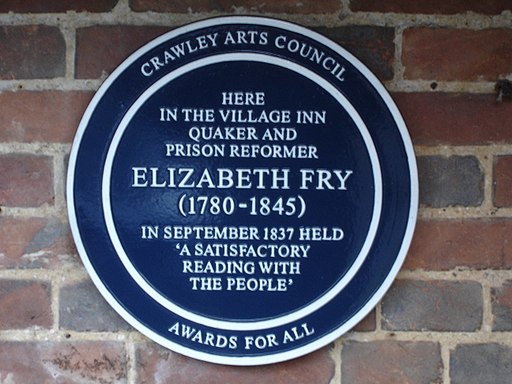
Wikimedia Commons
Elizabeth Gurney Fry acted on her beliefs. She was born in 1780 in Norwich, England into a prosperous and prominent Quaker family, the Gurneys. Her mother was part of the Barclay family of Barkley bank fame, and her father was a partner in the Gurney bank as well as a factory owner. Mrs. Gurney modeled concern for the community with her own charity work. She also required the children spend time daily in silence worship – 2 hours a day.
So it is not surprising that Elizabeth was a serious young woman, interested in working with the poor. She showed interest in political movements such as universal suffrage. After meeting an American Quaker, William Savery, who had preached in Norwich, she began projects to help the poor. She collected clothes for those in need and started a school in her house to teach local children to read. She was appointed to the committee that ran Ackworth School, a Quaker school.
Elizabeth married Joseph Fry in 1800 and by 1812 had born eight children. Her commitment to Quakerism grew, and she was approved as a preacher in 1811.
Prison Work Begins
Fry is known for her prison work which began after she learn of the conditions at Newgate Prison from a friend, Stephen Grellet in 1813. The state of the women and their children was appalling; they were cold, starving and without enough clothes. The women were all together no matter the seriousness of their crimes, their age or anything else. These conditions instigated in Fry a lifelong commitment to prison reform.
She established a school and a chapel in Newgate. She saw that the women learned to sew and gain other talents that could earn them a living. Ever a Christian reformer, Bible classes and chapel services were part of her plan for bettering these women’s lives.
Her brother-in-law, Thomas Buxton, became a member of parliament in 1818 and had the means to promote Fry’s ideas. In one speech, he pointed out that England had more people in prison than all the other kingdoms in Europe combined. Fry was called to give evidence to a committee of the House of Commons, quite unusual for a woman at the time.
Renown and Successes in Prison Work
Fry had three more children after her prison work began and managed to balance her roles as wife, mother and reformer. By the 1820’s, she was well enough know to be attacked in the press for taking so active a role in public affairs, especially when men sought her professional knowledge. She was accused of neglecting her home and family.
The 1823 Gaols Act was passed by parliament and allowed for visits from chaplains, women warders in women’s prisons, and paid jailers instead of jailers exacting fees for privileges from prisoners. These reforms at first did not apply to debtors prisons or local town jails. Fry and her brother-in-law visited these other prisons and wrote a book about the conditions.
Fry’s work and ideas impressed many in government, but they balked when she declared that capital punishment was evil. At the time, there were 200 capital offenses on the books in England, including forgery. Fry worked diligently on behalf of women sentenced to hang. In her testimony to the House of Lords, May 22, 1835, she said:
I feel it to be the bounden duty of the Government and the country that those truths [in the Bible] should be administered in the manner most likely to conduce to the real reformation of the prisoners for though severe punishment may, in a measure, deter them and others from crime, it does not amend and change the heart.
Beyond Prisons
When on vacation in Brighton in 1824, Fry was surprised by the number of beggars and at the poverty of the town. She established teams of voluntary visitors to go to the homes of the poor to provide assistance and comfort. The Brighton Visiting Society’s success lead to District Visiting Societies all over England.
Joseph Fry went bankrupt in 1828, damaging Elizabeth’s name and the reputation of the charities she was involved in. Her brother, Joseph, took over Joseph Fry’s affairs, sorted out the debts and provided Elizabeth with sufficient funds to continue her work.
Fry advocated for the homeless of London and worked to improve conditions for patients in asylums. She also focused on the conditions is workhouses and hospitals. The latter led her to become involved in nursing. In 1840, Fry started a nurses training school. Her trainees attended to the physical and spiritual needs of their patients. Florence Nightingale was so influenced by Fry’s training that she took a some of Fry’s nurses to tend the wounded in the Crimean War.
Quite a career for one woman in the 1800s. Fry died in 1845 after a brief illness. It is said that over one thousand people were at the graveyard in Barking when she was buried, standing in silence.
John Simkin, http://spartacus-educational.com/REfry.htm, provided much information for this article. I am in his debt.
Previous Post

November 1, 2017
SEXUAL HARASSMENT AND SHAME
Next Post

November 14, 2017 Without Gun Control, How Do We Protect the Innocent?
Browse Our Archives
Select a Category faith fighting guns lessons Light Politics prisons queries racism Uncategorized women youth
Select a Month November 2017 October 2017 September 2017 August 2017 July 2017 June 2017 May 2017 April 2017 March 2017 February 2017 January 2017 December 2016 November 2016 August 2016
Follow Us!
TAKE THE
Religious Wisdom Quiz
What is the seventh commandment?
Select your answer to see how you score.
Thou shall have no other gods before me. Thou shall not covet. Thou shalt not murder. Thou shall not commit adultery.
Related posts from Molly Wingate, Plain Speaking
Great Quaker Women: Mary Fisher, Jailed Repeatedly for...

Great Quaker Women: Lucretia Mott
Great Quaker women: Elise Boulding
TRENDING AT PATHEOS New Visions

Did Prayer Cure His Cancer? Or Was It...
At 4 AM one morning, Joshua W. Brown’s wife awoke to a...

8 Ways a Near-Death Experience Rewires the Soul
Does Consciousness Survive Physical Death? After 50 Years of Research, Dr. Raymond...

Holy Longing: What Our Restlessness Is Telling Us
“One can find so many pains when the rain is falling.” -John...

What this is NOT about. This blog is definitely not about...

Who said the Israelites were God’s chosen? That’s right, they did. Who...

The Spirit World Is the Real World: God...
A Monk’s Wisdom on Body and Spirit I sit with Brother Martin...
view all New Visions blogs
Ad-Free & Subscriber Log-In Subscription Support
- About Us
- 2026 Calendar
- Videos
- Podcasts
- Library of World Religions
- Faith In Media Tracker
- Advertise With Us
- Write for Us
- Privacy Policy
- Terms of Service
- Do Not Sell My Data
- Contact Us
- Radiant Digital
- Manage Newsletter Subscriptions
- Unsubscribe From Notifications
- Sitemap
Copyright 2008-2026, Patheos. All rights reserved.
Subscription Support Ad-Free & Subscriber Log-In
Follow Patheos