
BuddhistCatholicContemplativeEvangelicalGeneral ChristianHinduJewishLatter-day SaintMuslimNew VisionsProgressive Christian
Beliefs
- Buddhist
- Catholic
- Contemplative
- Evangelical
- General Christian
- Hindu
- Jewish
- Latter-day Saint
- More Voices
- Muslim
- New Visions
- Pagan
- Progressive Christian
Topics
- Religion News
- Food and Religion
- Sports and Religion
- Religious Art
- Religious Music and Entertainment
- Religious Events
- History and Religion
- Style and Religion
- Politics and Religion
- Women in Religion
- Recreation Outdoors and Religion
- Business Finance and Religion
- Careers Workplace and Religion
- Education and Religion
- Family Parenting and Religion
- Health Fitness and Religion
- Home and Religion
- Relationships and Religion
- Technology and Religion
- Travel and Religion
Columnists
- Buddhist Columnists
- Business Finance and Religion Columnists
- Careers Workplace and Religion Columnists
- Catholic Columnists
- Contemplative Columnists
- Education and Religion Columnists
- Evangelists Columnists
- Family Parenting and Religion Columnists
- General Christian Columnists
- Health Fitness and Religion Columnists
- Hindu Columnists
- History and Religion Columnists
- Home and Religion Columnists
- Jewish Columnists
- More Voices Columnists
- Latter Day Columnists
- Muslim Columnists
- New Visions Columnists
- Nonreligious Columnists
- Pagan Columnists
- Politics and Religion Columnists
- Progressive Columnists
- Recreation Outdoors and Religion Columnists
- Relationships and Religion Columnists
- Religion News Columnists
- Religious Art Columnists
- Religious Events Columnists
- Religious Music and Entertainment Columnists
- Sports and Religion Columnists
- Style and Religion Columnists
- Technology and Religion Columnists
- Travel and Religion Columnists
- Women in Religion Columnists
Resource Library
- 2026 Calendar
- Library of World Religions
- The 100 Most Holy Places on Earth
- Patheos Answers
- Podcasts
- Videos
- Faith Leaders Database
- Anglican Episcopalian
- Bahai
- Baptist
- Buddhism
- Christianity
- Confucianism
- Eastern Orthodoxy
- Hinduism
- Holiness and Pentecostal
- ISKCON
- Islam
- Judaism
- Lutheran
- Methodist
- The Church of Jesus Christ of Latter-day Saints
- New Age
- Paganism
- Presbytarian and Reformed
- Protestantism
- Religion Behind the Scenes
- Roman Catholic
- Scientology
- Shia Islam
- Sikhism
- Sufism
- Sunni Islam
- Taoism
- Zen
- See all religions
Research Tools
 Ad-Free & Subscriber Log-In Subscription Support
Ad-Free & Subscriber Log-In Subscription Support
Follow Patheos 

- Trending:
- Forgiveness
- |
- Marriage
- |
- Consciousness
- |
- Death Penalty
- |
- Election
- |
- Halloween
 Modern Witch
- Home
- Pagan
- The Undeniable Hubris of Knowing
The Undeniable Hubris of Knowing
Last updated on: December 3, 2019 at 6:26 pm by Storm Faerywolf
The Undeniable Hubris of Knowing 2019-12-03T18:26:07-07:00 Storm Faerywolf
Patheos Explore the world's faith through different perspectives on religion and spirituality! Patheos has the views of the prevalent religions and spiritualities of the world.
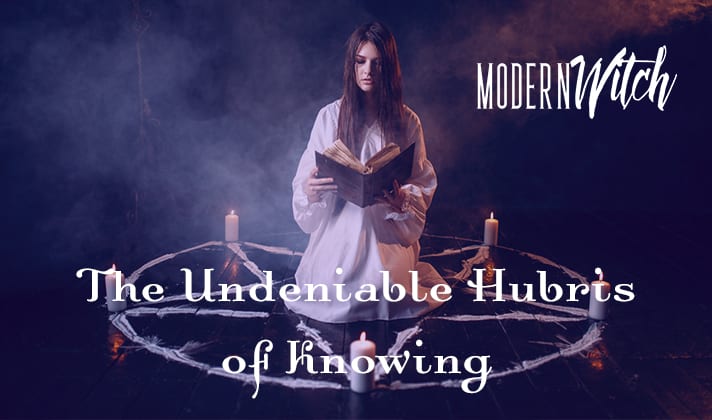
Bringing the “Mystery” Back to “Mystery Tradition”
Modern witches are truly creatures that walk between the worlds. While we are very much products of a society that has placed at least some value on scientific learning, we also believe in magic, and we see no contradiction between the two paradigms. While some might then accuse us of living in denial, we aren’t rebuffing reality, we are simply aware of (or at least open to) ideas and experiences that fall outside of what is considered “normal” or even “possible”. We strive to hold two seemingly contradictory truths as one, and herein lies the power of the Witch’s Eye: by holding paradox, we can see beyond what our “normal” senses tell us, allowing ourselves to be informed by not just our rational minds, but our imaginations as well, and that the imagination is far more than simply flights of fancy; a personal window into the indescribable mysteries of the multiverse.
Witches, like other practitioners of what we loosely call magic, are living in the less-charted frontiers of human consciousness. Depending on our particular culture or tradition, we may have certain maps that we use to guide our journeys, but we also should know that these maps can only take us so far. They have tremendous value, but all maps eventually become useless when we venture past the boundaries of what has previously been explored, not to mention that each map might not exactly depict our personal inner landscapes, which share many commonalities with others but are ultimately unique. Some may vary considerably. So, in the end we must adopt the role of explorers, paying serious attention to every detail we encounter, and resisting the very human urge to relax into explanations based on what amounts to little more than hearsay, rather than direct experience. Witchcraft, ideally, is a practice that favors experience over dogma.
Much of the modern Craft includes in their practice certain spirits and deities. Many will approach the gods with whom we may work as highly evolved or deeply chthonic spirits that are vast store houses of consciousness and power. These are the cosmic forces of nature, and are always at play, continually unfolding. As these forces are said to have interacted with humans over the eons, different cultures have developed specific ways in which to work with them. These culturally specific methods vary from place to place, often significantly, but there are some striking commonalities which may be observed as well.
The tendency to anthropomorphize the gods is a common such occurrence; a modern magical explanation being that we depict them as such so that we might be better able to make a psychic and emotional connection. It is understood, however, that they are not human, and in many cases are said to be older than humankind.
Another approach states that the gods are archetypes or aspects of human consciousness. They are “hard-wired” into our brain and represent deep impulses, instincts, and ancestrally shared wisdom. Here, they are symbolic projections from our own minds that might even be thought of as part of our “operating system” or “source code”. When we are interacting with a deity (and some would say with a spirit, angel, or demon, as well) we are really engaging lesser known aspects of ourselves, which can inspire and empower us toward great things.
Whether one asserts that the gods are independent, separate beings, or affirms that they are but aspects of the human psyche, both arguments suffer from the same fatal flaw: they assert to know something that by its very nature cannot be assessed fully with the rational mind. They each represent their own type of dogmatic thinking.
Humans spend a lot of time trying to be right. We like to feel that way; it’s validating. When we are in a state of emotional righteousness, we can feel very empowered in our decisions, especially when dealing with opposition. When we are standing up for what we feel is right, we can feel stronger in our convictions, and possibly in our practices to uphold them.
But in terms of art and spirituality, how can this even be determined? Plus, very often what we think we know to be true one day can actually turn out to be false. When we realize this, we feel bad, but that’s the catch: only when we actually realize it. Until then, being wrong felt just like being right. What was once thought to have been knowledge is now revealed to have only been belief.
We must get out of our own heads, for a moment, and step aside from the currents of even our most dearly held beliefs, for they will surely drag us away from the shores of truth and into the treacherous and murky waters of denial and confirmation bias. What if we didn’t have to define deity? What if we could just go looking for encounters with it instead? What if we could approach the gods, not as a certainty, but as a mystery?
I might have ideas on the nature of the gods with whom I work, but in all honesty, I can’t know for certain. I have had personal experiences that I cannot easily explain using a “mundane” paradigm, such as receiving specific information that was previously unknown to me, having intense visionary experiences that proved to be helpful to my real-world existence, and seemingly miraculous acts of healing and blessing. One might be able to explain some of these experiences as intense psychological events, but this wouldn’t adequately explain some of the physical phenomena. Other things could be chalked up to coincidence, true, but when the track record of such coincidences seems to coincide with acts of magic then I think I might be forgiven if I believe in the veracity of those workings.
But even then, I do not proclaim to know the gods, or even necessarily the mechanism by which they or magic work. I can only experience these things, and then form my beliefs about them accordingly. When I believe that I completely know them, I am depriving myself from an experience outside the limits of my expectation. When I approach something as a mystery, I am in a better position to more fully pay attention to whatever that experience might have to teach me. It is through the mystery that we truly touch the magic.
Previous Post

November 19, 2019
New Moon in Sagittarius for 2019
Next Post

December 9, 2019 Full Moon in Gemini for 2019
Browse Our Archives
Select a Category Astrology community community notes DEAR DEVIN Divination Festivals Full Moon Getting Stoned Help & How To interview Introduction Magic Mercury Retrograde Methods Modern Conjure movies New Moon New Years notable Witches Oracle Cards Pagan Fires paganism popculture Recommendation Resolutions reviews Rituals Spirits Tarot Uncategorized Updates Warlock Weekly Forecast witchcraft
Select a Month January 2021 December 2020 October 2020 August 2020 April 2020 March 2020 January 2020 December 2019 November 2019 October 2019 September 2019 August 2019
Follow Us!
TAKE THE
Religious Wisdom Quiz
According to Philippians, what should we think about?
Select your answer to see how you score.
Whatever is true, noble, right, pure, lovely, and admirable The word of God day and night The needs of others The suffering of Christ
Related posts from Modern Witch

Modern Witch Review | The Book of Candle...

The Rites of Resolution: Janus & The Road...
The Rites of Resolution: The Magical Act

The Craft: Legacy - A Spoilerific Review
TRENDING AT PATHEOS Pagan

I was recently chatting with someone on Instagram. She asked me what...

While there are many people who share their results, the end of...

On July 23, I saw Christopher Nolan's The Odyssey which is Homer’s...

As I write this two big events have just finished up. One...

Restoring the Watershed of Divine Love
Perhaps cooperation is not something we manufacture through legislation, ideology, or moral...

Many UUs don’t pray because of bad experiences in a previous religion,...
view all Pagan blogs
Ad-Free & Subscriber Log-In Subscription Support
- About Us
- 2026 Calendar
- Videos
- Podcasts
- Library of World Religions
- Faith In Media Tracker
- Advertise With Us
- Write for Us
- Privacy Policy
- Terms of Service
- Do Not Sell My Data
- Contact Us
- Radiant Digital
- Manage Newsletter Subscriptions
- Unsubscribe From Notifications
- Sitemap
Copyright 2008-2026, Patheos. All rights reserved.
Subscription Support Ad-Free & Subscriber Log-In
Follow Patheos