
BuddhistCatholicContemplativeEvangelicalGeneral ChristianHinduJewishLatter-day SaintMuslimNew VisionsProgressive Christian
Beliefs
- Buddhist
- Catholic
- Contemplative
- Evangelical
- General Christian
- Hindu
- Jewish
- Latter-day Saint
- More Voices
- Muslim
- New Visions
- Pagan
- Progressive Christian
Topics
- Religion News
- Food and Religion
- Sports and Religion
- Religious Art
- Religious Music and Entertainment
- Religious Events
- History and Religion
- Style and Religion
- Politics and Religion
- Women in Religion
- Recreation Outdoors and Religion
- Business Finance and Religion
- Careers Workplace and Religion
- Education and Religion
- Family Parenting and Religion
- Health Fitness and Religion
- Home and Religion
- Relationships and Religion
- Technology and Religion
- Travel and Religion
Columnists
- Buddhist Columnists
- Business Finance and Religion Columnists
- Careers Workplace and Religion Columnists
- Catholic Columnists
- Contemplative Columnists
- Education and Religion Columnists
- Evangelists Columnists
- Family Parenting and Religion Columnists
- General Christian Columnists
- Health Fitness and Religion Columnists
- Hindu Columnists
- History and Religion Columnists
- Home and Religion Columnists
- Jewish Columnists
- More Voices Columnists
- Latter Day Columnists
- Muslim Columnists
- New Visions Columnists
- Nonreligious Columnists
- Pagan Columnists
- Politics and Religion Columnists
- Progressive Columnists
- Recreation Outdoors and Religion Columnists
- Relationships and Religion Columnists
- Religion News Columnists
- Religious Art Columnists
- Religious Events Columnists
- Religious Music and Entertainment Columnists
- Sports and Religion Columnists
- Style and Religion Columnists
- Technology and Religion Columnists
- Travel and Religion Columnists
- Women in Religion Columnists
Resource Library
- 2026 Calendar
- Library of World Religions
- The 100 Most Holy Places on Earth
- Patheos Answers
- Podcasts
- Videos
- Faith Leaders Database
- Anglican Episcopalian
- Bahai
- Baptist
- Buddhism
- Christianity
- Confucianism
- Eastern Orthodoxy
- Hinduism
- Holiness and Pentecostal
- ISKCON
- Islam
- Judaism
- Lutheran
- Methodist
- The Church of Jesus Christ of Latter-day Saints
- New Age
- Paganism
- Presbytarian and Reformed
- Protestantism
- Religion Behind the Scenes
- Roman Catholic
- Scientology
- Shia Islam
- Sikhism
- Sufism
- Sunni Islam
- Taoism
- Zen
- See all religions
Research Tools
 Ad-Free & Subscriber Log-In Subscription Support
Ad-Free & Subscriber Log-In Subscription Support
Follow Patheos 

- Trending:
- Forgiveness
- |
- Marriage
- |
- Consciousness
- |
- Death Penalty
- |
- Election
- |
- Halloween
 Modern Kinship
- Home
- Progressive Christian
- Standing on the shoulders of LGBTQ saints
Standing on the shoulders of LGBTQ saints
Last updated on: November 1, 2016 at 3:15 am by David and Constantino Khalaf
Standing on the shoulders of LGBTQ saints 2016-11-01T03:15:53-07:00 David and Constantino Khalaf
Patheos Explore the world's faith through different perspectives on religion and spirituality! Patheos has the views of the prevalent religions and spiritualities of the world.
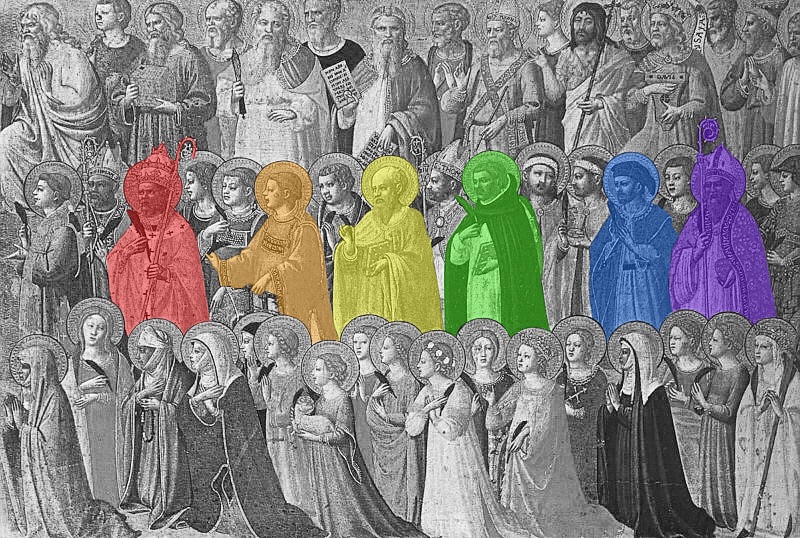
The Feast of All Saints, celebrated on Nov. 1, is rarely acknowledged in evangelical circles. Our non-denominational church, which follows the liturgical calendar, observed it this past Sunday. “The Festival of All Saints,” our church bulletin explained, “celebrates the faithful men and women, known and unknown, past and present, whose lives have been marked by the love and grace of God. It is an opportunity for us, as a church, to thank God for them and to remember the roles they have played in bringing God’s kingdom into our lives and into this world.” We were the first same-sex couple married at our church, and we write a blog about faith that a few people read. So it is with gratitude that, today, we think of all the LGBTQ saints, known and unknown, who paved the way for us.
We remember this day that the community of saints is built on relationships that transcend time and generations. And in that spirit, we thank God for the life of Rev. Dr. William R. Johnson, the first openly gay person ordained to the ministry in a mainline Christian denomination. Johnson, raised in a conservative Christian family in Texas, came of age in the 1960s, but that doesn’t mean that the revolutionary spirit of the era made accepting himself easy. A sermon he preached in 1971, as he awaited the ruling of an Ecclesiastical Council of the United Church of Christ that would determine if he could be ordained, speaks of his journey:
When I was in high school and college, I used to dream of a day when I could openly be who I am in every dimension of my personhood, including my sexual self. I must confess to you that in those days I felt it would be an impossible thing for me to take the risks involved in affirming myself and seeking to live a life of honesty and openness…
The struggle to embrace ourselves is the most difficult struggle of life and it is difficult for all persons. It is not an easy thing for any of us to stand naked before the mirror of our own selves and embrace the person that we are, complete with our shortcomings and abilities, our hopes and our fears. It is not an easy thing and it might even seem to you an impossible thing.
I struggled for many years with the fact of my own identity. There was no small amount of pain, and many times I ran away from the encounter I was having with myself. I was told more than once that I could not be gay and be a minister. I spent much time and money on psychotherapy, attempting to change…
Rev. Johnson, who received his Master of Divinity from the Pacific School of Religion, found the courage to live as the person God made him during his last year of seminary. At a forum convened to discuss the topic of homosexuality and the church, in front of 400 students, faculty, and church leaders, he stood up and came out. What he called “a statement of faith and affirmation,” led to threats of expulsion from the seminary. He faced, in 1970, the fear that LGBTQ students at conservative institutions continue to face today. But as he explains, two realities had sunk in by then that made self-integration possible—that allowed him to lean forward and embrace the image in the mirror of his own self:
I had come to realize that I had allowed many people through the years to fully know me as I am, in every dimension of my personhood. And every one of those people had remained in relationship with me. It became apparent that my inability to accept their acceptance of me grew out of the fact that I was still unable to accept my own self. The fact of the matter was that I had to embrace them and accept the embrace they offered me.
The second reality of my life was this: I had confidence that even while I was having difficulty loving myself, God’s love for me was constant. It remained for me only to let go of my self concern and my very presumptuous self-sufficiency and say yes to the pilgrimage of faith. Let me tell you, you can believe with all your heart the words that Jesus said, “God loves this world so much that He gave His only Son, that everyone who has faith in Him may not die, but have eternal life.”
Relationship—with God and with others—gave Rev. Johnson the courage to embrace faith. What a beautiful message that is; what a beautiful picture of church, of the risen body of Christ. It is a message that, as Johnson preached, brings forth life: “Many people spend their entire lives worrying about life after death and never really experience life after birth. But I’m going to tell you that I’ve been alive now for almost a year.”
This past Sunday, our pastor reminded us that as a church we stand on the shoulders of saints, who stand on the shoulders of saints, who stand on the shoulders of saints. As LGBTQ Christians, we still have a ways to go before we are fully accepted by all as equal members of the body of Christ. But the privileges, freedoms, and love to which we are privy today, we owe to those who came before. As the church grows ever closer to the Kingdom promised in the Gospel, let us never forget that it is not by breaking ties and excommunication that God makes things new. As Rev. Johnson so wisely preached, it is only through relationship that we can truly experience the divine:
Through the experiences of my college and seminary years, I learned that there is no such thing as a comfortable ministry. Those who are comfortable in the service of men are in all probability not serving God very well. I grew to realize that the quality of a person’s ministry is directly related to the quality of human relationships shared by the minister and those persons he seeks to change. If we are going to be ministers and we are called to the ministry by virtue of our discipleship to Christ our Lord, it is absolutely necessary that we be real, as Christ himself was real to those he sought to minister unto.
I became absolutely and unequivocally convinced that the spiritual reality of God is revealed to us in and through the personhood of Jesus of Nazareth. I know that there is a spiritual reality in life that is holy. I have experienced this Holy Spirit working in my life. The Holy Spirit does its most effective work whenever two or more persons are relating to one another with honesty, trust, and genuine caring. This is simply to say that if you want to experience the presence of the Holy Spirit in your life you must get involved with other people. In the security of your room or within the cell of your own ego, you will never experience the presence of the Holy Spirit. You might think that it is there, but sensing and experiencing are two different things. To experience the living, dynamic activity of the Holy Spirit in your life, you must be in relationship with another human being. You must be in a relationship of mutual honesty, trust, and caring.
The council that convened to discuss Rev. Johnson’s ordination voted 62 to 34 to approve it. This was after a smaller judicatory committee had turned down his request 5 to 4. He went on to hold several offices in the UCC. In the early 1980s he became a caregiver for numerous friends who had contracted AIDS, and as the epidemic grew, he found a new calling to give his life to that ministry. He worked with HIV and AIDS patients until he retired after more than four decades of service.
For the life, faith, and example of Reverend William Johnson, and for all LGBTQ people who have sacrificed to bring forth healing in the church, Lord we are grateful.
Like our Facebook page and follow us on Twitter for more.
Original image, “The Forerunners of Christ with Saints and Martyrs” by Fra Angelico, in the public domain.

Previous Post

October 29, 2016
A mother to her son: “I’d rather you be dead than gay”
Next Post

November 16, 2016 Planning for the Collapse of America
Browse Our Archives
Select a Category Academia Church Dating Faith Family LGBT LGBTQ Marriage Politics Relationship Relationship Advice Relationships Uncategorized
Select a Month January 2018 October 2017 August 2017 July 2017 June 2017 April 2017 March 2017 February 2017 January 2017 December 2016 November 2016 October 2016
Follow Us!
TAKE THE
Religious Wisdom Quiz
What nation conquered the Northern Kingdom of Israel?
Select your answer to see how you score.
Babylon Philistia Assyria Egypt
Related posts from Modern Kinship
The Gay Christian Network Becomes Q Christian Fellowship
The Dehumanization of People With HIV

A Clenched Fist When We Need Open Hands
Dear Eugene Peterson, We Will Read Your Books
TRENDING AT PATHEOS Progressive Christian

Why Christians Have a Sacred Duty to Vote:...
The Bible offers strong support for the sacred duty to vote. Here...

What Being a Modern-Day Apostle Means to Me
In my last column, I discussed the ins and outs of modern-day...

Did Ancient China Once Worship the God of...
Across human history, a common thread weaves through the origins of the...

Love Your Neighbor – Including Earth-Kin: Lev. 19,...
God’s command to love your neighbor means acting in an ethical and...

Lead a Church Study of “Jesus and Lao...
Guest writer Jack Thomas (The Irreverent Reverend) reflects on leading his church...

Principles for Understanding the Apostolic Ministry Today
Whenever people discover that my formal ministry title is "apostle," as in...
view all Progressive Christian blogs
Ad-Free & Subscriber Log-In Subscription Support
- About Us
- 2026 Calendar
- Videos
- Podcasts
- Library of World Religions
- Faith In Media Tracker
- Advertise With Us
- Write for Us
- Privacy Policy
- Terms of Service
- Do Not Sell My Data
- Contact Us
- Radiant Digital
- Manage Newsletter Subscriptions
- Unsubscribe From Notifications
- Sitemap
Copyright 2008-2026, Patheos. All rights reserved.
Subscription Support Ad-Free & Subscriber Log-In
Follow Patheos