
BuddhistCatholicContemplativeEvangelicalGeneral ChristianHinduJewishLatter-day SaintMuslimNew VisionsProgressive Christian
Beliefs
- Buddhist
- Catholic
- Contemplative
- Evangelical
- General Christian
- Hindu
- Jewish
- Latter-day Saint
- More Voices
- Muslim
- New Visions
- Pagan
- Progressive Christian
Topics
- Religion News
- Food and Religion
- Sports and Religion
- Religious Art
- Religious Music and Entertainment
- Religious Events
- History and Religion
- Style and Religion
- Politics and Religion
- Women in Religion
- Recreation Outdoors and Religion
- Business Finance and Religion
- Careers Workplace and Religion
- Education and Religion
- Family Parenting and Religion
- Health Fitness and Religion
- Home and Religion
- Relationships and Religion
- Technology and Religion
- Travel and Religion
Columnists
- Buddhist Columnists
- Business Finance and Religion Columnists
- Careers Workplace and Religion Columnists
- Catholic Columnists
- Contemplative Columnists
- Education and Religion Columnists
- Evangelists Columnists
- Family Parenting and Religion Columnists
- General Christian Columnists
- Health Fitness and Religion Columnists
- Hindu Columnists
- History and Religion Columnists
- Home and Religion Columnists
- Jewish Columnists
- More Voices Columnists
- Latter Day Columnists
- Muslim Columnists
- New Visions Columnists
- Nonreligious Columnists
- Pagan Columnists
- Politics and Religion Columnists
- Progressive Columnists
- Recreation Outdoors and Religion Columnists
- Relationships and Religion Columnists
- Religion News Columnists
- Religious Art Columnists
- Religious Events Columnists
- Religious Music and Entertainment Columnists
- Sports and Religion Columnists
- Style and Religion Columnists
- Technology and Religion Columnists
- Travel and Religion Columnists
- Women in Religion Columnists
Resource Library
- 2026 Calendar
- Library of World Religions
- The 100 Most Holy Places on Earth
- Patheos Answers
- Podcasts
- Videos
- Faith Leaders Database
- Anglican Episcopalian
- Bahai
- Baptist
- Buddhism
- Christianity
- Confucianism
- Eastern Orthodoxy
- Hinduism
- Holiness and Pentecostal
- ISKCON
- Islam
- Judaism
- Lutheran
- Methodist
- The Church of Jesus Christ of Latter-day Saints
- New Age
- Paganism
- Presbytarian and Reformed
- Protestantism
- Religion Behind the Scenes
- Roman Catholic
- Scientology
- Shia Islam
- Sikhism
- Sufism
- Sunni Islam
- Taoism
- Zen
- See all religions
Research Tools
 Ad-Free & Subscriber Log-In Subscription Support
Ad-Free & Subscriber Log-In Subscription Support
Follow Patheos 

- Trending:
- Forgiveness
- |
- Marriage
- |
- Consciousness
- |
- Death Penalty
- |
- Election
- |
- Halloween
 Muslimah Media Watch
- Home
- Muslim
- Religion News
- Book review: Jewels of Allah by Nina Ansary
Book review: Jewels of Allah by Nina Ansary
Last updated on: November 24, 2015 at 1:15 pm by syahirah
Book review: Jewels of Allah by Nina Ansary 2015-11-24T13:15:39-04:00 syahirah
Patheos Explore the world's faith through different perspectives on religion and spirituality! Patheos has the views of the prevalent religions and spiritualities of the world.
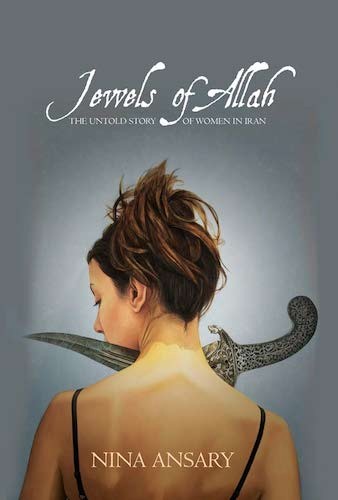 When I first heard the title of Dr. Nina Ansary’s latest book, Jewels of Allah, on the life of women in Iran, I must admit I had to restrain myself. In general I’m pretty wary about labelling women as two-dimensional objects, whether in a negative (‘lollipops’) or positive (‘pearl in its shell’) way. Ansary explains that the title is “meant to convey that women, who have been ordained as inferior [by hardline conservative factions] are in fact the jewels of the Creator”.
The book promises to tell the “untold story of women in Iran,” and it doesn’t disappoint in some ways. The first chapter begins with a determined tracing through centuries of history aiming to correct misconceptions about the popular narratives about women’s lives in Iran over the last 40 years. The popular narrative, according to Ansary, is one that creates a dichotomy between the free/modern/active/miniskirt-wearing Iranian woman during the Pahlavi monarchy and the gender-segregated/restricted/veiled Iranian woman in post-1979 Islamic Revolution Iran under Ayatollah Khomeini.
I feel optimistic when Ansary writes, “The real story is usually much more complicated, nuanced and less tidy.” These are the misconceptions she addresses in her book (one point per chapter):
- Before the Pahlavi monarchy, Persian women were always suppressed by the religious and political establishment.
- Iranian women didn’t advocate for their freedom until recently.
- During the Pahlavi era, all women were liberated.
- During the Khomeini era, women were totally oppressed.
- There is a lack of common ground between secular and religious women in Iran.
- There is not much of a women’s movement in modern-day Iran.
Chapter 2 looks at Ancient Persia and the then prevailing religion of Zoroastrianism, which she describes as egalitarian and progressive. Then, the 7th century Arab invasion and the “eventual infusion of Islamic values” into Persian society results in the loss of women’s equal status with men and their social separation, loss of educational opportunities. In the chapter, one hadith about women’s “brains [being] incapable of retaining knowledge” is quoted as if it were a widespread Islamic belief. Next, the chapter argues that women were granted a brief respite from oppression under the Iranian and Turkic dynasties from 9th to 13th centuries. However, the Safavid dynasty brought back the patriarchy, packaged in conservative Shia doctrine and persisting to this day.
Chapter 3 and 4 look at the nuances (as promised!) behind the Pahlavi and Khomeini eras. She argues that (conservative) rural women were not empowered under Pahlavi because their families kept them at home from school, while under Khomeini, a “failed gender ideology” resulted in women being empowered through education, despite legal and social efforts to oppress them. Chapter 4 contains a few rather extensive analyses of gender roles in elementary school textbooks, which read like standalone research essays.
Chapter 5, 6 and 7 look at the ups and downs of alliances between secular and religious feminists by tracing the development of various feminist publications and magazines.
The good
In the epilogue, Ansary highlights about 100 historical and contemporary Iranian women, over centuries, who espoused the feminist ideology of their times (these were previously posted on her Facebook page from March 2014 to May 2015). These women include scientists, artists, professionals and even a Paralympic athlete; this incredible collection is great for showing that Iranian women are not oppressed, have done many amazing things, and come from all walks of life – in short, they’re real people.
I also liked that she started the book with a story of her two grandmothers. Bringing in the personal helps give more context and motivation for why she wrote the book, something that authors should but rarely do.
Chapter 5 also includes a great explanation of Islamic feminism, and how religious and secular feminists in Iran work within a religious framework to advocate for women’s rights. A list of “Iran’s Islamic feminist movement” includes professor Dr. Jamileh Kadivar, journalist Parvin Ardalan, human rights activist Mehrangiz Kar, Nobel Laureate Shirin Ebadi and founder of Zanan magazine Shahla Sherkat. Other scholars mentioned include Nayereh Tohidi, Afsaneh Najmabadi, Haleh Afshar, Valentine Moghadam and Ziba Mir-Hosseini. A selection of quotes from these women indicates that they differentiate Islam as a religion from interpretation of Islamic laws and regulations – a point which is not so clear in the rest of the book.
The bad
One problem is the romantisation of history and, in particular, of Zoroastrian culture as being a gender utopia. Further, the framing of the Arab invasion and Safavid dynasty as being severely gender unequal serves to frame the empires in between as seemingly more egalitarian. In reality, analyses of these periods deserve just as much nuance (based on other intersectionalities such as sex, race/tribe, class) given to the Pahlavi and Khomeini eras. While there were certainly female leaders and commanders in Persian cities and states in 6th century BC, what class of women could reach these ranks? Most probably educated women of noble lineage.
Walter Benjamin wrote in On the Concept of History (1940)about a painting called Angelus Novus by Klee. The painting teaches us that our view of history as a sequence of events only serves to justify a certain narrative.
“Where we see the appearance of a chain of events, he sees one single catastrophe, which unceasingly piles rubble on top of rubble and hurls it before his feet (…) The storm drives him irresistibly into the future, to which his back is turned, while the rubble-heap before him grows sky-high. That which we call progress, is this storm.”
Furthermore, there were other problematic themes that kept popping up throughout the book. One was the framing of women who ‘veil’ as being conservative and those who don’t veil as being free. One of the first notable women Ansary features in her book is Sadiqeh Dowlatabadi (1882-1961), “one of the most distinguished advocates for female education” (p.28). She reportedly said on her deathbed: “I will never forgive anyone who visits my grave veiled”. This quote is not explained or given any further context or nuance, leaving the reader to conclude that veiling can only be an unfeminist and unempowered act. (In her epilogue she also features Masih Alinejad, creator of My Stealth Freedom Facebook page for women to post photos of themselves without a headscarf.)
Compare this to a description of ‘Rejected Princess’ Naziq al-Abid, Syria’s first female general in history, and for whom going veil-less was also a big part of her life.
“She’s seen here ripping off a veil, since going veil-less was a big part of her life. Not that there’s anything wrong with choosing to wear a veil — she just didn’t have that choice for the most part, although she wanted it badly.”
The conspicuous lack of context is odd, as Ansary seems aware that there is more symbolism to the veil than the oppression-freedom dichotomy. The book shows that she is aware that there are other bigger factors that determine a women’s empowerment, such as laws and educational opportunities. This is evident in how she describes Khomeini’s ‘Islamic Government’:
“a misogynistic regimen […] embedded in a constitution reinforcing the primacy of the Sharia (Islamic law) over civil law and the absolute leadership of a Shiite jurist over popular sovereignty.” (p.200)
So it is puzzling why she does not give more nuance where it is so crucially needed.
This lack of linkage to larger political factors and global processes can result in readers making problematic conclusions. Gina B Nahai, in her review of the book, laments the lack of a “satisfying explanation” as to why “an estimated million women actively took part in the overthrow of the Shah and the return of the ayatollahs to Iran”. Nahai ends up blaming Islam as a monolithic patriarchal force, and Allah as a patriarchal god, for the problems of Iranian women. (Perhaps she didn’t read the final chapters where religious and secular Iranian women show how they are able to articulate gender equality in laws within an Islamic framework, through an ideology otherwise known as Islamic feminism.).
The final chapter also comes to an odd conclusion as to how women in Iran can achieve equality. It mainly argues for a reform of Islam based on “theological reform in Western nations”, based on the work of German priest Martin Luther and Friedrich Nietzsche. There is no mention at all of Islamic laws in other countries that do not have the same outcomes as Iran. Even a cursory look at other Muslim majority countries such as Tunisia or Indonesia could show how gender equality is not solely determined by laws or religion, but also other factors like increased employment or improvement in standards of living.
A public relations sheet that came with the book highlighted some publications and organisations that have featured her book. One organisation that stood out was The Clarion Project, which has infamously produced several Islamophobic films, the most recent being Honor Diaries. This rightwing organisation aims to “challenge extremism”, but in reality it provides a simplistic view of ‘Muslim extremism’ in order to perpetuate a cruel and oppressive image of an all-monolithic Islam. Despite this, in her interview with The Clarion Project, I think Ansary has bravely attempted to include some nuance about Iran’s gender inequality, highlighting that the West has its own gender inequality issues too.
Final thoughts
The language in Ansary’s book is easy to read, but it is held back by its pace. I felt like I was reading different essays cobbled together: some delving into too much detail in some topics (analysis of elementary textbooks) and some skimming over topics that needed more analysis (tracing of feminist alliances, Muslim reformers from within).
Most importantly, when I finished the book, I realised that state-sponsored terror existed under both Pahlavi/free and Khomeini/oppressed regimes. Not many readers may know that under Pahlavi, police beat up veiled women and forcibly removed their veils. Today, the basij or religious police do the same to women who are ‘improperly’ veiled. It’s an authoritarian state that imposes a regime on its people that creates oppression, not religion or a veil.
While Ansary extensively looks at the actions of the Iranian state (censorship of feminist magazines, changing of laws, the overall impression that her book gives is that patriarchy/male supremacy/culture/religion is to blame for the oppressive and misogynist laws in Iran’s history. I think she could have done a better job in differentiating Islam as a belief system from Islam as a set of legal interpretations that vary across time and space. Similarly, I think Ansary should have clearly explained that there are a multitude of meanings behind a veil or hijab; that women may wear it for many reasons that are not immediately visible from the outside.
This book may be useful to those looking for historical references and a simple discussion of Iran’s political environment; however, the book can be heavily critiqued from various feminist perspectives and is a limited contribution to the work of Islamic and Muslim feminists.
Previous Post

November 23, 2015
Hate Crimes and Mother Tongues
Next Post
November 25, 2015 Sisterhood from Struggle
Browse Our Archives
Select a Category Advertisements Art/Theater Books/Magazines Cinema Comics/Cartoons Culture/Society Events Fashion Film Friday Links Merchandise/Commodities MMW Announcements MMW Highlights Music/Radio News Photography Politics Profile Ramadan 2012 Ramadan 2013 Ramadan 2014 Ramadan 2015 Roundtable Satire Social Media Sports Technology/Science Television Uncategorized Video Web
Select a Month November 2015 October 2015 September 2015 August 2015 July 2015 June 2015 May 2015 April 2015 March 2015 January 2015 December 2014 November 2014 October 2014 September 2014 July 2014 June 2014 May 2014 April 2014 March 2014 February 2014 January 2014 December 2013 November 2013 October 2013 September 2013 August 2013 July 2013 June 2013 May 2013 April 2013 March 2013 February 2013 January 2013 December 2012 November 2012 October 2012 September 2012 August 2012 July 2012 June 2012 May 2012 April 2012 March 2012 February 2012 January 2012 December 2011 November 2011 September 2011 August 2011 July 2011 June 2011 May 2011 April 2011 March 2011 February 2011 January 2011 December 2010 November 2010 October 2010 September 2010 August 2010 July 2010 June 2010 May 2010 April 2010 March 2010 February 2010 January 2010 December 2009 November 2009 October 2009 September 2009 August 2009 July 2009 June 2009 May 2009 April 2009 March 2009 February 2009 January 2009 December 2008 November 2008 October 2008 September 2008 August 2008 July 2008 June 2008 May 2008 April 2008 March 2008 February 2008 January 2008 December 2007 November 2007 October 2007 September 2007 August 2007
Follow Us!
TAKE THE
Religious Wisdom Quiz
Who said, "Silver and gold have I none, but what I have I give to you"?
Select your answer to see how you score.
Peter James Paul John
Related posts from Muslimah Media Watch



Book Review: Faïza Zerouala's Voices Behind the Veil

Making Sense of “the Other”: A Review of...
TRENDING AT PATHEOS Muslim

25 Years Later: How Much Has Changed for...
As we approach the 25th anniversary of September 11th, I’ve found myself...

Podcast: Third Spaces & The Rise of Yemeni...
In the latest episode of The Artistic Foodies Podcast, hosts Abbas...

HalalFest Picks: Best 60 Halal Spots for Super...
Back in 2016, I came up with a list of 29...

Unity Is America’s Strength — Division Is Its...
by Hidayatullah Ahsan When Valentina Gomez, a Republican candidate for Congress in...

Zohran Mamdani and New York’s Fight Against Islamophobia
This past June, against all odds, Zohran Mamdani won the Democratic primary...

What the Fourth of July Means to a...
As we mark another Fourth of July, millions of Americans will celebrate...
view all Muslim blogs
Ad-Free & Subscriber Log-In Subscription Support
- About Us
- 2026 Calendar
- Videos
- Podcasts
- Library of World Religions
- Faith In Media Tracker
- Advertise With Us
- Write for Us
- Privacy Policy
- Terms of Service
- Do Not Sell My Data
- Contact Us
- Radiant Digital
- Manage Newsletter Subscriptions
- Unsubscribe From Notifications
- Sitemap
Copyright 2008-2026, Patheos. All rights reserved.
Subscription Support Ad-Free & Subscriber Log-In
Follow Patheos