
BuddhistCatholicContemplativeEvangelicalGeneral ChristianHinduJewishLatter-day SaintMuslimNew VisionsProgressive Christian
Beliefs
- Buddhist
- Catholic
- Contemplative
- Evangelical
- General Christian
- Hindu
- Jewish
- Latter-day Saint
- More Voices
- Muslim
- New Visions
- Pagan
- Progressive Christian
Topics
- Religion News
- Food and Religion
- Sports and Religion
- Religious Art
- Religious Music and Entertainment
- Religious Events
- History and Religion
- Style and Religion
- Politics and Religion
- Women in Religion
- Recreation Outdoors and Religion
- Business Finance and Religion
- Careers Workplace and Religion
- Education and Religion
- Family Parenting and Religion
- Health Fitness and Religion
- Home and Religion
- Relationships and Religion
- Technology and Religion
- Travel and Religion
Columnists
- Buddhist Columnists
- Business Finance and Religion Columnists
- Careers Workplace and Religion Columnists
- Catholic Columnists
- Contemplative Columnists
- Education and Religion Columnists
- Evangelists Columnists
- Family Parenting and Religion Columnists
- General Christian Columnists
- Health Fitness and Religion Columnists
- Hindu Columnists
- History and Religion Columnists
- Home and Religion Columnists
- Jewish Columnists
- More Voices Columnists
- Latter Day Columnists
- Muslim Columnists
- New Visions Columnists
- Nonreligious Columnists
- Pagan Columnists
- Politics and Religion Columnists
- Progressive Columnists
- Recreation Outdoors and Religion Columnists
- Relationships and Religion Columnists
- Religion News Columnists
- Religious Art Columnists
- Religious Events Columnists
- Religious Music and Entertainment Columnists
- Sports and Religion Columnists
- Style and Religion Columnists
- Technology and Religion Columnists
- Travel and Religion Columnists
- Women in Religion Columnists
Resource Library
- 2026 Calendar
- Library of World Religions
- The 100 Most Holy Places on Earth
- Patheos Answers
- Podcasts
- Videos
- Faith Leaders Database
- Anglican Episcopalian
- Bahai
- Baptist
- Buddhism
- Christianity
- Confucianism
- Eastern Orthodoxy
- Hinduism
- Holiness and Pentecostal
- ISKCON
- Islam
- Judaism
- Lutheran
- Methodist
- The Church of Jesus Christ of Latter-day Saints
- New Age
- Paganism
- Presbytarian and Reformed
- Protestantism
- Religion Behind the Scenes
- Roman Catholic
- Scientology
- Shia Islam
- Sikhism
- Sufism
- Sunni Islam
- Taoism
- Zen
- See all religions
Research Tools
 Ad-Free & Subscriber Log-In Subscription Support
Ad-Free & Subscriber Log-In Subscription Support
Follow Patheos 

- Trending:
- Forgiveness
- |
- Marriage
- |
- Consciousness
- |
- Death Penalty
- |
- Election
- |
- Halloween
 Muslimah Media Watch
- Home
- Muslim
- Religion News
- Gender, Race and Muslim-Latin Solidarity
Gender, Race and Muslim-Latin Solidarity
Last updated on: October 8, 2015 at 5:25 pm by eren
Gender, Race and Muslim-Latin Solidarity 2015-10-08T17:25:33-04:00 eren
Patheos Explore the world's faith through different perspectives on religion and spirituality! Patheos has the views of the prevalent religions and spiritualities of the world.
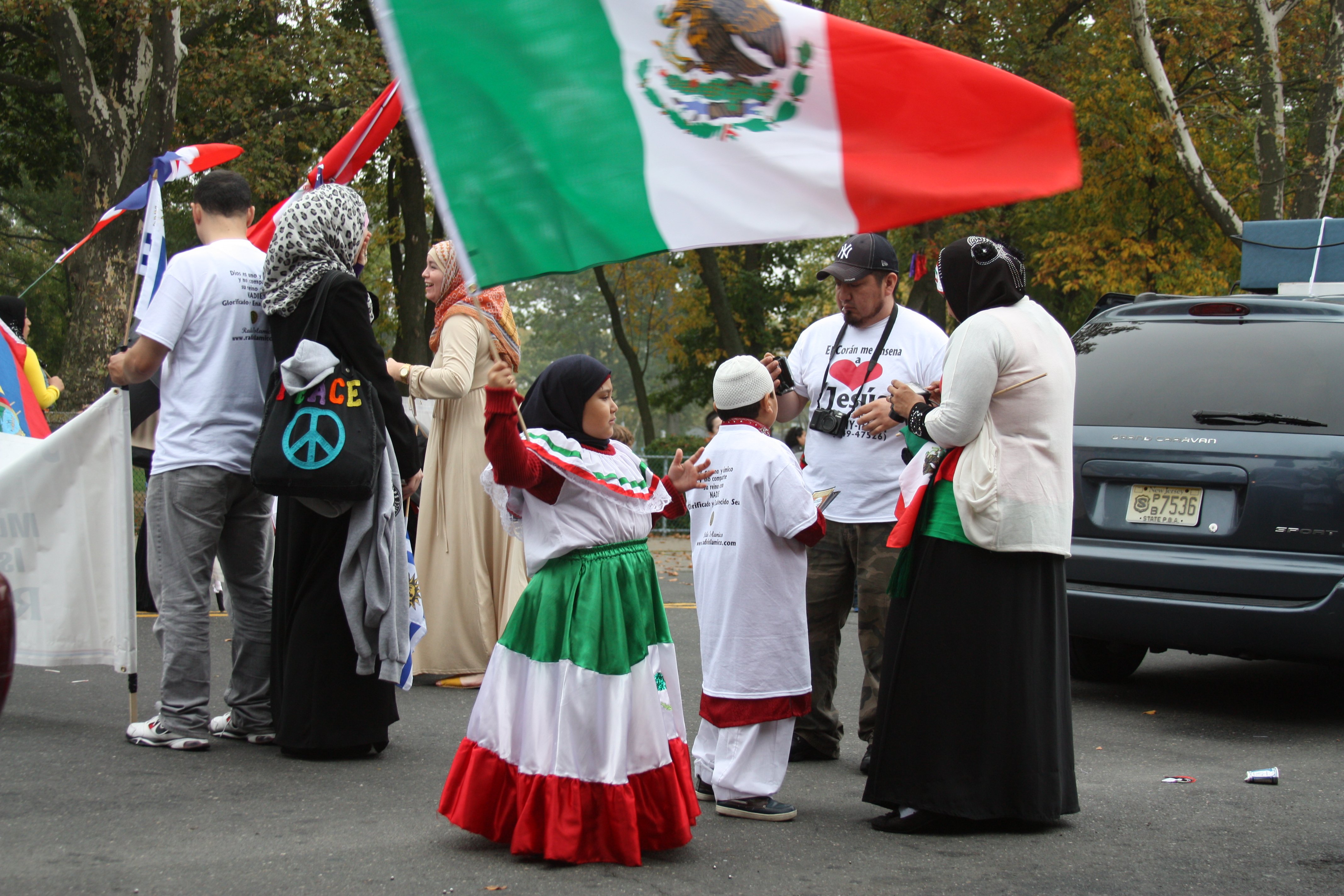
A Mexican Muslim girl waves a Mexican flag at a Hispanic pride parade in Union City, N.J. Source
In Mexico City there is a neighbourhood called Santa María La Ribera. The area was an affluent neighbourhood during the 19th and early 20th centuries; however, since the 50s it has become more of a lower-middle class vicinity. Yet, the old mansions remain as a permanent reminder of the city’s aristocratic history.
At the centre of this neighborhood there is a 19th century kiosk in the mudéjar style. The kiosk was designed by a Mexican engineer and put together in the US just to be brought into Mexico by 1905 under the orders of Mexican dictator Porfirio Díaz, well-known for loving everything foreign. Even though the kiosk is not really a foreign import, it is, until this day, known as the “Arab kiosk” or the “Moorish kiosk” in popular culture because of its style. The name inspires some kind of exoticism while referring to the strong ties that countries like mine have with the Arab-Muslim world through colonization.
To start a discussion about Latin(x)/Latin American-Muslim solidarity is to open up a pretty entangled topic. It is not simple and cannot be fully explored in a short post. However, I do think that it is necessary to start somewhere. I know there is a media tendency to lump everyone who could remotely have Latin American descent into one category, but we are, often times, pretty different. I use the term Latin(x) to describe (of course, not fully) communities of Latin American descent based primarily in the US or the original inhabitants of the area before the American annexation (mostly southern US) that today self-identify as Latin(x).

Conversely, I use the term Latin American to describe a radically different set of communities with different cultural codes that are not necessarily shared with Latin(x) communities in the US. Further, Latin American here is used to describe a geographical attachment that often includes Indigenous peoples from Mexico to Argentina, and that may encompass some Caribbean countries (Hispanic and otherwise).
These two identities are not always mutually exclusive, but sometimes they are. For instance, I identify as Latin American, not as Latin(x). As a convert of Latin American background, I get constantly bombarded with images and stories about Latin(x) Muslims in the US, something that I have explored before. These stories, of course, have gender dimensions.For instance, in some media coverage Latin(x) and Latin American cultures tend to be essentialized as inherently patriarchal making Islam look almost like an “outlet” for the Latin(x) and Latin American women that convert into the religion. On the flip side, among non-Muslim Latin(x) and Latin American communities the women that convert and marry outside the group are depicted as “brainwashed” and susceptible to the bad influences that Muslim men exercise over them.
The gender issue gets blurry when discussions about Indigeneity and Islam arise because, in many cases, those reporting on Indigenous peoples’ conversions to Islam have no idea how some Indigenous communities work socially, politically and spiritually. Sometimes discussions of the Latin(x) convert experience start off with a celebration of the Arab influence in Latin (x) and Latin American cultures.
You know, we start off by naming Shakira, Salma Hayek and Carlos Slim and we continue by giving people a grammar lesson. We like to recall that the word “Ojalá” in Spanish and “Oxalá” in Portuguese are supposed to be deviations from “Inshallah,” meaning “God willing.” We also like to remind ourselves that most words starting with “Al” in Spanish are supposed to have an Arabic origin. We now even recognize the Lebanese influence in famous Mexican dishes like tacos al pastor.
Overall, we try really hard to prove or reconcile our Muslim and Latin(x)/Latin American identities. Mind you… there is much conflation between “Arab” and “Muslim” because in colonial Spain the Arabs, the Muslims and the Moors were portrayed pretty much as the same group. Now, let’s clarify something. The Arab and Muslim expansions that followed the passing of Prophet Muhammad are sometimes described as imperialist, meaning that it sought to politically and economically dominate the occupied regions. However, I use the term colonial to exemplify deeper relationships of power that transformed societies and hierarchies, their political and legal systems, their notions of gender and sexuality as well as their ideas of race.

These days I encounter a lot of questions around solidarity between Muslims and Latin(x)/Latin American communities. At the end of the day in today’s day and age we are both “others.”
Latin(x) and Latin Americans have been criminalized for years in countries like the US; they have been excluded and marginalized and a wall has been built to keep them at bay. And even after the wall was built, we still get Donald Trump promising a “real wall” to keep Mexicans out (as opposed to what it is now in there) because, you know… Mexicans are all drug dealers, rapists and criminals. Latin(xs) and Latin Americans were depicted as the radicals and terrorists of the 80s and 90s, and news of the region (south of the US onwards) often show us as a source of crime, terror, poverty, conflict, drugs, patriarchy, violence, etc.
Those of us who have lived with those stereotypes, who have been marginalized, criminalized and sentenced to a lower existence, tend to somehow understand what it means to be the target of Islamophobia. Not everyone, of course, and among Latin(xs) and Latin Americans I sometimes hear pretty racist and Islamophobic stuff. Yet, generally speaking, we get what Western states and powerful elites have done to Muslims not only in the East, but also within privileged countries like the US and Canada. That is why some Latin(x) and Latin American social and political communities have come together to denounce the occupations of Iraq, Afghanistan and Palestine, the Syrian refugee crisis and Islamophobia in general.
In order to do that, in order to draw solidarity from somewhere, we often allude to our “historical connections” with the Arab-Muslim world. It seems to be a way to say, “we are ‘others’ and we stand together.” But as a woman of Indigenous descent who converted to Islam several years ago, I often feel troubled and divided in building solidarity through these historical claims… What we often overlook is that Arabs and Muslims have a history of being colonizers even before they became subjects of colonization in the 18th, 19th and 20th centuries. Although we try to say that Muslims were peaceful colonizers, that they brought along medicine and science to the Western world and that Muslims led peaceful inter-faith states that does not make their history any less problematic.
Indeed, Latin American-Arab connections were mediated by the very processes of colonization that led Muslims to Spain and Portugal and, later on, Spain and Portugal to the Americas. The colonization of the Americas was devastating for Indigenous peoples and had long lasting effects, including violence, for women and third gender peoples. Not to mention the fact that part of the slave population brought to the Americas was through transactions with Arab-Muslim slave traders. The slave trade was highly gendered and perpetuated many different types of violence against black women, including sexual exploitation. Despite the fact that some say that Islam expanded peacefully in Africa and other regions, the conquest of Spain, and probably many other areas, entailed several bloody encounters from the 8th to 15th century. Moreover, Muslims militarily conquered not only Spain, but the Sindh (modern Pakistan), North Africa, Persia and Mesopotamia, Armenia, and so on. And although in today’s Muslim communities we like to emphasize how “peaceful” and “seamless,” these processes were, that is looking at history through rose-colored glasses.
For instance, as Muslim heteronormativity made its way through South Asia it challenged the status of third gender peoples, a battle that continues to be fought today. Islamic laws brought by Muslims posed an affront to the notion of adat in Indonesia, for instance, where customary law was the practice of Indigenous communities. Also, to this date in Malay society Islamic law trumps the adat. Islamic law also encountered matriarchal societies that regulated marriage and inheritance differently. The contact led to syncretic arrangements among the few matriarchies that still remain. Restrictions, even though depicted as protections by some Muslims, were imposed on Christian and Jewish peoples in conquered Spain, something that is often described as a “second-class citizen” status. In addition, the fact that Arab-Muslims were heavily involved in the slave trade of black peoples is a dominant factor in the widespread anti-Black racism in many of our communities, which many black-Muslim activists have been challenging through activism and education.
Of course things are not black and white, it is not about how Muslims as colonizers were terrible or not. In fact, colonization makes it all so much more complex by filling us with contradictions. Take for instance my grandmother, an Indigenous woman from a matriarchal society. She is a Catholic not necessarily by choice, but because that is how colonization played out in Mexico. To this day her faith is incredibly important to her. Yet, it is an imposed faith… one that was complicit of the mass killings of Indigenous peoples across the continent and one that has supported patriarchal practices. However, how do I, as someone that preaches Indigenous resistance, take away from her the faith that makes so much sense to her now? It is a colonial paradox.
And I think that is where the conversation about solidarity should start, by acknowledging the paradoxes and understanding that although it makes sense to stand together in solidarity today, many of us still have tints of privilege and have taken part in each other’s oppression.
Let’s start by admitting that within that strand of Latin(x)/Latin American solidarity there are many oppressed groups such as Indigenous, black and Asian-descent peoples. Also, by identifying that Arab and white privilege (for instance, passing privilege) are a thing within Muslim communities, which often plays against black Muslims, particularly women. Let’s also accept that class is an issue and that there is no point of comparison between the Agha-Khan-type of Muslims or the rich Latin(xs) with passing privilege or those who are actually from white descent and the rest of us. Finally, let’s acknowledge colonial history, because such recognition is essential to truly develop solidarity movements that include Indigenous and black peoples, as well as the many “others” that today stand against Islamophobia.
Previous Post

October 6, 2015
Not Between Her and Allah: Hijab-shaming in Malaysia
Next Post

October 9, 2015 Friday Links
Browse Our Archives
Select a Category Advertisements Art/Theater Books/Magazines Cinema Comics/Cartoons Culture/Society Events Fashion Film Friday Links Merchandise/Commodities MMW Announcements MMW Highlights Music/Radio News Photography Politics Profile Ramadan 2012 Ramadan 2013 Ramadan 2014 Ramadan 2015 Roundtable Satire Social Media Sports Technology/Science Television Uncategorized Video Web
Select a Month November 2015 October 2015 September 2015 August 2015 July 2015 June 2015 May 2015 April 2015 March 2015 January 2015 December 2014 November 2014 October 2014 September 2014 July 2014 June 2014 May 2014 April 2014 March 2014 February 2014 January 2014 December 2013 November 2013 October 2013 September 2013 August 2013 July 2013 June 2013 May 2013 April 2013 March 2013 February 2013 January 2013 December 2012 November 2012 October 2012 September 2012 August 2012 July 2012 June 2012 May 2012 April 2012 March 2012 February 2012 January 2012 December 2011 November 2011 September 2011 August 2011 July 2011 June 2011 May 2011 April 2011 March 2011 February 2011 January 2011 December 2010 November 2010 October 2010 September 2010 August 2010 July 2010 June 2010 May 2010 April 2010 March 2010 February 2010 January 2010 December 2009 November 2009 October 2009 September 2009 August 2009 July 2009 June 2009 May 2009 April 2009 March 2009 February 2009 January 2009 December 2008 November 2008 October 2008 September 2008 August 2008 July 2008 June 2008 May 2008 April 2008 March 2008 February 2008 January 2008 December 2007 November 2007 October 2007 September 2007 August 2007
Follow Us!
TAKE THE
Religious Wisdom Quiz
According to James, what should you do if you lack wisdom?
Select your answer to see how you score.
Seek counsel from elders Study the Torah diligently Ask God, who gives generously Fast and pray for seven days
Related posts from Muslimah Media Watch

#PrayforParis, Muslim Women and Third World Violence


Hate Crimes and Mother Tongues

Interview with Comedian Eman El Husseini
TRENDING AT PATHEOS Muslim

25 Years Later: How Much Has Changed for...
As we approach the 25th anniversary of September 11th, I’ve found myself...

Podcast: Third Spaces & The Rise of Yemeni...
In the latest episode of The Artistic Foodies Podcast, hosts Abbas...

HalalFest Picks: Best 60 Halal Spots for Super...
Back in 2016, I came up with a list of 29...

Unity Is America’s Strength — Division Is Its...
by Hidayatullah Ahsan When Valentina Gomez, a Republican candidate for Congress in...

Zohran Mamdani and New York’s Fight Against Islamophobia
This past June, against all odds, Zohran Mamdani won the Democratic primary...

What the Fourth of July Means to a...
As we mark another Fourth of July, millions of Americans will celebrate...
view all Muslim blogs
Ad-Free & Subscriber Log-In Subscription Support
- About Us
- 2026 Calendar
- Videos
- Podcasts
- Library of World Religions
- Faith In Media Tracker
- Advertise With Us
- Write for Us
- Privacy Policy
- Terms of Service
- Do Not Sell My Data
- Contact Us
- Radiant Digital
- Manage Newsletter Subscriptions
- Unsubscribe From Notifications
- Sitemap
Copyright 2008-2026, Patheos. All rights reserved.
Subscription Support Ad-Free & Subscriber Log-In
Follow Patheos