
BuddhistCatholicContemplativeEvangelicalGeneral ChristianHinduJewishLatter-day SaintMuslimNew VisionsProgressive Christian
Beliefs
- Buddhist
- Catholic
- Contemplative
- Evangelical
- General Christian
- Hindu
- Jewish
- Latter-day Saint
- More Voices
- Muslim
- New Visions
- Pagan
- Progressive Christian
Topics
- Religion News
- Food and Religion
- Sports and Religion
- Religious Art
- Religious Music and Entertainment
- Religious Events
- History and Religion
- Style and Religion
- Politics and Religion
- Women in Religion
- Recreation Outdoors and Religion
- Business Finance and Religion
- Careers Workplace and Religion
- Education and Religion
- Family Parenting and Religion
- Health Fitness and Religion
- Home and Religion
- Relationships and Religion
- Technology and Religion
- Travel and Religion
Columnists
- Buddhist Columnists
- Business Finance and Religion Columnists
- Careers Workplace and Religion Columnists
- Catholic Columnists
- Contemplative Columnists
- Education and Religion Columnists
- Evangelists Columnists
- Family Parenting and Religion Columnists
- General Christian Columnists
- Health Fitness and Religion Columnists
- Hindu Columnists
- History and Religion Columnists
- Home and Religion Columnists
- Jewish Columnists
- More Voices Columnists
- Latter Day Columnists
- Muslim Columnists
- New Visions Columnists
- Nonreligious Columnists
- Pagan Columnists
- Politics and Religion Columnists
- Progressive Columnists
- Recreation Outdoors and Religion Columnists
- Relationships and Religion Columnists
- Religion News Columnists
- Religious Art Columnists
- Religious Events Columnists
- Religious Music and Entertainment Columnists
- Sports and Religion Columnists
- Style and Religion Columnists
- Technology and Religion Columnists
- Travel and Religion Columnists
- Women in Religion Columnists
Resource Library
- 2026 Calendar
- Library of World Religions
- The 100 Most Holy Places on Earth
- Patheos Answers
- Podcasts
- Videos
- Faith Leaders Database
- Anglican Episcopalian
- Bahai
- Baptist
- Buddhism
- Christianity
- Confucianism
- Eastern Orthodoxy
- Hinduism
- Holiness and Pentecostal
- ISKCON
- Islam
- Judaism
- Lutheran
- Methodist
- The Church of Jesus Christ of Latter-day Saints
- New Age
- Paganism
- Presbytarian and Reformed
- Protestantism
- Religion Behind the Scenes
- Roman Catholic
- Scientology
- Shia Islam
- Sikhism
- Sufism
- Sunni Islam
- Taoism
- Zen
- See all religions
Research Tools
 Ad-Free & Subscriber Log-In Subscription Support
Ad-Free & Subscriber Log-In Subscription Support
Follow Patheos 

- Trending:
- Forgiveness
- |
- Marriage
- |
- Consciousness
- |
- Death Penalty
- |
- Election
- |
- Halloween
 Muslimah Media Watch
- Home
- Muslim
- Religion News
- Timbuktu: A Film Review
Timbuktu: A Film Review
Last updated on: August 6, 2015 at 7:57 am by Azra
Timbuktu: A Film Review 2015-08-06T07:57:23-04:00 Azra
Patheos Explore the world's faith through different perspectives on religion and spirituality! Patheos has the views of the prevalent religions and spiritualities of the world.
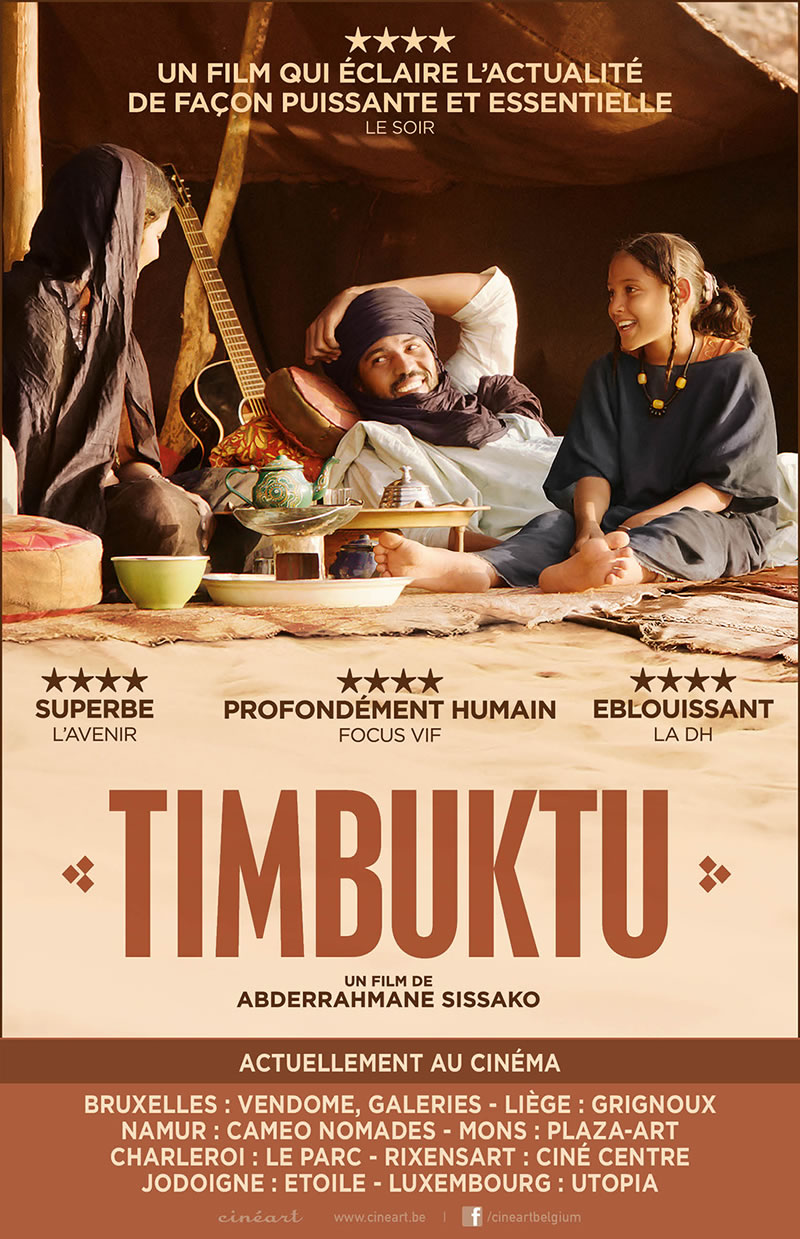
A few months ago I watched Abderrahmane Sisako’s Timbuktu, as part of a retrospective of Sissako’s work at the Walker Art Museum.
It stunned me at the time—the film examines how daily life changes in a Malian community where an al-Qaeda group has taken over. While the film focuses primarily on a young family’s tribulations when a murder is committed, the film explores how mundane, everyday situations under ordinary circumstances can suddenly become a minefield when the new impositions are not followed—for men, women, and children.
Sissako shared that his reason for making the film was to illustrate how the Malian town is affected living under al-Qaeda rule. There was little mention of Mali’s 2013 takeover by militants in the news. Not only was there little mention of the country’s upheaval, Sissako noted, but there was also little mention of how those living in Mali opposed their new rulers. Mali’s story became more widespread as historical artifacts were destroyed, as opposed to the human toll that many Malians faced. Sissako was inspired to make the film, in part, to a news story he read about an unmarried Malian couple who were stoned to death for having a child. Timbuktu was Sissako’s immediate take attempt at portraying human life under al-Qaeda rule.
The film offers a remarkable portrait of Mali—Sissako employed ample widescreen shots to illustrate the beauty of the Malian landscape (it was filmed in neighboring Mauritania). The film’s soundtrack is also sweeping and majestic, highlighting local music (sung by the wonderful Fatumata Diawara) and instrumental music composed by Amine Bouhafa. The everyday-ness of the film is also heightened by the characters on screen, many of whom were not professional actors, but rather individuals Sissako encountered who he felt would portray the characters in a new light. The film also moves swiftly between languages: from Arabic, to Bambara (the local language of the town), to French—it illustrates the increasingly global scope of the situation and complexity of translating norms.
Music plays a central role in the community, and there are even moments of comedy, as agents are charged with finding those who are playing music or singing. In one memorable scene, they come across a woman who is singing the praises of the prophet. The agents are utterly baffled by this, and instead of making an arrest, seek instead their superiors’ assistance with determining whether that would be permissible.
That women’s lives are profoundly affected by the arrival of the militants was not surprising, as women are overwhelmingly impacted during political upheaval.Timbuktu though, takes care to elucidate how women counter their newly-imposed limitations. A fisherwoman is livid at being forced to wear black gloves in addition to her hijab—how can she sell fish while wearing gloves? She loudly proclaims she’d rather have her hands cut off, and is taken away by the authorities.
There is another moment in the film when a singer is not caught singing the praises of the prophet in her own home, but rather a folksong while in the company of unrelated men, while not wearing her hijab. She is publically flogged for this, in a heart-breaking scene where she sings in defiance.
There are many more scenes that illustrate how everyday situations are suddenly not allowed, and how the new edicts are defied. A scene where the children play soccer without a ball (as playing soccer is forbidden) brilliantly shows how children overcome their limitations, continuing to play soccer in all their joyful, innocent creativity. At the heart of the film is a young family, where the father has committed a crime and is concerned for the impending fate of his only child—a young daughter.
How did I not know of Sissako’s work before the screening I attended? Sitting in the audience, I realized how long it had been since I had seen a non-English film made outside of Hollywood and Bollywood systems. Where do we get our news from and what type of culture do we consume? The answer to this has profound impact on our worldview, understanding of the world, and our inclination to do something about the suffering others face.
In addition to the media consumption questions, Sissako also raises questions about the future that is in store for children under militant rule. While the themes of hope and defiance are woven throughout the characters’ ordeals, there are no clear answers for how to overcome the impositions of those who fundamentally believe their convictions are religiously sound and demand to be obeyed. Even the local imam , was left baffled in his interactions as he attempted to counsel a militant set on forcing a marriage to a young girl against her and her mother’s wishes.
Timbuktu is a memorable film of our times, which asks viewers to consider how profoundly human lives are affected when militants come to rule. It sheds light on how women and girls are intimately affected at the cost of their wellbeing, and the everyday bravery of these communities as they combat their repressive rulers.
Timbuktu is available to rent or purchase on Google play.
Next Post

August 7, 2015 Friday Links
Browse Our Archives
Select a Category Advertisements Art/Theater Books/Magazines Cinema Comics/Cartoons Culture/Society Events Fashion Film Friday Links Merchandise/Commodities MMW Announcements MMW Highlights Music/Radio News Photography Politics Profile Ramadan 2012 Ramadan 2013 Ramadan 2014 Ramadan 2015 Roundtable Satire Social Media Sports Technology/Science Television Uncategorized Video Web
Select a Month November 2015 October 2015 September 2015 August 2015 July 2015 June 2015 May 2015 April 2015 March 2015 January 2015 December 2014 November 2014 October 2014 September 2014 July 2014 June 2014 May 2014 April 2014 March 2014 February 2014 January 2014 December 2013 November 2013 October 2013 September 2013 August 2013 July 2013 June 2013 May 2013 April 2013 March 2013 February 2013 January 2013 December 2012 November 2012 October 2012 September 2012 August 2012 July 2012 June 2012 May 2012 April 2012 March 2012 February 2012 January 2012 December 2011 November 2011 September 2011 August 2011 July 2011 June 2011 May 2011 April 2011 March 2011 February 2011 January 2011 December 2010 November 2010 October 2010 September 2010 August 2010 July 2010 June 2010 May 2010 April 2010 March 2010 February 2010 January 2010 December 2009 November 2009 October 2009 September 2009 August 2009 July 2009 June 2009 May 2009 April 2009 March 2009 February 2009 January 2009 December 2008 November 2008 October 2008 September 2008 August 2008 July 2008 June 2008 May 2008 April 2008 March 2008 February 2008 January 2008 December 2007 November 2007 October 2007 September 2007 August 2007
Follow Us!
TAKE THE
Religious Wisdom Quiz
What does "Immanuel" mean in Hebrew?
Select your answer to see how you score.
The Anointed One Prince of Peace God with us The Lord reigns
Related posts from Muslimah Media Watch
Review of Desert Dancer (2015)


On Hany Abu Asad’s Omar and the “Missing...

Dance Is How I Get Close to God:...
TRENDING AT PATHEOS Muslim

25 Years Later: How Much Has Changed for...
As we approach the 25th anniversary of September 11th, I’ve found myself...

Podcast: Third Spaces & The Rise of Yemeni...
In the latest episode of The Artistic Foodies Podcast, hosts Abbas...

HalalFest Picks: Best 60 Halal Spots for Super...
Back in 2016, I came up with a list of 29...

Unity Is America’s Strength — Division Is Its...
by Hidayatullah Ahsan When Valentina Gomez, a Republican candidate for Congress in...

Zohran Mamdani and New York’s Fight Against Islamophobia
This past June, against all odds, Zohran Mamdani won the Democratic primary...

What the Fourth of July Means to a...
As we mark another Fourth of July, millions of Americans will celebrate...
view all Muslim blogs
Ad-Free & Subscriber Log-In Subscription Support
- About Us
- 2026 Calendar
- Videos
- Podcasts
- Library of World Religions
- Faith In Media Tracker
- Advertise With Us
- Write for Us
- Privacy Policy
- Terms of Service
- Do Not Sell My Data
- Contact Us
- Radiant Digital
- Manage Newsletter Subscriptions
- Unsubscribe From Notifications
- Sitemap
Copyright 2008-2026, Patheos. All rights reserved.
Subscription Support Ad-Free & Subscriber Log-In
Follow Patheos