
BuddhistCatholicContemplativeEvangelicalGeneral ChristianHinduJewishLatter-day SaintMuslimNew VisionsProgressive Christian
Beliefs
- Buddhist
- Catholic
- Contemplative
- Evangelical
- General Christian
- Hindu
- Jewish
- Latter-day Saint
- More Voices
- Muslim
- New Visions
- Pagan
- Progressive Christian
Topics
- Religion News
- Food and Religion
- Sports and Religion
- Religious Art
- Religious Music and Entertainment
- Religious Events
- History and Religion
- Style and Religion
- Politics and Religion
- Women in Religion
- Recreation Outdoors and Religion
- Business Finance and Religion
- Careers Workplace and Religion
- Education and Religion
- Family Parenting and Religion
- Health Fitness and Religion
- Home and Religion
- Relationships and Religion
- Technology and Religion
- Travel and Religion
Columnists
- Buddhist Columnists
- Business Finance and Religion Columnists
- Careers Workplace and Religion Columnists
- Catholic Columnists
- Contemplative Columnists
- Education and Religion Columnists
- Evangelists Columnists
- Family Parenting and Religion Columnists
- General Christian Columnists
- Health Fitness and Religion Columnists
- Hindu Columnists
- History and Religion Columnists
- Home and Religion Columnists
- Jewish Columnists
- More Voices Columnists
- Latter Day Columnists
- Muslim Columnists
- New Visions Columnists
- Nonreligious Columnists
- Pagan Columnists
- Politics and Religion Columnists
- Progressive Columnists
- Recreation Outdoors and Religion Columnists
- Relationships and Religion Columnists
- Religion News Columnists
- Religious Art Columnists
- Religious Events Columnists
- Religious Music and Entertainment Columnists
- Sports and Religion Columnists
- Style and Religion Columnists
- Technology and Religion Columnists
- Travel and Religion Columnists
- Women in Religion Columnists
Resource Library
- 2026 Calendar
- Library of World Religions
- The 100 Most Holy Places on Earth
- Patheos Answers
- Podcasts
- Videos
- Faith Leaders Database
- Anglican Episcopalian
- Bahai
- Baptist
- Buddhism
- Christianity
- Confucianism
- Eastern Orthodoxy
- Hinduism
- Holiness and Pentecostal
- ISKCON
- Islam
- Judaism
- Lutheran
- Methodist
- The Church of Jesus Christ of Latter-day Saints
- New Age
- Paganism
- Presbytarian and Reformed
- Protestantism
- Religion Behind the Scenes
- Roman Catholic
- Scientology
- Shia Islam
- Sikhism
- Sufism
- Sunni Islam
- Taoism
- Zen
- See all religions
Research Tools
 Ad-Free & Subscriber Log-In Subscription Support
Ad-Free & Subscriber Log-In Subscription Support
Follow Patheos 

- Trending:
- Forgiveness
- |
- Marriage
- |
- Consciousness
- |
- Death Penalty
- |
- Election
- |
- Halloween
 Muslimah Media Watch
- Home
- Muslim
- Religion News
- France’s Jessica Houara
France’s Jessica Houara
Last updated on: July 28, 2015 at 4:52 pm by shireen
France’s Jessica Houara 2015-07-28T16:52:48-04:00 shireen
Patheos Explore the world's faith through different perspectives on religion and spirituality! Patheos has the views of the prevalent religions and spiritualities of the world.
This article, co-authored by Laurent Dubois (@soccerpolitics) and MMW’s Shireen Ahmed, previously appeared in Sports Illustrated.
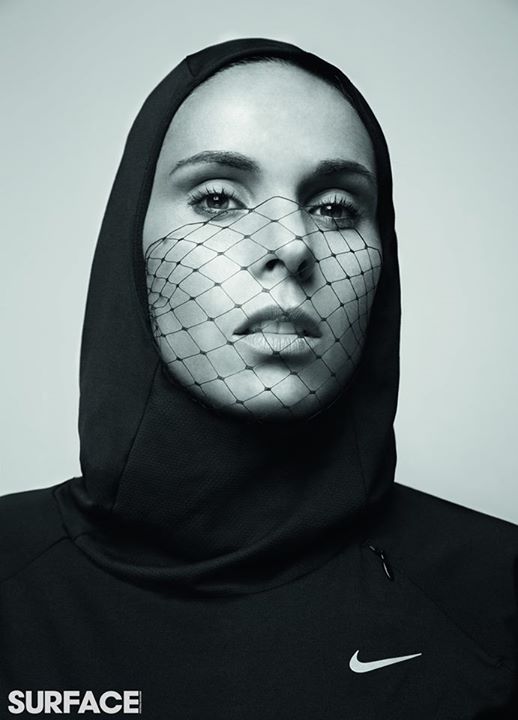
A recent special issue of the French Surface Football Magazine includes this portrait of national team player Jessica Houara-d’Hommeaux. The photograph is an invitation, even an incitement. In contemporary France, the discussion about and policing of what Muslim women do and don’t wear is a national obsession, one of the most electric and illuminating debates in the contemporary Republic. Houara’s striking portrait forces one to think through the layers of symbolism and politics surrounding the participation of Muslim women in contemporary sport in France and beyond.
France started out strong in the Women’s World Cup with a 1–0 defeat of England, but was shocked in a 2–0 loss to Colombia in its second game. Now Les Bleues will likely need a victory over Mexico on Wednesday to guarantee a place in the next round of the tournament.
In the years since its strong run in the 2011 World Cup, the French team has been increasingly celebrated back home. There is, however, a long way to go. The Surface magazine issue critiques the ways in which female players are sexualized—“Do we ask men to be good looking to play football?” asks star player Louisa Necib—and the inequality in coverage between men’s and women’s international football. In the pages of the magazine Les Bleues are presented as strong, powerful and glamorous superstars ready to take on the world. Their portraits show them in athletic gear, training on the pitch, but also in stylish clothes from a range of high-end fashion brands. The first profile is of Houara, whose portrait may be the most striking image in the magazine.
Houara is one of six players of North African background on the French national team. The others are Kenza Dali, Amel Majri, Kheira Hamraoui, the goalkeeper Sarah Bouhaddi, and Necib, one of great stars of international women’s football. With the increasing visibility of the team, these women have become some of the most recognized and visible women of North African descent in France. Necib, the most talented and successful of the group, has been particularly celebrated.
The 27 year-old Houara began playing football at the age of 10 after following her brother to his training sessions and matches. As she explains in Surface, her mother and father (both from Algeria) always supported her playing. She always wanted to make her father, who managed a youth team, proud of her accomplishments on the pitch. An attacking defender, she is a pillar of the professional women’s team at Paris Saint-Germain. One of the top clubs in the world, they played in the UEFA Women’s Champions League finals a month ago.
She has been a force on Les Bleues since 2008. In an international friendly against the U.S. in early 2015, Houara scored her first international goal: a breathtaking cross that resulted in a 2–0 win against one of women’s soccer’s foremost powers. The previous Women’s World Cup saw France finish in fourth place, but this time the 27 year-old is is aiming for a stronger result.
https://www.youtube.com/watch?v=dw_EAg3_9Q4
In the Surface portrait, Houara is wearing a Nike hoodie, wrapped tightly around her head so that it looks like a hijab. As Maria Hengeveld, a researcher at Columbia University who studies Nike’s relationship to women, explained to me in an interview, since its 1995 “If You Let Me Play” campaign, Nike has “actively capitalized on women’s issues and positioned itself as a booster for global women’s participation in sports to corner the women’s market.” At first Nike’s women’s ads were met with skepticism, given that anti-sweatshop campaigns focusing on the corporation were just then confronting consumers with the miserable and abusive conditions of its women workers. But since then, Nike has worked hard to transform its image. Its foundation actively partners with the UN Foundation, USAID, the British Department for International Development and various international women’s rights groups on girl-focused programs in the Global South to promote that message that, as Hengeveld notes, “the picture of Houara also seems to convey: that Nike helps women to challenge the laws and practices that hold them back.”
Nike’s campaigns directed at women in Africa, Hengeveld notes, “present women’s participation in the market economy and on the sports field as gateways to gender justice,” and therefore as a way to “liberate women from the traditional cultural practices that oppress them.” These campaigns conveniently overlook the “fact that the free market and the athletic apparel industry oppress women” too. “The Muslim women who stitch these products in Indonesian factories, generating the profits Nike uses for its endorsements and philanthropic feminist work,” notes Hengeveld, “still make such low wages they couldn’t even afford them.”
Houara’s portrait adds something to the Nike gear: a kind of sort of transparent niqab, one made of the netting from a goal, that covers most of her face. (The netting is used in several other photographs in the magazine, including a portrait of Bouhaddi, the goalkeeper of the team and Laura Georges, whose parents are from the French Caribbean, both of whom wear the netting over their entire heads). This is striking because it is illegal to wear in niqab in public in France. Given the intense debate about this law during the last years, the photograph is an ambiguous but powerful gesture. Indeed, when the photo was posted on Houara’s Facebook page, it immediately incited intense debate and commentary.
The portrait also directly evokes the complicated history surrounding the hijab and international soccer. That story goes back to 2007 at a youth tournament held in Quebec when an 11-year-old girl from Ottawa named Asmahan Mansour was told by the referee that she could not play in a hijab. She, her coach, and her teammates—along with several other teams—protested the decision and refused to play in solidarity with her. But the incident triggered a cascade of decisions with global implications: the Canadian Football Federation referred the matter to FIFA, which decided to ban the hijab from women’s soccer.
The justifications for the ban were never very clearly stated—they included the evocation of the dangers presented by the hijab to players wearing them in competition—but they had a serious impact on some teams. In June, 2011 the Iranian women’s football team was prevented from playing an Olympic qualifier because they were wearing hijab. Jordan’s Prince Ali Bin Al Hussein, a powerful voice within FIFA, lobbied the organization to change its policy. On July 5, 2012 the International Football Association Board determined that women would be allowed to play in international competition wearing certain approved hijab that meet required regulations. The ban was only ended on March 1, 2014, after the end of Women’s World Cup qualifying, though there are no players at the tournament wearing hijab.
The French Football Federation, however, immediately placed its own national ban in place. Female French players are currently the only ones in the world who can’t play in an IFAB-sanctioned hijab. None of the players on the national team so far has protested this decision. But the portrait of Houara-d’Hommeaux raises the question: What if they did? The issue, furthermore, will almost certainly come up again in an international context: the next Women’s World Cup will be held in France in 2019, and Middle Eastern teams like Jordan and Iran will be competing for a place in that tournament. Will they be allowed to wear hijab if they make it?
Houara-d’Hommeaux has offered Eid greetings to followers and publicly supported the historic run of Algerian team (many of whose players grew up in France) at the 2014 Men’s World Cup. But she has not otherwise explicitly stated that she observes Islam. But her portrait for Surface raises fascinating questions: Is Houara making a political statement, trying to create a collision of sports with social issues? Is she advocating for the right to wear hijab in French football? Is her netted evocation of the niqab a critical comment on the country’s laws surrounding the veil, suggesting that they may be as transparent and vacuous as a football netting?
Whatever its intended meaning, the image is beautiful and it is intense. The portrait reminds us that the veiled woman is a celebrated Olympian and a decorated footballer. Can footballers look like this? Should they look like this? Perhaps it is also be a reminder to athletic clothing companies, including Nike (which doesn’t design or manufacture any sportswear catering to headscarf-wearing athletes) to think more carefully about their potential customers.
Given Houara’s Algerian descent, the image does not seem to be about appropriating or parodying the veil. It is not a comment about the oppression of Muslim women. Instead, the portrait seems to be about quietly slaying some misconceptions. After all, it is not often that hijab is associated with athletic achievement and inclusiveness. With the potent image, Houara reminds us that as she speeds and succeeds on the pitch, le voile and les footballeuses are not contradictions.
Previous Post
July 27, 2015
Is Islamophobia Real?
Next Post

July 31, 2015 Friday Links
Browse Our Archives
Select a Category Advertisements Art/Theater Books/Magazines Cinema Comics/Cartoons Culture/Society Events Fashion Film Friday Links Merchandise/Commodities MMW Announcements MMW Highlights Music/Radio News Photography Politics Profile Ramadan 2012 Ramadan 2013 Ramadan 2014 Ramadan 2015 Roundtable Satire Social Media Sports Technology/Science Television Uncategorized Video Web
Select a Month November 2015 October 2015 September 2015 August 2015 July 2015 June 2015 May 2015 April 2015 March 2015 January 2015 December 2014 November 2014 October 2014 September 2014 July 2014 June 2014 May 2014 April 2014 March 2014 February 2014 January 2014 December 2013 November 2013 October 2013 September 2013 August 2013 July 2013 June 2013 May 2013 April 2013 March 2013 February 2013 January 2013 December 2012 November 2012 October 2012 September 2012 August 2012 July 2012 June 2012 May 2012 April 2012 March 2012 February 2012 January 2012 December 2011 November 2011 September 2011 August 2011 July 2011 June 2011 May 2011 April 2011 March 2011 February 2011 January 2011 December 2010 November 2010 October 2010 September 2010 August 2010 July 2010 June 2010 May 2010 April 2010 March 2010 February 2010 January 2010 December 2009 November 2009 October 2009 September 2009 August 2009 July 2009 June 2009 May 2009 April 2009 March 2009 February 2009 January 2009 December 2008 November 2008 October 2008 September 2008 August 2008 July 2008 June 2008 May 2008 April 2008 March 2008 February 2008 January 2008 December 2007 November 2007 October 2007 September 2007 August 2007
Follow Us!
TAKE THE
Religious Wisdom Quiz
I was breathing out murderous threats, but a blinding light changed everything. I became the greatest missionary the church has known. Who am I?
Select your answer to see how you score.
Peter Stephen Barnabas Saul
Related posts from Muslimah Media Watch

Friday Links - American flag hijabs, hate crimes,...

Bangladeshi Women, Media and the “Helpers of Allah”

TRENDING AT PATHEOS Muslim

25 Years Later: How Much Has Changed for...
As we approach the 25th anniversary of September 11th, I’ve found myself...

Podcast: Third Spaces & The Rise of Yemeni...
In the latest episode of The Artistic Foodies Podcast, hosts Abbas...

HalalFest Picks: Best 60 Halal Spots for Super...
Back in 2016, I came up with a list of 29...

Unity Is America’s Strength — Division Is Its...
by Hidayatullah Ahsan When Valentina Gomez, a Republican candidate for Congress in...

Zohran Mamdani and New York’s Fight Against Islamophobia
This past June, against all odds, Zohran Mamdani won the Democratic primary...

What the Fourth of July Means to a...
As we mark another Fourth of July, millions of Americans will celebrate...
view all Muslim blogs
Ad-Free & Subscriber Log-In Subscription Support
- About Us
- 2026 Calendar
- Videos
- Podcasts
- Library of World Religions
- Faith In Media Tracker
- Advertise With Us
- Write for Us
- Privacy Policy
- Terms of Service
- Do Not Sell My Data
- Contact Us
- Radiant Digital
- Manage Newsletter Subscriptions
- Unsubscribe From Notifications
- Sitemap
Copyright 2008-2026, Patheos. All rights reserved.
Subscription Support Ad-Free & Subscriber Log-In
Follow Patheos