
BuddhistCatholicContemplativeEvangelicalGeneral ChristianHinduJewishLatter-day SaintMuslimNew VisionsProgressive Christian
Beliefs
- Buddhist
- Catholic
- Contemplative
- Evangelical
- General Christian
- Hindu
- Jewish
- Latter-day Saint
- More Voices
- Muslim
- New Visions
- Pagan
- Progressive Christian
Topics
- Religion News
- Food and Religion
- Sports and Religion
- Religious Art
- Religious Music and Entertainment
- Religious Events
- History and Religion
- Style and Religion
- Politics and Religion
- Women in Religion
- Recreation Outdoors and Religion
- Business Finance and Religion
- Careers Workplace and Religion
- Education and Religion
- Family Parenting and Religion
- Health Fitness and Religion
- Home and Religion
- Relationships and Religion
- Technology and Religion
- Travel and Religion
Columnists
- Buddhist Columnists
- Business Finance and Religion Columnists
- Careers Workplace and Religion Columnists
- Catholic Columnists
- Contemplative Columnists
- Education and Religion Columnists
- Evangelists Columnists
- Family Parenting and Religion Columnists
- General Christian Columnists
- Health Fitness and Religion Columnists
- Hindu Columnists
- History and Religion Columnists
- Home and Religion Columnists
- Jewish Columnists
- More Voices Columnists
- Latter Day Columnists
- Muslim Columnists
- New Visions Columnists
- Nonreligious Columnists
- Pagan Columnists
- Politics and Religion Columnists
- Progressive Columnists
- Recreation Outdoors and Religion Columnists
- Relationships and Religion Columnists
- Religion News Columnists
- Religious Art Columnists
- Religious Events Columnists
- Religious Music and Entertainment Columnists
- Sports and Religion Columnists
- Style and Religion Columnists
- Technology and Religion Columnists
- Travel and Religion Columnists
- Women in Religion Columnists
Resource Library
- 2026 Calendar
- Library of World Religions
- The 100 Most Holy Places on Earth
- Patheos Answers
- Podcasts
- Videos
- Faith Leaders Database
- Anglican Episcopalian
- Bahai
- Baptist
- Buddhism
- Christianity
- Confucianism
- Eastern Orthodoxy
- Hinduism
- Holiness and Pentecostal
- ISKCON
- Islam
- Judaism
- Lutheran
- Methodist
- The Church of Jesus Christ of Latter-day Saints
- New Age
- Paganism
- Presbytarian and Reformed
- Protestantism
- Religion Behind the Scenes
- Roman Catholic
- Scientology
- Shia Islam
- Sikhism
- Sufism
- Sunni Islam
- Taoism
- Zen
- See all religions
Research Tools
 Ad-Free & Subscriber Log-In Subscription Support
Ad-Free & Subscriber Log-In Subscription Support
Follow Patheos 

- Trending:
- Forgiveness
- |
- Marriage
- |
- Consciousness
- |
- Death Penalty
- |
- Election
- |
- Halloween
 Muslimah Media Watch
- Home
- Muslim
- Religion News
- South Africa’s Open Mosque : Media, Feminist Critiques and “Unopen” Mosques.
South Africa’s Open Mosque : Media, Feminist Critiques and “Unopen” Mosques.
Last updated on: October 15, 2014 at 2:00 am by safiyyah
South Africa’s Open Mosque : Media, Feminist Critiques and “Unopen” Mosques. 2014-10-14T21:37:01-04:00 safiyyah
Patheos Explore the world's faith through different perspectives on religion and spirituality! Patheos has the views of the prevalent religions and spiritualities of the world.
The past month has been controversy ridden for the South African Muslim community, as news of the inauguration of the ‘Open Mosque’ in Cape Town has forced Muslims to tackle issues of gender equality, sexual orientation and religious freedom.
Community radio stations, national broadcasters, newspapers and social media have been abuzz with news of the Open Mosque, covering everything from the protests and backlash against such an idea and death threats against the founder, to the alleged closure of the mosque due to zoning regulations and, most recently, an arson attack on the building. This tiny little warehouse structure received coverage from the Huffington Post and BBC! Whilst this is not the focus of this article, I must state that I find the vindictive and violent responses from within the Muslim community to the opening of a place of worship – regardless of its ideology and orientation – extremely reprehensible.
The Open Mosque – proclaiming to be a Quran-centric, gender-equal, non-sectarian place of worship, headed by U.K-based Taj Hargey, sounds great on paper – but Muslim feminists across South Africa have taken issue with Hargey’s new establishment. It is this powerful narrative that emerged in the mainstream media that I would like to focus on – wherein Muslim women challenged and critiqued the Open Mosque. At least four such articles written by Muslim women appeared in reputable and widely read South African publications, tackling the issue of women’s access and inclusion in mosques, gender equality and community cohesion.
Like these women, who are friends and mentors, and as a Muslim woman deeply engaged in the gender justice discourse, I too see this issue as an opening, an opportunity to engage on the issue of the current mosque structures in South Africa – as we have seen many ulema (religious scholars) and community leaders come out to declare that ‘all mosques are in fact open’, seemingly rendering the concept of the Open Mosque in Cape Town defunct.
I have no affiliation or affinity to this new Open Mosque, because I find the assumptions and attitudes of its founder very problematic. At the same time, members of the clergy who have been responding to Hargey’s self-styled mosque revolution have been making claims that are also untrue – that ‘all mosques are open’. Indeed, as a Muslim male worshipper, regardless of your sexuality, Muslim school of thought or sect, you will be admitted into any mosque due to the privilege of simply being male. However, as a woman, this is not the case – your access to mosques will be restricted to side entrances, small over-crowded spaces, alienation from the main prayer hall (in some cases without even auditory access) and in worst case scenarios – you will have no access at all and simply be turned away.
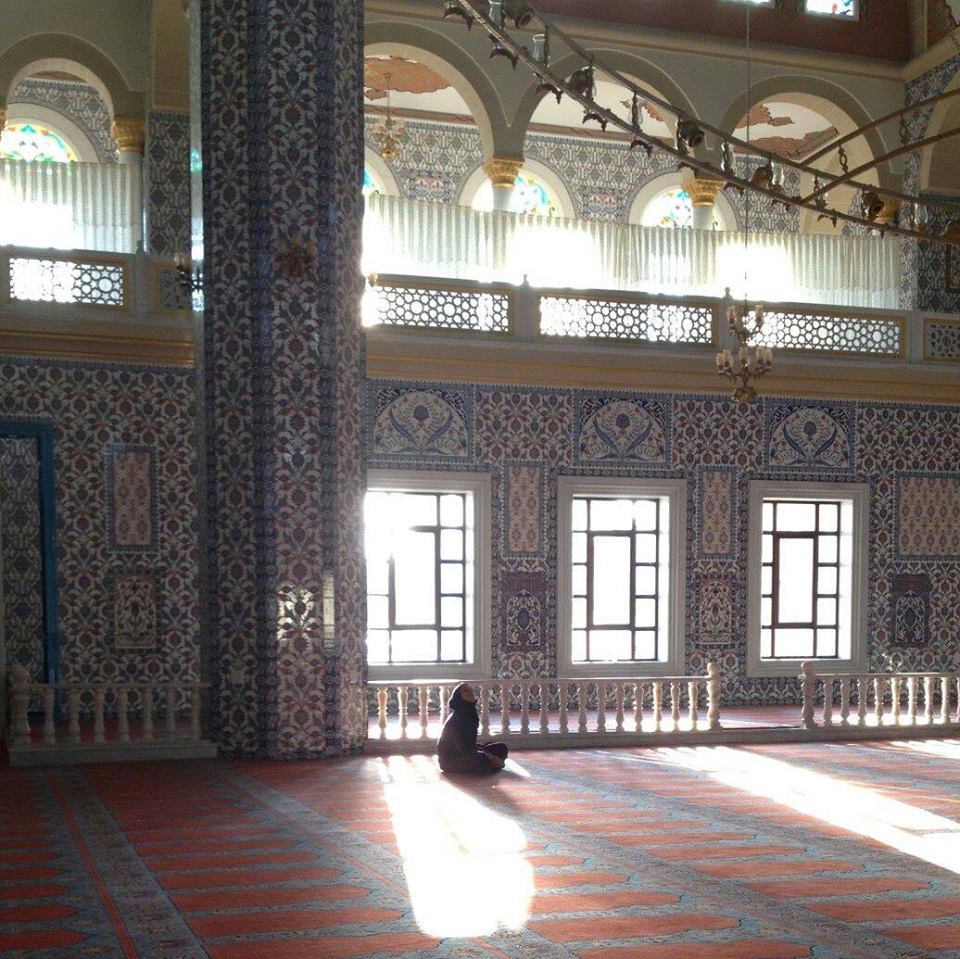
Nizamiye Mosque, Johannesburg.
Whilst women’s facilities have improved in the last decade, particularly with the establishment of mosques in affluent suburbs, women are still regularly discouraged from attending, cannot serve on the boards and committees of these institutions or have a voice in these spaces. This is in addition to frequently hearing messages from the pulpit that designate women as merely sexual that men become helpless to resist, or messages that a woman’s ‘place’ is in the home and that her role in society cannot extend beyond wife and mother. The men in charge of these spaces certainly do not make mosque visits for women pleasant or spiritually uplifting experiences, as the Prophet Muhammad (pbuh) did – and yet, incidentally, it is the Prophet that the ulema keep claiming we have to follow, in their responses in the media to Hargey.
The first article by a Muslim woman that appeared in the media was by community activist and journalist Farhana Ismail, who precisely challenged these conversations playing themselves out in the media in which ulema were claiming that ‘all mosques are open’. Ismail writes:
“What is interesting, though, is the response the open mosque story has elicited, particularly from a senior member of the Johannesburg-based Council of Muslim Theologians, Maulana Ebrahim Bham …
In an interview with Steven Grootes on radio this week, Bham was asked to comment on the statement by the founder of the Open Mosque, Taj Hargey, that the Qur’an does not say that men and women should worship separately. Referring to the two sources of Islamic teachings, the Qur’an and the traditions of the Prophet Mohammed (peace be upon him), Bham said: “The Qur’an tells us to do whatever the Prophet tells you to and whatever the Prophet prohibits you from, then stay away from it.”
Ironically, the argument that he uses is the same one those of us who hail from the trenches of the gender jihad have always used to insist on women’s inclusion and equal participation in mosques and Eid prayer spaces. In a sense, Bham made our case for us …
There certainly appears to be a mismatch between, on the one hand, Bham’s implied contention that all mosques in South Africa are Qur’an-centric and “open” and, on the other hand, Muslim women’s lived realities within and at the gates of these sacred spaces.”
In the second article, academic and lecturer, Dr Fatima Seedat, tackled Hargey’s condescending positions and his lack of community dialogue, in addition to tackling how our mosques operate:
“Unfortunately, while the real issue is exclusive mosque spaces, we’re talking about Hargey. His combative approach makes it clear that Hargey doesn’t know how to deal with difference without giving offence. In fact his suggestions that local Muslims are too dumb to think independently or to challenge the ulama with ‘matric qualifications’ smacks of a colonial arrogance that swoops in from afar to show the locals how to conduct their revolution …
But it’s not unusual for women’s issues to be handled in this way. It reflects a form of patriarchy that takes on women’s issues in the name of women but without involving women in the biggest decisions, and in Hargey’s case, with little concern for the impact on gender work already under way locally.”
For me, Seedat’s most important point remains:
“Without pandering to power elites, successful social transformation requires an approach that promotes social cohesion even as it advocates a radical break with patriarchal tradition.”
This is exactly what the Open Mosque does not do – in a particularly offensive statement, Hargey claimed, “The women will no longer make samoosas – they will make the decisions” … dismissing decades of gender activism and scholarship by Muslim women, not only in religious life, but in the political and social landscape of South Africa in general! Given that Hargey has been largely absent from the South African Muslim community for the last few decades, it is not surprising that his initiative was not met with excitement by Muslim activists and community in general – his approach was to come in and simply launch a mosque, inject the community with news deliberately meant to create various levels of shock and horror, attack all members of the clergy and all Muslims who have working relationship with them, and furthermore engage in no dialogue with communities. Any venture that seeks to redress issues of injustice cannot be undertaken without creating the appropriate discourse around the issues one wishes to fix.
In the third article, a moving reflective piece by a writer and convert to Islam, Hajira Amla shared her mosque experiences in South Africa, in light of all the debates created by the Open Mosque.
“As a fair-skinned convert, I’ve resigned myself to the cold or curious stares of others on the occasions when I have attended mosque … When I got married to my husband in 2008, I wanted to know if my parents would be able to come for the nikkah (marriage ceremony) at the Sultan Bahu mosque in Mayfair, Johannesburg. The Imam informed me that the women’s gallery, where the nikkah was to take place, was “not consecrated as part of the mosque” so non-Muslims could come to witness the ceremony. The revelation rankled. Why then should women even bother to come to these non-consecrated spaces?”
The most recent critique of the Open Mosque comes from influential Muslim feminist intellectual and scholar Dr Sa’diyya Shaikh; the piece is co-authored with social activist Shuaib Manjra. They discuss the problematic discourse propelled by Hargey, delving into the numerous contradictions in his claims to support and promote gender equality (including his support for the Burka ban in the U.K). The article describes Hargey’s approach as ‘sensationalist sound bites that sound superficially progressive but are in fact disrespectful, dismissive, degrading and disempowering.’ The article is extensive and deals with a number of Hargey’s claims, and his lack of consultation,
“… it is crucial to ask where in Hargey’s purportedly democratic vision of inclusivity is there any evidence of consultation with heterosexual women and queer communities, those marginalised Muslim constituencies that he claims to represent. Hargey’s very loud presence in the media is starkly contrasted with a complete lack of any public support from the gay, lesbian and women’s groups for his project. This is demonstrated by the extremely poor attendance at his mosque. This lack of public support is not due to fear since these activist groups have publicly operated for many years.”
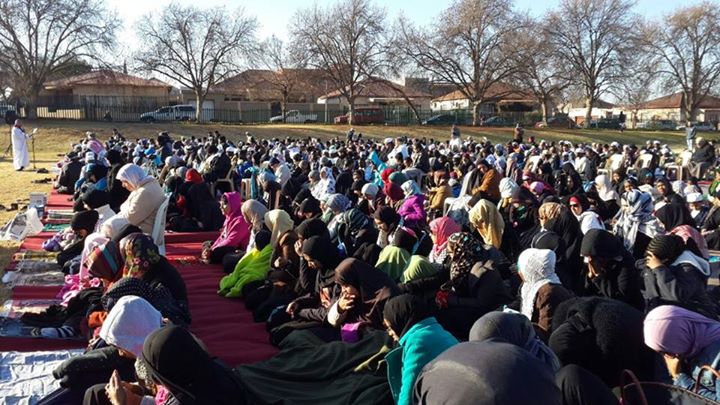
Eid prayers at Masjid ul Islam, Johannesburg.
I found it very powerful to have all the pieces in our mainstream media, challenging patriarchy, whether disguised or not, by Muslim women. All of these articles give credence to the community activism that has, for decades, been pushing for further access and inclusion of women in mosques. Three of the articles mention two of South Africa’s most progressive institutions – Masjid ul-Islam in Johannesburg and Claremont Main Road Mosque in Cape Town. These mosques regularly have women speakers for Friday prayers as well as other programs (for example: throughout the month of Ramadan, I presented tafsir before the Taraweeh prayers); men and women have access to the main prayer hall, serve on the committees and are as much a part of the congregation as men.
As a member of the Masjid ul-Islam community for over eight years, I am surprised at the outcry that erupted over the Open Mosque – a venture that seems to be calling out for as much media attention as possible to itself and its founder. Hargey comes across as an intolerant person for someone who claims to be so ‘open’. His dismissal of the entire Muslim community, and his rather colonialist mindset that Muslim women need to be saved from the oppressive clergy by himself, are patronizing, to say the least, for many of us who have for years been active agents of our own liberation from patriarchal interpretations of religion.
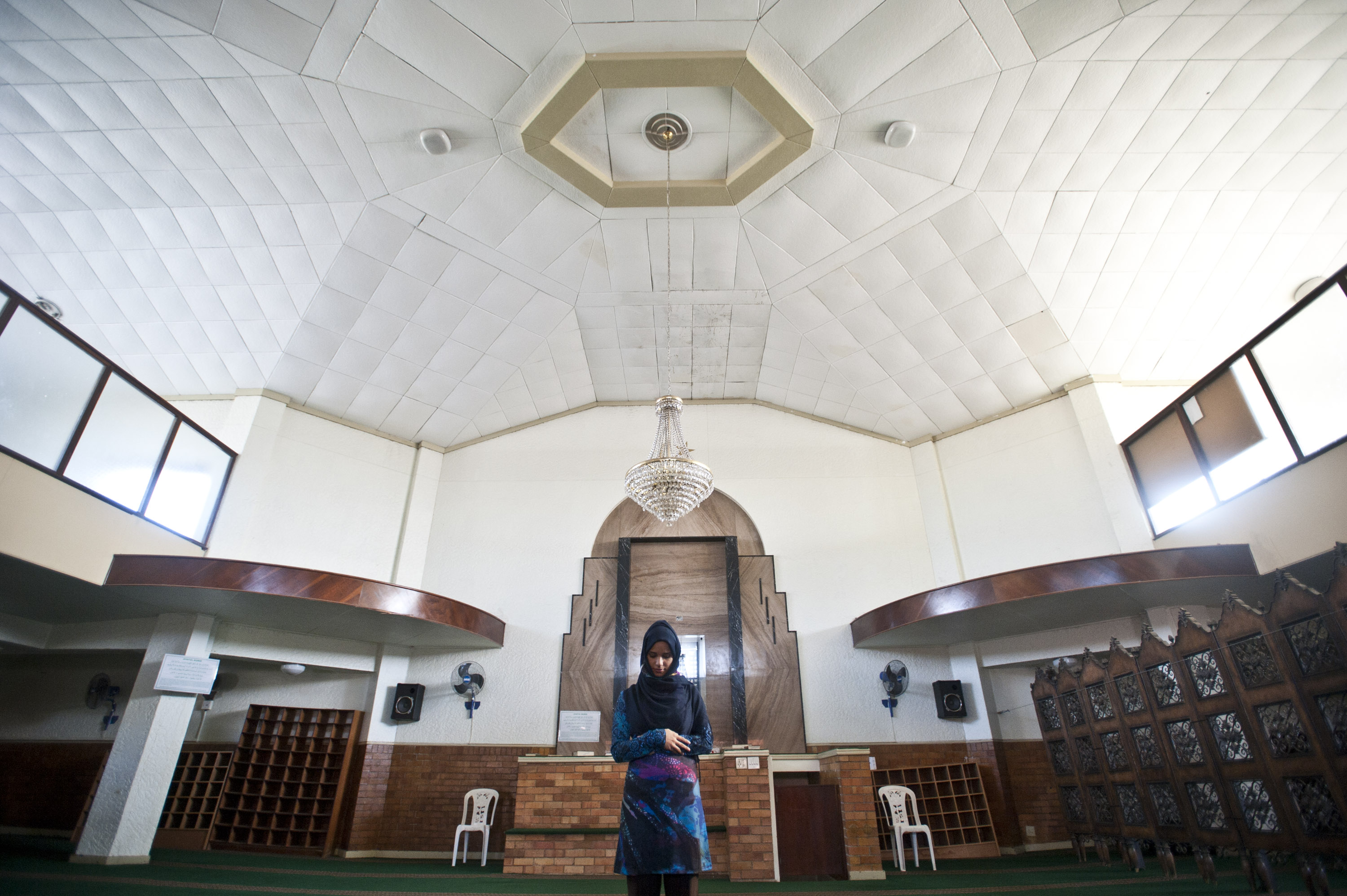
Praying at Masjid ul Islam, Johannesburg.
As Muslims all over the world marked the end of the Hajj pilgrimage, which culminated in Eid al-Adha, a day of feasting and celebration, on Sunday 5 October, it was a good time to reflect inwardly on the state of our sacred spaces as a Muslim community. Whilst Hargey invited women to his Eid prayers in his signature condescending manner, hundreds of other prayer gatherings across the country were in fact ‘closed,’ excluding women from this very significant communal ritual. However, some gatherings were ‘open’ – I have mentioned at least two of them – a process that has taken decades, much sacrifice and vision to create, and where participants go about their worship, community building, interfaith solidarity and social justice programs with much less attention seeking and intolerance than this latest venture.
Previous Post

October 13, 2014
A Muslim Thanksgiving?
Next Post
October 17, 2014 Friday Links | October 17, 2014
Browse Our Archives
Select a Category Advertisements Art/Theater Books/Magazines Cinema Comics/Cartoons Culture/Society Events Fashion Film Friday Links Merchandise/Commodities MMW Announcements MMW Highlights Music/Radio News Photography Politics Profile Ramadan 2012 Ramadan 2013 Ramadan 2014 Ramadan 2015 Roundtable Satire Social Media Sports Technology/Science Television Uncategorized Video Web
Select a Month November 2015 October 2015 September 2015 August 2015 July 2015 June 2015 May 2015 April 2015 March 2015 January 2015 December 2014 November 2014 October 2014 September 2014 July 2014 June 2014 May 2014 April 2014 March 2014 February 2014 January 2014 December 2013 November 2013 October 2013 September 2013 August 2013 July 2013 June 2013 May 2013 April 2013 March 2013 February 2013 January 2013 December 2012 November 2012 October 2012 September 2012 August 2012 July 2012 June 2012 May 2012 April 2012 March 2012 February 2012 January 2012 December 2011 November 2011 September 2011 August 2011 July 2011 June 2011 May 2011 April 2011 March 2011 February 2011 January 2011 December 2010 November 2010 October 2010 September 2010 August 2010 July 2010 June 2010 May 2010 April 2010 March 2010 February 2010 January 2010 December 2009 November 2009 October 2009 September 2009 August 2009 July 2009 June 2009 May 2009 April 2009 March 2009 February 2009 January 2009 December 2008 November 2008 October 2008 September 2008 August 2008 July 2008 June 2008 May 2008 April 2008 March 2008 February 2008 January 2008 December 2007 November 2007 October 2007 September 2007 August 2007
Follow Us!
TAKE THE
Religious Wisdom Quiz
What was the primary inheritance method in biblical times?
Select your answer to see how you score.
Youngest child Equal division Oldest daughter Firstborn son
Related posts from Muslimah Media Watch

#PrayforParis, Muslim Women and Third World Violence


Hate Crimes and Mother Tongues

Interview with Comedian Eman El Husseini
TRENDING AT PATHEOS Muslim

25 Years Later: How Much Has Changed for...
As we approach the 25th anniversary of September 11th, I’ve found myself...

Podcast: Third Spaces & The Rise of Yemeni...
In the latest episode of The Artistic Foodies Podcast, hosts Abbas...

HalalFest Picks: Best 60 Halal Spots for Super...
Back in 2016, I came up with a list of 29...

Unity Is America’s Strength — Division Is Its...
by Hidayatullah Ahsan When Valentina Gomez, a Republican candidate for Congress in...

Zohran Mamdani and New York’s Fight Against Islamophobia
This past June, against all odds, Zohran Mamdani won the Democratic primary...

What the Fourth of July Means to a...
As we mark another Fourth of July, millions of Americans will celebrate...
view all Muslim blogs
Ad-Free & Subscriber Log-In Subscription Support
- About Us
- 2026 Calendar
- Videos
- Podcasts
- Library of World Religions
- Faith In Media Tracker
- Advertise With Us
- Write for Us
- Privacy Policy
- Terms of Service
- Do Not Sell My Data
- Contact Us
- Radiant Digital
- Manage Newsletter Subscriptions
- Unsubscribe From Notifications
- Sitemap
Copyright 2008-2026, Patheos. All rights reserved.
Subscription Support Ad-Free & Subscriber Log-In
Follow Patheos