
BuddhistCatholicContemplativeEvangelicalGeneral ChristianHinduJewishLatter-day SaintMuslimNew VisionsProgressive Christian
Beliefs
- Buddhist
- Catholic
- Contemplative
- Evangelical
- General Christian
- Hindu
- Jewish
- Latter-day Saint
- More Voices
- Muslim
- New Visions
- Pagan
- Progressive Christian
Topics
- Religion News
- Food and Religion
- Sports and Religion
- Religious Art
- Religious Music and Entertainment
- Religious Events
- History and Religion
- Style and Religion
- Politics and Religion
- Women in Religion
- Recreation Outdoors and Religion
- Business Finance and Religion
- Careers Workplace and Religion
- Education and Religion
- Family Parenting and Religion
- Health Fitness and Religion
- Home and Religion
- Relationships and Religion
- Technology and Religion
- Travel and Religion
Columnists
- Buddhist Columnists
- Business Finance and Religion Columnists
- Careers Workplace and Religion Columnists
- Catholic Columnists
- Contemplative Columnists
- Education and Religion Columnists
- Evangelists Columnists
- Family Parenting and Religion Columnists
- General Christian Columnists
- Health Fitness and Religion Columnists
- Hindu Columnists
- History and Religion Columnists
- Home and Religion Columnists
- Jewish Columnists
- More Voices Columnists
- Latter Day Columnists
- Muslim Columnists
- New Visions Columnists
- Nonreligious Columnists
- Pagan Columnists
- Politics and Religion Columnists
- Progressive Columnists
- Recreation Outdoors and Religion Columnists
- Relationships and Religion Columnists
- Religion News Columnists
- Religious Art Columnists
- Religious Events Columnists
- Religious Music and Entertainment Columnists
- Sports and Religion Columnists
- Style and Religion Columnists
- Technology and Religion Columnists
- Travel and Religion Columnists
- Women in Religion Columnists
Resource Library
- 2026 Calendar
- Library of World Religions
- The 100 Most Holy Places on Earth
- Patheos Answers
- Podcasts
- Videos
- Faith Leaders Database
- Anglican Episcopalian
- Bahai
- Baptist
- Buddhism
- Christianity
- Confucianism
- Eastern Orthodoxy
- Hinduism
- Holiness and Pentecostal
- ISKCON
- Islam
- Judaism
- Lutheran
- Methodist
- The Church of Jesus Christ of Latter-day Saints
- New Age
- Paganism
- Presbytarian and Reformed
- Protestantism
- Religion Behind the Scenes
- Roman Catholic
- Scientology
- Shia Islam
- Sikhism
- Sufism
- Sunni Islam
- Taoism
- Zen
- See all religions
Research Tools
 Ad-Free & Subscriber Log-In Subscription Support
Ad-Free & Subscriber Log-In Subscription Support
Follow Patheos 

- Trending:
- Forgiveness
- |
- Marriage
- |
- Consciousness
- |
- Death Penalty
- |
- Election
- |
- Halloween
 Muslimah Media Watch
- Home
- Muslim
- Religion News
- Muslim Women in Sports Media: Is It Still Progress if No One Cares?
Muslim Women in Sports Media: Is It Still Progress if No One Cares?
Last updated on: September 25, 2014 at 11:09 am by shireen
Muslim Women in Sports Media: Is It Still Progress if No One Cares? 2014-09-25T11:09:40-04:00 shireen
Patheos Explore the world's faith through different perspectives on religion and spirituality! Patheos has the views of the prevalent religions and spiritualities of the world.
On September 16, 2014, basketball’s international governing body, FIBA, announced it would be allowing headcoverings during competitive play for a trial period. It stopped short, however, of permanently lifting its ban on hijabs, turbans and yarmulkes worn by basketball players. Stories of players being rejected from tournaments and forced to forfeit because of their headcoverings have been reported for the last few years.
A development that could potentially include thousands of players is great news.
Sort of.
First of all, the decision itself, and any remaining requirements that players must adhere to, is not clear. Second, this issue was minimally covered in the media because it isn’t a hot story. As someone who has been through a similar process and faced exclusion from a sport, I find both the lack of clarity from FIBA and the lack of coverage by media equally frustrating.
![Basketball player Indira Kaljo. [Source].](https://wp-media.patheos.com/blogs/sites/92/2014/09/basketball3.jpg)
Basketball player Indira Kaljo. [Source].
After the anouncement, I spoke with Indira Kaljo, a professional basketball player, who started a Change.Org peitition to lobby FIBA to allow women to play. Her petition garnered more almost 70,000 signatures and pushed FIBA to promptly address the issue.
However, the results of a FIBA meeting in Istanbul were not exactly what prominent Muslimah athletes such as Indira Kaljo and Bilquis Abdul-Qadir were hoping for. “I am elated” Kaljo told me, “But what are the next steps*?*”
She has been trying to seek clarification about whether she can now play professionally, but the obstacles, such as the club having to petition the National Basketball Federation for a change of uniform, seem unnecessary and arduous. “We have been tirelessly trying to contact one person….they will not give us one point of contact for clarification*,*” says Kaljo.
The recent decision to temporarily allow headbands of more than 5 cm is complicated. It allows players to wear hijabs or turbans, but they must apply for eligibility for their headcoverings to be part of their uniform. This formal application is submitted before each match to the governing body of the national basketball program of their club or team. The federation would notify the referee association and the player would be allowed to compete. But even the details of how this would work are not specified by FIBA.
The problem is that this is tremendous paperwork and might be considered a liability for any professional team. If the FIBA ban were lifted altogether, then the players could, well, simply PLAY.
![Egypt’s national women’s basketball team. [Source].](https://wp-media.patheos.com/blogs/sites/92/2014/09/basketball1.jpg)
Egypt’s national women’s basketball team. [Source].
Right now, the Asian Games are being held in Incheon, South Korea. Despite FIBA’s very recent announcement, women are being forced to forfeit their matches over disputes about their hijabs. Clarification and proper directives from FIBA are critical at this juncture but are not being provided.
I’ve become very familiar with the case of the soccer world, governed by FIFA, finally allowing hijabs, through an approach that differed with that of FIBA. During a trial period that was announced by IFAB (the governing body of FIFA) in July 2012, women were allowed to wear hijab and a specific prototype was being tested by a medical safety team. Less than two years later, the ban was formally lifted.
Pressure for FIFA to lift the ban came from an executive committee member, Prince Ali bin al-Hussein of Jordan, who was spearheading the campaign. FIBA does not have a similar representative on its committee pushing for change. Without considerable media attention and pressure on FIBA, the fate of basketballers is still in limbo.
Another difference between this case and that of FIFA is the media attention.
If there were any reports on the coverage of this issue in mainstream media, they were presented by men, who may be in favour of lifting the ban, but there were no perspectives from actual Muslimah players themselves. There were smatterings from major sports outlets such as ESPN and a heavily recycled piece by Doug Feinberg of the The Associated Press.
I spoke with SLAM magazine contributor and basketball expert Habeeba Husain, who wrote a fantastic piece (that ought to have been shared widely) about this issue. She explained to me that, from her perspective: “Hijab isn’t the barrier. A lot more misunderstanding took place. FIBA was the barrier and so was their decision making process.”
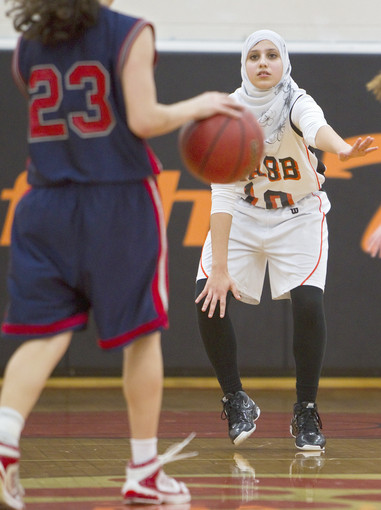
Basketball player Yasmeen Amer (pic via Kaitlin McKeown, Daily Press / February 2, 2012).
I had approached and pitched this story to different sports editors and did not even get a reply. Then again, why on earth would this story appeal to sports editors? A story about Muslim athletes isn’t as click-worthy without catchwords such as “struggle” or “fight” against stereotypical systems that allude to the Muslimah athlete’s “freedom” from family, religion, or culture. A story about how hijab does not oppress or get in the way of an athlete’s ability is also considered newsworthy.
But the boring yet very relevant stories of bureaucracy and politics that athletes must endure are not as exciting. They don’t provide warm fuzzies or speak of the struggles and pain of an athlete’s journey. That doesn’t diminish their importance in reality. Sport media has an obligation to present these developments as they pertain to sports.
The most widely circulated recent story about a Muslimah athlete was the tale of a team of non-Muslim young women coming to the rescue of their teammate Samah, who was banned from playing soccer because of her hijab. Before a game, her teammates decided to wear hijab and took a picture, which was lauded as incredible solidarity. This feature created a fresh “feel-good-about-hijab-in-sport” legend, but as I wrote about in a previous MMW piece, the focus of the media was not on Samah or her struggles, but on the gesture of the team. The deeper story was completely ignored.
The deeper story of this latest FIBA ruling may not appeal to major sports outlets, and their editors may shrug it off as uninteresting. Particularly when there are more important stories to cover, like how prominent female sportswomen get naked for photoshoots, or more recently how famous athlete’s computer systems are being hacked and their nude pictures leaked.
This gets significantly more attention.
There are reports of women’s basketball leagues, tournaments and varsity competitions teams with Muslim women participating – not just from the US but from all over the world. For sports media journalists to discount all of these players by not publishing stories on their formal access to the sport is irresponsible. The potential that basketball programs may now be open to athletes who wear hijab is great story. To recognize that clarity from FIBA is critical in order for these women to play is and participate is a good story. It is a good for the game and it is newsworthy.
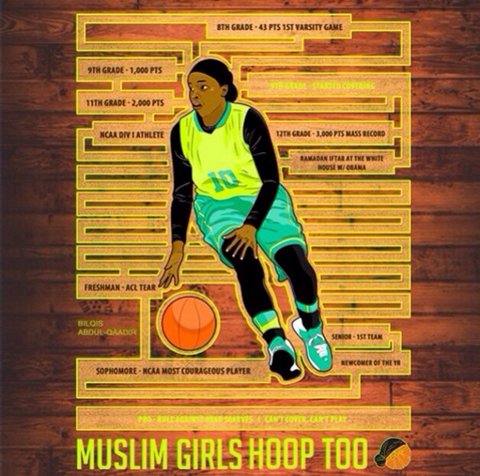
Graphic by Bilquis Abdul Qaadir (https://twitter.com/Queen_Of_Sheeba).
When I spoke with Habeeba Husain of SLAM, she suggested that the lack of press attention on this topic actually is indicative of how few people of colour and Muslims are represented in sports media, and of who decides what story gets covered. No pun intended.
When sports journalists actually do cover real stories of Muslimahs, as banal as they may seem, there seems to be a sense that we should be grateful. Haseeba has seen this trend from Muslimah athletes who “thank” journalists for covering their stories.
“You want to thank them,” says Habeeba, “but you shouldn’t have to. It’s their job.”
Previous Post

September 23, 2014
Disabled Muslims Need More than Du’a to Overcome Mosque Barriers
Next Post
September 26, 2014 Friday Links | September 26, 2014
Browse Our Archives
Select a Category Advertisements Art/Theater Books/Magazines Cinema Comics/Cartoons Culture/Society Events Fashion Film Friday Links Merchandise/Commodities MMW Announcements MMW Highlights Music/Radio News Photography Politics Profile Ramadan 2012 Ramadan 2013 Ramadan 2014 Ramadan 2015 Roundtable Satire Social Media Sports Technology/Science Television Uncategorized Video Web
Select a Month November 2015 October 2015 September 2015 August 2015 July 2015 June 2015 May 2015 April 2015 March 2015 January 2015 December 2014 November 2014 October 2014 September 2014 July 2014 June 2014 May 2014 April 2014 March 2014 February 2014 January 2014 December 2013 November 2013 October 2013 September 2013 August 2013 July 2013 June 2013 May 2013 April 2013 March 2013 February 2013 January 2013 December 2012 November 2012 October 2012 September 2012 August 2012 July 2012 June 2012 May 2012 April 2012 March 2012 February 2012 January 2012 December 2011 November 2011 September 2011 August 2011 July 2011 June 2011 May 2011 April 2011 March 2011 February 2011 January 2011 December 2010 November 2010 October 2010 September 2010 August 2010 July 2010 June 2010 May 2010 April 2010 March 2010 February 2010 January 2010 December 2009 November 2009 October 2009 September 2009 August 2009 July 2009 June 2009 May 2009 April 2009 March 2009 February 2009 January 2009 December 2008 November 2008 October 2008 September 2008 August 2008 July 2008 June 2008 May 2008 April 2008 March 2008 February 2008 January 2008 December 2007 November 2007 October 2007 September 2007 August 2007
Follow Us!
TAKE THE
Religious Wisdom Quiz
What fruit of the Spirit is described as "patience" or "longsuffering"?
Select your answer to see how you score.
Patience Apathy Pride Anger
Related posts from Muslimah Media Watch

#PrayforParis, Muslim Women and Third World Violence

Friday Links - American flag hijabs, hate crimes,...

Bangladeshi Women, Media and the “Helpers of Allah”
TRENDING AT PATHEOS Muslim

25 Years Later: How Much Has Changed for...
As we approach the 25th anniversary of September 11th, I’ve found myself...

Podcast: Third Spaces & The Rise of Yemeni...
In the latest episode of The Artistic Foodies Podcast, hosts Abbas...

HalalFest Picks: Best 60 Halal Spots for Super...
Back in 2016, I came up with a list of 29...

Unity Is America’s Strength — Division Is Its...
by Hidayatullah Ahsan When Valentina Gomez, a Republican candidate for Congress in...

Zohran Mamdani and New York’s Fight Against Islamophobia
This past June, against all odds, Zohran Mamdani won the Democratic primary...

What the Fourth of July Means to a...
As we mark another Fourth of July, millions of Americans will celebrate...
view all Muslim blogs
Ad-Free & Subscriber Log-In Subscription Support
- About Us
- 2026 Calendar
- Videos
- Podcasts
- Library of World Religions
- Faith In Media Tracker
- Advertise With Us
- Write for Us
- Privacy Policy
- Terms of Service
- Do Not Sell My Data
- Contact Us
- Radiant Digital
- Manage Newsletter Subscriptions
- Unsubscribe From Notifications
- Sitemap
Copyright 2008-2026, Patheos. All rights reserved.
Subscription Support Ad-Free & Subscriber Log-In
Follow Patheos