
BuddhistCatholicContemplativeEvangelicalGeneral ChristianHinduJewishLatter-day SaintMuslimNew VisionsProgressive Christian
Beliefs
- Buddhist
- Catholic
- Contemplative
- Evangelical
- General Christian
- Hindu
- Jewish
- Latter-day Saint
- More Voices
- Muslim
- New Visions
- Pagan
- Progressive Christian
Topics
- Religion News
- Food and Religion
- Sports and Religion
- Religious Art
- Religious Music and Entertainment
- Religious Events
- History and Religion
- Style and Religion
- Politics and Religion
- Women in Religion
- Recreation Outdoors and Religion
- Business Finance and Religion
- Careers Workplace and Religion
- Education and Religion
- Family Parenting and Religion
- Health Fitness and Religion
- Home and Religion
- Relationships and Religion
- Technology and Religion
- Travel and Religion
Columnists
- Buddhist Columnists
- Business Finance and Religion Columnists
- Careers Workplace and Religion Columnists
- Catholic Columnists
- Contemplative Columnists
- Education and Religion Columnists
- Evangelists Columnists
- Family Parenting and Religion Columnists
- General Christian Columnists
- Health Fitness and Religion Columnists
- Hindu Columnists
- History and Religion Columnists
- Home and Religion Columnists
- Jewish Columnists
- More Voices Columnists
- Latter Day Columnists
- Muslim Columnists
- New Visions Columnists
- Nonreligious Columnists
- Pagan Columnists
- Politics and Religion Columnists
- Progressive Columnists
- Recreation Outdoors and Religion Columnists
- Relationships and Religion Columnists
- Religion News Columnists
- Religious Art Columnists
- Religious Events Columnists
- Religious Music and Entertainment Columnists
- Sports and Religion Columnists
- Style and Religion Columnists
- Technology and Religion Columnists
- Travel and Religion Columnists
- Women in Religion Columnists
Resource Library
- 2026 Calendar
- Library of World Religions
- The 100 Most Holy Places on Earth
- Patheos Answers
- Podcasts
- Videos
- Faith Leaders Database
- Anglican Episcopalian
- Bahai
- Baptist
- Buddhism
- Christianity
- Confucianism
- Eastern Orthodoxy
- Hinduism
- Holiness and Pentecostal
- ISKCON
- Islam
- Judaism
- Lutheran
- Methodist
- The Church of Jesus Christ of Latter-day Saints
- New Age
- Paganism
- Presbytarian and Reformed
- Protestantism
- Religion Behind the Scenes
- Roman Catholic
- Scientology
- Shia Islam
- Sikhism
- Sufism
- Sunni Islam
- Taoism
- Zen
- See all religions
Research Tools
 Ad-Free & Subscriber Log-In Subscription Support
Ad-Free & Subscriber Log-In Subscription Support
Follow Patheos 

- Trending:
- Forgiveness
- |
- Marriage
- |
- Consciousness
- |
- Death Penalty
- |
- Election
- |
- Halloween
 Muslimah Media Watch
- Home
- Muslim
- Religion News
- Sandcastles and Snowmen: When Personal Stories Become Tools for Support and Education
Sandcastles and Snowmen: When Personal Stories Become Tools for Support and Education
Last updated on: June 19, 2014 at 2:00 am by samya
Sandcastles and Snowmen: When Personal Stories Become Tools for Support and Education 2014-06-17T10:52:56-04:00 samya
Patheos Explore the world's faith through different perspectives on religion and spirituality! Patheos has the views of the prevalent religions and spiritualities of the world.
[Source].
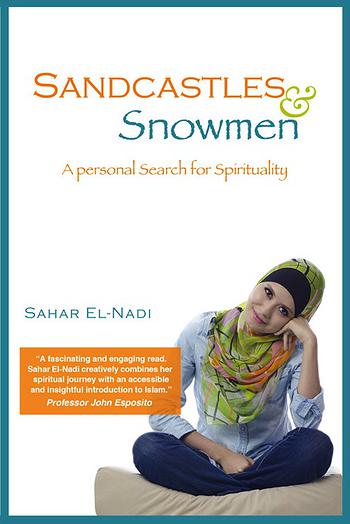
In her recent book, Sandcastles and Snowmen, Egyptian writer Sahar El-Nadidelivers what she calls “a personal search for spirituality.” By combining her personal stories and experience with the main pillars and teachings of Islam, El-Nadi tries to give her readers a glimpse of her perspective on what Islam is.
Sahar El-Nadi is a writer and an international speaker who focuses on advocating tolerance, integration, inclusion, and respect of diversity. She is the person behind the initiative “Don’t Hate, Educate,” launched in 2006. In Sandcastles and Snowmen, El-Nadi tackles different aspects of Islam, such as its basics (What is Islam? What are the main pillars? What is the ultimate goal of a Muslim?), manners and ethics in Islam, human rights, women’s rights, gender roles and equality, politics and democracy, arts and culture, in addition to many other topics.
There are many parts of the book that touched me in a personal way, especially when El-Nadi talks about women’s rights and gender equality. In this chapter, El-Nadi writes that she believes a woman is a free spirit, and for gender equality to take place,
“women should have a completely free choice to do what makes her happy. Society should be able to support her and respect her choices without pushing her to fit in to a pre-set frame. She should not be pressured to be just like all the others or else lose her self-esteem.”
Having lived a year in the United States, and coming from the Middle East, I have faced several strange looks from people because of my head cover. Sometimes I have had to explain what Islam is because most of the people here believe that it is an extremist religion that supports violence and treats women in a bad way. Such stressful incidents have made me think several times about taking off my headscarf, to just look like everybody else, so that I don’t have to receive the strange looks, or answer weird question. But reading stories Muslim women working against any attempts to undermine their roles and make them look like followers to men, such as El-Nadi’s book, gives me the strength to hold on to what I believe, and step up and act in a brave manner to represent Muslim women in my community.
Last week, I accompanied my 6-year-old son to a scout’s camp in Houston. In one of the games, the boys had to run away from their parents, who had to catch them. I was the only covered lady in the whole camp. The coach asked me specifically whether I would be able to run. I was amazed by the question, and said: “Yes of course, but why are you asking me in particular?” He pointed to my head cover and said: “I thought you as Muslim women cannot run because you are not allowed to do so!”
The answer surprised me because I thought we live in the information age where people know about almost everything in the world, but apparently I was wrong. So, after the game was over, I sat down with the coach and explained to him about Islam and how there are several misconceptions about Muslim women. As I was reading through Sahar El-Nadi’s book, I found a quote that summed up the explanation I gave to the coach. She says:
“I have decided to veil not just for religious reasons, but also for an ethical reason: I wanted to be the change I wanted to see in this world. I did not like how some women misinterpreted the veil. Instead of just criticizing them, I wanted to show a better example. I also wanted to prove that it was nobody’s business what I wore since I was still the same person with the same mind and soul, whether my body wore a veil or a bikini.”
The book talks about many other elements that are important to a Muslim’s everyday life. Some of these aspects are touched upon by the writer from a personal perspective, while others are discussed using references and examples from history. Since the book has a personal touch that El-Nadi tried to add to her writings, I believe it would have been better if she just concentrated on certain aspects of Islam, rather than being so ambitious by talking about Islam and different sectors in our lives, such as science, business and politics. For example, when El-Nadi discusses Politics and Democracy, and especially the part about “Religion’s Role in Public Life in the Middle East,” her discussion only scratches the surface of this issue. Such a big discussion requires books and long essays written about it, and it is unfair to attempt to address it in so few pages. The Middle East is a complicated region that has witnessed long struggles, and seen so much change in the last 100 years, let alone in the last 1500 years.
The same thing applies to the chapter on “Science in the Quran.” El-Nadi gives a brief introduction on how the Quran discusses certain scientific phenomena. Again, I think such a discussion should be more detailed, and does not fit well in the whole context of the book.
In the book’s introduction, Sahar El-Nadi says that “the book is for the global reader to inform and inspire and to help break barriers and encourage communication across divides of race and creed.” I believe that books like this one, and other works by Muslim women speakers such as Yasmin Mogahed, are important for Muslims as well. I think it could give many women a charge of confidence to act according to what they believe in, because at the end of the day, we have different levels of courage and persistence in sticking to our beliefs.
I really wish every woman, and every Muslim woman in particular, could share with the rest of the world their thoughts about the struggle they might be facing because of what they believe in. I think such stories and experiences are one way that we can strengthen each other, and give support to one another. This reminds us that we are not alone in this world, and that there are also other women fighting to prove themselves.
Previous Post
June 18, 2014
Muslim Mummies Dot Com: Interview with Muslim Mommy Blogger Fouzia
Next Post

June 20, 2014 Friday Links | June 20, 2014
Browse Our Archives
Select a Category Advertisements Art/Theater Books/Magazines Cinema Comics/Cartoons Culture/Society Events Fashion Film Friday Links Merchandise/Commodities MMW Announcements MMW Highlights Music/Radio News Photography Politics Profile Ramadan 2012 Ramadan 2013 Ramadan 2014 Ramadan 2015 Roundtable Satire Social Media Sports Technology/Science Television Uncategorized Video Web
Select a Month November 2015 October 2015 September 2015 August 2015 July 2015 June 2015 May 2015 April 2015 March 2015 January 2015 December 2014 November 2014 October 2014 September 2014 July 2014 June 2014 May 2014 April 2014 March 2014 February 2014 January 2014 December 2013 November 2013 October 2013 September 2013 August 2013 July 2013 June 2013 May 2013 April 2013 March 2013 February 2013 January 2013 December 2012 November 2012 October 2012 September 2012 August 2012 July 2012 June 2012 May 2012 April 2012 March 2012 February 2012 January 2012 December 2011 November 2011 September 2011 August 2011 July 2011 June 2011 May 2011 April 2011 March 2011 February 2011 January 2011 December 2010 November 2010 October 2010 September 2010 August 2010 July 2010 June 2010 May 2010 April 2010 March 2010 February 2010 January 2010 December 2009 November 2009 October 2009 September 2009 August 2009 July 2009 June 2009 May 2009 April 2009 March 2009 February 2009 January 2009 December 2008 November 2008 October 2008 September 2008 August 2008 July 2008 June 2008 May 2008 April 2008 March 2008 February 2008 January 2008 December 2007 November 2007 October 2007 September 2007 August 2007
Follow Us!
TAKE THE
Religious Wisdom Quiz
What miracle did Elisha perform for a widow?
Select your answer to see how you score.
Made fire fall Raised her son Fed 5,000 Multiplied oil
Related posts from Muslimah Media Watch

Book review: Jewels of Allah by Nina Ansary

Book Review: Faïza Zerouala's Voices Behind the Veil

Making Sense of “the Other”: A Review of...

TRENDING AT PATHEOS Muslim

25 Years Later: How Much Has Changed for...
As we approach the 25th anniversary of September 11th, I’ve found myself...

Podcast: Third Spaces & The Rise of Yemeni...
In the latest episode of The Artistic Foodies Podcast, hosts Abbas...

HalalFest Picks: Best 60 Halal Spots for Super...
Back in 2016, I came up with a list of 29...

Unity Is America’s Strength — Division Is Its...
by Hidayatullah Ahsan When Valentina Gomez, a Republican candidate for Congress in...

Zohran Mamdani and New York’s Fight Against Islamophobia
This past June, against all odds, Zohran Mamdani won the Democratic primary...

What the Fourth of July Means to a...
As we mark another Fourth of July, millions of Americans will celebrate...
view all Muslim blogs
Ad-Free & Subscriber Log-In Subscription Support
- About Us
- 2026 Calendar
- Videos
- Podcasts
- Library of World Religions
- Faith In Media Tracker
- Advertise With Us
- Write for Us
- Privacy Policy
- Terms of Service
- Do Not Sell My Data
- Contact Us
- Radiant Digital
- Manage Newsletter Subscriptions
- Unsubscribe From Notifications
- Sitemap
Copyright 2008-2026, Patheos. All rights reserved.
Subscription Support Ad-Free & Subscriber Log-In
Follow Patheos