
BuddhistCatholicContemplativeEvangelicalGeneral ChristianHinduJewishLatter-day SaintMuslimNew VisionsProgressive Christian
Beliefs
- Buddhist
- Catholic
- Contemplative
- Evangelical
- General Christian
- Hindu
- Jewish
- Latter-day Saint
- More Voices
- Muslim
- New Visions
- Pagan
- Progressive Christian
Topics
- Religion News
- Food and Religion
- Sports and Religion
- Religious Art
- Religious Music and Entertainment
- Religious Events
- History and Religion
- Style and Religion
- Politics and Religion
- Women in Religion
- Recreation Outdoors and Religion
- Business Finance and Religion
- Careers Workplace and Religion
- Education and Religion
- Family Parenting and Religion
- Health Fitness and Religion
- Home and Religion
- Relationships and Religion
- Technology and Religion
- Travel and Religion
Columnists
- Buddhist Columnists
- Business Finance and Religion Columnists
- Careers Workplace and Religion Columnists
- Catholic Columnists
- Contemplative Columnists
- Education and Religion Columnists
- Evangelists Columnists
- Family Parenting and Religion Columnists
- General Christian Columnists
- Health Fitness and Religion Columnists
- Hindu Columnists
- History and Religion Columnists
- Home and Religion Columnists
- Jewish Columnists
- More Voices Columnists
- Latter Day Columnists
- Muslim Columnists
- New Visions Columnists
- Nonreligious Columnists
- Pagan Columnists
- Politics and Religion Columnists
- Progressive Columnists
- Recreation Outdoors and Religion Columnists
- Relationships and Religion Columnists
- Religion News Columnists
- Religious Art Columnists
- Religious Events Columnists
- Religious Music and Entertainment Columnists
- Sports and Religion Columnists
- Style and Religion Columnists
- Technology and Religion Columnists
- Travel and Religion Columnists
- Women in Religion Columnists
Resource Library
- 2026 Calendar
- Library of World Religions
- The 100 Most Holy Places on Earth
- Patheos Answers
- Podcasts
- Videos
- Faith Leaders Database
- Anglican Episcopalian
- Bahai
- Baptist
- Buddhism
- Christianity
- Confucianism
- Eastern Orthodoxy
- Hinduism
- Holiness and Pentecostal
- ISKCON
- Islam
- Judaism
- Lutheran
- Methodist
- The Church of Jesus Christ of Latter-day Saints
- New Age
- Paganism
- Presbytarian and Reformed
- Protestantism
- Religion Behind the Scenes
- Roman Catholic
- Scientology
- Shia Islam
- Sikhism
- Sufism
- Sunni Islam
- Taoism
- Zen
- See all religions
Research Tools
 Ad-Free & Subscriber Log-In Subscription Support
Ad-Free & Subscriber Log-In Subscription Support
Follow Patheos 

- Trending:
- Forgiveness
- |
- Marriage
- |
- Consciousness
- |
- Death Penalty
- |
- Election
- |
- Halloween
 Muslimah Media Watch
- Home
- Muslim
- Religion News
- Qatar’s Modest Proposal: Dignity or Diversion?
Qatar’s Modest Proposal: Dignity or Diversion?
Last updated on: June 24, 2014 at 4:11 pm by syahirah
Qatar’s Modest Proposal: Dignity or Diversion? 2014-06-24T16:11:06-04:00 syahirah
Patheos Explore the world's faith through different perspectives on religion and spirituality! Patheos has the views of the prevalent religions and spiritualities of the world.
Originally published at Aquila Style.
Qatar has revived a modesty campaign dating from 2012, when it was known as “One of us” and originally started by a group of Qatari women.[i] Due to be relaunched on 20 June 2014 – just in time for Ramadan – as “Reflect your respect”, the campaign is targeting public spaces with flyers and a social media poster showing various dress choices.[ii] Four stick bodies represent clothing choices that are deemed unacceptably immodest for revealing shoulders, arms, legs below the knee, and (men’s) chest hair.
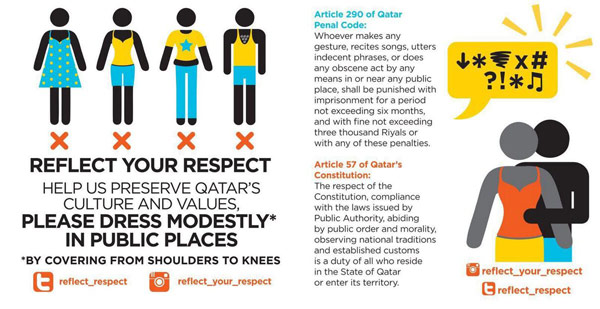
Images by @reflect_respect – Source
It’s part of a larger code of recommended etiquette when in Qatar. An advisory issued by the Doha airport advises that “Women should dress modestly, and men should not be shirt-less in public. Public displays of affection and intimacy are strongly discouraged.”
The symbolic representation of women and men is interesting enough for me to take a closer look. If the fourth figure with broader shoulders and chest hair is presumably a man, this makes women’s bodies the main focus of the dress code.
The basic requirement is for both sexes to cover up from shoulder to knee. Personally, I don’t think it’s too much to ask, considering that Saudi Arabia requires all female tourists to wear the abaya and hijab. I think it’s perfectly reasonable for countries to issue a dress code for tourists in certain areas. For example, most Buddhist temples in Thailand require shoulders to be covered. Borobudur, a major tourist attraction in Indonesia, now requires all tourists to cover their legs with a piece of cloth. Orthodox Russian churches also require female tourists to cover their hair, providing small scarves at the entrance – not unlike many mosques today.
Tweeter @RubyZubair notes that it’s a refreshing change from the constant demands from Western countries on Muslim women to not wear hijab or niqab.
@LaurenBoothUK @reflect_respect nice dress code,Tht’s true freedom 2 live up 2 ur values,not what culturally imperialist nations dictate you
— Rubina Zubair (@RubyZubair) June 4, 2014
However, her tweet reminds us that nothing happens in a vacuum. Things that happen in one country or region have an impact on others. Is this a grassroots campaign that aims to preserve Qatari culture, values and traditions just because it’s a noble goal, or is it a reaction against the growing numbers of migrant workers and tourists? Does it detract from other pressing issues in the country, like the high death rate of migrant workers due to unexplained illness?[iii]
This campaign is also a kind of reaction against the measures taken in the West in response to their fears of growing numbers of Muslim populations. Some people from countries like Belgium, France and the Netherlands, that spent the last half decade or so discussing and implementing “burqa bans”, point out the hypocrisy of Muslims being able to enforce dress codes, while they can’t tell Muslim women what to wear. (News flash: dress codes have been in vogue for decades already, in the “East” as much as in the “West”.)
Is it a fair comparison? Does a Muslim woman have the same right to wear hijab as a non-Muslim woman does to wear the bikini? Should anyone be criminalised for transgressing dress codes? One could say that to truly support women’s freedom of choice, the answers to the above questions should be “yes”, “yes” and “no”. The following Tweeters clearly thought so, judging by their reactions to the Qatari campaign.
@reflect_respect Reflect your respect: don’t wear these cloths in the West. Help us preserve our culture and values. pic.twitter.com/TmxH2kPNbZ
— De Onnoembare (@Ray_le_Chef) May 28, 2014
However, we should contextualise this issue against the background of Islamophobia in the West. This is very real, and has resulted in mostly Muslim women being attacked on the streets and beaten up – sometimes tragically to death.[iv] There is even a hotline called Tell Mama in the UK for “recording Islamophobic crimes and incidents”. [v] Do tourists get attacked in the Middle East for covering up sufficiently? In the case of Qatar, they could get slapped with a fine or imprisonment. But there aren’t Qataris skulking in corners waiting to lynch them for exposing a shoulder.
Therein lies the most important difference: what are the penalties for not following the rules? Perhaps the most important thing we can be aware of is that no matter the country, initiatives to “maintain” national honour is often enforced at the expense of women. And that with all imposed dress codes, focusing on a campaign to promote “modesty” often deflects our attention from other more pressing issues in the country.
[i] ‘Backing ‘One of Us’ modesty campaign, QTA to post dress code guidelines in public spaces’, Doha News, 18 Nov 2012, available here
[ii] Victoria Scott, ‘Local modesty campaign ‘reflect your respect’ to relaunch in Qatar’, 20 May 2014, available here
[iii] Owen Gibson, ‘Qatar government admits almost 1,000 fatalities among migrants’, The Guardian, 14 May 2014, available here
[iv] Ava Vidal, ‘“People grab our veils, call us terrorists and want us dead”: What it’s really like to be a Muslim woman in Britain’, The Telegraph, 6 May 2014, available here
[v] Haroon Siddique, ‘Muslim women more likely to suffer Islamophobic attacks than men – study’, The Guardian, 20 Nov 2013, available here
Previous Post

June 23, 2014
"Their Patriarchy" is Worse
Next Post

June 25, 2014 Modest Fashion, Islamic Consciousness and Affordability: Part 1
Browse Our Archives
Select a Category Advertisements Art/Theater Books/Magazines Cinema Comics/Cartoons Culture/Society Events Fashion Film Friday Links Merchandise/Commodities MMW Announcements MMW Highlights Music/Radio News Photography Politics Profile Ramadan 2012 Ramadan 2013 Ramadan 2014 Ramadan 2015 Roundtable Satire Social Media Sports Technology/Science Television Uncategorized Video Web
Select a Month November 2015 October 2015 September 2015 August 2015 July 2015 June 2015 May 2015 April 2015 March 2015 January 2015 December 2014 November 2014 October 2014 September 2014 July 2014 June 2014 May 2014 April 2014 March 2014 February 2014 January 2014 December 2013 November 2013 October 2013 September 2013 August 2013 July 2013 June 2013 May 2013 April 2013 March 2013 February 2013 January 2013 December 2012 November 2012 October 2012 September 2012 August 2012 July 2012 June 2012 May 2012 April 2012 March 2012 February 2012 January 2012 December 2011 November 2011 September 2011 August 2011 July 2011 June 2011 May 2011 April 2011 March 2011 February 2011 January 2011 December 2010 November 2010 October 2010 September 2010 August 2010 July 2010 June 2010 May 2010 April 2010 March 2010 February 2010 January 2010 December 2009 November 2009 October 2009 September 2009 August 2009 July 2009 June 2009 May 2009 April 2009 March 2009 February 2009 January 2009 December 2008 November 2008 October 2008 September 2008 August 2008 July 2008 June 2008 May 2008 April 2008 March 2008 February 2008 January 2008 December 2007 November 2007 October 2007 September 2007 August 2007
Follow Us!
TAKE THE
Religious Wisdom Quiz
What does "Hosanna" mean?
Select your answer to see how you score.
Hurry Praise Rejoice Save us
Related posts from Muslimah Media Watch

#PrayforParis, Muslim Women and Third World Violence


Hate Crimes and Mother Tongues

Interview with Comedian Eman El Husseini
TRENDING AT PATHEOS Muslim

25 Years Later: How Much Has Changed for...
As we approach the 25th anniversary of September 11th, I’ve found myself...

Podcast: Third Spaces & The Rise of Yemeni...
In the latest episode of The Artistic Foodies Podcast, hosts Abbas...

HalalFest Picks: Best 60 Halal Spots for Super...
Back in 2016, I came up with a list of 29...

Unity Is America’s Strength — Division Is Its...
by Hidayatullah Ahsan When Valentina Gomez, a Republican candidate for Congress in...

Zohran Mamdani and New York’s Fight Against Islamophobia
This past June, against all odds, Zohran Mamdani won the Democratic primary...

What the Fourth of July Means to a...
As we mark another Fourth of July, millions of Americans will celebrate...
view all Muslim blogs
Ad-Free & Subscriber Log-In Subscription Support
- About Us
- 2026 Calendar
- Videos
- Podcasts
- Library of World Religions
- Faith In Media Tracker
- Advertise With Us
- Write for Us
- Privacy Policy
- Terms of Service
- Do Not Sell My Data
- Contact Us
- Radiant Digital
- Manage Newsletter Subscriptions
- Unsubscribe From Notifications
- Sitemap
Copyright 2008-2026, Patheos. All rights reserved.
Subscription Support Ad-Free & Subscriber Log-In
Follow Patheos