
BuddhistCatholicContemplativeEvangelicalGeneral ChristianHinduJewishLatter-day SaintMuslimNew VisionsProgressive Christian
Beliefs
- Buddhist
- Catholic
- Contemplative
- Evangelical
- General Christian
- Hindu
- Jewish
- Latter-day Saint
- More Voices
- Muslim
- New Visions
- Pagan
- Progressive Christian
Topics
- Religion News
- Food and Religion
- Sports and Religion
- Religious Art
- Religious Music and Entertainment
- Religious Events
- History and Religion
- Style and Religion
- Politics and Religion
- Women in Religion
- Recreation Outdoors and Religion
- Business Finance and Religion
- Careers Workplace and Religion
- Education and Religion
- Family Parenting and Religion
- Health Fitness and Religion
- Home and Religion
- Relationships and Religion
- Technology and Religion
- Travel and Religion
Columnists
- Buddhist Columnists
- Business Finance and Religion Columnists
- Careers Workplace and Religion Columnists
- Catholic Columnists
- Contemplative Columnists
- Education and Religion Columnists
- Evangelists Columnists
- Family Parenting and Religion Columnists
- General Christian Columnists
- Health Fitness and Religion Columnists
- Hindu Columnists
- History and Religion Columnists
- Home and Religion Columnists
- Jewish Columnists
- More Voices Columnists
- Latter Day Columnists
- Muslim Columnists
- New Visions Columnists
- Nonreligious Columnists
- Pagan Columnists
- Politics and Religion Columnists
- Progressive Columnists
- Recreation Outdoors and Religion Columnists
- Relationships and Religion Columnists
- Religion News Columnists
- Religious Art Columnists
- Religious Events Columnists
- Religious Music and Entertainment Columnists
- Sports and Religion Columnists
- Style and Religion Columnists
- Technology and Religion Columnists
- Travel and Religion Columnists
- Women in Religion Columnists
Resource Library
- 2026 Calendar
- Library of World Religions
- The 100 Most Holy Places on Earth
- Patheos Answers
- Podcasts
- Videos
- Faith Leaders Database
- Anglican Episcopalian
- Bahai
- Baptist
- Buddhism
- Christianity
- Confucianism
- Eastern Orthodoxy
- Hinduism
- Holiness and Pentecostal
- ISKCON
- Islam
- Judaism
- Lutheran
- Methodist
- The Church of Jesus Christ of Latter-day Saints
- New Age
- Paganism
- Presbytarian and Reformed
- Protestantism
- Religion Behind the Scenes
- Roman Catholic
- Scientology
- Shia Islam
- Sikhism
- Sufism
- Sunni Islam
- Taoism
- Zen
- See all religions
Research Tools
 Ad-Free & Subscriber Log-In Subscription Support
Ad-Free & Subscriber Log-In Subscription Support
Follow Patheos 

- Trending:
- Forgiveness
- |
- Marriage
- |
- Consciousness
- |
- Death Penalty
- |
- Election
- |
- Halloween
 Muslimah Media Watch
- Home
- Muslim
- Religion News
- The Crimes and Punishment of Apostasy and Adultery
The Crimes and Punishment of Apostasy and Adultery
Last updated on: May 27, 2014 at 7:03 am by tasnim
The Crimes and Punishment of Apostasy and Adultery 2014-05-27T07:03:00-04:00 tasnim
Patheos Explore the world's faith through different perspectives on religion and spirituality! Patheos has the views of the prevalent religions and spiritualities of the world.
Meriam Ibrahim, a Sudanese doctor who married a Christian man in 2011, was convicted last week on charges of apostasy. While Ibrahim has a Muslim father, she appears to have been raised Christian. Apostasy implies conversion, but as Ibrahim reportedly told the judge, “I am a Christian and I never committed apostasy.” By her account, Ibrahim has always considered herself to be Christian, raising the question of what it means for a court to be using “Islamic law” to sentence her when its basis for considering her a Muslim may itself be dubious in Islamic law.
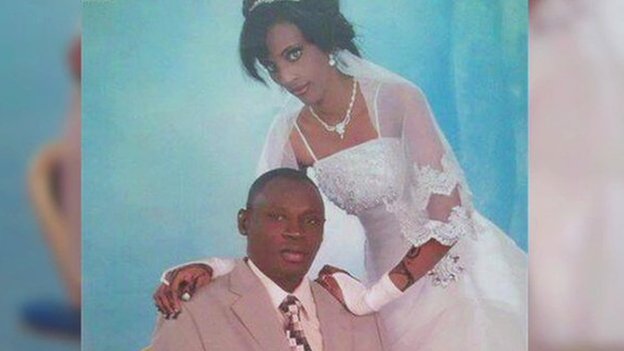
[Source].
Ibrahim was given a “grace period” of three days to repent. AFP reports that the judge told her: “We gave you three days to recant but you insist on not returning to Islam. I sentence you to be hanged to death.” The couple reportedly have a child and Ibrahim is eight months pregnant. Local media report that the death sentence would not be carried out for two years after she gives birth. However, since her marriage with a non-Muslim man is not recognized as legitimate by Sudanese law, the court in Khartoum has ordered Ibrahim to be given 100 lashes for committing adultery. This sentence is apparently to be carried out after she has recovered from giving birth.
The story has drawn widespread outrage and condemnation, from protestors outside the court who held up banners insisting on the freedom of conscience to calls by international rights groups for Ibrahim’s immediate and unconditional release. Amnesty’s Sudan researcher Manar Idriss condemned the punishments, saying apostasy and adultery should not be considered crimes:
“The fact that a woman has been sentenced to death for her religious choice, and to flogging for being married to a man of an allegedly different religion is appalling and abhorrent… Adultery and apostasy are acts which should not be considered crimes at all.”
Ibrahim is Christian, but the court considers her to be Muslim; therefore she is accused of apostasy. She is married, but her marriage is not recognized; therefore it is described as adultery. The story has catapulted into the headlines, some looking to highlight the most shocking aspects: Pregnant Sudanese Woman To Be Whipped & Hung For Apostasy. Other media outlets provides more context, whether in terms of Omar Al-Bashir’s 1989 coup and introduction of hudud punishments, or in terms of the split within Islam when it comes to apostasy – succinctly compressing a debate of thousands of years into a paragraph:
“There is a long-running debate in Islam over whether apostasy is a crime. Some liberal scholars hold the view that it is not – and back up their argument by citing the Koranic verse which states: ‘There shall be no compulsion in religion.’ Others say apostasy is tantamount to treason – and refer to what Prophet Muhammad said: ‘It is not permissible to spill the blood of a Muslim except in three [instances]: A life for a life; a married person who commits adultery; and one who forsakes his religion and separates from the community.’ The latter is the dominant view in conservative Muslim states such as Sudan, Saudi Arabia and Pakistan and the cause of much religious tension.”
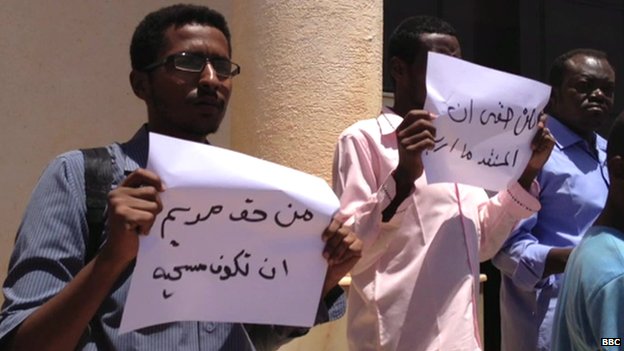
Protestors hold up banners: “Merium has the right to be Christian” and “I have the right to believe what I wish.” [Source].
I think it is important to understand this story within the particular context of Sudan and the wider context of the debate about freedom of religion within Islam, not because this is somehow a fair question with two valid sides to be debated, but because it is essential to bring in the question of how Muslims have responded and should respond to such cases. In a recent debate where Maajid Nawaz described himself as taking a position “between” his fellow panelists Ayaan Hirsi Ali and Feisal Abdul Rauf on whether Islam is a religion of peace or a religion of war, he commented simply that “Islam is a religion” that is always interpreted. However, he made the point that the dominant view in recent decades has been that of conservative and fundamentalist forces. For Nawaz, the questions arising out of these interpretations, issues such as blasphemy, apostasy, and hudud punishment, require critical conversations which have taken far too long to happen within Muslim communities. But how can they happen most productively?
The conversation Nawaz was taking part in, as in a similar debate he took part in a couple of years earlier, seems to me an example of what happens when these debates are primarily addressing a Western audience, with the emphasis always falling too heavily on either defensiveness or reassurance. For self-critique to truly take hold, there needs to be a real engagement with Muslim communities. Otherwise, there is a danger that what should be a deep debate becomes a superficial “look how progressive I am” show.
The question of internal debate and self-critique recalls Tariq Ramadan’s debate with Nicholas Sarkozy in 2003, where Sarkozy demanded that Ramadan condemn the notion of barbaric punishments such as stoning for adultery. Although Ramadan condemned the death penalty for apostasy outright, he responded by arguing for a moratorium when it comes to the punishment of adultery. Some may argue that the lack of any consensus on these issues supports Ramadan’s call for an internal debate and a halt to the punishments, while for others this is essentially cowardly avoidance. Towards the end of an interview on Al Jazeera, Ramadan responded to these questions by arguing that he is attempting to win a debate within Muslim communities, from “from within the universe of reference as Muslims”. One of those on the panel challenging him, Alan Johnson, argued that “when women are being stoned, I think it is up to democrats to take a firm position and take a stand.” Ramadan responds: “why don’t you criticise Amnesty International saying in the States they are for a moratorium on death penalty? Are they cowards?”
Yasmin Albahi Brown, representing British Muslims for Secular Democracy, put it this way: “I want to hear from you…there is no moratorium on stoning, it is wrong and it should never happen. I want to hear a direct sentence like that.”
But I wonder, what comes after that direct sentence? How does an internal debate happen? How do we talk about how we understand crime and corporal punishment within Islam today? And, while we try to encourage this internal debate, how do we take a stand in relation to the sentencing of women such as Meriam Ibrahim?
Previous Post

May 21, 2014
Women in Gaza Underrepresented in Talent Shows
Next Post
May 23, 2014 Friday Links | May 23, 2014
Browse Our Archives
Select a Category Advertisements Art/Theater Books/Magazines Cinema Comics/Cartoons Culture/Society Events Fashion Film Friday Links Merchandise/Commodities MMW Announcements MMW Highlights Music/Radio News Photography Politics Profile Ramadan 2012 Ramadan 2013 Ramadan 2014 Ramadan 2015 Roundtable Satire Social Media Sports Technology/Science Television Uncategorized Video Web
Select a Month November 2015 October 2015 September 2015 August 2015 July 2015 June 2015 May 2015 April 2015 March 2015 January 2015 December 2014 November 2014 October 2014 September 2014 July 2014 June 2014 May 2014 April 2014 March 2014 February 2014 January 2014 December 2013 November 2013 October 2013 September 2013 August 2013 July 2013 June 2013 May 2013 April 2013 March 2013 February 2013 January 2013 December 2012 November 2012 October 2012 September 2012 August 2012 July 2012 June 2012 May 2012 April 2012 March 2012 February 2012 January 2012 December 2011 November 2011 September 2011 August 2011 July 2011 June 2011 May 2011 April 2011 March 2011 February 2011 January 2011 December 2010 November 2010 October 2010 September 2010 August 2010 July 2010 June 2010 May 2010 April 2010 March 2010 February 2010 January 2010 December 2009 November 2009 October 2009 September 2009 August 2009 July 2009 June 2009 May 2009 April 2009 March 2009 February 2009 January 2009 December 2008 November 2008 October 2008 September 2008 August 2008 July 2008 June 2008 May 2008 April 2008 March 2008 February 2008 January 2008 December 2007 November 2007 October 2007 September 2007 August 2007
Follow Us!
TAKE THE
Religious Wisdom Quiz
I danced before the ark with all my might, wearing only a linen ephod. Who am I?
Select your answer to see how you score.
Saul Jonathan Solomon David
Related posts from Muslimah Media Watch

#PrayforParis, Muslim Women and Third World Violence


Hate Crimes and Mother Tongues

Interview with Comedian Eman El Husseini
TRENDING AT PATHEOS Muslim

25 Years Later: How Much Has Changed for...
As we approach the 25th anniversary of September 11th, I’ve found myself...

Podcast: Third Spaces & The Rise of Yemeni...
In the latest episode of The Artistic Foodies Podcast, hosts Abbas...

HalalFest Picks: Best 60 Halal Spots for Super...
Back in 2016, I came up with a list of 29...

Unity Is America’s Strength — Division Is Its...
by Hidayatullah Ahsan When Valentina Gomez, a Republican candidate for Congress in...

Zohran Mamdani and New York’s Fight Against Islamophobia
This past June, against all odds, Zohran Mamdani won the Democratic primary...

What the Fourth of July Means to a...
As we mark another Fourth of July, millions of Americans will celebrate...
view all Muslim blogs
Ad-Free & Subscriber Log-In Subscription Support
- About Us
- 2026 Calendar
- Videos
- Podcasts
- Library of World Religions
- Faith In Media Tracker
- Advertise With Us
- Write for Us
- Privacy Policy
- Terms of Service
- Do Not Sell My Data
- Contact Us
- Radiant Digital
- Manage Newsletter Subscriptions
- Unsubscribe From Notifications
- Sitemap
Copyright 2008-2026, Patheos. All rights reserved.
Subscription Support Ad-Free & Subscriber Log-In
Follow Patheos