
BuddhistCatholicContemplativeEvangelicalGeneral ChristianHinduJewishLatter-day SaintMuslimNew VisionsProgressive Christian
Beliefs
- Buddhist
- Catholic
- Contemplative
- Evangelical
- General Christian
- Hindu
- Jewish
- Latter-day Saint
- More Voices
- Muslim
- New Visions
- Pagan
- Progressive Christian
Topics
- Religion News
- Food and Religion
- Sports and Religion
- Religious Art
- Religious Music and Entertainment
- Religious Events
- History and Religion
- Style and Religion
- Politics and Religion
- Women in Religion
- Recreation Outdoors and Religion
- Business Finance and Religion
- Careers Workplace and Religion
- Education and Religion
- Family Parenting and Religion
- Health Fitness and Religion
- Home and Religion
- Relationships and Religion
- Technology and Religion
- Travel and Religion
Columnists
- Buddhist Columnists
- Business Finance and Religion Columnists
- Careers Workplace and Religion Columnists
- Catholic Columnists
- Contemplative Columnists
- Education and Religion Columnists
- Evangelists Columnists
- Family Parenting and Religion Columnists
- General Christian Columnists
- Health Fitness and Religion Columnists
- Hindu Columnists
- History and Religion Columnists
- Home and Religion Columnists
- Jewish Columnists
- More Voices Columnists
- Latter Day Columnists
- Muslim Columnists
- New Visions Columnists
- Nonreligious Columnists
- Pagan Columnists
- Politics and Religion Columnists
- Progressive Columnists
- Recreation Outdoors and Religion Columnists
- Relationships and Religion Columnists
- Religion News Columnists
- Religious Art Columnists
- Religious Events Columnists
- Religious Music and Entertainment Columnists
- Sports and Religion Columnists
- Style and Religion Columnists
- Technology and Religion Columnists
- Travel and Religion Columnists
- Women in Religion Columnists
Resource Library
- 2026 Calendar
- Library of World Religions
- The 100 Most Holy Places on Earth
- Patheos Answers
- Podcasts
- Videos
- Faith Leaders Database
- Anglican Episcopalian
- Bahai
- Baptist
- Buddhism
- Christianity
- Confucianism
- Eastern Orthodoxy
- Hinduism
- Holiness and Pentecostal
- ISKCON
- Islam
- Judaism
- Lutheran
- Methodist
- The Church of Jesus Christ of Latter-day Saints
- New Age
- Paganism
- Presbytarian and Reformed
- Protestantism
- Religion Behind the Scenes
- Roman Catholic
- Scientology
- Shia Islam
- Sikhism
- Sufism
- Sunni Islam
- Taoism
- Zen
- See all religions
Research Tools
 Ad-Free & Subscriber Log-In Subscription Support
Ad-Free & Subscriber Log-In Subscription Support
Follow Patheos 

- Trending:
- Forgiveness
- |
- Marriage
- |
- Consciousness
- |
- Death Penalty
- |
- Election
- |
- Halloween
 Muslimah Media Watch
- Home
- Muslim
- Religion News
- The Countdown to the Jaafari Law Decision
The Countdown to the Jaafari Law Decision
Last updated on: April 23, 2014 at 7:02 am by eren
The Countdown to the Jaafari Law Decision 2014-04-23T07:02:43-04:00 eren
Patheos Explore the world's faith through different perspectives on religion and spirituality! Patheos has the views of the prevalent religions and spiritualities of the world.
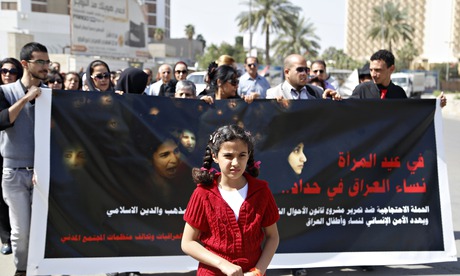
“A demonstration against the draft personal status law. The sign reads: ‘Women are not for sale or purchase.'” Via The Guardian.
On April 30th the Jaafari Personal Status Law will be voted on in the Iraqi Parliament. The Jaafari Law, as it’s being referred to, has been controversial because it would enable Shia men to marry girls as young as 9 years old. Whereas the legal age for marriage in Iraq is 18 years of age, the Jaafari Law does not state an age limit for marriage, but spells out the divorce conditions for girls who have reached the age of 9. This piece of legislation, nonetheless, would also legalize marital rape by embedding into law that wives must comply with their husband’s sexual requests. Similarly, the law will affect issues of guardianship (restricting women’s mobility), and it favours fathers in custody issues if the children are older than 2 years of age. The bill is said to target Shias, whose electoral support is considered to be primordial in the upcoming election. Such a statement implies that Shias are the primary supporters of such restrictions on women.
Needleless to say the Jaafari Law has attracted considerable media attention and has sparked on-line mobilizations to stop the motion. Human Rights Watch released a call to stop the bill from being passed. The Iraqi Civil Society Solidarity Initiative launched a campaign for the same purpose. Walk Free, Care2 and Take Action feature on-line petitions to collect signatures against the bill (these can be accessed through the links).
The law shows the complexities of religious accommodation and how religion is utilized for political purposes. In a recent Al-Monitor article, Mushreq Abbas points out that Article 41 of the Iraqi Constitution stipulates that “Iraqis are free to abide by their personal status according to their religions, sects, beliefs or choices, as regulated by law.” This statement, which is meant to accommodate a variety of religious denominations, is being used to justify the Jaafari Law. However, Abbas also notes that the Constitution states that, “No law may be enacted that contradicts the established provisions of Islam” (Article 2, paragraph A).
The question that is left for interpretation is, whose Islam?
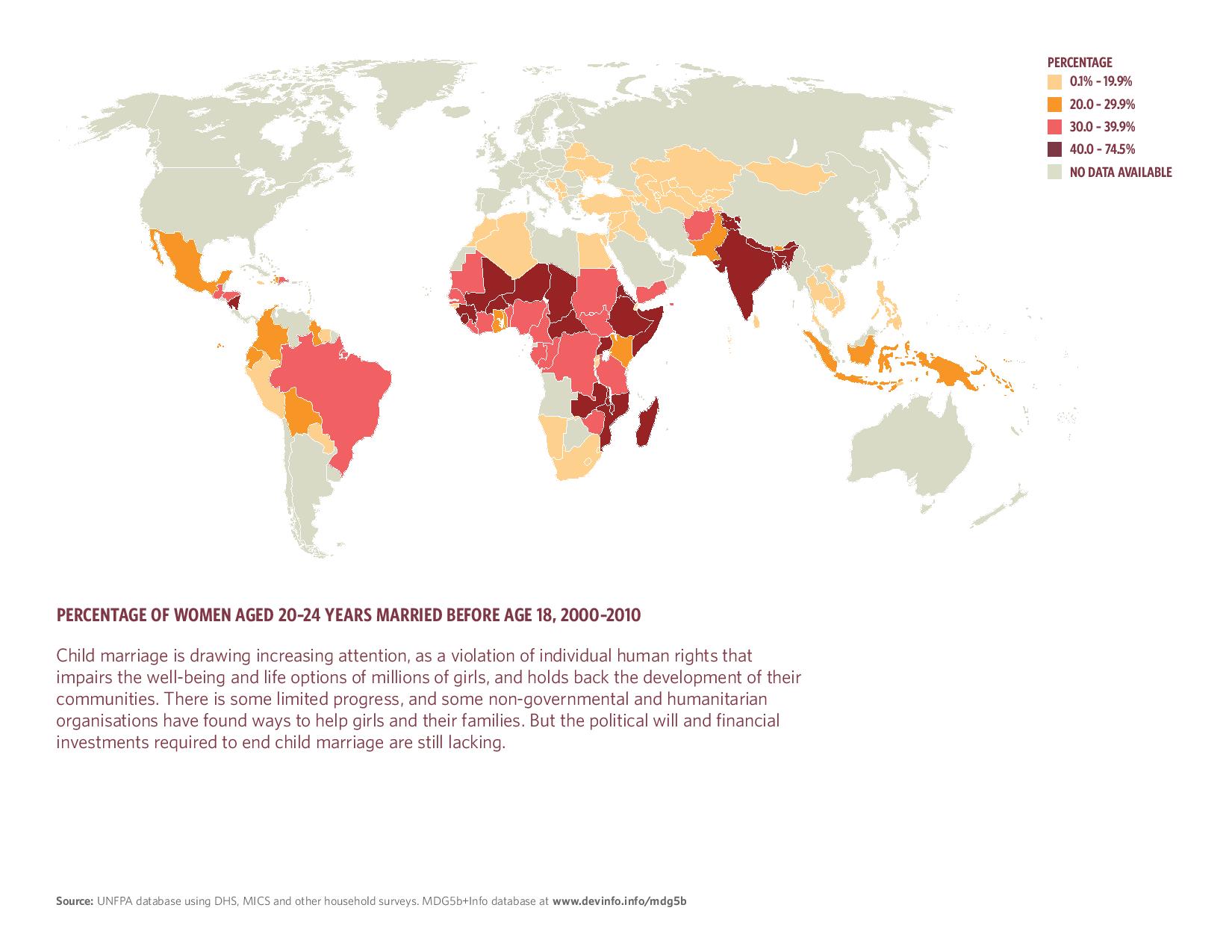
A map of child marriage around the world, except Western countries. Via United Nations Population Fund.
Whereas the Iraqi Justice Minister, Hassan al-Shimmari, has been quoted as saying that the Jaafari Law would prevent women’s abuse by regulating child marriage (currently existing but unregulated), passing such a law will entail an important setback in women’s rights in the country. In addition, it will not help regulate existing child marriages because the law does not entail provisions to empower women to seek divorce, child custody or protection from abuse. In short, the law does nothing to protect girls and women in forced marriages, and it does not regulate the unregulated.
The Jaafari Law is a political move; yet, no answers have been provided as to who will benefit from this law. Some of the coverage of the issue indicates that Shia men will be the primary beneficiaries; however, I wonder, how many Shia men are looking to marry underage girls or have their daughters betrothed to older men in settings where they can be coerced into sex? Whereas these situations exist, and not only in the Arab world, UNICEF makes a point of saying that, “Child marriage is also a strategy for economic survival as families marry off their daughters at an early age to reduce their economic burden.”
It ihas been reported that child marriage rose after the American occupation of Iraq, and although sources like the Washington Post attribute child marriage to tradition, it is well-known that conflict and war bring along gender-based violence and institutions that, even if non-existent before, affect women in particular ways. According to Girls not Brides child marriage is most prevalent among the poorest countries in the world; their site offers little information on the prevalence of child marriage in Western countries.
A lot of the discussion over the issue has neglected further investigation into child marriage in the country, and the rise of the phenomenon post-conflict. Such an approach neglects important facts necessary to further explore the situation of girls and women in Iraq. For instance, we disregard the effects of more than a decade of American occupation on gender equality, which in itself would entail some kind of accountability on the issue at hand. Furthermore, we limit the description to talk about Shias without specifying among which groups is child marriage most prominent and the reasons behind it. Whether poverty, custom, tradition or politics are at the heart of the matter it is essential to investigate the roots of this phenomenon, because otherwise we can’t predict the effects of the law (or simply the discussion about the law) will affect vulnerable girls and women.
However, if embedded in law, the proposed bill will shut down these discussions, particularly because policy and laws are never neutral. This is why the efforts to avoid the institutionalization of child marriage, marital rape and custody inequities is so important. Yet, moving forward, we need to recognize that child marriage exists around the globe, and that conflict is a primary driver of gender inequalities. Then we are left with the questions, who is accountable and how do we move forward?
Previous Post

April 22, 2014
Book Review: “Normal Calm” by Hend Hegazi
Next Post

April 25, 2014 Friday Links | April 25, 2014
Browse Our Archives
Select a Category Advertisements Art/Theater Books/Magazines Cinema Comics/Cartoons Culture/Society Events Fashion Film Friday Links Merchandise/Commodities MMW Announcements MMW Highlights Music/Radio News Photography Politics Profile Ramadan 2012 Ramadan 2013 Ramadan 2014 Ramadan 2015 Roundtable Satire Social Media Sports Technology/Science Television Uncategorized Video Web
Select a Month November 2015 October 2015 September 2015 August 2015 July 2015 June 2015 May 2015 April 2015 March 2015 January 2015 December 2014 November 2014 October 2014 September 2014 July 2014 June 2014 May 2014 April 2014 March 2014 February 2014 January 2014 December 2013 November 2013 October 2013 September 2013 August 2013 July 2013 June 2013 May 2013 April 2013 March 2013 February 2013 January 2013 December 2012 November 2012 October 2012 September 2012 August 2012 July 2012 June 2012 May 2012 April 2012 March 2012 February 2012 January 2012 December 2011 November 2011 September 2011 August 2011 July 2011 June 2011 May 2011 April 2011 March 2011 February 2011 January 2011 December 2010 November 2010 October 2010 September 2010 August 2010 July 2010 June 2010 May 2010 April 2010 March 2010 February 2010 January 2010 December 2009 November 2009 October 2009 September 2009 August 2009 July 2009 June 2009 May 2009 April 2009 March 2009 February 2009 January 2009 December 2008 November 2008 October 2008 September 2008 August 2008 July 2008 June 2008 May 2008 April 2008 March 2008 February 2008 January 2008 December 2007 November 2007 October 2007 September 2007 August 2007
Follow Us!
TAKE THE
Religious Wisdom Quiz
True or False: The entire city of Nineveh repented after Jonah preached to them.
Select your answer to see how you score.
FALSE TRUE
Related posts from Muslimah Media Watch



Why British MP’s statements defending Muslim women do...

TRENDING AT PATHEOS Muslim

25 Years Later: How Much Has Changed for...
As we approach the 25th anniversary of September 11th, I’ve found myself...

Podcast: Third Spaces & The Rise of Yemeni...
In the latest episode of The Artistic Foodies Podcast, hosts Abbas...

HalalFest Picks: Best 60 Halal Spots for Super...
Back in 2016, I came up with a list of 29...

Unity Is America’s Strength — Division Is Its...
by Hidayatullah Ahsan When Valentina Gomez, a Republican candidate for Congress in...

Zohran Mamdani and New York’s Fight Against Islamophobia
This past June, against all odds, Zohran Mamdani won the Democratic primary...

What the Fourth of July Means to a...
As we mark another Fourth of July, millions of Americans will celebrate...
view all Muslim blogs
Ad-Free & Subscriber Log-In Subscription Support
- About Us
- 2026 Calendar
- Videos
- Podcasts
- Library of World Religions
- Faith In Media Tracker
- Advertise With Us
- Write for Us
- Privacy Policy
- Terms of Service
- Do Not Sell My Data
- Contact Us
- Radiant Digital
- Manage Newsletter Subscriptions
- Unsubscribe From Notifications
- Sitemap
Copyright 2008-2026, Patheos. All rights reserved.
Subscription Support Ad-Free & Subscriber Log-In
Follow Patheos