
BuddhistCatholicContemplativeEvangelicalGeneral ChristianHinduJewishLatter-day SaintMuslimNew VisionsProgressive Christian
Beliefs
- Buddhist
- Catholic
- Contemplative
- Evangelical
- General Christian
- Hindu
- Jewish
- Latter-day Saint
- More Voices
- Muslim
- New Visions
- Pagan
- Progressive Christian
Topics
- Religion News
- Food and Religion
- Sports and Religion
- Religious Art
- Religious Music and Entertainment
- Religious Events
- History and Religion
- Style and Religion
- Politics and Religion
- Women in Religion
- Recreation Outdoors and Religion
- Business Finance and Religion
- Careers Workplace and Religion
- Education and Religion
- Family Parenting and Religion
- Health Fitness and Religion
- Home and Religion
- Relationships and Religion
- Technology and Religion
- Travel and Religion
Columnists
- Buddhist Columnists
- Business Finance and Religion Columnists
- Careers Workplace and Religion Columnists
- Catholic Columnists
- Contemplative Columnists
- Education and Religion Columnists
- Evangelists Columnists
- Family Parenting and Religion Columnists
- General Christian Columnists
- Health Fitness and Religion Columnists
- Hindu Columnists
- History and Religion Columnists
- Home and Religion Columnists
- Jewish Columnists
- More Voices Columnists
- Latter Day Columnists
- Muslim Columnists
- New Visions Columnists
- Nonreligious Columnists
- Pagan Columnists
- Politics and Religion Columnists
- Progressive Columnists
- Recreation Outdoors and Religion Columnists
- Relationships and Religion Columnists
- Religion News Columnists
- Religious Art Columnists
- Religious Events Columnists
- Religious Music and Entertainment Columnists
- Sports and Religion Columnists
- Style and Religion Columnists
- Technology and Religion Columnists
- Travel and Religion Columnists
- Women in Religion Columnists
Resource Library
- 2026 Calendar
- Library of World Religions
- The 100 Most Holy Places on Earth
- Patheos Answers
- Podcasts
- Videos
- Faith Leaders Database
- Anglican Episcopalian
- Bahai
- Baptist
- Buddhism
- Christianity
- Confucianism
- Eastern Orthodoxy
- Hinduism
- Holiness and Pentecostal
- ISKCON
- Islam
- Judaism
- Lutheran
- Methodist
- The Church of Jesus Christ of Latter-day Saints
- New Age
- Paganism
- Presbytarian and Reformed
- Protestantism
- Religion Behind the Scenes
- Roman Catholic
- Scientology
- Shia Islam
- Sikhism
- Sufism
- Sunni Islam
- Taoism
- Zen
- See all religions
Research Tools
 Ad-Free & Subscriber Log-In Subscription Support
Ad-Free & Subscriber Log-In Subscription Support
Follow Patheos 

- Trending:
- Forgiveness
- |
- Marriage
- |
- Consciousness
- |
- Death Penalty
- |
- Election
- |
- Halloween
 Muslimah Media Watch
- Home
- Muslim
- Religion News
- On Hany Abu Asad’s Omar and the “Missing Voice” of Women
On Hany Abu Asad’s Omar and the “Missing Voice” of Women
Last updated on: April 30, 2014 at 12:51 pm by tasnim
On Hany Abu Asad’s Omar and the “Missing Voice” of Women 2014-04-30T12:51:13-04:00 tasnim
Patheos Explore the world's faith through different perspectives on religion and spirituality! Patheos has the views of the prevalent religions and spiritualities of the world.
Hany Abu-Assad’s film Omar (2013) has been described as “a film about love in the face of grueling adversity,” with the various obstacles facing the young couple symbolized by the very literal obstacle of the separation wall that meanders into the West Bank, cutting off Palestinian areas from each other. Omar routinely scales the wall to meet up with Nadja, but as Abu Assad puts it in an interview: “This is the outside obstacle, because the inside obstacle between the two lovers is trust.”
The obstacle of trust isn’t just between Omar and Nadja, however. In fact, the focus is more on Omar’s relationships with his childhood friends Tarek and Amjad, and with Rami, his Israeli handler. Nadja’s role might be described as a largely symbolic one. This was pointed out to Abu Assad, in a Q&A session, by an Arab woman in the audience. To translate her words, in Arabic, close to the end of this video of the Q&A session:
“I am writing a study of women’s representations in Palestinian cinema, and I see that the woman in this film is depicted negatively…she is the victim of men as well as the occupation that uses her against them.”
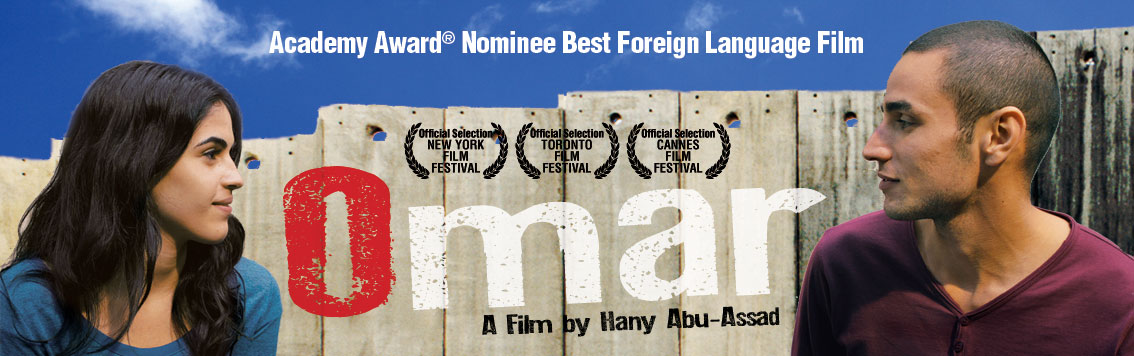
In responding, Abu Assad admitted that Nadja’s role was “passive.” Reasonably enough, he went on to say that you can’t tell all the stories all the time, and that this particular film was focused on Omar’s story. As he says elsewhere in an interview:
“I like movies that deal with trapped men. Men that need to make choices that are not obvious or easy choices…You create this character conflicted between two sides, because drama is about the conflict of two things, between your duty and your will, between what you want and what you can’t have.”
Abu Assad’s interest in the point of view of “trapped men” is evident in both Omar and his earlier film about two suicide bombers, Paradise Now (2005). However, an earlier film, Rana’s Wedding (2002), could be said to be about a “trapped woman,” Rana, who wakes up one morning to an ultimatum: to choose a husband from her father’s preselected list, or to leave Palestine for Egypt with her father that afternoon. Determined to stay in Palestine, Rana goes on a mission to marry the man of her own choosing.
There are, obviously, many films, novels, and plays about as well as by Palestinian women. The argument isn’t about whether there are enough Palestinian narratives from a woman’s point of view, but of how that perspective should be presented and how this impacts the “Palestinian question.” One example is the Palestinian rap group DAM’s 2012 music video, “If I Could Go Back in Time,” telling the story of a young woman killed by her father and brother for not marrying the man they chose for her. For two women, Lila Abu-Lughod and Maya Mikdashi, this song was a disappointment, and simplified complexities by buying into an ideologically motivated women’s rights discourse – in fact, it seemed to them that DAM had been “seduced by the Honor Crime”:
“Given DAM’s unapologetic and sophisticated political positions, it is surprising that when they decide to champion women’s rights, they succumb to an international anti-politics machine that blames only tradition for the intractability of (some) people’s problems. Why, when they decide to speak up about violence against women, do they suddenly forget the gritty and complex realities of life on the ground in the places they know?”
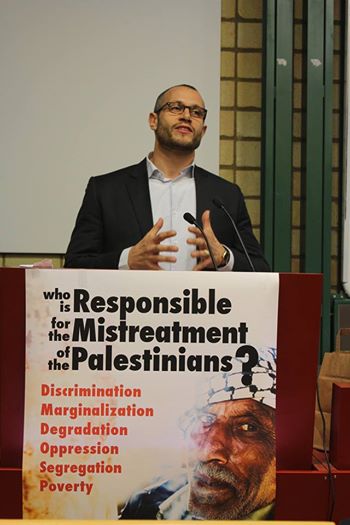
I can understand this point of view, having read and loved Abu-Lughod’s recent book, Do Muslim Women Need Saving? I see evidence of what Abu-Lughod critiques everywhere, in the work of those who seek to use rights discourse to score points, to further their advocacy, and this is certainly true in the case of Palestine. A prime example of this is The Jerusalem Institute of Justice ‘s “Palestinian Human Rights Week,” which is less about human rights than about how human rights can be used for ideological purposes. Its founder, Calev Myers, argues that it would be “within the human rights interest of the Palestinian refugees” to scrap UNWRA and to end their claim to the right of return. Myers also advocates the “recognition” of Gaza as a Palestinian State, and the annexing of “Judea and Samaria.” All of this is done through an appeal to the “human rights” of the Palestinians – as can be seen in the JiJ poster, featuring an elderly man with bloodshot eyes in a kuffiyeh. Above his head, the words: Who is responsible for the mistreatment of Palestinians?
Apparently, the Palestinians themselves, along with the rest of the Arab world.
To further this narrative, Myers appears regularly to participate in “debates” – such as this one, in which he “debates” an Algerian woman on Arab women’s rights, while she agrees vehemently with everything she says. In the face of such twisting of rights discourse, some might be forgiven for arguing that we need to be careful in raising the issue of “women’s rights.” But in fact, it is through self-critique that we can best pull the rug out from underneath those who do abuse the discourse of “human rights” and “women’s rights” to present simplistic and ideological narratives about victims and perpetrators. As Nehad Khader put it, in a different article about DAM’s 2012 song:
“the local and indigenous discussion of domestic violence and crimes against women among Palestinians forces society to seriously address the issue at hand. It does so by complicating the false reductionist binary that positions the Arab woman as perpetual victim and the Arab man as perpetual perpetrator.”
As it is, Omar is a great film, as was recognised when it was selected as the Palestinian entry for the Best Foreign Language Film, where for the first time, it was a film from “Palestine,” not the Palestinian Territories. This is something to celebrate. And I do feel that sometimes the question of the “missing voice” can be misplaced. We might want all the missing voices all the time, a smorgasbord of every available narrative, but to tell a particular story you need a particular perspective. For example, the question of the “missing woman’s voice” has been put to another film about Palestinian experience, A World Not Ours, a documentary about the refugee camp Ain el Hilweh. In this Q&A session, someone asked why women are not given a voice. The producer responded by saying that while it wasn’t a conscious choice, the perspective makes the film “an interesting exploration of masculinity in the camp, across different generations.” Another recent film about Syria, Return to Homs, has faced similar questions, although it is a story about a “frontline” where no women were present.
Let’s say that Omar tells a particular story which requires the focus on the central character. I think that’s true – but that there were still ways to make Nadja’s character more than a symbolic cipher. So I am glad the woman in the audience asked the question about Nadja’s passivity – because it’s about time we recognize that we can push the boundaries in multiple directions.
Next Post

May 1, 2014 The Male Gaze and the Muslimah Fashion Industry
Browse Our Archives
Select a Category Advertisements Art/Theater Books/Magazines Cinema Comics/Cartoons Culture/Society Events Fashion Film Friday Links Merchandise/Commodities MMW Announcements MMW Highlights Music/Radio News Photography Politics Profile Ramadan 2012 Ramadan 2013 Ramadan 2014 Ramadan 2015 Roundtable Satire Social Media Sports Technology/Science Television Uncategorized Video Web
Select a Month November 2015 October 2015 September 2015 August 2015 July 2015 June 2015 May 2015 April 2015 March 2015 January 2015 December 2014 November 2014 October 2014 September 2014 July 2014 June 2014 May 2014 April 2014 March 2014 February 2014 January 2014 December 2013 November 2013 October 2013 September 2013 August 2013 July 2013 June 2013 May 2013 April 2013 March 2013 February 2013 January 2013 December 2012 November 2012 October 2012 September 2012 August 2012 July 2012 June 2012 May 2012 April 2012 March 2012 February 2012 January 2012 December 2011 November 2011 September 2011 August 2011 July 2011 June 2011 May 2011 April 2011 March 2011 February 2011 January 2011 December 2010 November 2010 October 2010 September 2010 August 2010 July 2010 June 2010 May 2010 April 2010 March 2010 February 2010 January 2010 December 2009 November 2009 October 2009 September 2009 August 2009 July 2009 June 2009 May 2009 April 2009 March 2009 February 2009 January 2009 December 2008 November 2008 October 2008 September 2008 August 2008 July 2008 June 2008 May 2008 April 2008 March 2008 February 2008 January 2008 December 2007 November 2007 October 2007 September 2007 August 2007
Follow Us!
TAKE THE
Religious Wisdom Quiz
True or False: The Thessalonians were told that the day of the Lord will come like a thief in the night.
Select your answer to see how you score.
TRUE FALSE
Related posts from Muslimah Media Watch

Review of Desert Dancer (2015)


Dance Is How I Get Close to God:...
TRENDING AT PATHEOS Muslim

25 Years Later: How Much Has Changed for...
As we approach the 25th anniversary of September 11th, I’ve found myself...

Podcast: Third Spaces & The Rise of Yemeni...
In the latest episode of The Artistic Foodies Podcast, hosts Abbas...

HalalFest Picks: Best 60 Halal Spots for Super...
Back in 2016, I came up with a list of 29...

Unity Is America’s Strength — Division Is Its...
by Hidayatullah Ahsan When Valentina Gomez, a Republican candidate for Congress in...

Zohran Mamdani and New York’s Fight Against Islamophobia
This past June, against all odds, Zohran Mamdani won the Democratic primary...

What the Fourth of July Means to a...
As we mark another Fourth of July, millions of Americans will celebrate...
view all Muslim blogs
Ad-Free & Subscriber Log-In Subscription Support
- About Us
- 2026 Calendar
- Videos
- Podcasts
- Library of World Religions
- Faith In Media Tracker
- Advertise With Us
- Write for Us
- Privacy Policy
- Terms of Service
- Do Not Sell My Data
- Contact Us
- Radiant Digital
- Manage Newsletter Subscriptions
- Unsubscribe From Notifications
- Sitemap
Copyright 2008-2026, Patheos. All rights reserved.
Subscription Support Ad-Free & Subscriber Log-In
Follow Patheos