
BuddhistCatholicContemplativeEvangelicalGeneral ChristianHinduJewishLatter-day SaintMuslimNew VisionsProgressive Christian
Beliefs
- Buddhist
- Catholic
- Contemplative
- Evangelical
- General Christian
- Hindu
- Jewish
- Latter-day Saint
- More Voices
- Muslim
- New Visions
- Pagan
- Progressive Christian
Topics
- Religion News
- Food and Religion
- Sports and Religion
- Religious Art
- Religious Music and Entertainment
- Religious Events
- History and Religion
- Style and Religion
- Politics and Religion
- Women in Religion
- Recreation Outdoors and Religion
- Business Finance and Religion
- Careers Workplace and Religion
- Education and Religion
- Family Parenting and Religion
- Health Fitness and Religion
- Home and Religion
- Relationships and Religion
- Technology and Religion
- Travel and Religion
Columnists
- Buddhist Columnists
- Business Finance and Religion Columnists
- Careers Workplace and Religion Columnists
- Catholic Columnists
- Contemplative Columnists
- Education and Religion Columnists
- Evangelists Columnists
- Family Parenting and Religion Columnists
- General Christian Columnists
- Health Fitness and Religion Columnists
- Hindu Columnists
- History and Religion Columnists
- Home and Religion Columnists
- Jewish Columnists
- More Voices Columnists
- Latter Day Columnists
- Muslim Columnists
- New Visions Columnists
- Nonreligious Columnists
- Pagan Columnists
- Politics and Religion Columnists
- Progressive Columnists
- Recreation Outdoors and Religion Columnists
- Relationships and Religion Columnists
- Religion News Columnists
- Religious Art Columnists
- Religious Events Columnists
- Religious Music and Entertainment Columnists
- Sports and Religion Columnists
- Style and Religion Columnists
- Technology and Religion Columnists
- Travel and Religion Columnists
- Women in Religion Columnists
Resource Library
- 2026 Calendar
- Library of World Religions
- The 100 Most Holy Places on Earth
- Patheos Answers
- Podcasts
- Videos
- Faith Leaders Database
- Anglican Episcopalian
- Bahai
- Baptist
- Buddhism
- Christianity
- Confucianism
- Eastern Orthodoxy
- Hinduism
- Holiness and Pentecostal
- ISKCON
- Islam
- Judaism
- Lutheran
- Methodist
- The Church of Jesus Christ of Latter-day Saints
- New Age
- Paganism
- Presbytarian and Reformed
- Protestantism
- Religion Behind the Scenes
- Roman Catholic
- Scientology
- Shia Islam
- Sikhism
- Sufism
- Sunni Islam
- Taoism
- Zen
- See all religions
Research Tools
 Ad-Free & Subscriber Log-In Subscription Support
Ad-Free & Subscriber Log-In Subscription Support
Follow Patheos 

- Trending:
- Forgiveness
- |
- Marriage
- |
- Consciousness
- |
- Death Penalty
- |
- Election
- |
- Halloween
 Muslimah Media Watch
- Home
- Muslim
- Religion News
- Unpacking #MuslimMaleAllies
Unpacking #MuslimMaleAllies
Last updated on: March 24, 2014 at 2:00 am by amina
Unpacking #MuslimMaleAllies 2014-03-23T22:07:09-04:00 amina
Patheos Explore the world's faith through different perspectives on religion and spirituality! Patheos has the views of the prevalent religions and spiritualities of the world.
Earlier this month, Shaykh Abu Eesa Niamatullah wreaked havoc on International Women’s Day (IWD) after posting a series of painfully sexist comments on Twitter and Facebook. Reactions were virtually instant and plentiful. Among the more interesting responses, Hind Makki started using #MuslimMaleAllies on Twitter. That the hashtag became widely popular raises questions about the expectations (or lack thereof) we have for Muslim men within our communities.
For those that haven’t been following, here’s the quick recap: Abu Eesa is a British Imam and lecturer known for his stereotypically dry, dark English sense of humour. He, however, took it much too far on IWD. Abu Eesa’s posts included a tweet that “Int’l Women’s Day is great, but starting tomorrow, it’s 364 International Men’s Day again, so stick that in your oven and cook it. #IWD.” He also made a meme posted on his Facebook page featuring his own picture that read “Don’t try to understand women. Women understand women and hate each other.” A subsequent “apology” was arguably worse, making light of rape culture and domestic violence.
The reactions were swift, with an onslaught of condemnations ensuing for days. In her AltMuslimah post, Rabia Chaudry courageously referred to the personal impacts of Abu Eesa’s comments, recalling her experiences in an abusive marriage and fears for her two young daughters. In “The Shaykh and the F Word,” Sana Saeed looked critically at feminism in the context of Islam. Omid Safi offered “What a Real Apology from Abu Eesa Should Look Like.” Hind Makki, of the brilliant Side Entrance blog, responded on Twitter and suggested fellow Tweeps use #MuslimMaleAllies to shift focus away from the misogynistic Abu Essa and name Muslim men that uphold the dignity of women. The hashtag has since taken a life of its own, trended strongly through most of IWD, and filled my twitter feed with anecdotes of men we know and love. (For those that want to read the breath of reactions to Abu Essa’s comments, Makki has a great post that catalogs these links here.)
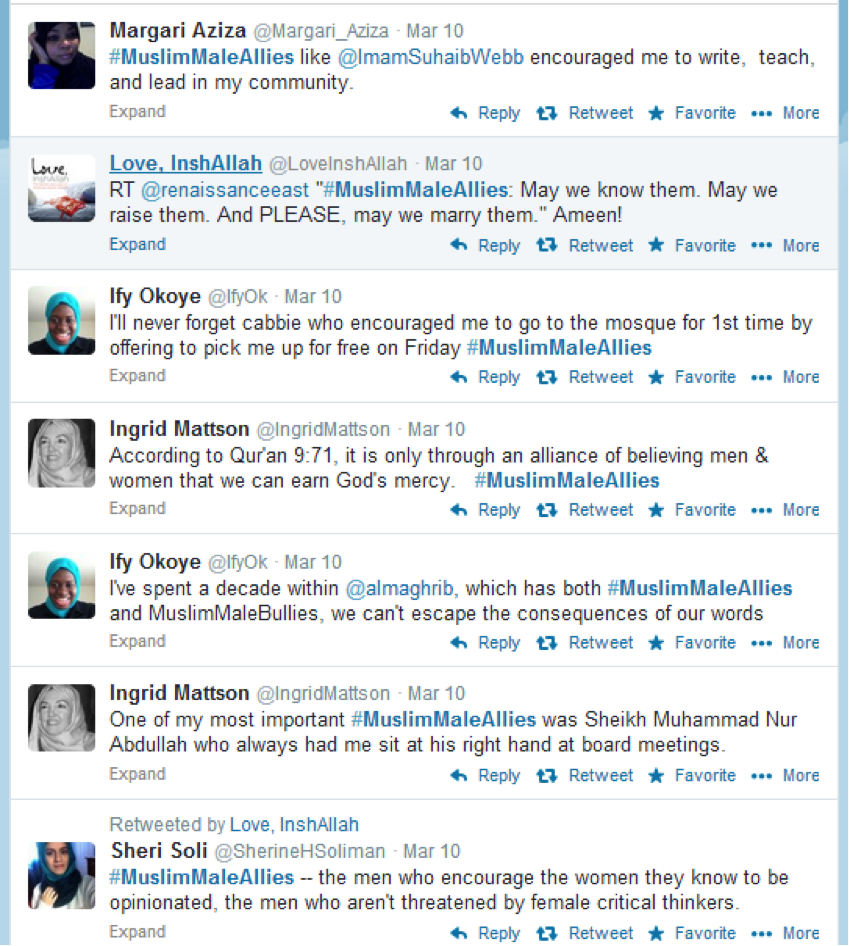
Screenshot of some of the #MuslimMaleAllies tweets.
I didn’t contribute to the hashtag and, fortunately, that wasn’t at all related to a deficit of Muslim men that I tremendously admire. I was concerned, however, that we find it necessary to highlight behaviour that should be status quo. Fathers should be caring in ways that enable their daughters to be strong and independent. We should not be shocked that women in heterosexual relationships can build genuinely equitable, loving partnerships with their husbands/boyfriends/partners. Our leaders should be expected to be unequivocal in their support for women, particularly in reaction to comments like those of Abu Eesa. To expect any less simply sets low and, frankly speaking, unacceptable standards of behaviour from all men, Muslim or otherwise. Moreover, applauding what should be otherwise normal implies we think little of the capacities within the men of our communities; that we’re somehow surprised when they do the right thing.
Yet, I understand the tremendous inclination to use #MuslimMaleAllies, even on a day like IWD. As Muslims in the West, we’re worried about the backlash from Abu Eesa’s comments. We’ve seen lightening-rod news stories, like the “honour killing” of Aqsa Parvez, that force our communities into awkward, defensive positions. Abu Eesa’s posts make us nervous because we know his misogynistic comments perpetuate stereotypes that Muslimahs are oppressed and that these kinds of incidents can ignite the West’s saviour complex. I spend enough time trying to convince friends, acquaintances, and colleagues that I’m not a Muslim woman who needs any saving. Abu Eesa’s posts made that more difficult. #MuslimMaleAllies tried to alleviate that.
The hashtag is trying to show that we have good men within the community. The insinuation becomes, however, that men who are explicitly named are the exception, not the rule. We, as women, often spend enormous amounts of time digging for each miniscule Quranic ayah, hadith, and sunnah that is supportive of women’s empowerment as proof to the world and other Muslims of the equity inherent to Islam. I understand the purpose of that process: that it’s a means of getting to know our faith and use the scriptures to guide our ways of life. But I’m simultaneously disheartened; I find myself feeling that we’re thumping the Quran because we, as Muslimahs, are grappling with the realities that we are not equals within the faith.
We can better grapple with the sexism within Muslim communities by acknowledging that sexism isn’t endemic to just Islam. Sexism is a normative process within most cultural contexts in the world, Western or Eastern, First-World or Third-World, Muslim or not. As I wrote in “Mosques and Marriages: Manifestations of Patriarchy and Misogyny in a Western, Muslim Context,” sexism manifests itself within our religious and cultural spaces in ways that are different from non-Muslim ones. Not necessarily better or worse. Just different. In other words, we have to acknowledge that sexism exists within most Islamic cultural contexts. We deal with those inequities by applying solutions that are relevant to their respective contexts, not by using one-size-fits-all approaches to women’s empowerment prescribed from Western perspectives.
I understand why #MuslimMaleAllies trended so strongly on Twitter. But I also know that I deserve equity across all of my relationships. We can and should be asking more from men. That’s the entire point of having an International Women’s Day.
Previous Post

March 21, 2014
Friday Links | March 21, 2014
Next Post
March 25, 2014 Grey Zones of #letsamahplay
Browse Our Archives
Select a Category Advertisements Art/Theater Books/Magazines Cinema Comics/Cartoons Culture/Society Events Fashion Film Friday Links Merchandise/Commodities MMW Announcements MMW Highlights Music/Radio News Photography Politics Profile Ramadan 2012 Ramadan 2013 Ramadan 2014 Ramadan 2015 Roundtable Satire Social Media Sports Technology/Science Television Uncategorized Video Web
Select a Month November 2015 October 2015 September 2015 August 2015 July 2015 June 2015 May 2015 April 2015 March 2015 January 2015 December 2014 November 2014 October 2014 September 2014 July 2014 June 2014 May 2014 April 2014 March 2014 February 2014 January 2014 December 2013 November 2013 October 2013 September 2013 August 2013 July 2013 June 2013 May 2013 April 2013 March 2013 February 2013 January 2013 December 2012 November 2012 October 2012 September 2012 August 2012 July 2012 June 2012 May 2012 April 2012 March 2012 February 2012 January 2012 December 2011 November 2011 September 2011 August 2011 July 2011 June 2011 May 2011 April 2011 March 2011 February 2011 January 2011 December 2010 November 2010 October 2010 September 2010 August 2010 July 2010 June 2010 May 2010 April 2010 March 2010 February 2010 January 2010 December 2009 November 2009 October 2009 September 2009 August 2009 July 2009 June 2009 May 2009 April 2009 March 2009 February 2009 January 2009 December 2008 November 2008 October 2008 September 2008 August 2008 July 2008 June 2008 May 2008 April 2008 March 2008 February 2008 January 2008 December 2007 November 2007 October 2007 September 2007 August 2007
Follow Us!
TAKE THE
Religious Wisdom Quiz
Blessed is the one who perseveres under trial because, having stood the test, that person will receive the ____ of life that the Lord has promised to those who love him.
Select your answer to see how you score.
Reward Gift Blessing Crown
Related posts from Muslimah Media Watch

#PrayforParis, Muslim Women and Third World Violence

Facebook Foodies: Libyan Women’s Visibility Online

How Facebook fails Muslim Women
TRENDING AT PATHEOS Muslim

25 Years Later: How Much Has Changed for...
As we approach the 25th anniversary of September 11th, I’ve found myself...

Podcast: Third Spaces & The Rise of Yemeni...
In the latest episode of The Artistic Foodies Podcast, hosts Abbas...

HalalFest Picks: Best 60 Halal Spots for Super...
Back in 2016, I came up with a list of 29...

Unity Is America’s Strength — Division Is Its...
by Hidayatullah Ahsan When Valentina Gomez, a Republican candidate for Congress in...

Zohran Mamdani and New York’s Fight Against Islamophobia
This past June, against all odds, Zohran Mamdani won the Democratic primary...

What the Fourth of July Means to a...
As we mark another Fourth of July, millions of Americans will celebrate...
view all Muslim blogs
Ad-Free & Subscriber Log-In Subscription Support
- About Us
- 2026 Calendar
- Videos
- Podcasts
- Library of World Religions
- Faith In Media Tracker
- Advertise With Us
- Write for Us
- Privacy Policy
- Terms of Service
- Do Not Sell My Data
- Contact Us
- Radiant Digital
- Manage Newsletter Subscriptions
- Unsubscribe From Notifications
- Sitemap
Copyright 2008-2026, Patheos. All rights reserved.
Subscription Support Ad-Free & Subscriber Log-In
Follow Patheos