
BuddhistCatholicContemplativeEvangelicalGeneral ChristianHinduJewishLatter-day SaintMuslimNew VisionsProgressive Christian
Beliefs
- Buddhist
- Catholic
- Contemplative
- Evangelical
- General Christian
- Hindu
- Jewish
- Latter-day Saint
- More Voices
- Muslim
- New Visions
- Pagan
- Progressive Christian
Topics
- Religion News
- Food and Religion
- Sports and Religion
- Religious Art
- Religious Music and Entertainment
- Religious Events
- History and Religion
- Style and Religion
- Politics and Religion
- Women in Religion
- Recreation Outdoors and Religion
- Business Finance and Religion
- Careers Workplace and Religion
- Education and Religion
- Family Parenting and Religion
- Health Fitness and Religion
- Home and Religion
- Relationships and Religion
- Technology and Religion
- Travel and Religion
Columnists
- Buddhist Columnists
- Business Finance and Religion Columnists
- Careers Workplace and Religion Columnists
- Catholic Columnists
- Contemplative Columnists
- Education and Religion Columnists
- Evangelists Columnists
- Family Parenting and Religion Columnists
- General Christian Columnists
- Health Fitness and Religion Columnists
- Hindu Columnists
- History and Religion Columnists
- Home and Religion Columnists
- Jewish Columnists
- More Voices Columnists
- Latter Day Columnists
- Muslim Columnists
- New Visions Columnists
- Nonreligious Columnists
- Pagan Columnists
- Politics and Religion Columnists
- Progressive Columnists
- Recreation Outdoors and Religion Columnists
- Relationships and Religion Columnists
- Religion News Columnists
- Religious Art Columnists
- Religious Events Columnists
- Religious Music and Entertainment Columnists
- Sports and Religion Columnists
- Style and Religion Columnists
- Technology and Religion Columnists
- Travel and Religion Columnists
- Women in Religion Columnists
Resource Library
- 2026 Calendar
- Library of World Religions
- The 100 Most Holy Places on Earth
- Patheos Answers
- Podcasts
- Videos
- Faith Leaders Database
- Anglican Episcopalian
- Bahai
- Baptist
- Buddhism
- Christianity
- Confucianism
- Eastern Orthodoxy
- Hinduism
- Holiness and Pentecostal
- ISKCON
- Islam
- Judaism
- Lutheran
- Methodist
- The Church of Jesus Christ of Latter-day Saints
- New Age
- Paganism
- Presbytarian and Reformed
- Protestantism
- Religion Behind the Scenes
- Roman Catholic
- Scientology
- Shia Islam
- Sikhism
- Sufism
- Sunni Islam
- Taoism
- Zen
- See all religions
Research Tools
 Ad-Free & Subscriber Log-In Subscription Support
Ad-Free & Subscriber Log-In Subscription Support
Follow Patheos 

- Trending:
- Forgiveness
- |
- Marriage
- |
- Consciousness
- |
- Death Penalty
- |
- Election
- |
- Halloween
 Muslimah Media Watch
- Home
- Muslim
- Religion News
- Rediscovering Noor Inayat Khan and the Good Muslim
Rediscovering Noor Inayat Khan and the Good Muslim
Last updated on: March 17, 2014 at 9:42 am by tasnim
Rediscovering Noor Inayat Khan and the Good Muslim 2014-03-17T09:42:02-04:00 tasnim
Patheos Explore the world's faith through different perspectives on religion and spirituality! Patheos has the views of the prevalent religions and spiritualities of the world.
I will confess that I first became aware of Noor Inayat Khan, also known as Madeline, only quite recently, that is, during the campaign in 2011 to commemorate her, before it was discovered that she had already been commemorated. I remember looking up her story at the time and coming across her biography, Spy Princess: The Life of Noor Inayat Khan by Shrabani Basu. I did plan on reading the book, but reviews at Goodreads, which complained about the amount of detail and the tone of the first half of the biography, put me off. This is only because there’s something about detailed biographies that I find discomfiting. I keep finding myself asking, “yes, but how do you know?“ I’m not sure whether to suspend disbelief or obsessively fact-check. I’m not a big biography reader.
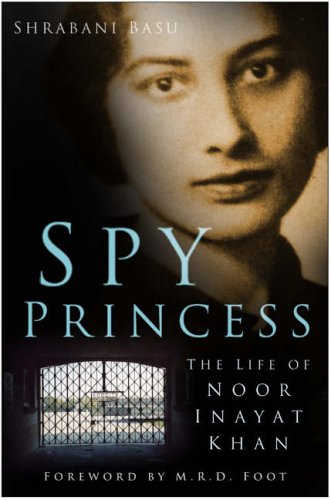
Cover of Spy Princess: The Life of Noor Inayat Khan. [Source].
However, it should be said that the glowing reviews of this biography outweigh the mealy-mouthed ones. Reviewers also frequently point out that the subject certainly deserved having her biography written, and that this story of an “Indian-American Muslim woman who worked as a British spy in Nazi-occupied Paris,” this “international child” born in Moscow to an Indian father and an American mother and raised in Britain and France, should be more widely known. It looks like that might be about to happen, not only because producers Zafar Hai and Tabrez Noorani obtained the movie rights for the book, but also because of this 60-minute biographical docu-drama, Enemy of the Reich: The Noor Inayat Khan Story, directed by Robert H. Gardner.
Since I haven’t seen this docu-drama yet, I can’t say much about it, other than that I really want to see it. But reading some of the reviews and articles about Khan, I was struck by a repeating reference to her and her father’s Sufism. Again and again we are informed that Khan was “raised in the pacifistic Sufi Islamic tradition in France.” Or that, she was “brought up in the mystical Sufi tradition” and therefore “abhored violence.” In other reviews, descriptions of her deeds of derring-do are tempered with reminders that she was “not a natural warrior”:
“It may have been tales of his ferocity in battle told by her father, Hazrat, which steeled Noor to carry a pistol through the streets of Paris, but she was not a natural warrior. Suffused with Sufism’s creed of non-violence, she studied child psychology at the Sorbonne and became a children’s writer in the 1930s.”
Sufi! Sorbonne! Children’s writer! Of course I’ve heard the Sufi as the warm and cuddly version of Islam before. I would wager most Muslims in this day and age have. You know the question that begins “But the, what are they called, those mystic people? They whirl around and don’t get dizzy?” Or, worse, the assumption that Sufi is a category entirely separate from “Sunni” and “Shia,” when, in fact, “Sufism is more accurately described as an aspect or dimension of Islam” rather than a sect on its own. I’ve tried talking about shariya and tariqa, as the outward (shariya) and inward (tariqa) path to God, but putting the two in the same sentence seems to make people nervous or confused or I don’t know. Maybe I’m just very bad at explaining. I once made the disastrous mistake of talking about Youssef Chahine’s 1998 film al-Masir (Destiny) which might as well be summed up as Ibn Rushd v.s Al Ghazali. I got the bewildered response, “So wait, that Sufi guy was the dogmatist?” Not many people know that Hasan al-Banna, the founder of the Muslim Brotherhood (that old bogeyman, now deemed “terrorist” by the Egyptian government again) was heavily influenced by Sufism and was a member of a Sufi order when he was younger. Sufism is different for different people, and Sufis, like all Muslims, like all humans, can be both good and bad, mystical and dogmatic, pacifist and not-so-pacifist, sometimes at the same time.
I think maybe the problem is that we (and I am now doing that awful terrible thing of using “we” to refer to the category “Muslims”) play into this dichotomy of the Good and Bad Muslim. For example, on the website for the docu-drama, Dalia Mogahed is quoted as saying:
“Enemy of the Reich: The Noor Inayat Khan Story reveals the courage, strength and compassion of Noor Khan as her Muslim faith inspired her to risk everything to battle Nazi oppression. She is a source of inspiration for anyone working for freedom and justice today.”
I admire Dalia Mogahed’s cool, calm on-pointness enormously – see this video of her debating Irshad Manji, for example – but I am not sure what to do with the idea that we can claim decisively that Khan’s “Muslim faith,” rather than simply her humanity, “inspired her to risk everything.”
If I were to pinpoint the source of my unease, it is that the cause and effect seem kind of limiting. Attributing goodness to religious observance, to being inspired by faith, simply inverts rather than breaks down the religiously-motivated dynamic, which turns everything into “good Muslim” and “bad Muslim.” Just like Bad Muslims are driven by their mad ideological fanatical fundamentalist faith rather than a range of complex human emotions, Good Muslims are motivated by “soft” Islam, adulterated, mystical, cultural, whatever you want to call it. Then you can start putting down labels neatly in each column. Pacifistic and Sufi go under good Muslim, of course, as do “cultural Muslim,” “progressive Muslim” and so on and so forth. This makes the “look, there are good Muslims” game a whole lot easier for anyone who wants to get involved.
This is also what disturbs me about Robert Satloff’s book, Among the Righteous: Lost Stories From the Holocaust’s Long Reach into Arab Lands, which is mentioned alongside the docu-drama in this article. The book is described as “a quest to find the Arab hero whose story will change the way Arabs view Jews, themselves, and their own history.” This seems like a pretty lofty target. How exactly will this quest for an “Arab hero” change the way Arabs view Jews and how Arabs view themselves, assuming either are uniform attitudes, and assuming these are entirely seperate categories? What does it prove? Who needs this proof, to validate what?
Rather than setting out on a quest for an “Arab hero” it seems to me that it makes more sense to look at this comprehensively, to look at the good, the bad and the ugly, as Gilbert Achcar has done in his study of Arabs and the Holocaust. Of course, Satloff does look at not-so-heroic Arabs on his way to finding the good ones, but the whole book is geared towards proving there were a few Arabs who can be counted “among the righteous” and therefore…what? Arabs are human? Peace is possible?
And then the book description goes on: “The story of the Holocaust’s long reach into the Arab world is difficult to uncover, covered up by desert sands and desert politics.” Desert sands and desert politics. I just don’t know what to do with that. “The Arab Lands” part of the title is a bit Aladdin too.
I don’t mean to make light of any of this. I think the stories are enormously important, just like telling the story of Noor Inayat Khan is important – not least as a way to counter the despicable and prevalent phenomenon of anti-Jewish attitudes in Muslim majority countries and Muslim communities. But maybe we can tell these stories differently.
Do we have to disguise the word Muslim under a reassuring flood of “international child and pacifistic Sufi spy princess codenamed Madeline”? Do we have to stamp the word Muslim on Khan’s forehead by categorically insisting that her anti-Nazi stance was solely inspired by and wrapped up in the fact that she was Muslim?
Maybe she just thought Nazis were bad news. Maybe she was “just” a good human.
Previous Post

March 14, 2014
Friday Links | March 14, 2014
Next Post
March 18, 2014 Muslim Anti-Racist Collaborative Centres Black Muslim Voices
Browse Our Archives
Select a Category Advertisements Art/Theater Books/Magazines Cinema Comics/Cartoons Culture/Society Events Fashion Film Friday Links Merchandise/Commodities MMW Announcements MMW Highlights Music/Radio News Photography Politics Profile Ramadan 2012 Ramadan 2013 Ramadan 2014 Ramadan 2015 Roundtable Satire Social Media Sports Technology/Science Television Uncategorized Video Web
Select a Month November 2015 October 2015 September 2015 August 2015 July 2015 June 2015 May 2015 April 2015 March 2015 January 2015 December 2014 November 2014 October 2014 September 2014 July 2014 June 2014 May 2014 April 2014 March 2014 February 2014 January 2014 December 2013 November 2013 October 2013 September 2013 August 2013 July 2013 June 2013 May 2013 April 2013 March 2013 February 2013 January 2013 December 2012 November 2012 October 2012 September 2012 August 2012 July 2012 June 2012 May 2012 April 2012 March 2012 February 2012 January 2012 December 2011 November 2011 September 2011 August 2011 July 2011 June 2011 May 2011 April 2011 March 2011 February 2011 January 2011 December 2010 November 2010 October 2010 September 2010 August 2010 July 2010 June 2010 May 2010 April 2010 March 2010 February 2010 January 2010 December 2009 November 2009 October 2009 September 2009 August 2009 July 2009 June 2009 May 2009 April 2009 March 2009 February 2009 January 2009 December 2008 November 2008 October 2008 September 2008 August 2008 July 2008 June 2008 May 2008 April 2008 March 2008 February 2008 January 2008 December 2007 November 2007 October 2007 September 2007 August 2007
Follow Us!
TAKE THE
Religious Wisdom Quiz
Who said: "Do not merely listen to the word, and so deceive yourselves. Do what it says"?
Select your answer to see how you score.
Paul Peter James Jesus
Related posts from Muslimah Media Watch

Book review: Jewels of Allah by Nina Ansary



Why British MP’s statements defending Muslim women do...
TRENDING AT PATHEOS Muslim

25 Years Later: How Much Has Changed for...
As we approach the 25th anniversary of September 11th, I’ve found myself...

Podcast: Third Spaces & The Rise of Yemeni...
In the latest episode of The Artistic Foodies Podcast, hosts Abbas...

HalalFest Picks: Best 60 Halal Spots for Super...
Back in 2016, I came up with a list of 29...

Unity Is America’s Strength — Division Is Its...
by Hidayatullah Ahsan When Valentina Gomez, a Republican candidate for Congress in...

Zohran Mamdani and New York’s Fight Against Islamophobia
This past June, against all odds, Zohran Mamdani won the Democratic primary...

What the Fourth of July Means to a...
As we mark another Fourth of July, millions of Americans will celebrate...
view all Muslim blogs
Ad-Free & Subscriber Log-In Subscription Support
- About Us
- 2026 Calendar
- Videos
- Podcasts
- Library of World Religions
- Faith In Media Tracker
- Advertise With Us
- Write for Us
- Privacy Policy
- Terms of Service
- Do Not Sell My Data
- Contact Us
- Radiant Digital
- Manage Newsletter Subscriptions
- Unsubscribe From Notifications
- Sitemap
Copyright 2008-2026, Patheos. All rights reserved.
Subscription Support Ad-Free & Subscriber Log-In
Follow Patheos